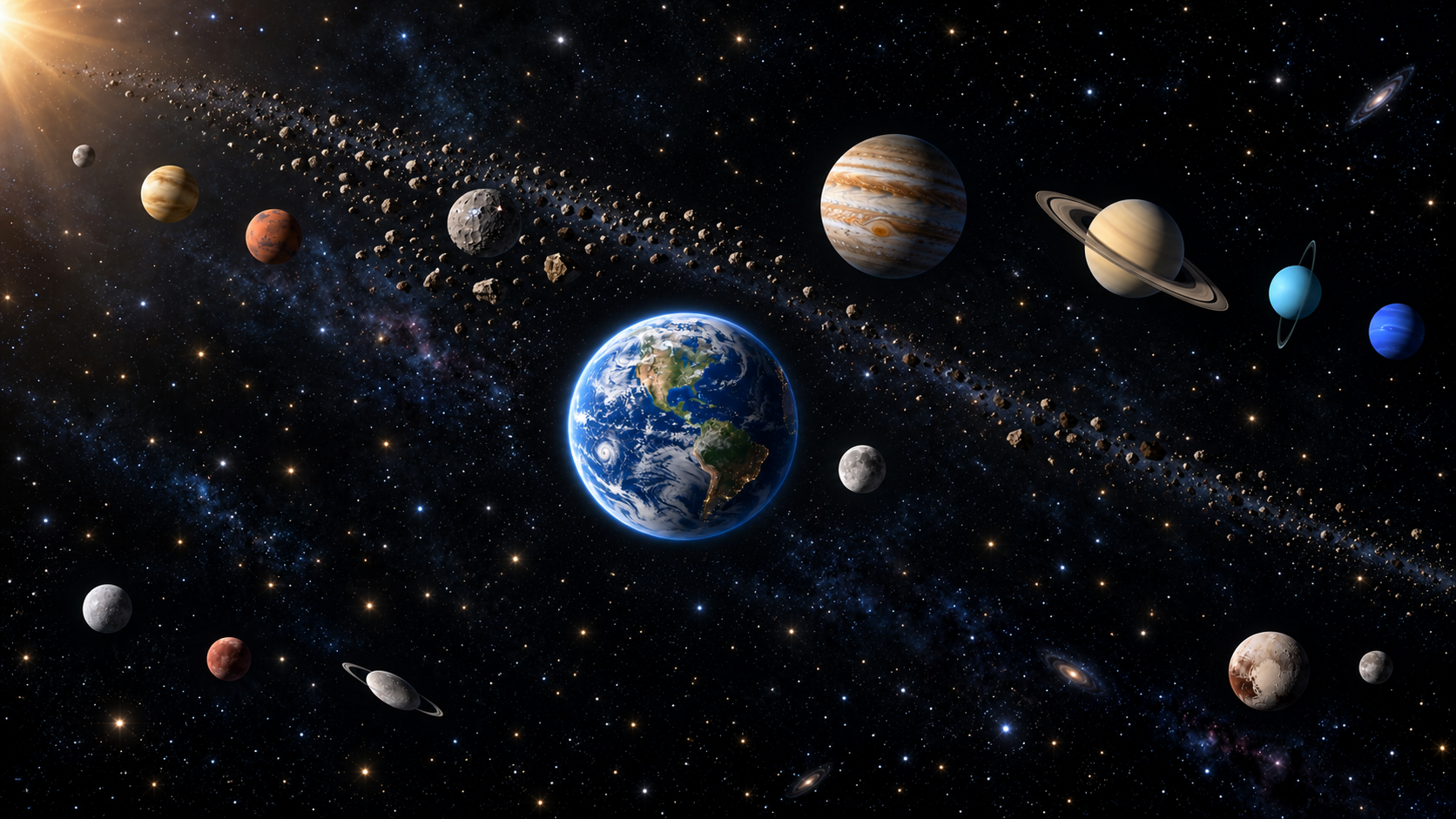
I Have Been Moving in the Wrong Direction
I have noticed something about my recent astronomy writing. I keep getting farther away from Earth.
There is nothing wrong with that.
But, that is sort of the problem.
Once astronomy gets hold of me, Jupiter becomes its moons, the Sun becomes the heliosphere, and Voyager becomes interstellar space. Then there are objects beyond Neptune, visitors from other stars, galaxies, black holes, dark matter. Suddenly I am several billion light-years away wondering how an evening of reading became this.
The Planet That Pulls on Worlds let me spend time with Jupiter and the worlds caught in its influence. The Far Side of Almost Nothing followed our absurdly persistent machines beyond the heliosphere. Even The Sun in the Wires, which brought space directly into human infrastructure, gave me another reason to think about Voyager.
Then The Universe Is Under No Obligation to Be Ordinary more or less abandoned geographical restraint.
Somewhere in that widening excursion, I wrote:
“The others are planets. Earth is where the laundry is.”
I keep returning to that line. It names the unevenness in my attention. I can spend a long time trying to understand a distant world while treating this one as the place where everything inconvenient happens.
So, I want to reverse direction. Start with the smaller worlds, come back to the Moon, then Earth, then whatever is going on inside the house.
I have spent a while looking farther away.
This place is weird too.
Smaller Does Not Mean Simpler
First, the dwarf planets.
Briefly: these are worlds orbiting the Sun whose gravity has pulled them into roughly rounded shapes, but which have not become gravitationally dominant in their orbital neighborhoods. They are not moons. That is enough classification for now. Whatever we call Pluto has remarkably little effect on Pluto.
What interests me is the place.
Before New Horizons flew past in 2015, even our best images offered little more than blurry patches. Then we had mountains, glaciers, layered atmospheric haze, a landscape complicated enough to keep scientists busy for years.
Pluto has broad plains of nitrogen ice. Water ice forms mountains because, at those temperatures, it can behave as the sturdy structural material beneath the more mobile frozen nitrogen. Something I mostly encounter melting in a glass becomes something capable of holding up a mountain.
Its thin atmosphere exchanges material with surface ice as sunlight and temperature change. A dramatically tilted axis and a stretched, 248-year orbit make seasons there an enormous rearrangement of illumination and cold. A season can occupy much of a human lifetime.
And, Charon is no minor accessory. It is about half Pluto’s diameter, large enough relative to its companion that their shared center of mass, the barycenter, lies outside Pluto. Both worlds circle a point in the space between them.
That is considerably more interesting than being the disputed ninth item in a school mnemonic.
But, Pluto does not own the category. Farther out, Eris travels with its moon, Dysnomia. Haumea spins in about four hours, stretching into an elongated shape, and has a ring. Makemake carries frozen methane on its surface. Similar labels conceal very different arrangements.
Then there is Ceres, which gives us a route inward. It lives in the asteroid belt between Mars and Jupiter, only about 940 kilometers across.
On that small world stands Ahuna Mons, rising roughly four kilometers above the surrounding terrain.
The leading explanation is cryovolcanism. Instead of molten-rock lava, material involving salty brine and mineral particles rose through an ice-rich interior and built a mountain. Think thick slurry, with water, salts, and solids behaving under conditions very different from those on Earth.
Dawn did not watch it erupt. Scientists reconstructed the history from the mountain’s shape, its composition, gravity measurements, and models of how material might move below the surface. One analysis interprets the gravity anomaly beneath Ahuna Mons as evidence of an upwelling that supplied the mountain-building slurry.
I like the uncertainty here. There is something to investigate: a mountain whose steepness, chemistry, and relationship to the interior place limits on the possible explanations.
A battered little world turns out to have ice, salts, evidence of brines, and a complicated geological past.
“Dwarf” describes a classification.
It does not mean simple.
Luna, Recently Revised
Closer in is a world so familiar that it can become difficult to remember it is a world.
The Moon is a phase on a calendar. A shape children draw. Something placed above a landscape to establish that it is nighttime.
I like calling it Luna. The name restores a little distance, enough to make the familiar object strange again.
People have stood there.
They crossed actual ground: plains, slopes, craters, pulverized rock called regolith. That powder is the product of impacts breaking the surface down over immense stretches of time. Sunlit ground can become intensely hot; darkness brings extraordinary cold. Without rain, rivers, or Earth-style plate tectonics continually reworking the surface, much of its history remains exposed.
We see roughly the same face because the Moon rotates once during each orbit around Earth. Tidal locking does not mean it has stopped spinning. Its rotation and orbit keep pace.
And, the far side receives sunlight. “Far” describes its relationship to us. It does not describe a permanent lighting problem.
Recently, a routine quality check of Lunar Reconnaissance Orbiter imagery revealed something that makes the Moon feel considerably less ancient and finished.
A bright spot with a dark halo appeared where earlier images showed no such feature. Further investigation identified McGetchin crater: about 222 meters wide and 43 meters deep, formed sometime between April 11 and May 22, 2024.
We did not watch the collision happen. We have images from before and after.
The distinction matters, but so does the plain fact underneath it. The inventory changed.
While people here were making dinner, fighting wars, putting children to bed, going to work, and checking their phones, something struck the Moon hard enough to excavate that enormous hole.
Nobody on Earth had to notice at the moment for it to happen.
I like that.
Craters usually arrive in my imagination already ancient. This one is younger than some of the food in the back of somebody’s freezer.
Yet, the Moon’s relationship with us is much more continuous than an occasional discovery. Go to a beach and wait. The waterline moves partly because that distant world pulls unevenly across Earth. The Sun contributes too, and the shapes of coastlines and ocean basins determine how those forces become the tides at a particular shore.
A tide is orbital mechanics arriving at the beach.
Across geological time, tidal interactions have slowed Earth’s rotation and moved the Moon farther away. We are dealing with a system whose members keep changing one another.
We have come from nitrogen glaciers and a mountain built from salty material to water moving over sand.
One more step home.
The Machines Above the Beach
Before landing, though, there is the machinery.
We have surrounded this planet with things we built.
The International Space Station has been continuously occupied since November 2000, carrying a working laboratory around Earth roughly every ninety minutes. Hubble has spent decades observing from low Earth orbit, above the atmospheric blurring and absorption that complicate astronomy from the ground.
Other satellites help us work out where we are. GPS turns signals and precise timing into navigation. Weather satellites track clouds and storms. Earth-observing instruments measure oceans, vegetation, ice, fires, and atmospheric chemistry. Communications satellites carry portions of our conversations and entertainment.
Some of the machinery studying Earth helps us decide whether to leave the house with an umbrella. Some helps us understand changes unfolding across generations.
Webb belongs to this technological neighborhood too, though it is much farther away. It travels around the Sun with Earth, following a halo orbit around the Sun–Earth L2 region, roughly 1.5 million kilometers from us. It is not circling Earth the way Hubble or the station does.
The neighborhood has grown crowded. Commercial constellations are multiplying, and orbital debris is an increasing problem. We have managed to export maintenance concerns along with curiosity.
Still, I find the basic achievement astonishing. We built eyes outside the atmosphere so we could look both inward and outward.
Some watch clouds gathering over an ocean. Others collect light from galaxies forming early in the universe’s history.
The same species wanted to know about both.
Below all of them is the place that made the wanting possible.
The Planet Underneath all of It
Earth is the hardest planet for me to experience as a planet.
It is the floor.
Rotation becomes morning. Orbit and axial tilt become the changing length of days and the seasons. These immense movements arrive so reliably that I can complain about them without remembering what they are.
The same thing happens with the surface. Ground seems like something that stays put, although Earth’s rocky outer shell is divided into moving tectonic plates. Their interactions build mountains, open ocean basins, recycle crust into the interior, and sometimes make the apparent stability of the floor violently disappear.
Meanwhile, sunlight supplies energy for evaporation. Air carries water inland. Rain enters soil, groundwater, rivers, organisms. Some freezes. Some returns to the ocean. Water wears down mountains that movements inside Earth helped raise.
The connections become harder to separate the longer I follow them.
Rainwater and carbon dioxide participate in reactions that weather rock. Dissolved material reaches the oceans. Carbon passes among air, water, soil, living things, and rock, sometimes quickly, sometimes over geological ages. Volcanism returns carbon from below. Photosynthesis changes the chemistry of the air.
The atmosphere is partly the accumulated consequence of what geology and life have done to one another.
Deeper still, motion in the electrically conducting liquid outer core generates Earth’s magnetic field. That field extends into space, where it interacts with the solar wind. The Sun supplies much of the energy moving through surface systems, while the interior contributes heat from below.
There is no clean place to draw a line between “the planet” and “what happens on the planet.”
Which brings me to a measurement I love precisely because it sounds so unimpressive.
Earth’s center of mass shifts by millimeters over the year relative to the solid planet.
The whole Earth system includes its water and air. When snow accumulates, monsoon rains arrive, groundwater changes, ocean water redistributes, and atmospheric pressure shifts, mass is being moved around. The system’s balance changes with it.
A recent study combined satellite tracking and ground measurements with models of those changing loads. Part of the difficulty is that the solid surface deforms under the loads too. The scientists have to distinguish the changing balance from the movement of the measuring stations.
Their analysis connects the seasonal motion to specific patterns of snow, continental water, oceans, and atmosphere. The exact estimates continue to be refined.
But, the underlying idea is wonderfully concrete: an entire planet subtly changes its balance because water fell somewhere else.
Millimeters.
After the distances astronomy usually asks me to imagine, this feels almost indecently intimate.
It also returns me to the thought beneath The Sun in the Wires. Earth is participating in its surroundings. Solar particles encounter its magnetic environment. The Moon pulls on its oceans. Our machines travel above it.
Home is astronomical.
And, Then Somehow it Became Alive
It is also inhabited.
Earth is the only confirmed biosphere we have. That does not mean it is the only possible one, or even the only existing one. It means that, among all the places we have investigated, this is where the evidence becomes undeniable.
And, what a ridiculous abundance of evidence.
In a forest, plants use sunlight to build energy-rich organic matter, while fungi thread through soil and dead material becomes available for other lives. Bacteria inhabit the ground, the water, and the bodies moving through both. Much of the activity never becomes visible without instruments.
At a hydrothermal vent, microbes can use chemical reactions to support a food web where sunlight does not reach. Life has more than one way to pay its energy bills.
Then there are the bodies themselves. A whale moves through an ocean with an entire mammalian life organized around returning to the surface for air. An octopus explores with arms. Birds move between ground and sky. Insects occupy spaces and pursue lives I can overlook while standing beside them.
Deserts, ice, reefs, deep rock, our own intestines: the conditions that would kill me are not a useful definition of where life can happen.
I do not want to flatten this variety into a cheerful statement that everything is connected. I want to notice how different these organisms actually are.
And, among them are apparently innumerable centers of experience. The evidence for consciousness is much stronger for some animals than others; we do not have a reliable census of every creature for whom being alive feels like something.
But, this planet contains more than functioning biological machinery. It contains fear, perception, desire, play, and ways of encountering a world that I cannot inhabit from the inside.
Some portion of that life eventually began asking what planet it was on.
Unfortunately, this brings us to us.
Unfortunately, Us
Human beings are capable of making this section very difficult to write.
War, torture, slavery, genocide. We have made suffering systematic, supplied it with paperwork, built institutions that depend on it, and congratulated ourselves while doing it.
I cannot look at that history, or the present, and produce an uncomplicated celebration of human intelligence. Intelligence has helped us make cruelty more efficient.
But, it also helps us find a matching organ donor.
A person can reorganize a life around caring for a child. Someone can enter danger to rescue a stranger. Scientists spend decades trying to treat diseases they may never have. People build hospitals, develop vaccines, and arrange for food to reach people whose names they will never learn.
We care for disabled people. We are disabled people caring for others. We care for animals, sometimes reconsidering who deserves that care in the first place.
And, alongside those urgent acts, we write novels, make music, invent mathematics, paint, tell jokes, and construct telescopes to investigate things with no obvious bearing on next month’s bills.
I am not trying to balance one column against another. A pediatric hospital does not cancel a torture chamber. No discovery redeems genocide.
The disturbing fact is that the same kind of creature can build all of it.
An animal capable of destroying ecosystems also launches instruments to understand them. A species capable of organized murder can notice a faint change in lunar imagery and carefully work out what happened.
Contradiction may be too weak a word.
This is also where I return to Somebody Has to Be Here, and the difference between a universe existing and a universe being experienced.
For billions of years, Earth existed without inhabitants capable of understanding that it was Earth. Now there are creatures here who reconstruct its formation, calculate its orbit, measure the seasonal movement of its center of mass, and send machines beyond the heliosphere.
That is not evidence that we were the point.
I do not think the universe spent billions of years preparing to produce a man in Missouri with strong opinions and physical therapy appointments.
The universe was under no obligation to produce us. Earth was under no obligation to become understandable to something living on it.
Yet, locally, matter acquired an inside. However incomplete our explanation of consciousness remains, experience is happening.
Somebody is here.
And, somebody needs to find the other shoe.
Earth Is Where the Laundry Is
Most life is not spent contemplating the geocenter.
There are dishes. Lunches need packing. A diaper needs changing. Someone has to answer the email, buy groceries, clean the thing that will immediately become dirty again.
There is television with the children. An argument with Christa about something whose importance will be difficult to explain later. Physical therapy. A nap. The familiar experience of arriving in a room with no surviving record of the intention that brought me there.
These things do not become smaller because I have just been thinking about Pluto.
They are what the view from Pluto would fail to show.
From far enough away, Earth is a point. Closer in, it has oceans and continents. Closer still, somebody is trying to help somebody else get through a room.
In By Inches and Seconds, I wrote about Charlotte noticing an easel in my way and moving it before I asked. It was a small adjustment in a family home. The meaning depended on the actual people there, the space between objects, the fact that she noticed.
No more distant perspective makes that event adequately visible.
Every novel was written here. Every war in human history began here. Every child ever held belongs to this one world’s history, along with the meals, funerals, first kisses, failed jokes, and incredibly boring Tuesday afternoons.
Even the people who have left the surface have remained very close to it.
The mundane is what the cosmic looks like from inside a life.
That does not require me to enjoy every chore. Laundry remains laundry. Astronomy has not improved the folding situation.
But, when I wrote, “The others are planets. Earth is where the laundry is,” the joke depended on pretending those were different categories.
Earth is a planet.
And, Earth is where the laundry is.
Those facts make each other stranger.
I Will Probably Zoom Back Out
I do not expect this to inaugurate my career as the astronomy writer who stays close to Earth.
I know myself better than that.
Some new Webb observation will appear. Someone will discover something ridiculous around another star. Voyager will cross another entirely invented but emotionally satisfying milestone. A black hole will do something I do not understand.
There will be another moon.
There is always another moon.
So, I will probably zoom back out. This does not need to end with a declaration that home matters more than everything farther away. I wanted to remember that the movement works both ways.
Astronomy can make Earth disappear into a point. It can also make me look directly at the point.
Ceres has a mountain likely built from salty slurry. The Moon acquired a new 222-meter crater while we were occupied with spring 2024. Earth shifts its balance by millimeters as water and air move around it.
Above us are machines we built to watch. Below them, geology and a biosphere. Within that biosphere, minds containing equations, songs, grocery lists, grief, jokes, and plans for tomorrow.
Somewhere in my house there is probably laundry.
I do not know what the next astronomy essay will be. Probably something farther away.
But, every direction away from Earth begins here. Every astonishing thing I have learned about the universe was learned by somebody standing, sitting, rolling, flying, or orbiting very close to this one small world.
We live here
A place we rarely meet
Take a look