The Far Side of Almost Nothing
The Slow Art of Staying On
At some point, exploration stops looking like motion and starts looking like care.
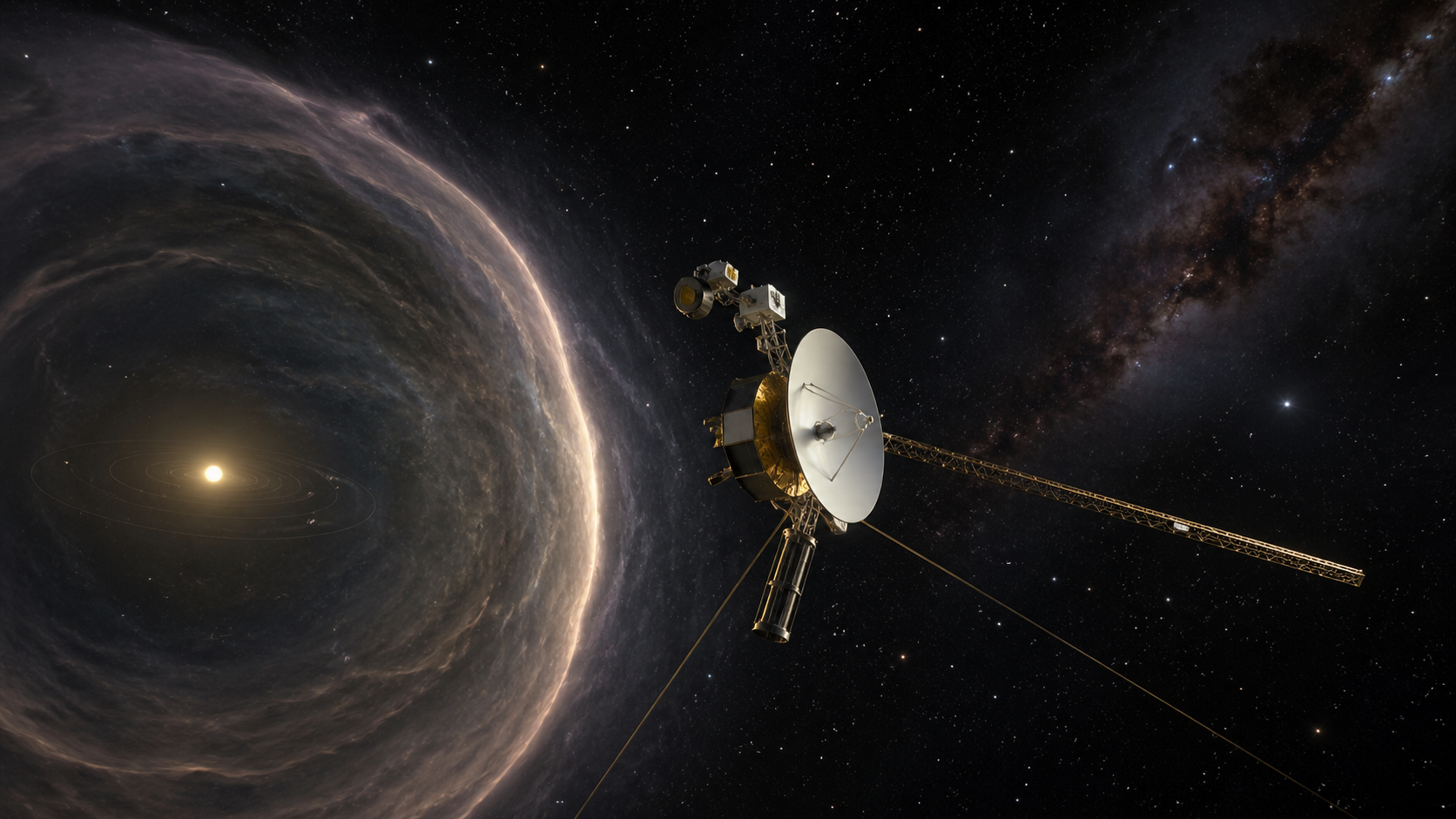
That is what struck me about NASA’s recent update on Voyager 1. The news itself sounds almost small at first: engineers turned off another instrument to save power. Not a launch. Not a landing. Not a new image of a planet. Just a decision made from far away, on behalf of a machine that has been traveling since 1977, to let one part go so the rest can keep speaking a little longer.
On April 17, 2026, engineers at NASA’s Jet Propulsion Laboratory shut down Voyager 1’s Low-Energy Charged Particles experiment, or LECP. The instrument had been operating for almost forty-nine years, measuring low-energy charged particles, including ions, electrons, and cosmic rays from our solar system and from the galaxy beyond it. NASA says the LECP helped provide critical data about the structure of the interstellar medium, including pressure fronts and regions of varying particle density beyond the heliosphere.
There is something quietly brutal about that. Also something beautiful.
Voyager is not dying in the dramatic way we usually imagine spacecraft dying. It is not exploding, falling, burning up, or vanishing behind a planet. It is being pared down. One instrument at a time. One heater at a time. One system at a time. The mission continues through subtraction.
The Voyagers are powered by radioisotope thermoelectric generators, which convert heat from decaying plutonium into electricity. NASA says each spacecraft’s generator now produces about four fewer watts each year, which is why the team has had to choose, carefully and painfully, which instruments and support systems to turn off. That number, four watts, feels almost absurdly intimate. It is less than a bright nightlight. Less than many phone chargers. Yet, out there, at the edge of everything we have directly touched, four watts is the difference between a little more knowledge and silence.
Maybe that is why the story stays with me. It is not just about a spacecraft. It is about stewardship. It is about deciding what matters when there is no longer enough power for everything.
A Day Away by Light
Voyager 1 is now more than 15 billion miles from Earth. That is the kind of number the mind politely accepts and then fails to imagine.
The distance becomes more real when translated into waiting. NASA says a command sent to Voyager 1 takes about 23 hours to reach the spacecraft. Then the reply takes about another 23 hours to come home. A decision made in California arrives almost a day later at a machine moving through interstellar space, and the answer returns from a place no human being has ever been. When JPL sent the shutdown commands for the LECP, the shutdown process itself took about three hours and fifteen minutes after the sequence reached the spacecraft.
That is not remote work. That is attention stretched across the solar system.
There is no real-time troubleshooting at that distance. There is no quick nudge, no instant correction, no satisfying refresh button. The team sends a carefully designed sequence into the dark and waits. If something has gone wrong, they will not know until the mistake is already almost a day old.
This gives the whole mission a strange moral weight. Every command has to be imagined before it can be confirmed. Every repair is an argument with delay. Every success is old news by the time it reaches us.
The Place Between Stars
The phrase “interstellar space” can sound like pure emptiness, a name for the blank between the interesting parts. Stars are interesting. Planets are interesting. Moons, rings, storms, oceans under ice, volcanoes, all of that is easy to love. The space between stars sounds like the hallway between rooms.
That is wrong, or at least incomplete.
The interstellar medium is not nothing. Johns Hopkins Applied Physics Laboratory describes the space beyond our solar system as filled with gas, plasma, dust, cosmic rays, and magnetic fields. It is also the material out of which stars and planets form, and the region where cosmic rays from massive stellar explosions move through the galaxy.
NASA describes the heliosphere as the protective bubble created by the Sun’s magnetic field and the outward flow of the solar wind. The Voyager Interstellar Mission is now studying what lies beyond that bubble: interstellar magnetic fields, particles, and plasma waves.
That word protective matters. The heliosphere is not a hard wall, but it is a kind of boundary. It is the Sun’s reach, the zone where our star’s particles and magnetic influence push outward against the material between stars. Eventually the solar wind slows, piles up, bends, and gives way. The place where the solar wind finally yields is called the heliopause.
Voyager 1 crossed into interstellar space in 2012. Voyager 2 crossed in 2018. NASA says they are still the only human-made spacecraft to operate outside the heliosphere.
This is one of those facts that becomes stranger the longer I sit with it. We have built telescopes that see galaxies so distant their light reaches us from near the beginning of cosmic history. We have mapped the cosmic microwave background. We have detected gravitational waves. We have photographed a black hole’s shadow.
Yet, when it comes to the actual physical space just outside our own solar bubble, the only instruments directly sampling it are two aging machines built before the first personal computers became ordinary household objects.
That gives Voyager a particular kind of authority. It is not only looking from afar. It is there.
The Science of a Faint Signal
This is where the mission becomes more than nostalgia.
Voyager’s late life is scientifically valuable because it is giving us direct measurements from a region we have barely entered. The LECP instrument that NASA shut down on Voyager 1 had been measuring charged particles since launch, helping scientists understand cosmic rays, particle density, and the structure of the interstellar medium beyond the Sun’s protective influence.
That kind of sentence can flatten into technical mush if I do not slow down with it. Charged particles. Pressure fronts. Particle density. These are not glamorous phrases. They do not have the immediate emotional charge of a blue planet rising over a gray horizon.
Still, this is how a place becomes knowable. Not all at once, not as a grand revelation, but through measurements. How dense is the plasma? Which direction is the magnetic field turning? How many cosmic rays are reaching the detector? What changes when the Sun’s influence fades and the galaxy’s background environment begins?
Voyager 1’s own crossing into interstellar space was confirmed in part because its plasma wave subsystem detected oscillations in the plasma around the spacecraft, showing that it had moved into a denser plasma environment. Voyager 2’s crossing was confirmed later through both particle instruments and its plasma science instrument.
That is not a spectacle in the usual sense. It is something quieter and maybe more durable: a boundary becoming legible.
The heliopause is not a clean line drawn around the planets. It is an interaction. The Sun is pushing outward. The galaxy is pressing back. Voyager is old enough, patient enough, and far enough away to notice.
What Counts as Important
I understand why someone might shrug at this.
The Voyagers are not going anywhere useful in the ordinary sense. They are not headed to another star on a human timescale. They are not going to turn around with samples. They are not solving dinner, rent, war, disease, loneliness, or whatever else is pressing its full weight against the living world.
Still, I distrust the idea that only immediately useful knowledge matters.
There are practical reasons to care about the interstellar medium. It helps us understand cosmic rays, the Sun’s protective influence, the magnetic structure around our solar system, and the kind of environment that surrounds other stars. There are engineering reasons too. The Voyagers are case studies in endurance, improvisation, and deep-space operations. When engineers send a command and then wait nearly two days to know whether the whole conversation worked, they are practicing a kind of patience most modern systems are not built to admire.
Yet, the deeper reason may be simpler.
Voyager matters because it enlarges the human sense of place.
The solar system can feel like a diagram: the Sun, the planets, the belt, the outer dark. Voyager reminds us that the diagram is alive with boundaries and pressures. The Sun is not just a bright object in the center of a model. It is a star moving through a galaxy, carrying a bubble of influence with it. Earth is inside that bubble. So are we. Every ordinary day happens inside a structure most of us never think about.
To learn the shape of that structure is to learn something about home.
That does not make the groceries cheaper or the body less fragile. It does not answer grief. It does not tell us what to do with the time we have. Still, it shifts the frame. It lets us see our situation more accurately, and accuracy has its own moral beauty. To know where you are is not nothing.
The Record we Sent With It
The Golden Records deserve their own pause, because they are easy to turn into vague space-romance if we do not say what they actually are.
Each Voyager carries a gold-plated phonograph record: a physical time capsule meant to represent Earth if the spacecraft were ever encountered by another intelligence. NASA says the contents were selected by a committee chaired by Carl Sagan of Cornell University. Sagan and his collaborators assembled 115 images, natural sounds, music from different cultures and eras, greetings in fifty-five languages, and printed messages from President Jimmy Carter and U.N. Secretary-General Kurt Waldheim. Each record was placed in a protective aluminum jacket with a cartridge, a needle, and symbolic instructions for how to play it.
Carl Sagan’s name matters here, not just because people recognize it, but because he embodied the double impulse of the Voyager mission: scientific rigor and almost reckless tenderness. He understood that exploration was not only about gathering data. It was also about learning how to see ourselves from farther away.
The Golden Record is not a realistic communication strategy in any immediate sense. NASA has noted that the chances of the record being found are extremely small, and Voyager will not make a close approach to another planetary system for tens of thousands of years.
That almost makes it more moving.
The record is not only a message to possible strangers. It is a message to ourselves. Ed Stone, Voyager’s longtime project scientist, described it that way: a record of who we think we are, sent outward in many languages, many kinds of music, many images, many signs of life.
There is something humbling about that. A species capable of cruelty, confusion, boredom, paperwork, tenderness, Beethoven, whale song, spacecraft engineering, and committee meetings somehow built a machine, gave it instruments, gave it memory, gave it a record, and sent it outward.
Not because anyone was likely to find it soon.
Because the gesture itself mattered.
The Machine and the Mirror
The more I think about Voyager’s power-down sequence, the less it feels like a story about decline.
It is decline, of course. There is no getting around that. Instruments that once worked no longer do. Systems that once had power no longer get it. The spacecraft are being simplified by necessity. The planetary tour is long over. The cameras are off. The old spectacular mission has become a quieter one.
Maybe that is part of why I find it moving. The Voyagers are no longer producing the kind of wonder that arrives as an image and immediately explains itself. They are producing a more austere wonder: data from a place we have never been, sent by a machine older than many of the people interpreting it.
There is a human lesson here, though I want to be careful not to make the spacecraft too cute or turn engineering into a greeting card. The lesson is not “Voyager is just like us.” It is not.
Still, the metaphor is hard to miss.
Aging often means choosing. Energy changes. Capacities change. Some systems cannot keep running. The question becomes what can still be done with what remains. Not everything. Not the old everything. Something.
Voyager’s late mission is not an embarrassment beside its earlier triumphs. It is another form of triumph. Not the triumph of arrival, but of continuance. Not the triumph of doing everything, but of preserving the most meaningful work after the extra power is gone.
One More Season of Speech
There is also a small, improbable note of optimism inside the power-down story.
NASA says shutting down the LECP should give Voyager 1 about a year of breathing room. The team is using that time to finalize a more ambitious energy-saving fix for both Voyagers. They call it “the Big Bang,” because it would swap out a group of powered devices all at once, turning some things off and replacing them with lower-power alternatives while keeping the spacecraft warm enough to continue gathering science data. NASA says the team plans to try it first on Voyager 2, which has a little more power and is closer to Earth, before attempting it on Voyager 1 no sooner than July 2026. If it works, there is even a chance Voyager 1’s LECP could be switched back on.
That detail changes the emotional shape of the story.
This is not simply “the spacecraft is fading.” It is “the spacecraft is fading, and people are still inventing ways to care for it.”
That feels like the heart of the piece. Not denial. Not sentimentality. Just a very old machine, a very far signal, and a room full of people still trying to buy it one more season of speech.
There will come a time when the Voyagers stop answering. Maybe some instrument will fail. Maybe the remaining power will fall below what the spacecraft need. Maybe the Deep Space Network will listen and hear nothing back. NASA says that even after science data ends, engineering data could continue for several more years, and the spacecraft may remain within range of the Deep Space Network until about 2036, depending on how much power remains to send a signal home.
That future silence is already part of the story.
The Golden Records will keep traveling after the transmitters go quiet. The spacecraft will continue outward, no longer as working observatories but as artifacts. Messages without a delivery guarantee. Human-made objects moving through the galaxy long after their makers have stopped receiving replies.
Maybe that is too romantic. Maybe it is exactly romantic enough.
The practical value of Voyager is real. The science matters. The engineering matters. The measurements matter. The interstellar medium is not empty, and the Voyagers are telling us, in their diminished but still astonishing way, what that not-emptiness is like.
Yet, the mission also matters because it gives us an image of attention stretched across time.
A machine leaves Earth. It visits worlds. It keeps going. Its power fades. Its makers learn how to ask less of it without asking nothing. The mission becomes leaner, quieter, more fragile. Still, from beyond the Sun’s protective reach, it sends back what it can.
That is not a small story.
That is one of the best stories we have.
Past what we know of
They fly through the night, searching
Our calls and our signs