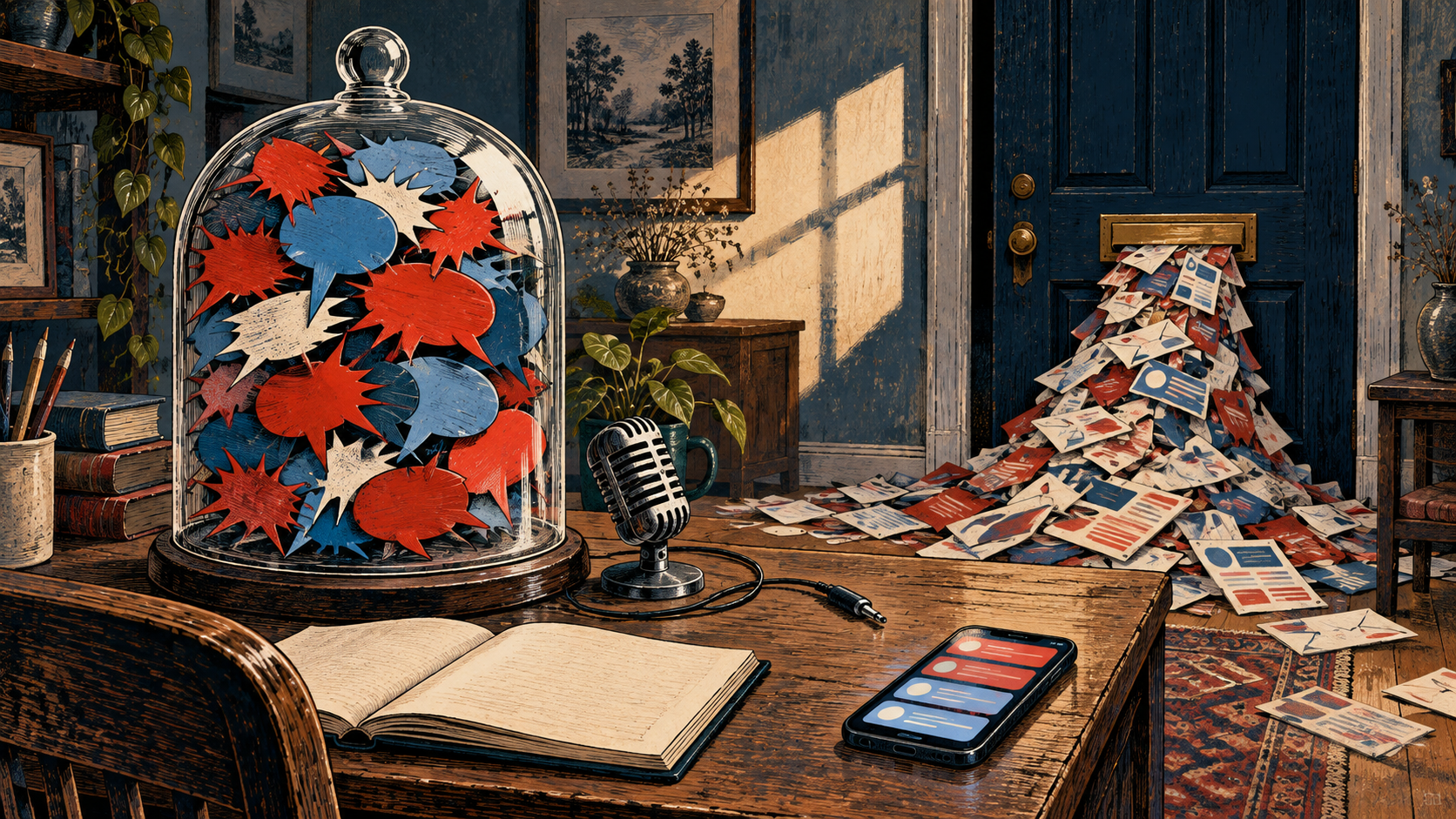
I still care about politics. I would just appreciate fewer opportunities to demonstrate it. My opinions remain fully operational, even when speaking them aloud takes more energy than I want to spend. Meanwhile, campaigns seem determined to contact me through every available opening in my life. There is a considerable gap between caring about an election and wanting it to become a houseguest.
These two essays come from different parts of that exhaustion. One is about the arguments I increasingly keep to myself as speech becomes harder. The other is about people who could stand to keep a little more to themselves, preferably somewhere other than my inbox or front porch. A profanity warning for both the essays and their accompanying songs: the exasperation is considerable, and “good grief” was not going to cover it.

1. The Argument Stays in my Head
Someone brings up Trump, and I have a response.
You may never hear it.
The same thing happens with a court ruling, an executive action, or whatever happened five minutes ago and has already produced twelve competing versions of reality online.
Maybe I agree completely. Maybe I think the person has misunderstood almost everything. Maybe the first sentence in my head is, That is absolutely fucking insane.
Outwardly, these can look remarkably similar. A nod. A facial expression. A couple of words. Then the conversation moves on.
Whether someone is praising the leadership or criticizing it matters enormously to what happens inside my head. It makes surprisingly little difference to how much comes out of my mouth.
I have not become politically neutral. I am not detached, enlightened, or above it all. My opinions are still here, occasionally making an unreasonable amount of noise.
Speaking has become work.
Speech loss makes casual conversation slower and more effortful. What used to happen almost automatically now requires intention. Before I explain why I disagree, another question arrives: do I want to spend the energy turning all of this into spoken language?
Increasingly, no. Even enthusiastic agreement can seem like more work than I want to take on.
One More Quiet Luxury
In “Quiet Luxuries”, I wrote about a strange secondary effect of disability: being less able to participate can sometimes create permission to step back from participation.
This seems like another version of that.
I would rather be able to speak normally and choose silence whenever I wanted. Speech loss is still loss. It has taken things I miss, including the ease of saying something small without first deciding whether saying it is worth the trouble.
But, this is the body I currently have. Within its limitations, I occasionally find some relief.
I no longer feel compelled to chase every conversational ball thrown across the room. A whole rebuttal can appear internally, and I can let it die there.
Calling that a quiet luxury feels a little ridiculous. The luxury is the occasional release from the expectation that every opinion needs an answer. The disability itself remains something I would happily give back.
Arguing takes too much damn effort. Sometimes that settles the matter.
I Still Want to Win
I mentioned my tendency to want to win arguments in “The Breakup That Worked Out”. That part of me has survived quite well.
I still want to be right. Worse, I sometimes want the other person to know I am right. There is a difference, and I remain embarrassingly familiar with it.
My brain can still construct the response I would have given years ago. It can produce an internally devastating closing argument that will never be entered into the record because saying it aloud sounds exhausting.
Congratulations to me. I won the debate nobody else knew we were having.
Silence Is Not Agreement
Of course, the other person cannot hear any of this.
Conversation depends on responses. We interrupt, laugh, qualify, challenge, or add a story. Those little signals tell people how their words have landed. When I speak much less, some of the usual cues become unreliable.
Someone saying something I find deeply wrong may get almost the same outward response as someone saying something I strongly agree with. The statements have not landed the same way. My response simply carries less of what happened.
My face and the few words I choose have more work to do now. They cannot always do all of it.
So, my silence does not necessarily mean agreement. It does not necessarily mean disagreement, either. Sometimes it really is just silence.
In “The Essay Keeps Opening”, I wrote about expression becoming more deliberate and effortful as speech becomes harder. Writing is one of the primary ways I still get my thoughts into the world. Here, I can take the time to say what I mean.
In conversation, I often let the moment pass.
There Are Exceptions
Sometimes something is cruel enough, false enough, or otherwise worth challenging that I make the effort. Whatever internal threshold exists gets crossed, and the cost matters less.
But, that is relatively rare.
Someone mentioning a court decision has not automatically requested oral argument before the Supreme Court of Kevin. Someone liking or disliking Trump does not require my forty-seven-point response.
The world will survive without my immediate take.
Probably.
What Has Actually Changed
My politics have changed over the years, for reasons I have explored elsewhere on Open Doors. This particular shift, though, is mostly logistical.
Disability can change behavior while leaving the belief underneath it intact.
I used to hear something, feel the response rise, and start talking. Now the response still rises. Then I consider what speaking will require.
That pause may make me look calmer than I am. Possibly wiser. Please do not give me too much credit. There may simply be an angry little political commentator in my head who has lost access to the microphone.
I am not recommending this arrangement. I miss my speech, and I would take it back. I also have no lesson to offer about how much anyone else should talk about politics.
I am describing something that happened to me.
Every once in a while, inside the loss, there is a small freedom. I hear the comment. I feel the argument assembling. I know what I would say.
And, sometimes I can just sit there and let the conversation move on.
Maybe that is one more quiet luxury.
Not agreeing. Not surrendering.
Just deciding that this particular argument does not need my voice.

2. Please Stop Reaching Out
Every election season, people I have never met become very comfortable using my first name.
“Kevin, it’s Andrew Yang!”
Andrew. What are we?
One of the texts I received opened this way before introducing a Senate race in Idaho and eventually asking me to rush money over before midnight. I live in Missouri. Apparently, having political concerns in my own state was
insufficient. I have been assigned additional concerns.
I do care who wins elections. I care about policy, rights, and what happens to people. I have fairly strong opinions about all of it.
I would also like my phone to shut the fuck up.
These positions seem compatible to me.
A Very Demanding Friendship
The texts and emails arrive with an intimacy I do not remember establishing. Everybody knows my name. Everybody needs something. Everything is urgent.
The cumulative effect is that of being trapped in a group project where every other member has decided my contribution will be money.
There is always a deadline. Then there is another deadline. Then there is a final opportunity, which somehow has descendants.
I understand that campaigns need money. I understand that contacting voters is part of campaigning. I can even believe that some of these messages work.
I would just like to be among the people they stop working on.
Agreement does not help. You can support a candidate, agree with the cause, and still develop a deep personal resentment toward whoever keeps putting it in your inbox.
Yes, I care about the future. I was hoping to spend a few minutes of the present doing something else.
The Children Are Asleep
Then there are the canvassers.
Some of these people are probably perfectly lovely. They care enough to walk around talking to strangers, which is more than I am willing to do about almost anything.
I wish them well. I wish them comfortable shoes. I wish them a different porch.
They always seem to ring the doorbell when the kids are asleep.
I realize they cannot know this. From outside, our house probably looks like an ordinary place where a registered voter might appreciate some literature. Inside, we have briefly achieved the kind of quiet that adults with small children should be allowed to protect under an international treaty.
Then the doorbell rings.
Would I like to discuss the issues that matter most to my family?
Yes. The noise you just made is currently polling very high.
I already find conversation exhausting. Adding an unexpected political discussion at my front door does not improve it. Adding the possibility of waking the kids gives the whole encounter an urgency that, for once, the campaign did not have to invent.
Please go away.
Quietly. There is still a chance.
My Election Wish
Thank God we do not watch TV and have to suffer through the political ads, too. My phone, inbox, and doorbell have already assembled a comprehensive program of harassment. I do not need the version with ominous music.
In “The Argument Stays in My Head,” I describe how much can be happening internally while very little comes out of my mouth.
Here, the internal response is considerably shorter.
Go away.
Some of you may have my support. None of you needs to become a daily presence in my life.
I cannot wait for Election Day. I want to know what happens, obviously. But, I am also looking forward to the possibility that, for a little while, nobody will need twenty-six dollars from me before midnight.
Let me have my opinions. Let the kids sleep.
Andrew, we need some space.
No response
Only when worth it
Go away