The Sun in the Wires
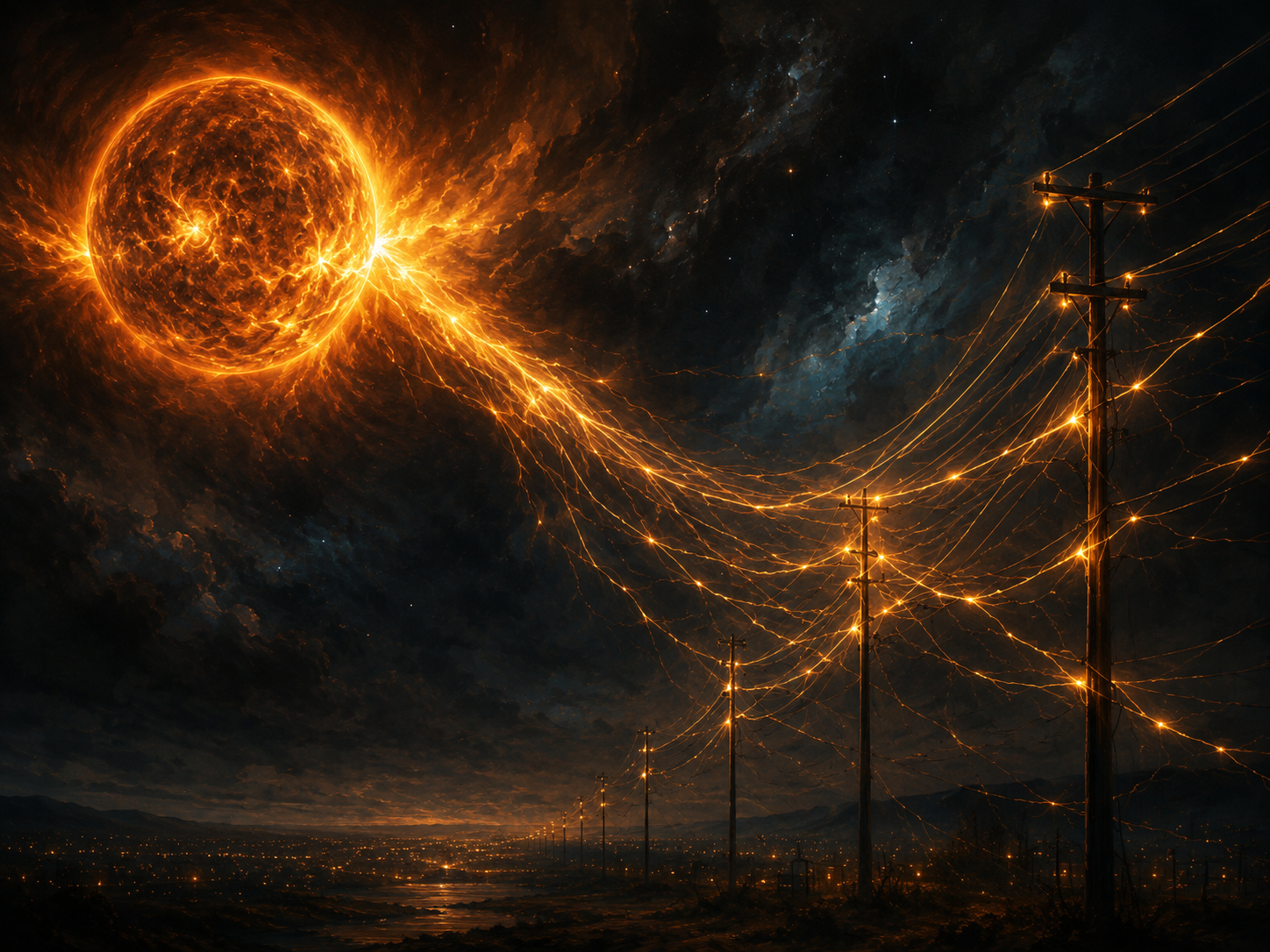
In 1859, during what we now call the Carrington Event, the Sun did something I find almost impossibly strange.
A massive solar eruption hit Earth hard enough to induce electrical currents in telegraph lines. Equipment sparked. Operators received shocks. Auroras appeared absurdly far from the poles. And, in some places, telegraph operators disconnected their batteries and discovered they could keep sending messages anyway.`
The storm itself was powering the wires.
I have known about the Carrington Event for a while. For some reason, I am especially fascinated by it now.
Maybe part of that is AI.
I spend a lot of time thinking about increasingly capable systems that can feel almost immaterial. Intelligence appears on a screen. Models answer questions, reason through problems, generate images, help with research. The experience encourages a kind of abstraction.
But, none of it is abstract underneath.
There are chips. Power lines. Cooling systems. Fiber-optic cables. Satellites. Transformers. Data centers full of physical machinery doing physical things.
A sufficiently severe solar storm could disrupt parts of that infrastructure, potentially very badly. That does not mean another Carrington Event would automatically collapse civilization. We monitor the Sun now. Electrical systems can be prepared and hardened. There are people whose entire jobs involve thinking about this.
Still, could is doing only slightly reassuring work there.
What unsettles me is the reminder that a technological civilization can become astonishingly sophisticated and remain completely embedded in physics. We can build something that feels almost like disembodied intelligence, and then the star ninety-three million miles away can remind us that it all still has a body.
What Grandpa Taught Me
I suspect my grandfather is somewhere underneath my fascination with all of this.
I have written about our endless conversations about nothing, which probably remain the strangest part of the intellectual inheritance he left me. I would ask what nothing was. He would answer. I would find some problem with the answer. He would try again.
Apparently neither of us had anywhere else to be.
But, he also taught me about stars.
And galaxies. And the speed of light. And the scale of the universe. And all manner of mild physics delivered to a child who kept asking follow-up questions long after another adult would reasonably have changed the subject.
I do not remember these as lessons exactly. I remember them as conversations.
That distinction matters.
He was not trying to produce a tiny astronomer. He was showing me, definitely not accidentally, that enormous things could be thought about. A galaxy was incomprehensibly large, but we could still sit there and talk about one. Light was unimaginably fast, but it had a speed. Stars were distant beyond anything I could picture, but their light crossed that distance and reached my eyes anyway.
Maybe what he really gave me was an appetite for scale.
Not mastery of it.
Just the willingness to keep looking at numbers too large for the mind and asking what they might mean.
One Day Away
That is probably why I am already strangely excited about Voyager 1 reaching one light-day from Earth.
NASA says that will happen on November 18, 2026.
Nothing will happen.
That may be my favorite part.
Voyager will not cross a physical boundary. No instrument will register a change. There is no one-light-day line floating through interstellar space for the spacecraft to pass through.
We made the milestone up.
And, I love it.
At that distance, light itself, moving as fast as anything can move, takes twenty-four hours to cross the space between Voyager and Earth. A signal sent from here will need a full day to reach it. A signal from Voyager will need another day to return.
Sixteen billion miles is a number.
One day at the speed of light feels like something else.
It gives the mind a handle.
I already wrote about Voyager because I find the spacecraft almost unbearably compelling: these old machines still moving outward, still transmitting what little they can, still being tended by people on a planet they left in 1977.
But, I suspect I will write about it again when that completely invented milestone arrives.
Some milestones deserve to be invented.
The Thought Underneath the Thought
This essay also began in a way I recognize more and more.
I knew the Carrington Event was interesting to me. I knew my interest had suddenly intensified. I did not know why.
So, I put the half-formed thought into conversation.
Then the connections started appearing.
AI.
Infrastructure.
My grandfather.
Voyager.
The speed of light.
Those old conversations about nothing.
That is a small example of something I was trying to describe in The Thinking Room. Sometimes I do not need someone, or something, to give me an answer. I need somewhere for the unfinished thought to become visible long enough for me to notice what it is attached to.
And, apparently, this one was attached to quite a lot.
Still, I do not think the point is AI.
I think the point is the Sun.
Or maybe space more generally.
The universe is very easy to turn into scenery. Stars above us. Galaxies far away. Space as the enormous dark place beyond the world where actual life happens.
Except that is wrong.
Actual life happens inside it.
The Sun reaches Earth and lights the room. Its magnetic violence can enter our wires. Its particles shape the enormous bubble Voyager eventually crossed out of. A machine we built can travel so far that soon even light will need a day to reach it.
And, decades ago, my grandfather could sit with a kid and explain that light had a speed at all.
Maybe that is why I keep returning to these things.
The scales are ridiculous. The distances resist us. The numbers eventually become noises rather than quantities.
And, somehow, they remain intimate.
A wire.
A spacecraft.
A conversation.
A child trying to imagine a galaxy.
The universe is not somewhere else.
It has been here the whole time.
When the sun speaks
It’s loud, but also gives life
Peculiar object