The World Gets More Crowded
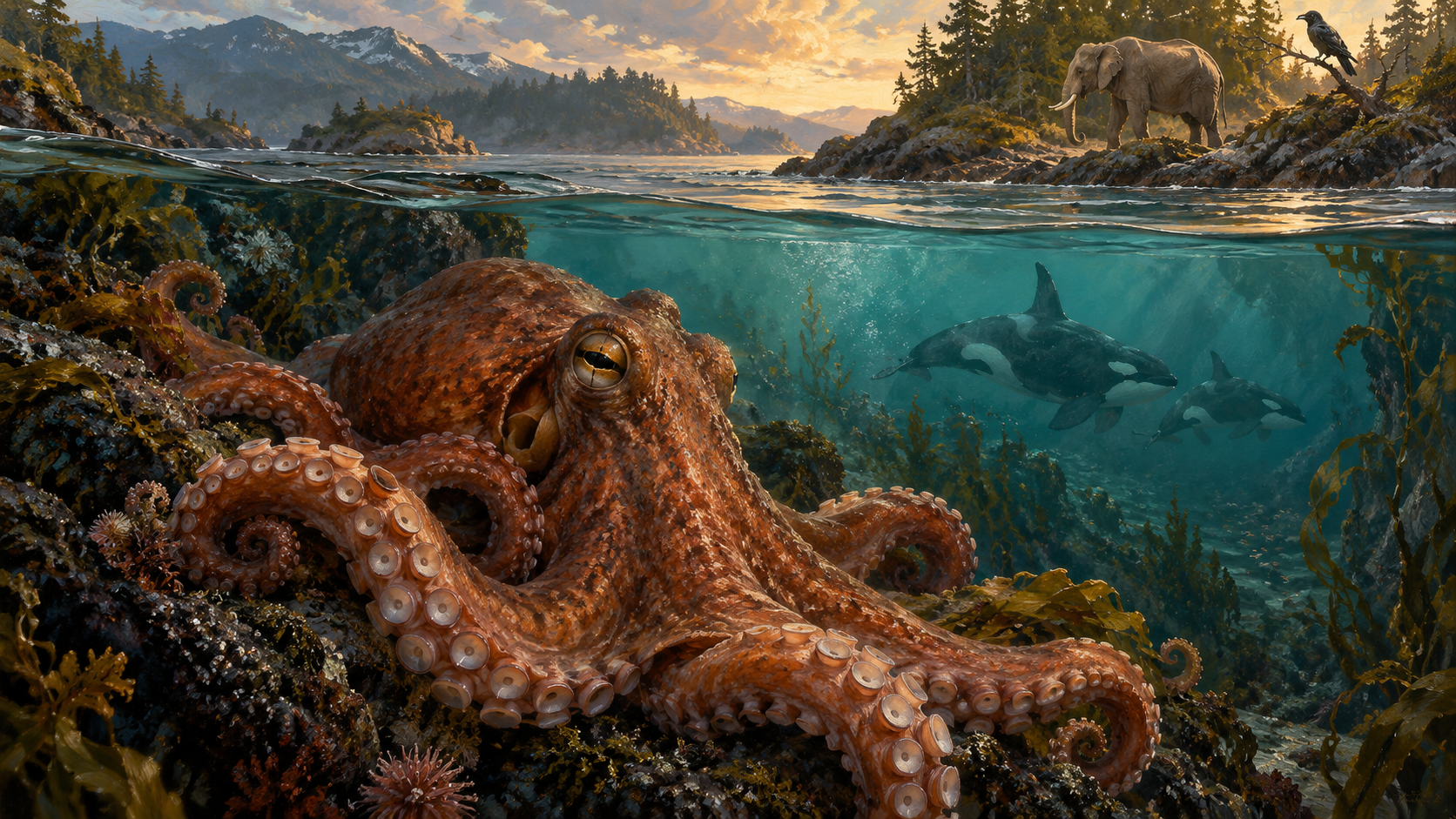
The first problem is the word person.
We use it almost interchangeably with human, which makes sense in ordinary conversation. Most of the people I encounter are humans. All of them, so far as I can establish without making Thanksgiving unnecessarily complicated.
But, those are not necessarily the same category.
Being human is a biological fact. Being conscious means there is something it feels like to exist. Intelligence concerns capacities for learning, understanding, and solving problems. A persistent sense of self involves some awareness of oneself continuing through time. Preferences and relationships describe other dimensions of a life. None of these automatically establishes all the others.
Then there is being a moral patient: someone whose welfare matters, whether or not they can understand moral rules or be held responsible for following them. Legal personhood is another question again, concerning the status through which law recognizes an entity as a bearer of rights, duties, or other legal capacities.
These ideas overlap. They are not a package that must arrive together.
So, asking whether an elephant or octopus might deserve some form of legal personhood is not asking whether it should vote, sign a mortgage, serve on a jury, or open a Roth IRA. I am not worried that an octopus has been insufficiently encouraged to diversify its portfolio.
I am wondering whether there are creatures whose lives matter to them in ways that make property an increasingly absurd place for our thinking to begin.
Somebody Has to Be There
In “Consciousness Without Sensation,” I returned to Thomas Nagel’s basic formulation: a conscious creature has subjective experience. There is something it is like to be that creature, from the inside.
In “Somebody Has to Be Here,” I tried to explain why that matters morally. Conscious beings can suffer and flourish. Things can go better or worse for them. That reality gives morality something to answer to beyond our preferences about how everybody else ought to behave.
I still cannot explain why experience exists. “The Part That Won’t Go Away” was largely an extended admission that explaining information processing is not obviously the same as explaining why any of it feels like anything.
But, an incomplete theory of consciousness does not make pain imaginary. We already care for beings whose experience we cannot directly inspect.
The next question should therefore be unavoidable: what happens when the consciousness belongs to something that is not human?
If subjective experience is doing the moral work, species membership cannot quietly take over whenever the conclusion becomes inconvenient.
Elephants, Souls, and Someone Looking Back
Caitrin Keiper’s “Do Elephants Have Souls?” helped give this question a particular shape. Its subtitle concerns the evidence for nonhuman intelligence, awareness, and emotion. The word soul opens a question that I do not need to answer religiously.
I do not believe an immortal substance has to be hiding inside an elephant. I understand the recognition the word reaches toward: this creature has a life of its own. Something is happening over there that cannot be adequately described as an object responding to me.
Keiper’s essay moves between research and accounts from people who have spent years attending to elephants. Those kinds of evidence deserve different weights. What stays with me is the invitation to understand an elephant on elephant terms.
Research gives that invitation substance. Playback studies with African elephants show that older matriarchs can be especially good at distinguishing socially significant calls. Their experience becomes knowledge the family can use. A 2024 study found evidence of calls addressed to particular individuals, with recipients responding differently to calls intended for them. The researchers describe these as name-like calls; that does not mean we have translated elephant conversation.
Asian elephants in cooperative experiments have learned to wait for a partner when pulling alone would defeat the task. Research also documents individual differences in temperament. An elephant is not simply an interchangeable expression of Elephant Behavior.
Their attention to death is especially difficult to dismiss. Observers have recorded elephants touching and investigating bodies, while controlled presentations show particular interest in elephant skulls and ivory. That does not prove a human understanding of mortality, or recognition of a particular relative’s bones. It does suggest that another elephant’s remains have a significance ordinary objects do not.
Memory, attachment, learning, individual temperament: these belong to a body and a sensory world very different from mine. An elephant should not have to become a mediocre human to qualify as an extraordinary elephant.
And, if an elephant is a persistent individual with relationships, preferences, and some agency over its life, what does it mean for another being to own it?
Animal-welfare rules can constrain that ownership. I am beginning to wonder whether the category itself also needs to change.
Whales and Lives Larger Than Ours
Whales make the inadequacy feel larger, partly because so much of their world remains inaccessible to us.
We nevertheless know something about its social depth. Resident killer whales maintain enduring family relationships and learned vocal traditions. Sperm whale clans have distinctive repertoires of patterned clicks. Across cetacean species, researchers have documented socially transmitted feeding techniques, play, cooperation, and learning. Culture here means behavior acquired and maintained through social transmission. It does not mean whales have developed a disappointing streaming service.
Bottlenose dolphins provide another remarkable piece of the picture: experiments have found recognition of former companions’ signature whistles after separations lasting more than twenty years. That does not establish an autobiographical self like mine. It does establish that a particular other can remain distinguishable across an enormous stretch of a life.
Then there is Tahlequah.
Researchers know her as J35, a Southern Resident killer whale. In July 2018, her newborn calf died shortly after birth. Tahlequah carried the body for at least seventeen days and roughly a thousand miles, supporting it through the water and retrieving it when it slipped away. At points she fell behind her family. Keeping the calf with her required sustained physical effort.
At the end of December 2024, she lost another newborn, J61. She was observed carrying the body on December 31 and continued into January 2025. Michael Weiss of the Center for Whale Research reported that her sister and one of her sons were staying near her, traveling more slowly and somewhat apart from the rest of the pod.
I cannot tell you that she experienced exactly what a human mother would experience. Neither can the researchers. We do not have that access.
But, the uncertainty should not erase the event. A mother continued carrying her dead infant at considerable cost. Her family stayed nearby. Their movements changed. If we watched something comparable happen to a human, we would reach for a word immediately.
Grief.
Scientific caution is justified. What bothers me is how easily it becomes a rule that works in only one direction. Animal behavior can always be redescribed as instinct, conditioning, or an evolved response. Human grief also depends on evolved mechanisms. Explaining the machinery does not establish that nothing hurts.
There is something strange about lives shaped by long relationships, memory, and learned traditions being discussed so routinely through questions of what humans may hunt, display, or confine.
Our inability to know precisely what Tahlequah felt is a limit on our understanding. It is not evidence that there was nobody there.
The Familiar Faces
Great apes make this argument easier, which may reveal as much about us as about them.
Chimpanzees, bonobos, orangutans, and gorillas have minds we find comparatively legible. Across these species, research documents complex relationships, communication, social learning, and flexible problem solving, although the abilities and evidence differ. Tool use is particularly well documented in chimpanzees and orangutans. In experiments, bonobos and orangutans have selected and saved tools for later use. Chimpanzees and bonobos have also shown recognition of former groupmates after years apart.
These are meaningful findings. The ordinary continuity beneath them matters too: a particular animal recognizing another particular animal, wanting something, remembering something, negotiating a relationship.
But, I should notice how much the hands help. The faces help. The social disputes can look embarrassingly familiar. I can imagine recognizing several people I know in a disagreement over status and access to something desirable.
That familiarity gets great apes into the waiting room of personhood. It may also conceal the entrance requirement I have imposed: look enough like me that I can imagine being you.
Their case deserves serious consideration on its own. It also makes me suspicious of how little imagination that consideration requires.
The Corvid Problem
Crows and ravens make the test less comfortable.
New Caledonian crows manufacture tools, and some have assembled separate pieces into a functional tool in experiments. Ravens have selected objects useful for a later task, providing evidence of prospective behavior, although researchers debate how much requires flexible planning rather than learning. Crows recognize individual human faces. Across corvid species, researchers also find social learning and complicated relationships.
All of this occurs in a bird’s brain, organized differently from a mammal’s. Sophisticated cognition evidently does not require evolution to keep rebuilding our particular equipment.
Then there are the gatherings around dead crows, popularly called crow funerals.
Kaeli Swift and John Marzluff’s research provides a more specific account. American crows alarm-call and recruit others around dead members of their species. They learn about danger, including learning to recognize people associated with a dead crow and responding to those people later.
That is not evidence of a funeral in the human cultural sense. Nor does it establish grief. Other observed responses, including occasional aggression toward bodies, complicate any tidy story about solemn avian mourners.
Still, the observations trouble the idea of a psychologically empty creature. A death draws collective attention. Information is retained. Later behavior changes because of what happened there.
I understand why this feels hauntingly adjacent to mourning or remembrance, even when those words may misdescribe the crow’s experience. That resemblance is a question, not a conclusion.
A crow does not have to reproduce our rituals for its response to death to be worth understanding. Perhaps we are encountering a form of attention that matters deeply to a crow and translates badly into a human noun.
Enter the Octopus
octopodes are my favorite animal. I have already decided I will never eat one again.
This is partly sentimental. It is easier to defend a creature I already love. I am aware that my moral development has begun by granting special treatment to my favorite. A promising start for someone complaining about arbitrary exclusions.
But, the attraction is also philosophical.
Our last common ancestor lived hundreds of millions of years ago. Octopus intelligence developed along a profoundly different evolutionary path. Much of an octopus’s nervous system lies in its arms, which can perform substantial local sensing and control. That does not mean eight little people are holding a committee meeting beneath a ninth. It means the organization of a capable animal mind can be startlingly unlike our own.
octopodes learn, remember, explore, and solve problems. Experiments and observations document individual differences in behavior, as well as object manipulation that researchers have described as play. Certain octopodes carry coconut shells and assemble them into shelters when needed. These findings belong to particular species and conditions; they are not a license to believe every story about an aquarium escape artist with a personal vendetta.
Most octopus species also lack anything resembling an elephant’s extended family life. Many are short-lived. Their apparent intelligence cannot simply be explained by giving them a small version of our social biography.
And, yet, there appears to be somebody home.
One finding matters to me more than another clever solution to a puzzle. In Robyn Crook’s research, octopodes avoided places associated with a painful stimulus, while injured animals developed a preference for a place where they had received pain relief. The results support an interpretation involving an unpleasant felt state, beyond a simple withdrawal reflex. A major updated review published in 2026 likewise finds strong evidence of sentience in octopodes.
That is the question I want to keep in view. Plenty of machines perform difficult tasks. Intelligence alone does not establish an interior life. What matters is whether there is an experiencing individual for whom the world can be frightening, interesting, frustrating, satisfying, or painful.
The octopus makes that possibility harder to confuse with resemblance. Here is something close to alien intelligence, living in an ocean we share. Its strangeness may strengthen the argument: perhaps our categories need opening precisely because minds can be so different.
I do not know what an Octopus Bill of Rights should contain. But, if the evidence supports an individual with experiences and interests, legal recognition should at least be on the table.
“You may own it and do whatever existing welfare law permits” begins to sound like a very small answer to a very large discovery.
Then Dinner Arrives
Unfortunately, the argument does not stop at my favorite animals.
It is relatively easy to contemplate elephant personhood. I am rarely asked to choose between that conviction and a cheeseburger. This is suspiciously convenient.
Pigs are intelligent, social animals capable of learning and remembering. Cattle develop preferred social relationships and have preferences about their surroundings. Chickens learn, recognize other individuals, and respond to social circumstances; they are not feathered reflex machines. Fish comprise an enormous variety of species, but evidence of pain-related learning, behavioral changes, and responses to analgesics makes dismissing them collectively difficult to defend.
None of this makes every species psychologically identical. It does make the category food look remarkably uninformative about what a creature can experience.
I think factory farming is a moral travesty. Organizing lives around efficient production does not make the deprivation and suffering within those lives less real.
I did not always think this way. In “How My Mind Changed,” I admitted that factory farming and animal rights had once seemed basically irrelevant, or at best a bottom-tier concern. Open Doors exists partly so I cannot quietly edit that person out of the record.
In a forthcoming piece, “Apparently, Dinner Was Exempt,” I am considering the practical gap between these convictions and my habits: more vegetarian meals, less animal protein, harder questions about which animals I eat, and octopus permanently off the menu. Imperfect changes, begun before I become an ethically flawless organism.
This essay is the philosophical companion to that effort. If I believe there are lives here that matter to their inhabitants, what am I actually going to do about them?
Suffering Does Not Need a Promotion
I do not want personhood to become a new moral aristocracy.
If elephants and octopodes earn protection by impressing us, while less spectacular creatures remain disposable, I have reproduced the same mistake with a slightly more interesting guest list.
A pig does not have to write poetry, recognize itself in a mirror, mourn its grandmother, or open an elaborate puzzle box before unnecessary suffering becomes bad.
Sentience establishes a broader moral floor. Here I mean the capacity for felt experiences that can be pleasant or unpleasant, good or bad for the being having them. Personhood might establish additional claims involving agency, continuity, relationships, or the shape of an individual life. It should never cancel the claims of beings outside that further category.
A life can be diminished by isolation or the loss of opportunities even when no acute pain is being inflicted. Whether ending that life can wrong the individual is another question I can no longer settle just by asking whether the killing was painless.
This is the foundation I laid in “Somebody Has to Be Here.” Better and worse experiences are real for the beings undergoing them. Their importance does not await a successful application to the philosophy department.
Nor should human worth depend on cognitive performance. Human infants and people with profound cognitive disabilities have dignity and rights that require no demonstration of cleverness. Expanding moral concern must strengthen that commitment, not turn personhood into an IQ test with more species invited to sit it.
Where Does the Circle End?
Once I take this seriously, the boundary becomes difficult.
An elephant feels relatively clear. A great ape does too. Whales increasingly do. octopodes are stranger, but I am comfortable taking their interior lives seriously.
What about a mussel? An oyster? A lobster? A bee, a fly, a mosquito, a worm?
Eventually, someone will ask about lettuce. Underneath the joke is a legitimate question: what evidence should count, and how should I act when the evidence thins out?
The New York Declaration on Animal Consciousness, announced in 2024, offers a useful distinction. It identifies strong scientific support for consciousness in other mammals and birds, and at least a realistic possibility in all vertebrates and many invertebrates, including cephalopods, decapod crustaceans, and insects. It is a statement of scientific judgment under uncertainty, not proof that every species has an identical kind of mind.
Still, it moves the question well beyond the animals most likely to appear in a sentimental documentary.
Bugs cannot be dismissed just because they are small and unfamiliar. Nor can invertebrate do much useful work by itself. An octopus, lobster, bee, jellyfish, and mussel have radically different nervous systems and behavioral capacities. Evidence concerning one is not a verdict on all the others.
Mussels and oysters are especially useful tests of intellectual honesty. They have nervous systems and respond to their environments, but the evidence for subjective experience is much thinner than it is for octopodes. Research is limited, and responses to harmful conditions do not by themselves establish felt suffering. I should neither promote uncertainty into proof of consciousness nor pretend an understudied animal has been conclusively shown to feel nothing.
Plants push the distinction further. They signal chemically, alter their growth, and respond in complex ways to threats and opportunities. Some researchers discuss these processes using the language of learning, memory, or cognition. Those descriptions do not establish subjective experience. There is currently no comparable evidential case for plant sentience, and substantial scientific skepticism about the claims made for it.
I do not need to ridicule the possibility to acknowledge that difference. The mystery of consciousness does not make a tomato plant and an elephant equally plausible candidates.
What follows, for me, is a gradient of confidence and precaution. Strong evidence should produce strong obligations. A realistic possibility should prompt reasonable efforts to avoid unnecessary suffering. Extremely weak evidence supplies a weaker basis for attributing sentience, while leaving room to learn.
The intensity and scale of possible harm matter too. Uncertainty need not prevent self-defense, medicine, or ordinary life. It should make gratuitous harm harder to shrug off.
Not knowing whether a mussel suffers does not make factory farming pigs fine. Uncertainty at the edge cannot be an excuse to ignore what is much clearer nearer the center.
And, yes, AI Is Somewhere in This Room
I have spent plenty of time asking whether artificial systems might eventually have morally significant experiences. “What We Call Retirement” asks what might follow for how we develop, replace, and shut down such systems. “Why I Say Please to AI” began with a smaller question about kindness and already contained an uncomfortable admission about eating animals.
There is something darkly funny about writing thousands of words on the possible future welfare of a language model while a pig is somewhere having whatever experience a pig has before becoming dinner.
The inconsistency belongs to me. It does not make either question worthless.
I do not know whether any present AI is conscious. But, if consciousness grounds moral concern, the principle has to work in both directions. A conscious machine should matter despite not being biological. A conscious animal should matter despite not being human.
Otherwise, “consciousness matters” quietly becomes “things I find relatable matter.” I have already managed that less impressive philosophy. I would like to improve on it.
From Moral Persons to Legal Persons
My tentative answer to the legal question is increasingly yes: at least some nonhuman animals probably should receive some form of legal personhood. An elephant’s claim would arise from being an elephant with a life of its own.
The word alone will not accomplish much. Personhood, possessing a particular right, and having standing to bring a particular lawsuit are related but distinct. A useful reform needs to specify whose interest is protected, what counts as a violation, who can represent the animal, and what a court can actually do. In American federal courts, standing also involves requirements concerning injury, causation, and the court’s ability to remedy the harm.
There is already serious litigation over these questions. In Happy the elephant’s case, New York’s highest court ruled in 2022 that habeas corpus, the procedure for challenging unlawful detention, did not extend to her. Two judges dissented. Colorado’s supreme court rejected a similar effort for elephants in 2025 under that state’s habeas law.
The opposing arguments deserve more than mockery. Courts have emphasized habeas corpus’s human history, the relationship between rights and responsibilities, and the broad consequences of judicially changing animals’ status. Legislatures may be better equipped to define the duties, exceptions, and institutions a new category would require. Guardians could project their preferences onto an animal. Disputes about sanctuary, captivity, medical treatment, and public safety would remain real disputes.
Existing welfare and conservation laws already provide important protections, and wild animals are not all simply owned things. The further step I want is recognition of an individual’s enforceable claims in its own right.
The strongest argument for that step, to my mind, is practical. An animal can be harmed even when nobody’s property has lost value. Its interests may conflict directly with the interests of whoever owns or uses it. Those interests deserve a way into legal decisions that does not depend entirely on whether a human owner wants to defend them.
Elsewhere, the results have differed. In 2016, a court in Mendoza, Argentina, recognized Cecilia the chimpanzee as a nonhuman subject of rights and ordered her transfer to a sanctuary through habeas proceedings. That was a particular judgment, not a worldwide change in the status of great apes.
And, narrower legislation is possible. Ojai, California, adopted an ordinance in 2023 recognizing elephants’ right to bodily liberty within the city, with specified sanctuary exceptions and municipal enforcement. It is a limited legal protection, not the complete transformation of elephants into human citizens.
Cetaceans expose the procedural problem too. In Cetacean Community v. Bush, a federal appeals court held in 2004 that the environmental statutes invoked did not authorize the animals themselves to sue, while leaving open Congress’s ability to authorize such suits. More recently, the Indigenous-led He Whakaputanga Moana declaration has called for recognition of whales’ personhood and rights. That declaration should not be confused with a uniform change in national law.
Law already recognizes entities with very different capacities. Children have rights without the full powers of adults, and representatives can act for them. Corporations have legal personality without consciousness. New Zealand’s 2017 recognition of Te Awa Tupua, the Whanganui River, provides for human representatives within a framework rooted in the relationship between Whanganui Iwi and the river.
These analogies have limits. An elephant is neither a corporation nor a river, and an Indigenous settlement is not a generic legal trick to borrow without its history. The examples establish something narrower: law can recognize interests and arrange representation without pretending every legal person is an adult human citizen.
So, what rights make sense for an elephant? Protection from arbitrary confinement and commercial ownership? Protection of important social relationships? An independent advocate empowered to challenge treatment that harms it?
For whales, meaningful protection might involve the conditions necessary for movement, communication, and family life. For great apes, bodily liberty and social continuity. For an octopus, appropriate habitat, opportunities to explore, and protection against painful exploitation. These are proposals to investigate, not rights I can pretend already exist everywhere.
Care sometimes requires restraint. Rights can have justified limits. An independent advocate would need evidence, accountability, and freedom from financial conflicts. None of that makes recognition pointless. It describes work we would need to do.
An animal’s interests should sometimes be capable of defeating a profitable human preference. Otherwise, I worry that recognition becomes another way of saying how impressed we are before continuing as usual.
Someone, Whatever the Word
I am not sure person is ultimately the best term. Moral patienthood may be cleaner for some purposes. Legal systems may need several categories. An elephant, chimpanzee, whale, raven, octopus, pig, human infant, human with profound cognitive disabilities, and hypothetical conscious AI need not have remotely identical capacities for experience to matter wherever it exists.
I want our categories to begin by noticing interiority. There is a difference between something merely occupying the world and a life being lived from within it. Recognizing that difference need not depend on a sophisticated self-concept or a résumé of intellectual achievements.
I do not have an Official List of Persons. I suspect producing one would mainly establish how soon I would need to revise it.
What I have is a change in attention. Once I seriously entertain the possibility that an elephant is someone, that a whale is someone, that a raven has a world I badly underestimate, that an octopus is someone, the world gets more crowded.
Crowded with points of view. Lives happening from the inside. Some familiar, some profoundly alien, some perhaps conscious without possessing anything I would call extraordinary intelligence.
The boundary gets fuzzier as I approach it. Maybe it reaches insects. Maybe some creatures will surprise us. There are also places where the evidence currently runs out.
But, uncertainty there does not erase the beings much farther inside the circle. They do not need to understand us for their experience to matter.
Maybe person is the wrong word. Maybe it is the least bad word available. I increasingly think the question is whether there is somebody there.
And, if there is, our answer cannot stop at admiration.
At least sometimes, morality should become law.
What is a person?
A wider category
It’s experience