The Universe Is Under no Obligation to Be Ordinary
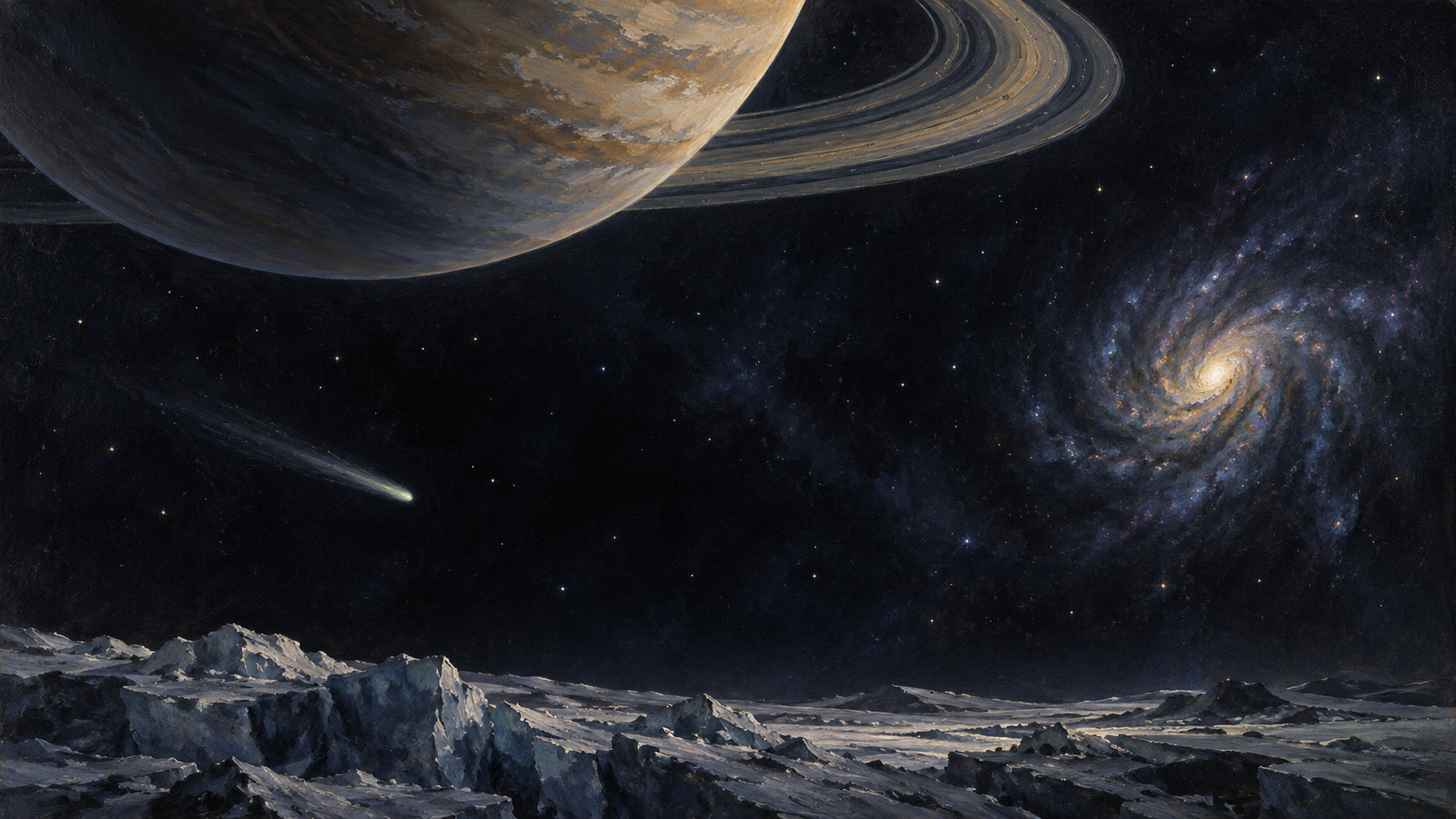
I keep trying to read one astronomy article.
This is apparently beyond me. One article becomes a moon. The moon becomes an ocean. The ocean turns out to be under ice, orbiting a planet whose magnetic field is doing something I had not previously known magnetic fields could do. Then someone mentions a galaxy that may never have made any stars, and the evening is gone.
I am comfortable calling this a good use of an evening.
My recent astronomy pieces have circled particular fascinations: Jupiter, the Sun, the Voyagers moving beyond the solar bubble. But, underneath those subjects is something broader that I have been trying to name.
If only a few things deserve the word sacred, surely this is one of them.
The actual universe. The fact that any of this exists, behaves in particular ways, and can become partly understandable to creatures who live on one small piece of it.
I do not mean that I have discovered religion through a telescope. I mean that certain things deserve a quality of attention I cannot quite reduce to interest. Astronomy gives me that feeling with embarrassing regularity. Sometimes all it takes is a paragraph about a rock.
Admittedly, the rock is usually doing something outrageous.
The Star we Have Managed to Get Used To
Some of this began with my grandfather. I touched on those beginnings in Somebody Has to Be Here, and returned to his conversations about stars, galaxies, and light in The Sun in the Wires. He gave me enough understanding to ask another question, which may be the most lasting kind of education.
The Sun is a good place to keep asking.
We have a star. We say this as if it were an unremarkable feature of the neighborhood. It contains about 99.8 percent of the solar system’s mass, sustains nuclear fusion in its core, and has been doing versions of this for roughly 4.6 billion years.
We call its light “day.”
That familiarity is useful. Nobody could get much done if every sunrise required a full reckoning with stellar physics. But, occasionally, I want the familiarity to loosen. The light in the room has a source. The source is an enormous body of plasma whose magnetic activity can disturb the electrical systems we have built here on Earth.
That was what caught me about the Carrington Event: the star entering the wires. Meanwhile, its solar wind helps form the heliosphere, the vast bubble whose outer boundary the Voyagers crossed, as I explored in The Far Side of Almost Nothing.
Even before considering another planet, the word home has become considerably larger.
Eight Planets, None of Them Generic
The schoolroom arrangement is wonderfully memorable. Eight planets in order, each with a distinguishing feature, all looking reasonably tidy on the page.
It leaves out a great deal of personality.
Mercury and Venus: the Nearest Strangeness
Mercury is the smallest planet and the closest to the Sun, which makes the presence of water ice near its poles feel like a clerical error. Yet, deep craters contain permanently shadowed places cold enough to preserve it. On the same world, sunlit ground becomes ferociously hot.
“Closest to the Sun” is true. It just does not tell you everything about every place there.
Venus takes another familiar idea, a rocky world roughly Earth’s size, and follows it somewhere appalling. Its thick carbon dioxide atmosphere traps enough heat to make it hotter at the surface than Mercury. The pressure is crushing. Clouds contain sulfuric acid.
It also rotates so slowly that one complete turn takes longer than one trip around the Sun. That is a statement about rotation, rather than the interval between sunrises, but either way Venus has made a mess of my intuitive calendar.
Neither Mercury nor Venus has a moon. They are managing to be sufficiently interesting on their own.
Earth and Mars: Familiarity Is Uneven
Earth is the one I am most likely to forget belongs in the list.
The others are planets. Earth is where the laundry is.
Yet, this is the world with exposed oceans, a breathable atmosphere for creatures like us, and the only life we have confirmed anywhere. Everything we know about music, grief, bacteria, parenthood, and arguments about whether something is a planet has happened here.
Our Moon is familiar enough to become a symbol before it becomes a place. But, it is a place: cratered ground, mountains, old lava plains. Its rotation matches its orbit closely enough that we keep seeing the same broad face. The far side receives sunlight too. Being hidden from us is not the same as being dark.
Mars feels near in a different way. We have sent machines to travel across it, and their images contain things I can almost imagine encountering: stones, slopes, dust collecting around a wheel. There are traces of ancient rivers and lakes on a world now cold and dry at the surface.
Its moons, Phobos and Deimos, are small, irregular bodies whose origins remain under investigation. Phobos is gradually spiraling inward and will eventually collide with Mars or break apart.
Even a moon can be a temporary arrangement. We have simply arrived during the part that looks settled.
Jupiter and Saturn: Whole Systems Disguised as Planets
I have already given Jupiter considerable attention in The Planet That Pulls on Worlds, and could easily become unreasonable about it again.
Its size is only the beginning. Around Jupiter, gravity becomes activity inside other worlds. Io’s orbit is kept slightly stretched through interactions with neighboring moons, and the changing tidal pull helps heat its interior. The result is extraordinary volcanism. Europa, meanwhile, shows strong evidence of a global ocean beneath its ice, with tidal heating helping explain how liquid water could persist so far from the Sun.
One planet, two moons, and already we have a volcanic world and a possible habitat concealed beneath a frozen surface.
Saturn seems almost unfairly equipped to compete. The rings would have been enough. Vast numbers of separate particles, mostly water ice, collectively produce something that looks from a distance like an impossible piece of architecture.
Then there is Titan, with its dense atmosphere and rivers, lakes, and seas of liquid hydrocarbons. Methane participates in a cycle involving clouds, rain, and flowing liquid. The pattern is recognizable. The chemistry makes it profoundly alien.
Enceladus is smaller and, somehow, no less extravagant. It has a subsurface ocean and sends water vapor and ice grains into space through fractures near its south pole. Cassini sampled those plumes. We have examined material thrown from the interior of an ocean moon orbiting Saturn.
I sometimes have to stop at sentences like that.
A 2026 study added another complication. Cassini’s archived measurements revealed an extended system of electromagnetic waves associated with Enceladus, reaching more than half a million kilometers through Saturn’s magnetic environment. These Alfvén waves carry disturbances along magnetic field lines as the moon and material from its plumes interact with the surrounding plasma.
The moon is only about five hundred kilometers across.
I had been thinking of Enceladus as a small world with an extraordinary interior. It turns out that “small” also depends on whether you measure the object or how far its effects reach.
Uranus and Neptune: we Have Barely Been There
Uranus rotates almost on its side. Its magnetic field is strongly tilted relative to that rotation, which already gives the planet more complexity than its quiet appearance suggests.
But, the detail that recently caught me concerns our confidence about it.
Voyager 2 made humanity’s only close visit in 1986. A reanalysis published in 2024 suggests that it arrived during unusually intense solar-wind conditions that compressed the planet’s magnetosphere. The researchers estimated that comparable conditions occurred only about four percent of the time in their comparison data.
The spacecraft measured something real. We may have mistaken an unusual state for a representative one.
I find that almost as fascinating as the planet itself. A fleeting encounter becomes decades of understanding, until someone goes back through the measurements and asks what was happening just before we arrived.
Meanwhile, Miranda has enormous fault canyons and sharply contrasting terrains packed onto a little moon. Ariel carries long fault-bounded valleys and evidence of geological activity. These are entire landscapes we have only begun to examine, orbiting a planet we visited once.
Neptune is farther still, with powerful winds in its atmosphere and a moon system that may preserve the aftermath of an ancient disaster.
Triton, its largest moon, orbits in the opposite direction to Neptune’s rotation. The leading explanation is that it formed elsewhere and was captured. That arrival may have destabilized and destroyed much of Neptune’s original moon system.
Webb observations reported in 2026 give that story new support. Minerals detected on some inner moons and in the rings appear to have formed through prolonged interaction between rock and liquid water, probably inside larger bodies. The small moons we see today may have assembled from exposed interior material after those bodies were destroyed.
Another study proposes that Nereid, on its highly elongated orbit, could be an intact survivor of the original system. These are reconstructions with alternatives still in play, but what a history to be trying to recover.
The neat diagram contains wreckage. Some of the wreckage has become moons.
Things That Do not Stay in Their Assigned Places
There is no reason to stop being interested at Neptune.
Pluto remains a world with mountains, plains of nitrogen ice, and a large companion, Charon, regardless of the category we use for it. Beyond and among the planets are other dwarf planets, asteroids, comets, and smaller bodies preserving pieces of the solar system’s formation.
A change in vocabulary does very little to the geology.
And, apparently, trying to finish an essay about astronomy is an excellent way to discover that astronomy has more to add.
A coordinated Webb and Hubble survey recently brought twenty-seven newly discovered objects beyond Neptune into view. These trans-Neptunian objects are small, faint, icy bodies, some only a few kilometers across. Webb detected them in infrared observations, while Hubble supplied visible-light measurements for part of the sample.
The surprising part was what their colors suggested.
Scientists expected collisions and fragmentation to have altered the surfaces of these small bodies enough to distinguish them from their larger relatives. Instead, the small objects followed similar color patterns, suggesting that clues to their original composition had survived.
Even objects whose orbits had been rearranged during the giant planets’ early migration seemed to retain something of where they formed. Perhaps collisions happened less frequently than expected. Perhaps their compositional signatures survived the collisions. The observations leave that question open.
The survey also found fewer very small objects than some formation models predicted.
I like that combination. We discover twenty-seven things, and part of the discovery is that there should perhaps have been more things. Even the inventory becomes a question.
These bodies are remnants of the material from which planets grew. They never became worlds like Earth or Neptune, but that makes them valuable records of an earlier stage. Around Jupiter, tiny orbital tilts may preserve something of a vanished young planet. Farther out, the color of a faint point of light may preserve something of a vanished arrangement of the solar system.
A few kilometers of ice and rock can give us a reason to reconsider billions of years.
Comets particularly undo the sense that everything belongs in a tidy place. Many spend most of their time far from the Sun, becoming conspicuous when warming releases gas and dust. Some return on orbits measured in decades. Others make us expand the calendar considerably.
And, some were never ours.
The Visitors
ʻOumuamua, discovered in 2017, was the first recognized interstellar object passing through the solar system. Its changing brightness and unexpected acceleration prompted scientific debate that the brief observations could not fully settle. Then came the clearly cometary 2I/Borisov in 2019, followed by 3I/ATLAS in 2025.
These discoveries also produced the predictable question: could one of them be artificial?
I understand the attraction. Evidence of technology from another civilization would be among the most consequential discoveries we could make. I would like to know about it.
But, unexplained details do not establish engineering. In the case of 3I/ATLAS, the observed activity and small deviations in motion are consistent with a comet releasing material as it warms. There is plenty to investigate without upgrading uncertainty into a spacecraft.
The ordinary explanation is already astonishing: material formed around another star crossed interstellar space and passed close enough for us to study.
3I/ATLAS approached from the direction of Sagittarius, although a direction on our sky is not an identified birthplace. Near its closest approach to the Sun, it reached roughly 246,000 kilometers per hour. Its hyperbolic path carries it through and away, rather than around an orbit that will bring it back.
That is what catches me. The solar system, which can seem so complete in a diagram, is somewhere an object from elsewhere can pass through.
A comet does not become less remarkable when nobody built it.
Where the Stars Are Still Being Made
Beyond our system, the variety continues. We have found planets orbiting two stars, giant planets pressed into very short orbits, and worlds between Earth and Neptune in size that have no close equivalent here. There are also planetary-mass objects traveling without a host star.
Our eight are a local arrangement. Learning them was a beginning.
The stars themselves resist becoming one category of bright dots. Small red dwarfs can persist for immense spans of time. Massive stars spend their fuel much faster. Some stellar lives leave white dwarfs behind; others produce neutron stars, extraordinarily dense remnants that can send beams of radiation sweeping through space as they rotate. When those beams repeatedly cross us, we detect a pulsar.
Elsewhere, stars are still forming.
A recent Webb image of the Treasure Chest, a cloud in the Carina Nebula about 7,500 light-years away, brings that into particular focus. The cloud contains a young cluster of roughly seventy stars, including a rare O-type star around nineteen times the Sun’s mass.
It is called a cometary globule because of its shape, rather than because it is a comet. The names are getting rather crowded by this point.
Radiation and stellar winds are reshaping the surrounding material. Young stars remain embedded in the cloud that helped make them, while their own activity and that of nearby stars gradually expose them.
The beautiful image records a temporary condition. This particular arrangement will pass. The process is still going on.
A Galaxy Can Fail to Become a Galaxy
Eventually, even a star becomes a small part of the picture.
The Milky Way’s stellar disk spans more than a hundred thousand light-years. Our Sun travels within it, accompanied by the entire planetary arrangement I have just spent several sections trying to comprehend.
Beyond it are other galaxies: spirals, ellipticals, irregular systems, interacting systems. Galaxies gather into groups and clusters. On larger scales, matter forms a cosmic web around enormous voids.
I can follow that progression in language much farther than I can follow it in imagination. At some point “a galaxy” becomes suspiciously easy to say for something containing so much.
Then Cloud-9 complicates even that.
Radio observations reveal a cloud of hydrogen near the galaxy Messier 94. Deep Hubble observations found no associated population of stars. Researchers interpret it as a strong candidate for a dark-matter halo that retained gas but never formed stars: a so-called failed galaxy.
The inferred halo could contain roughly five billion solar masses of dark matter. That estimate depends on a model of the gas and gravity; nobody has simply photographed the dark matter. What we have is detectable gas, an absence of detected stars, and an explanation being tested against the evidence.
“Failed galaxy” is an arresting phrase. It also sounds a little judgmental. The universe presumably did not assign it a development goal.
Still, the possibility stays with me: a vast structure that never became the luminous thing we would most readily recognize. Astronomy has to learn from what does not light up as well as from what does.
The Work of Finding What Was Already There
That also makes me think of Matteo Paz, who developed machine-learning methods while still a high school student, working with a mentor at Caltech, to search NEOWISE’s enormous archive of infrared observations.
The project examined changes in brightness across repeated measurements. Caltech’s 2025 account described about 1.5 million potential new objects flagged and classified; a later project presentation reported roughly 1.9 million candidate variable sources in the broader catalog. These were candidates requiring interpretation, rather than a million and a half newly confirmed planets.
What interests me is the possibility of discovery remaining inside data already collected. The light reached the instrument. The measurement survived. Someone needed a way to recognize the pattern.
An archive can contain things we have observed without yet understanding what we have.
Where Light Cannot Come Back
Black holes push this feeling further than almost anything else.
Stellar-mass black holes can form from the collapse of massive stars. Supermassive black holes occupy the centers of most large galaxies, with masses ranging into millions or billions of Suns. Between those populations are intermediate-mass candidates whose identification and history remain active areas of research.
Sagittarius A*, at the center of our galaxy, contains about four million solar masses. The central black hole in M87 contains billions.
I understand “four million” as arithmetic. I do not have an adequate place to put four million Suns.
The event horizon is stranger still: a boundary beyond which light cannot escape to the outside universe. It is not a solid surface. It marks a change in what paths outward are possible.
We learn about black holes through their effects: stars moving around unseen mass, hot material emitting radiation before it falls in, the dark central regions reconstructed in Event Horizon Telescope images. We also detect gravitational waves from black holes merging, disturbances in spacetime reaching instruments on Earth from distant events.
Something happened far away. The geometry of our own surroundings changed by a measurable amount.
Understanding how such measurements work makes them more astonishing to me. There were instruments to design, sources of noise to exclude, predictions to compare, people doing difficult work until an almost inconceivable event became evidence.
There are also limits. We do not have a completed account of what happens at the deepest interior, where the predictions of general relativity press against the need for quantum physics. I want to preserve that uncertainty. It belongs to the subject as much as the things we can measure.
A Word I am Willing to Keep
I could keep going. That is becoming the defining problem of these essays.
There would be another moon, another strange star, another result hidden in decades of measurements. Each object would deserve more than the paragraph I had left for it.
But, the fascination underneath them is fairly simple. I want to know what kind of place this is. I want enough understanding to notice when something I had filed away as familiar turns out to contain an ocean, an ancient collision, or a question nobody has answered.
This does not require the universe to have intended us. It does not make its violence benevolent or turn its scale into a verdict about whether our lives matter. A black hole is not offering advice about my priorities. Neptune has no opinion of me.
I am the one having the response.
And, the response is that some things deserve sustained attention even when they offer no reassurance. I can learn what a thing is made of, how it formed, why it moves, and still feel something close to reverence. Sometimes the explanation is what makes that feeling possible.
That is a use of sacred I am willing to keep.
My grandfather could sit with a child and talk about light crossing distances neither of them could picture. Decades later, I am still trying to follow it.
There is more here than I will ever get to know.
I would like to know a little more.
Movement
It never stops
From beginning to end
So many things are just forming
Or, there