Writers love control the way cats love gravity: we pretend we’re above it, then we spend our whole lives rearranging the furniture to avoid the fall.
These three short essays orbit the same irritation from different angles. First, the harsh truth: once you publish, the work stops being yours in the way your ego wants it to be. Readers touch it, smear their lives across it, misunderstand it, improve it, and sometimes carry it farther than you ever could. Then, the lighter fight: the smug little “the book is better” verdict, which is usually less about art and more about status—plus a reminder that adaptation is translation, not a morality test. Finally, the one that made all of this personal for me: when my eyes made paper harder and my hearing made language richer, I had to admit the gatekeeping was always the flimsiest part of the whole religion.
Taken together, it’s one argument in three voices: control is a fantasy, attention is the point, and the doorway you use doesn’t decide your seriousness.
1.
The Moment Your Words Stop Being Yours
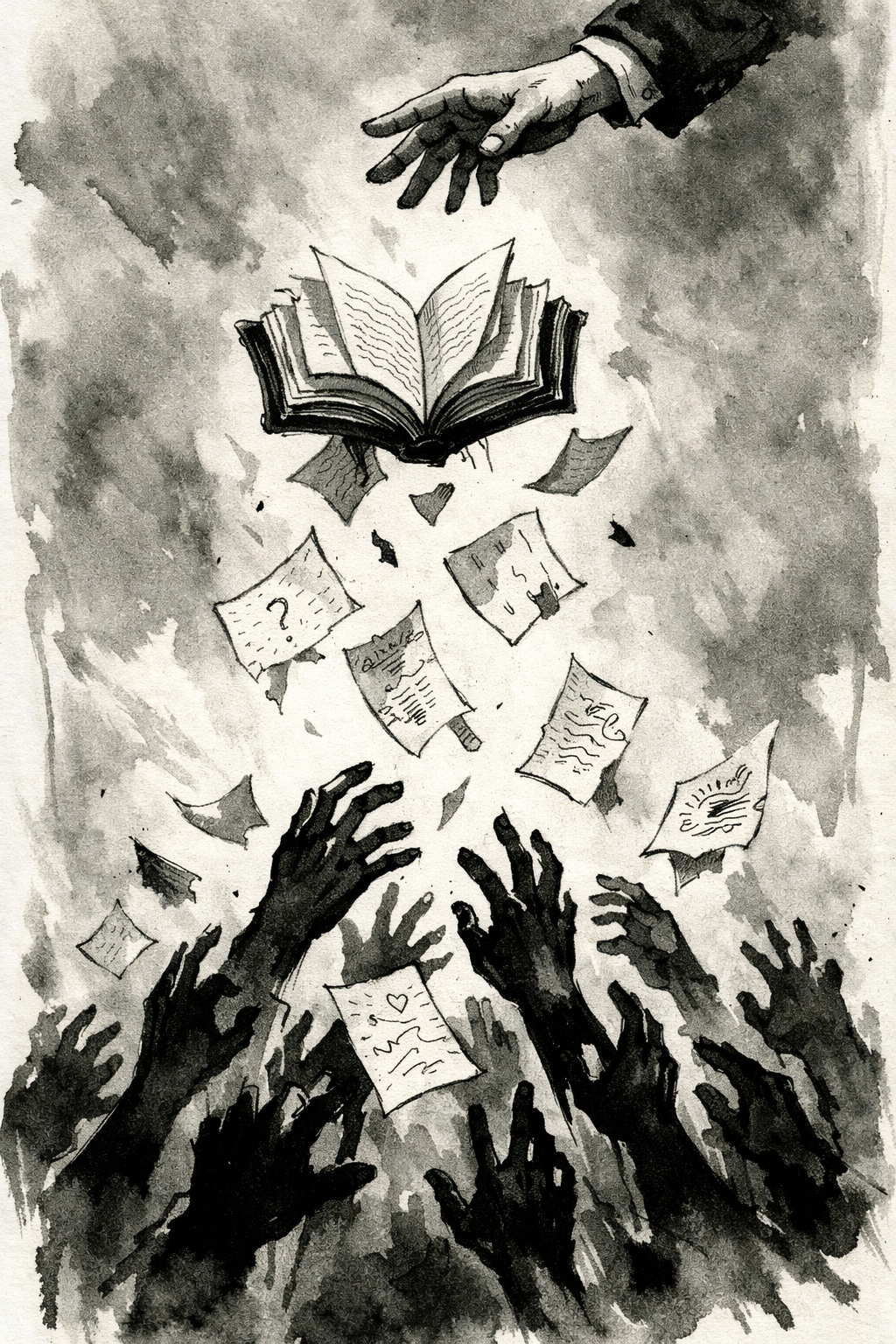
The instant you publish something—post it, print it, release it into the wild—you’re not the owner anymore. Not in the way writers secretly want to be. You’re the source, sure. You’re the person who made the thing. But once it’s public, it stops being private property and becomes a shared object that other minds get to pick up and handle however they like.
This is the part where writers nod solemnly about “reader response” and “the death of the author” and pretend they’re fine with it. Most of us are not fine with it. We want to be fine with it in the way people want to be fine with flossing and taxes, but deep down we still crave the fantasy that the audience will absorb the work exactly as intended, like a clean data transfer with no distortion.
That is not what reading is. Reading is vandalism with permission.
Readers interpret. Readers project. Readers bring their own history, their own grief, their own obsessions, their own insomnia, and they smear it across the text like fingerprints on glass. Sometimes they do it brilliantly. Sometimes they do it stupidly. Either way, they’re doing it. That’s the deal.
And, once the work is out there, you—the author—become another reader too. You are demoted. Welcome to the crowd.
Intentions Are not Magic Spells
This is where the authorial ego tries to smuggle itself back in through a side door.
Writers love to say what they “meant.” They love to provide the hidden key. They love to reveal the secret backstory. They love to explain that the scene is “really about” something else, as if meaning is a locked box and they’re the only one with the combination.
Sometimes that’s useful. Context can help. Craft talk can be illuminating. If an author says, “Here’s what I was trying to do,” a reader can decide whether that helps them see the work more clearly.
But, here’s the thing: after publication, intention becomes commentary, not authority.
A text is not your intention. A text is the words that actually made it onto the page, plus the patterns the reader can reasonably infer from them. If your intention doesn’t show up in the writing, that’s not the reader’s moral failure. That’s either a craft problem, a communication problem, or a “you didn’t actually write that part” problem.
Retroactive Canon and Other Forms of Delusion
Now we arrive at the particular flavor of nonsense that makes me tired in my bones: the attempt to declare new “canon” years later, as if the work is a living document that updates whenever the author clears their throat.
There is a difference between
“I intended this character to be X,”
and
“This character is X.”
The first is honest. It admits you had an aim. It also admits you may not have hit it. It leaves room for the reader to say, “Cool, but I’m not seeing that in the text.”
The second is an attempt to overwrite the artifact after the fact, which is adorable in the same way it’s adorable when someone tries to win an argument by saying, “Actually, I was right all along,” while quietly editing their original comment.
J.K. Rowling is the most famous example, though she’s hardly alone. The Harry Potter books were published. People read them. People reread them. People lived in that world for years. They formed attachments to characters and themes as they actually appeared on the page. Then, long after the fact, she’d drop declarations online about what was “true,” as if readers were obligated to patch their memories and retrofit their understanding.
No. That’s not how books work.
If you want something to be canon, you put it in the work. You don’t smuggle it in later through social media like it’s a software update. A book is not an app. The reader does not need to refresh to get the latest version of your feelings.
And, if you insist on doing it anyway, fine—announce your behind-the-scenes intentions. Lots of readers enjoy that. Just don’t pretend it has the same status as what’s actually in the text. Don’t act like you’ve altered reality. You’ve added commentary. That’s it. Commentary. Fun facts. DVD extras.
The Reader Owns the Meaning Now
Once a piece is public, readers are allowed to interpret it however they want. Yes, even when they’re wrong. Yes, even when you want to shake them gently by the shoulders and ask what on earth they think they’re doing.
Some interpretations are implausible. Some are so disconnected from the text that they’re basically original fiction loosely inspired by your work. But readers still get to have them. You don’t get to police meaning the way you want to. The best you can do is write clearly, build strong textual evidence, and hope the reader meets you halfway.
After that, you’re in the same position as everyone else: you can argue your interpretation, but you can’t declare it.
Internal Logic Is not Optional, Actually
Now for the companion pet peeve, which is related, and which makes me substantially more feral.
One of my biggest complaints with fiction is when it breaks its own internal logic. Not when it has dragons. Not when it has magic. Not when it invents a universe with different rules. I love all of that. Give me portals, prophecies, sentient oceans, haunted houses with opinions—whatever. I’ll sign the contract.
But, the contract has terms.
A story can bend physics, sure. A story can ignore biology. A story can laugh at the laws of nature. Great. That’s what fantasy and sci-fi are for.
What it cannot do—without making me want to throw something gentle but heavy—is break the rules it already established because it needs to hurry up and get to the next big moment.
If you build a world with constraints and then treat those constraints like a suggestion, you’re not writing fantasy. You’re writing “I couldn’t be bothered,” dressed up in dragons.
The Game of Thrones Teleportation Service
The most famous example of this, and still one of my favorites to complain about, is late-stage Game of Thrones, when the show began treating geography like a decorative theme instead of a real feature of the world.
There’s that moment in the final season where Jon Snow and others are trapped beyond the Wall on a chunk of ice, surrounded by White Walkers. Daenerys, far to the south, flies a dragon north and rescues them in what the show presents as basically no time.
This would be thrilling if the show hadn’t spent multiple seasons teaching us that Westeros is enormous. That travel is slow. That distance is a meaningful obstacle. That armies marching and ships sailing take time. That scale matters.
Then, suddenly, scale does not matter, because the script would like to wrap this up before anyone notices.
For Daenerys to arrive when she does, she’d need to cross thousands of miles in a span that reads like minutes, or hours if you’re being comically generous. That implies a speed so ridiculous that we’re not talking about “dragons are fast.” We’re talking about “dragons are a supersonic railgun and Daenerys is a human flag flapping in the wind.”
And, she’s clinging on without a saddle, without restraints, without anything that would keep a human body attached at those implied speeds. Even if the dragon could do it, the rider becomes the limiting factor. Human anatomy has opinions about this sort of thing.
So, when someone says, “It’s fantasy, it has dragons, it has magic,” I get the urge to become the kind of person who starts carrying a whiteboard marker to dinner parties.
Yes. It has dragons. That’s a biological impossibility, and I accept it.
This is not that.
This is the show breaking its own established scale because the writers wanted a rescue scene. That’s not “magic.” That’s convenience with special effects.
Calling it “fantasy” doesn’t fix the category error. “Magic exists” does not mean “anything can happen at any time for any reason.” If that were true, stories wouldn’t have stakes. They wouldn’t have tension. They’d just be a sequence of events the writer feels like arranging that day.
Fantasy isn’t the absence of rules. It’s the presence of different rules, applied consistently.
The Classic Defense: Stop Noticing Things
I’ve had people try to explain this away with the same familiar shrug: why are you taking it so seriously, it’s just a show.
Here’s the problem with that defense: noticing is literally the job.
I’m a reader. I’m trained at it in the way anyone is trained by loving books for long enough, and, yes, also in the slightly pretentious way of having studied writing and caring about craft. When a story establishes an internal logic, and then snaps it in half because it’s late and the writers are tired and HBO wants fireworks, I notice. I can’t not notice. It’s like a magician doing a card trick and then dropping the deck on the floor and asking you to pretend it didn’t happen.
You don’t get to demand I suspend disbelief and then punish me for believing you when you told me what the world was.
The Same Core Issue, Twice
This is why the internal-logic rant belongs in the same piece as the “words stop belonging to the author” argument.
In both cases, the work is trying to cheat the relationship it has with the reader.
Retroactive canon is the author trying to keep control of meaning after publication—trying to reach into the reader’s experience and rearrange it.
Broken internal logic is the story trying to keep control of consequence—trying to reach into its own established reality and rearrange it.
Both moves rely on the same hope: that the reader won’t notice, won’t remember, won’t care.
Some readers won’t. Fine. I envy them a little. They probably sleep well.
But, for the rest of us—the annoying ones, the careful ones, the ones who actually paid attention when you told us the rules—this is the moment the spell breaks. And once the spell breaks, you can throw as much magic at the screen as you want. It won’t matter.
At that point, the reader is still reading.
They’re just reading you as someone who got lazy.
And, yes, that interpretation is canon now, too.
2.
Yes, Brad, I Read The Book
The Tap-Water Sommelier Take
The phrase “the book is better than the movie” has the same energy as someone leaning back at a party and announcing they can taste the difference between tap water brands. It’s not always wrong. It’s just… rarely useful. And, it’s delivered, nine times out of ten, like a tiny moral verdict. The book is the pure thing. The movie is the compromised thing. Congratulations, you have correctly identified that two different art forms do different things.
What bugs me isn’t the opinion. It’s the lazy little power move inside the opinion. “I read the book” becomes shorthand for “I am Serious.” It’s cultural flossing. And, it’s also a convenient way to skip actually talking about what worked, what didn’t, and why.
Books have time. Movies have velocity. Books can spend five pages letting you live inside a character’s inner life. Movies get two seconds of a look, a cut, a hand hovering over a doorknob, and if it lands, it lands. Neither one is inherently superior. They’re built for different kinds of attention.
Also, some books are… not begging to be defended. They’re begging to be edited. Which brings me to The Count of Monte Cristo.
The Count of Monte Cristo and the Joy of Editing
The novel is great. It’s also a glorious serial-era sprawl, the literary equivalent of a friend who says, “Quick story,” and then you look up, and it’s midnight, and you’re somehow meeting their best friend’s ex-boyfriend from 20 years ago. That’s part of its charm. It’s also part of why adaptation makes sense: a film can take the emotional spine—the injustice, the transformation, the long fuse of revenge—and strip away the scenic detours that exist because the original format rewarded detours.
The 2002 movie isn’t perfect, and it isn’t trying to be “prestige.” It’s trying to tell a clean, propulsive story, and honestly? It mostly succeeds. It condenses in the right places, it moves, it feels satisfying, and it doesn’t pretend that faithfulness is the same thing as excellence. It’s a good reminder that “better” sometimes means “better at being what it is.”
Also, before anyone side-eyes the casting conversation: no, I’m not here to smuggle in any Jim Caviezel weirdness. I’m talking about the movie as a movie, not the internet’s ongoing hobby of turning everything into an ideological personality quiz.
And, while we’re here, the “book is better” line often functions as a preemptive disappointment. It’s a way of walking into a movie already armored. If you need the movie to fail so you can be right, you’ll get your wish.
There’s a quieter truth underneath all the snark: sometimes the book is better. Sometimes the movie is better. Sometimes they’re doing such different jobs that ranking them is like arguing whether a poem is better than a photograph. Interesting debate, sure. But, maybe we could start by admitting that the argument itself is often the boring part.
Translation, not Photocopying
Film adaptation is its own art. And, adaptation always involves choices: what to keep, what to compress, what to externalize, what to invent so the feeling survives the move into a different medium.
A great adaptation doesn’t worship the source. It listens to it, then rebuilds it with the tools of cinema—performance, pacing, music, composition, silence, the power of what you don’t show. And, sometimes the most respectful thing you can do to a book is to betray it in small, necessary ways so the story can breathe on screen.
The clearest example for me is The Lord of the Rings. I love the books. I love the films. They’re not identical, and thank God for that. Tolkien can linger in a way that feels like walking—beautiful, patient, full of side roads. The films have to move like a river. They make changes that are mostly about rhythm and clarity, not swagger. Characters get merged, moments get rearranged, certain beats get sharpened for the screen, and somehow the heart still comes through: fellowship, burden, temptation, mercy, endurance.
That’s the goal, really. Not “did they include every scene I remember,” but “did they preserve the emotional truth while earning it in a new language?”
If you want to say “the book is better,” fine. Just don’t say it like a verdict from a high bench. Say it like someone who actually watched the movie, noticed what it tried to do, and respected the attempt—even when it missed.
3.
Reading With my Ears, not my Ego
The Old Religion of Paper
In grad school, “reading” was a prop as much as it was an act.
You brought the book. You underlined it. You dog-eared it like you were leaving little flags for your future self, proof that you’d been there. You could set it on the table in workshop with a casual thud and let the cover do a little work for you. A copy of Moby-Dick looked like effort. A paperback that had been through three moves looked like devotion. A stack in your tote bag looked like identity.
There was also a quiet suspicion that if you weren’t holding paper, you weren’t doing the real thing. Audiobooks were for commuters. E-books were for people in a hurry. Listening was adjacent to reading the way a movie is adjacent to a novel: related, but not the same. That was the vibe. I didn’t invent it. I inhaled it.
I shared the opinion, too, which is the part that matters. I liked the gate. I liked being on the right side of it. I liked the feeling that I was doing something purer than everyone else doing it the “easy” way.
It’s embarrassing to admit, mostly because it was never about literature. It was about status.
The Argument I Used to Make
If you’d asked me back then, I could’ve made the case with a straight face.
With a physical book, I’d say, you control the pacing. You see the sentence’s shape. You can stop mid-paragraph and let the thought ring out in the silence you chose. You can flip back, linger, compare. You can underline and write in the margins and create a private dialogue with the author that becomes, over time, a second book: yours.
Listening, I’d say, makes the experience passive. The narrator decides the emphasis. The story washes over you while you do dishes or drive or fold laundry, and “washing over you” is exactly the problem. You miss things. You drift. You confuse absorption with attention.
This all sounded reasonable to me because I was building the argument from a body that still let me read the way I wanted to read. I didn’t think of it as privilege. I thought of it as rigor.
Then my vision got worse.
When Access Changes the Rules
At some point, paper stopped being a romantic ideal and became a daily negotiation. Fonts got smaller. Contrast got trickier. Eye fatigue started charging interest. “Just read for an hour” turned into a plan with consequences.
Something else happened alongside that: my hearing got better. Not louder, exactly. More detailed. I started picking up texture—tone, pacing, the tiny emotional life inside someone’s voice. That shift didn’t feel like a consolation prize. It felt like a door opening in a room I didn’t know I had.
Audiobooks became less like a workaround and more like… reading. Actual reading. The thing books are for, which is to enter your mind and start rearranging furniture.
Now I listen exclusively, and I don’t feel like I’ve lost anything essential. I’ve lost certain rituals, sure. I can’t easily underline a sentence with a pencil and circle it like I’m trying to save it from time. I can’t glance at the page and see how close I am to the end of a chapter, which is its own kind of reassurance.
What I haven’t lost is comprehension. I haven’t lost depth. I haven’t lost the ability to be changed.
If anything, I’ve gained a kind of closeness that the old version of me would’ve misunderstood.
What Listening Actually Gives Me
A good narrator doesn’t replace the text. They reveal it.
They make you hear rhythm. They make you notice repetition, the way certain words keep returning like a hand on your shoulder. They make dialogue feel like breath instead of ink. They make comedy land and grief ache and irony sharpen. In books that are heavy with voice—books that want to be heard—listening can feel like the intended form, even if that sounds sacrilegious to say.
There’s also a different kind of attention in listening, one that doesn’t always get credit. It isn’t weaker. It’s embodied. It’s threaded through motion and routine and real life. I can listen while I’m moving through my day, and the book isn’t diluted by that. It’s braided into it.
Some of the best thinking I do happens while my hands are busy. Listening takes advantage of that. It turns dead time into fertile time, and it does it without shrinking the book into background noise. When I’m locked in, I’m locked in.
Drifting happens, of course. It happened with paper, too. I drifted in seminars while staring at paragraphs like I was praying. I drifted while highlighting lines I didn’t even understand yet, collecting evidence of seriousness. The format wasn’t saving me. I was just younger and more certain.
Now, if I drift, I rewind. If a sentence hits, I bookmark it. If I need to sit still, I sit still. The tools are different. The relationship is the same.
The bigger change is this: I no longer confuse difficulty with virtue. I no longer treat access as a moral category.
Audiobooks didn’t make me less of a reader. They made me drop a dumb badge I used to wear.
I was wrong. A lot of us were wrong. Not because paper is bad, or because physical books don’t matter—they do, and I still love them as objects, as artifacts, as little rooms you can hold. I worked at a used book store. I own hundreds of physical books. The smell of an old, used book is like nothing else. We were wrong because we treated one doorway as the only doorway.
The book is the book. The mind is the mind. The point is the meeting.
It doesn’t belong
To Just you, at least. Maybe
You just get a part
It belongs to all readers
You had your chance before