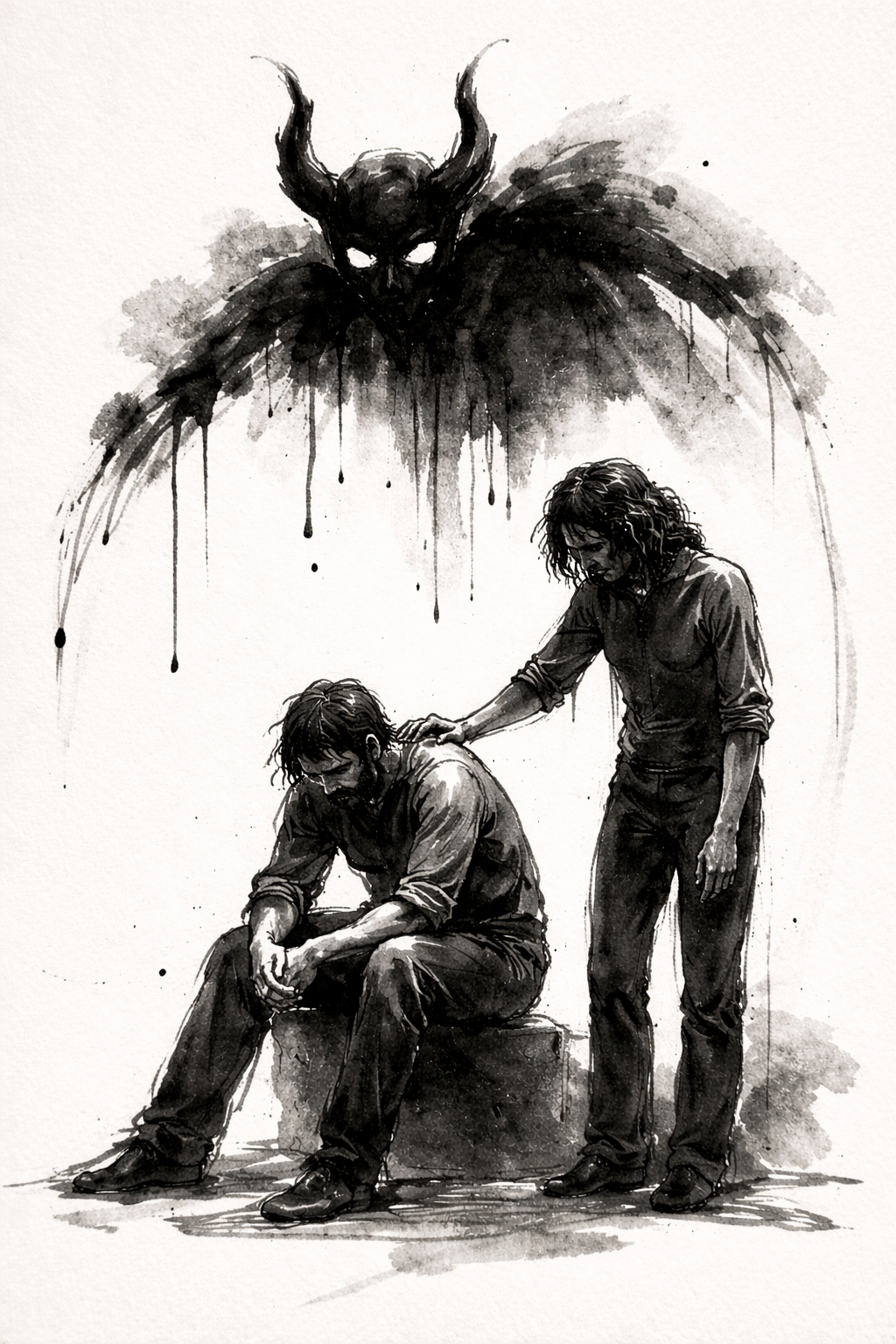
There’s a kind of down that doesn’t feel dramatic. It doesn’t feel like a crisis with sharp edges. It feels like a low-ceiling room you’ve lived in long enough to know where you’ll bump your head.
A few weeks ago, I landed in one of those nights.
Christa was exhausted. I was exhausted. I can’t speak for her internal weather, but I could see the weight: the work, the constant problem-solving, the way “done” never really arrives. I’m wrestling with my own body like it’s an argument that keeps changing rules mid-sentence. My mouth still wasn’t healing the way it should, which was such a petty, infuriating add-on that I almost laughed at it. My immune system, my nerves, my fatigue, my eyes, my mobility—all of it felt like a committee that never votes yes.
We rarely go to bed before midnight. Not because we’re out doing something fun. Because the day doesn’t end when the kids go down. It just gets quieter. Quieter doesn’t mean finished.
I still had dishes to do. I still had to take a shower, which had become this stupid, looming thing. I hadn’t taken one in like four damn days—not because I didn’t want to feel clean, but because getting up, getting into the bathroom, stepping in, doing the whole choreography of it… it’s a pain. Literally. It’s effort I kept not having at the end of the day. Then the longer it went, the heavier it got. It wasn’t just “I should shower.” It became “why can’t I do something this basic,” which is the kind of thought that turns the pit into a pit with a trapdoor.
So, yes, I needed to take one. I needed the hot water. I needed the reset. I needed to stop letting the avoidance pile up into its own quiet shame.
Rage Is for the Good Days
I was too tired to be angry.
That’s the part that hit me with a weird kind of recognition, because it reminded me of something from The Sunset Limited—White talking about rage like it’s a privilege, like it belongs to people who still have fuel in the tank. I’m not going to pretend I can quote it perfectly. I can’t. I just remember the feeling of it: rage as a sign you still have extra energy lying around, energy you can afford to burn.
That night I didn’t. I wasn’t raging. I was just… buried.
Love, Plus the Extra Weight
I love my kids with everything in me. That isn’t the problem. That’s the point. The love is the point. The love is also the weight.
Parenting is its own full-body occupation. Parenting while disabled adds a second job you never applied for, one that follows you into every room and charges you interest. Parenting while your partner is working like crazy adds another layer. Everyone is doing their best, and somehow the best still doesn’t feel like enough to keep the days from becoming a blur of obligations.
That blur is its own kind of grief. Not the cinematic grief of some big loss, but the slow grief of feeling your life pass through your fingers in small, practical pieces. Another day where you did what needed doing. Another day where you didn’t quite get to feel like a person in the middle of it.
I could already hear the easy countermoves.
You have so much to be grateful for.
You have a family.
You have a home.
You have running water.
You have food.
You have… you have… you have…
All true. None of it false.
Also: shit’s rough.
The part people miss, the part I miss when I’m talking myself off the ledge, is that gratitude doesn’t erase pain. Gratitude doesn’t cancel fatigue. Gratitude doesn’t cure disability. Gratitude is not a magic spell you chant until your nervous system behaves. Gratitude is a candle you light inside the same room where you’re still stuck.
The Small, Specific Kindness
Christa—God, Christa—keeps lighting candles in her own way.
She bought me replacement mugs for the one I broke. Not “a mug.” The kind that actually works for me. The one I like. The one that fits my hands and my habits and all the tiny, unromantic details that make something usable when you’re tired and living inside a body that argues back.
She also bought me different honeys with different flavors to go with tea, because she knows I love it. She knows what I reach for when I’m trying to feel like myself again.
At the time, I hadn’t even tried them yet.
Not because I didn’t care. Because it was always late. Because I was always spent. Because by the time the house got quiet, my brain was an unplugged appliance. I kept looking at the new mugs and the honey like they were a future I kept failing to arrive in.
I felt awful about that.
That’s the cruel little twist: someone loves you with attention and effort, and you don’t have the energy to receive it properly, and then you feel guilty for being tired, which makes you more tired, which makes you more guilty. A perfect little exhaustion engine.
A small update, weeks later: I’ve used the mugs. I’ve tried the honey. Just a couple times, nothing ceremonial, nothing Instagrammable. It was more like proof of life. A few sips that said, quietly, I’m still here. I can still receive things. Even if it’s slow.
The Arithmetic Of Disability
The truth is messier and more human: I can be thankful and worn down at the same time. I can be lucky and still be struggling. I can have a life I would not trade and still feel crushed by the maintenance of it.
Sometimes the maintenance is the whole thing.
There’s a particular exhaustion that comes from the constant mental accounting. Disability forces you to think about things other people get to leave unthought. Energy becomes a budget. Vision becomes logistics. Pain becomes scheduling. Recovery becomes strategy. You start bargaining with your own body like it’s a landlord.
How much walking did I do today?
How many “up and down” motions did I do?
How much did I push?
How much did I pretend I wasn’t pushing?
That bargaining eats up the same mental space you want to give to your kids. Your kids don’t care about your energy budget. They care about your attention. They care about your presence. They care about whether you’re really there when you say, “I’m here.”
That’s the sting. I can give them love and still feel myself splitting in two trying to meet the moment.
Christa is carrying her own version of that split. She works like crazy. She shows up. She keeps the machinery running. The quiet heroism of that is real, and the cost is real, too. We can both be doing the right things and still arrive at the end of the day feeling like we got hit by a truck.
Small Answers for a Heavy Night
So, what do you do with a night like that?
Not in the “here are five tips” way. I’m not interested in that voice. I mean it literally: what do you do with the dishes, with the shower, with the heavy body and the heavy mind?
Sometimes the answer is smaller than my pride wants it to be.
I do one plate.
Then another.
Then I stop pretending the entire kitchen needs to be restored to some ideal.
I make “clean enough” into a moral philosophy.
I take the shower not because I feel inspired, but because I’m overdue and I need it, and because hot water is a kind of truce. A way of telling my nervous system: you’re allowed to unclench for a few minutes. The shower doesn’t fix the day. It changes my temperature. It changes my skin. It changes the immediate sensory world in a way that matters.
Maybe later—maybe the next morning if the universe is kind—I make tea. I pick one of the honeys. I use one of the new mugs. I let myself actually receive the love that’s sitting there on the counter, waiting.
Not as a performance of gratitude. Just as a small, honest act of being cared for.
The Middle Place
There’s a style of self-talk that tries to motivate by shaming. Other people have it worse. Stop complaining. Be grateful. Hustle harder. Optimize. Push through. That voice can work in small doses when you’re healthy. When you’re depleted, it becomes another weight.
I don’t need that voice.
I need something closer to a hand on the shoulder.
Yes, we have running water.
Yes, that matters.
No, that doesn’t mean the night is easy.
Somewhere in the middle of that—between the miracle of plumbing and the dread of a sink full of dishes—there’s a kind of honesty that feels like breathing again.
I think that’s what I was trying to write my way back to: a version of myself who can say, plainly, “This is hard,” without feeling like I’m betraying my own life.
Because my life is not the problem. My life is the love of it. My life is Christa in the next room, still carrying too much. My life is the kids, who are everything and also require everything. My life is this body I didn’t choose, that I’m learning to live inside anyway.
That night I was in the pit.
Also, that night I was in a house with clean water and a shower that can run hot, and I let those ordinary luxuries count as the small, stubborn grace they are.
I did the dishes. I took the shower. I went to bed too late again.
Then the next day I tried, once more, to build a day that fits inside the body I have, inside the family I love, inside the tiredness we’re both carrying.
Not heroic. Not optimized.
Just real.
Mountains
I can’t just climb
I try to be grateful
Usually, I can do it
Sometimes
I added another version of the song for this one because the first dropped a single “it” which was driving me crazy.