At the Gate
We’re at the gate now, pointed toward home, that strange in-between where your body is seated but your mind has already started unpacking. Airports do that. They turn time into a waiting room. They make everyone a little more temporary.
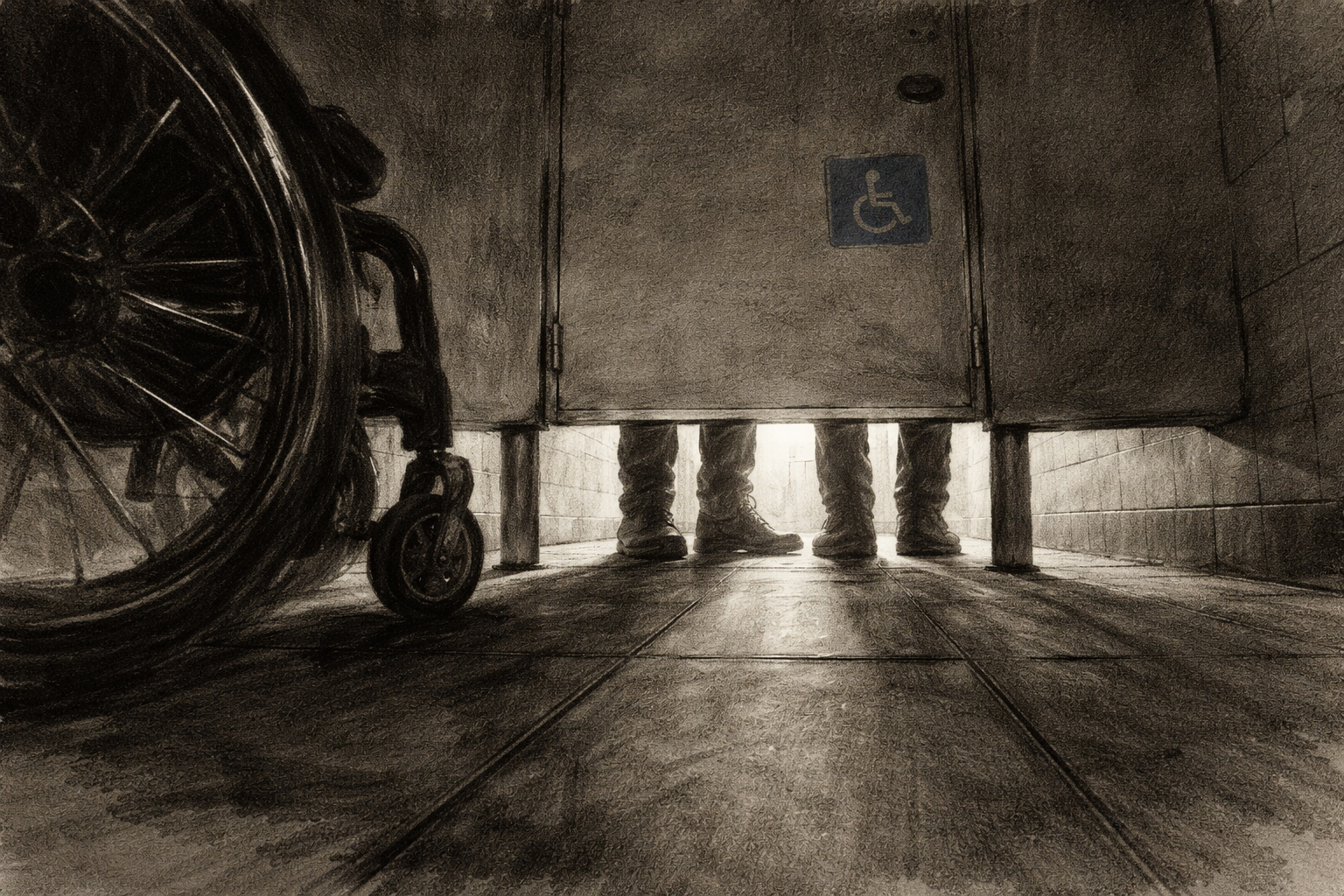
I stop by the restroom one last time before boarding. Not dramatic. Not symbolic. Just necessary—another tiny checkpoint in the long choreography of travel. I always use the accessible stall. Not because I like the deluxe version of anything, but because the shape of my life has changed, and certain shapes fit and others don’t. Space, for me, isn’t indulgence. It’s physics. It’s the difference between doing a thing and not doing a thing.
Right before I go in, two guys walk through the door ahead of me.
That’s odd on its own, the timing—like they’d been waiting just outside for some reason I can’t quite imagine. But then they do the part that sticks. No hesitation, no scan of the room, no “oh, this one’s open.” They make a clean line for the accessible stall and shut the door like they’ve claimed it.
I stop and wait.
The Minimum Viable Version of Privacy
There’s a particular kind of pause that happens in moments like this. It’s not just the literal waiting. It’s the little internal recalculation. The mental math of “Can I make the regular stall work if I have to?” The quiet inventory of balance and fatigue and the slim margin between independence and complication.
Technically, I can sometimes wedge into a standard stall. Technically, I can sometimes do a lot of things. Technically is a word people use when they don’t have to pay the cost of the workaround. Technically doesn’t include the angle of a chair, the reach to a latch, the awkward pivot that turns one normal task into a clumsy negotiation. Technically doesn’t include the way dignity is not a concept but a setup: grab bars, turning radius, enough room to exist without apologizing.
The accessible stall isn’t some VIP lounge. It isn’t a perk. It is, in a very literal way, the minimum viable version of privacy for certain bodies. The extra room isn’t “extra.” It’s the only room.
And still, people treat that space like a small reward for being in a hurry or being tall or wanting to spread out. Like an upgrade you didn’t earn but also don’t feel guilty taking.
I feel the same flare of heat when I see someone parked over the blue lines next to an accessible spot. The striped space that looks, to an untrained eye, like empty real estate. Dead space. Wasted space. But those lines are not decoration. They are a ramp’s breath. They are the room a van door needs to open. They are the margin that lets a wheelchair slide out instead of getting trapped between steel and concrete.
To someone who never needs it, accessibility can look like abundance. A little more room. A little special treatment. A bigger stall. A closer spot. And that’s the problem: when you’ve never had to measure your life in inches, inches feel optional.
I also know the sentence I’m tempted to write and the one I have to interrogate: They didn’t look disabled.
I know. I know. Invisible disabilities are real. Pain can be quiet. Conditions can be private. People can need that stall in ways I can’t see. I’m not interested in becoming the kind of person who polices other people’s bodies. The last thing we need is a world where the price of access is performing your suffering for strangers.
But there’s also a difference between humility and denial. Between “I can’t know their story” and “come on.” There’s a kind of casual ownership some people carry into spaces that were built as lifelines for others. A confidence that says, This is here for me too, because everything is.
Standing there, waiting outside the door, I can feel how small these moments are and how they add up anyway. This is the invisible tax: not a single catastrophe, just a drip. One more delay. One more adjustment. One more instance of being reminded that my ability to move through the world depends, in part, on strangers treating accessibility like what it is—shared infrastructure, not personal bonus space.
Eventually the door opens. They walk out. They wash their hands like nothing happened, like the room was simply there to be used, like the world is a buffet and everything on the table is equally meant for you.
And I go in, and I do what I needed to do, and I come back out into the bright, carpeted airport light, back to the gate, back to the line, back to the ritual of boarding. And, the moment follows me anyway.
Because this is the quiet question under the bigger essay about airports: when you see accommodation, do you see convenience—or do you see someone else’s survival made ordinary?
Three Seconds
If you’re able-bodied and reading this, here’s the simplest ask I can offer without turning it into a sermon.
When you’re about to take the accessible stall just because it’s bigger, pause.
When you’re about to drift over the blue lines because it’s easier, pause.
Three seconds. That’s all.
Imagine someone outside the door doing the same small math I just did. Imagine that space as a hinge—one choice, and the day swings a little easier or a little harder for someone you’ll never meet.
Then take the other stall. Park inside the lines. Leave the breathing room intact.
Not because you’re a hero. Not because you’re being watched. Just because the world is already hard enough without us treating other people’s access like spare change.
It’s not extra
It’s meant to give us freedom
Take just a moment