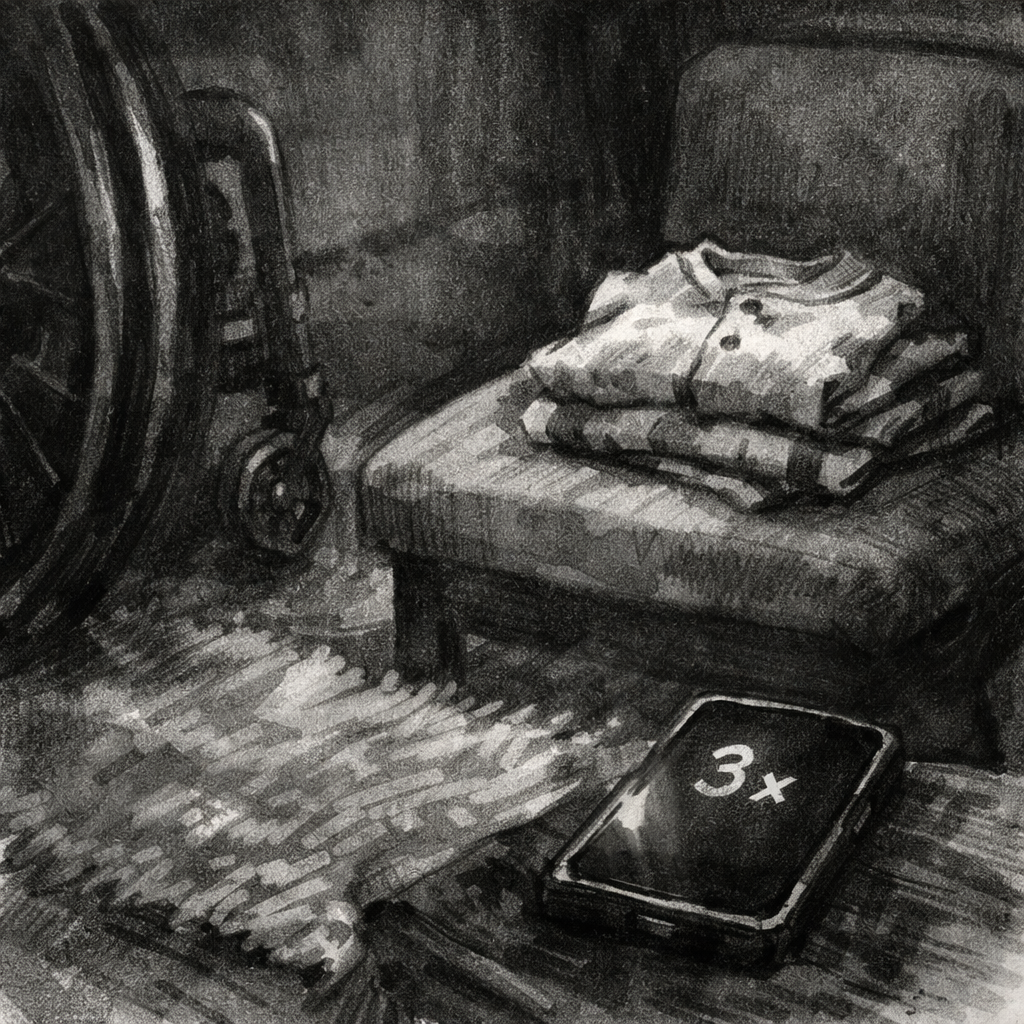
I wrote the first pass of this a couple weeks ago, while we were still in Delray—late at night, in that travel-limbo where everything is unfamiliar and your body has to re-learn tiny routes and thresholds. Now we’re home, and I’m reading it back with the benefit of distance. And, what’s surprising is how little the location matters once you get to the real center of it.
Because the core of it wasn’t Delray.
Bedtime Is the Center
It was bedtime.
It was the way the world changes when the girls are asleep and the day stops asking so much of my body. No more constant recalibration. No more scanning, guessing, compensating—at least not at the same intensity. Just a quieter house and a quieter nervous system.
That sentence—“the girls are asleep”—still lands like a kind of blessing.
The House Goes Quiet
Even at home, even with the same realities waiting for me in the morning, that small nightly shift feels like crossing a threshold. The day has finally closed its tabs. The constant requests—the constant “figure this out, adjust to that, compensate again”—they slow down. The house is quiet. Christa is in the other room. And, I’m here by myself, sitting in the calm like it’s a place I can actually enter.
I put on a podcast.
Normal Speed
And, I do the thing I always do now: I speed it up. Not a little. A lot. The voices come out fast enough that, to most people, it would sound like someone swapped English for pure vibration. But, to me it’s clean. It’s comfortable. It’s not a gimmick, it’s just how I listen. My ears—and maybe my brain—have learned this rhythm. It feels like the difference between trudging through mud and finally finding a smooth path. Same content. Less drag.
Back when we were traveling, my mother-in-law walked in on this mid-listen and stopped cold. “You listen that fast?” she said, like I’d turned the phone into a magic trick. Then she laughed and shook her head. “It sounds like Chinese to me.”
I laughed too. What else do you do when your coping mechanism gets reviewed by a live audience.
And, I told her the truth: “It’s normal to me.”
A Small Proof Of Adaptation
That tiny exchange still makes me smile—not just because it’s funny, but because it’s a neat little window into what adaptation actually looks like. It’s not always dramatic. It’s not always brave. Sometimes it’s just… your version of normal sounding completely unhinged to someone else.
What sounds like noise from the outside becomes clarity on the inside.
And, that’s part of what I’m noticing more lately, whether we’re traveling or home. At the end of the day, when I’m not moving much and not trying to extract information from the world with my eyes, I notice my disabilities less. Not because they’ve disappeared—my vision doesn’t miraculously return because it’s bedtime, and the chronic pain doesn’t politely excuse itself. Those things are still here. They’re part of the furniture of my life at this point, whether I like it or not.
But, the effort drops. The effort is the key.
The Day’s Micro-Decisions
During the day, disability isn’t just a condition. It’s a steady stream of micro-decisions.
Where’s the cleanest line through this room
Is that doorway narrower than it looks
Did someone leave something right where my front caster will catch it
How many transfers do I have left in me before my body starts negotiating back
A normal day asks me to be a problem-solver in the background at all times. My eyes don’t just see; they work. My body doesn’t just move; it strategizes. Even small outings become these layered tasks—timing, energy, accessibility, crowded spaces, lighting, uneven ground, the whole subtle comedy of the world being built for a different kind of body.
And, it’s not only physical. It’s emotional. There’s a particular mental posture disability can create: always slightly braced, always slightly prepared for friction. Not fear exactly—though sometimes, sure—but a readiness. A readiness for something not to work the way it “should.”
When the Headline Fades
At night, a lot of that readiness dissolves.
I’m not scanning the world for visual information because there isn’t much to scan. The lighting is softer. The environment is stable. I’m not trying to read anything small or identify something across the room. I’m not negotiating crowds or bright glare or those moments where you can feel your eyes falling behind the pace of life.
I’m just sitting, and listening, and being still.
And, when I’m still, a strange thing happens: the disability stops being a headline. It becomes more like a background hum. Present, undeniable, but no longer grabbing the microphone every ten seconds.
That doesn’t mean it’s easy. It just means it’s quieter.
I think that’s what surprised me most when I first noticed it—how different the emotional temperature can be. I’m used to disability as a kind of constant pressure. A constant awareness. But right now, I feel relaxed. Not euphoric, not pretending. Just… okay. Calm enough that I’m not narrating my limitations to myself every moment.
Sound as a Road
The podcasts help. The audiobooks help. Sound has become a primary road for me, and it’s a road I can travel without bumping into walls. There’s something deeply soothing about letting a voice carry you forward—someone else’s sentences, someone else’s pacing, someone else’s story. It gives my mind something to follow that doesn’t require me to wrestle the environment.
And, the speed matters too. The speed is part of the comfort.
It’s a funny thing to say, but listening fast feels like control. It feels like fluency. Like I’ve found a setting where the world meets me instead of the other way around. The day is full of moments where I have to slow everything down—move carefully, recalibrate, wait, ask for help, take the long way, do the safer transfer, conserve energy. All good choices, all necessary, but they add up to a life that can feel sluggish from the inside.
So, at night, I let my brain go the speed it wants. I let language come at me in a quick, bright stream. And, it doesn’t feel like rushing. It feels like finally clicking into the tempo my mind recognizes.
Owning the Normal.
That’s why my mother-in-law’s comment landed as both hilarious and oddly tender. “It sounds like Chinese.” To her, it’s chaos. To me, it’s home. I didn’t feel defensive about it at all. I didn’t feel the need to explain. I just said, simply, “It’s normal to me.”
Which is its own little milestone, honestly.
Because disability can turn you into a constant explainer if you’re not careful. You explain what you need. You explain why you’re doing something a certain way. You explain why a thing that looks minor to someone else isn’t minor for you. You explain the chair, the vision, the fatigue, the pain, the logistics, the “no, I can’t just…” of it all.
But, that night, I didn’t explain. I just owned the normal.
Redesign, not Just Loss
Maybe that’s part of the deeper thing I’m trying to name here: how much of disability is not only loss, but redesign. How much of it is building a life that fits the body you have, even when that body wasn’t the one you planned on.
Some days that redesign feels like grief. Some days it feels like work. Some days it feels like bargaining. But sometimes—quietly, unexpectedly—it feels like competence. Like I’ve learned the controls. Like I can move through the parts of my life that are built for sound and stillness with a kind of ease that isn’t fake.
The Nightly Mercy
So, yes, we’re home now. Delray is already a couple weeks back. The locations change quickly, and the writing always chases them a little.
But, bedtime stays.
And, so does this small nightly mercy: a few hours where the day stops demanding, my body stops being tested, my eyes stop being asked to solve impossible puzzles, and my mind gets to rest inside sound—fast, fluent, and strangely peaceful.
Not cured. Not fixed.
Just, for a while, unburdened by effort.
A new way to hear
The speed seems normal to me
A skill I didn’t train