The Sea Was Never Blue
For years, I have carried around one of those facts that feels almost too satisfying not to repeat.
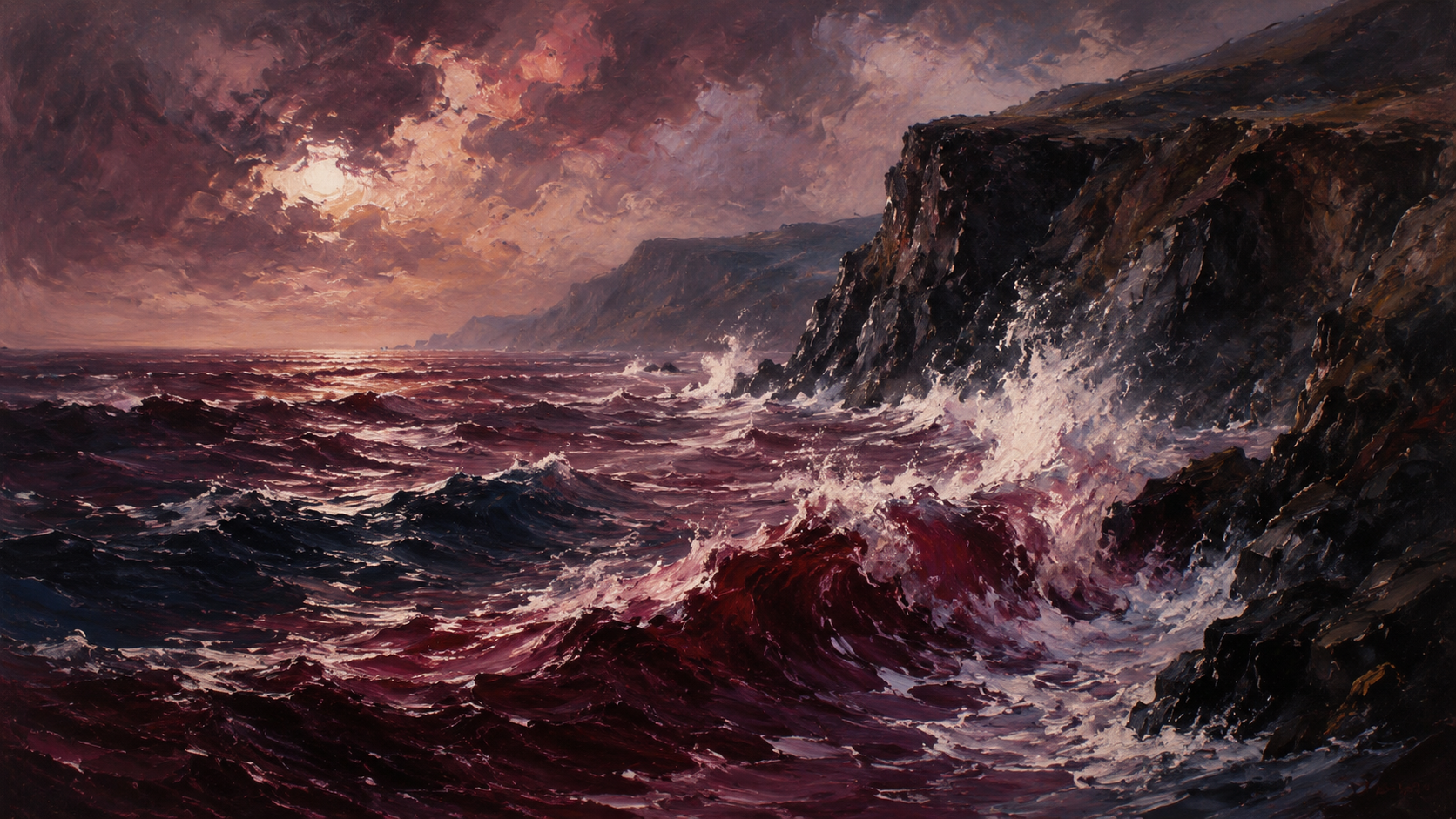
Homer does not really call the sea blue, I would say. He gives us the “wine-dark sea,” which is either one of the greatest phrases ever written or evidence that someone in ancient Greece needed to label the crayon box more clearly.
This became, over time, one of those recurring conversations I had with my dad. Not a real argument. More like a durable family ritual. Some families discuss sports. Some discuss politics. We have, for whatever reason, returned more than once to the question of whether the ancient Greeks had properly sorted out blue.
I do not mean that literally. I was never claiming that ancient people physically could not see blue, as if the Aegean had been sitting there for centuries waiting for someone to download a firmware update. The more interesting claim is about language. Ancient Greek color terms did not divide the world the same way modern English does, and Homer’s sea is a perfect little trap for seeing how strange that can feel from our side of history.
Modern English speakers tend to treat “blue” as obvious. The sky is blue. The ocean is blue. A child’s drawing gives the sky a blue stripe across the top of the page, and everyone knows what is happening. Blue feels less like a word than a fact.
Then Homer comes along and ruins the drawer system.
What Homer Was Doing
The phrase “wine-dark sea” is famous because it refuses to behave. It does not match the ocean in the simple, paint-chip way we expect. It has depth, danger, shine, darkness, maybe even motion. It feels less like a hue than an event.
That turns out to be part of the point. Maria Michela Sassi, a scholar of ancient philosophy, notes that Homer does use words touching parts of what we would call blue: kuaneos, a dark shade moving toward blue-black, and glaukos, closer to blue-gray or gleaming gray, as in Athena’s famous epithet. Yet the sea and sky are not simply “blue” in the clean modern sense. The Greek color world often attends to brightness, darkness, shimmer, material quality, and movement as much as hue. The rough sea can range through whitish, blue-gray, deep blue, and nearly black, but the category does not settle into our familiar shortcut.
That is what I should have been saying to my dad all along, though it is obviously much less fun than announcing, “The Greeks had no blue,” and then looking pleased with myself.
The better version is stranger. The sea was not missing anything. The language was doing something different.
Sassi makes the point directly: no one today thinks there was a stage in human history when certain colors had not yet become perceptible. The difference is not anatomy. It is vocabulary, attention, culture, and the habits by which a people learns to make the world shareable.
This is where the whole thing becomes more than trivia. Language does not merely slap names onto a world that arrives already sorted. It helps decide what counts as an obvious distinction. It tells us which features deserve a clean drawer and which can remain bundled together with brightness, darkness, mood, texture, or use.
Blue, in other words, was not absent. It just was not always sitting in the same chair.
The Other Blues
A modern example helps keep this from turning into a fake story about ancient limitation.
Russian has two common basic terms where English usually has one: siniy for darker blue and goluboy for lighter blue. In a well-known 2007 study, researchers found that Russian speakers were faster than English speakers at distinguishing two shades of blue when the colors crossed the Russian language boundary between those categories. The effect disappeared when participants had to perform a verbal-interference task, suggesting that language was actively involved in the speed of the distinction.
That does not mean English speakers cannot see light and dark blue. Obviously we can. It means that language can make certain differences feel more ready to hand. A distinction that one language builds into ordinary speech may sit a little closer to the surface than a distinction another language leaves optional.
That is the fascinating part. Not blindness. Not magic. Not ancient people wandering around in a half-rendered world. Just the ordinary weirdness of words shaping what we notice quickly, what we name easily, and what feels natural because we inherited it early enough to mistake it for the world itself.
Once you see that, it applies far beyond color. We do this with emotions, relationships, politics, illness, work, family roles, taste, and almost everything else that matters. The word comes first often enough that the experience starts to bend around it. Or, at least, the experience becomes easier to point at once the word is there.
This is how a small argument about Homer turns into a larger suspicion about reality, which is exactly the sort of move that makes my dad deserve some kind of hazard pay.
Blue Was Still in the Paint
There is also the inconvenient fact that the ancient world did, very much, have blue in the material sense.
The British Museum has documented Egyptian blue on the Parthenon sculptures, including traces visible on figures from the east pediment. Egyptian blue was an early synthetic pigment used by Egyptians and later by Greeks and other ancient cultures. Some remnants are still vivid to the naked eye, while others are detected using visible-induced infrared luminescence.
This is why the cheap version of the argument falls apart. The Greeks were not strangers to blue. They could use it, make it, paint with it, and see it. The mismatch is not between ancient eyes and modern eyes. It is between ancient categories and modern expectations.
That mismatch is the good part.
A culture can have blue pigment and still not make “blue sea” its obvious poetic move. It can know the color materially and still describe water through wine, shine, depth, darkness, turbulence, or gleam. That does not make the language primitive. It makes it alive in a different direction.
Modern English wants the sea to report to the color department. Homer lets it stay a little harder to file.
I think that is why I never really wanted to give up the argument, even after learning the more careful version. The dramatic version is less accurate, but the careful version is better. It says something about the way language becomes invisible to the people living inside it. We think we are naming what is there. Often, we are also revealing what we have been trained to isolate.
The sea was always there. The blue was there. The pigment was there. What changed was the verbal net thrown over the water.
Which brings me, reluctantly, back to my dad.
His instinct was closer to right than my favorite simplified version. Not because the Homer thing is fake. It is not. “Wine-dark sea” remains gloriously weird. It still opens a door into another way of describing the visible world. It still makes modern blue feel less inevitable.
The correction is only this: the ancients were not missing blue. They were not failing to perceive reality. They were showing us that reality does not come pre-captioned.
Language gives us the caption.
Sometimes the caption says blue.
Sometimes it says wine-dark.
And, annoyingly for my dad, now that I know the difference, I get to keep bringing it up.
A feud with my dad
No, not a feud. Just a view
It’s all in good fun
Why do I care about this?
Because it keeps coming up