The Christa Files
I did not set out to write a series of essays documenting the many ways my wife is correct. That would have been a strange project to begin on purpose. Yet here we are, with enough evidence to suggest that Christa has built a commanding lead in the ongoing household case of Reality v. Kevin. There are bins. There are lists. There are things she “might” do that she is absolutely already doing. There are thermostat disputes. There are color rulings. There is even, God help us, the possibility that the children are inheriting both her competence and my commentary.
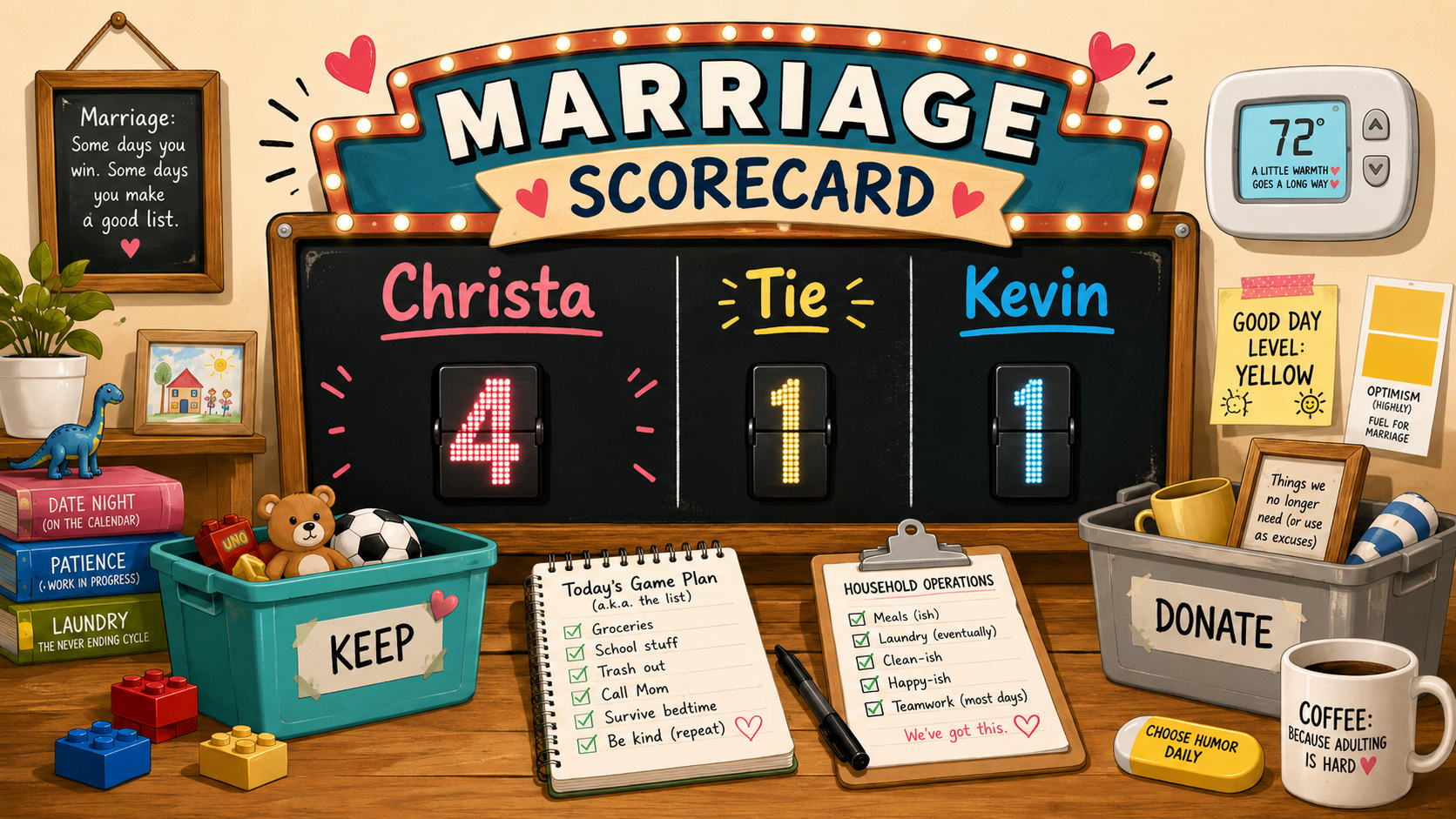
These pieces could each stand alone, but that feels inefficient, and if there is one thing this series has taught me, it is that inefficiency eventually becomes evidence against me. So I’m gathering them here as a small archive of marital field reports: affectionate, incriminating, and only slightly damaging to my dignity. The current score (according to my own essays, at least), not that anyone is keeping score, appears to be Christa wins four, we tie once, and I win one (I had to give myself one). Which means I am technically still on the board. That feels important to say before she corrects the math.
1. Love in the Time of Checkboxes
The bins thing is real. I stand by my previous remarks.
I still don’t love them. I still don’t feel spiritually transformed by the presence of a labeled rectangle. I still resist the quiet implication that my life could be improved by putting my belongings into matching plastic compartments, as if I am a failed zookeeper trying to rehabilitate my own office.
Still, I am beginning to understand that the bins were never the real issue.
The real issue is that Christa is not merely a bins person.
Christa is a lists person.
This is a deeper condition. A more advanced one. Bins are visible. Lists are atmospheric. Bins sit on shelves. Lists reproduce in notebooks, on phones, in text threads, on scraps of paper, in the margins of other lists. Bins are objects. Lists are a worldview.
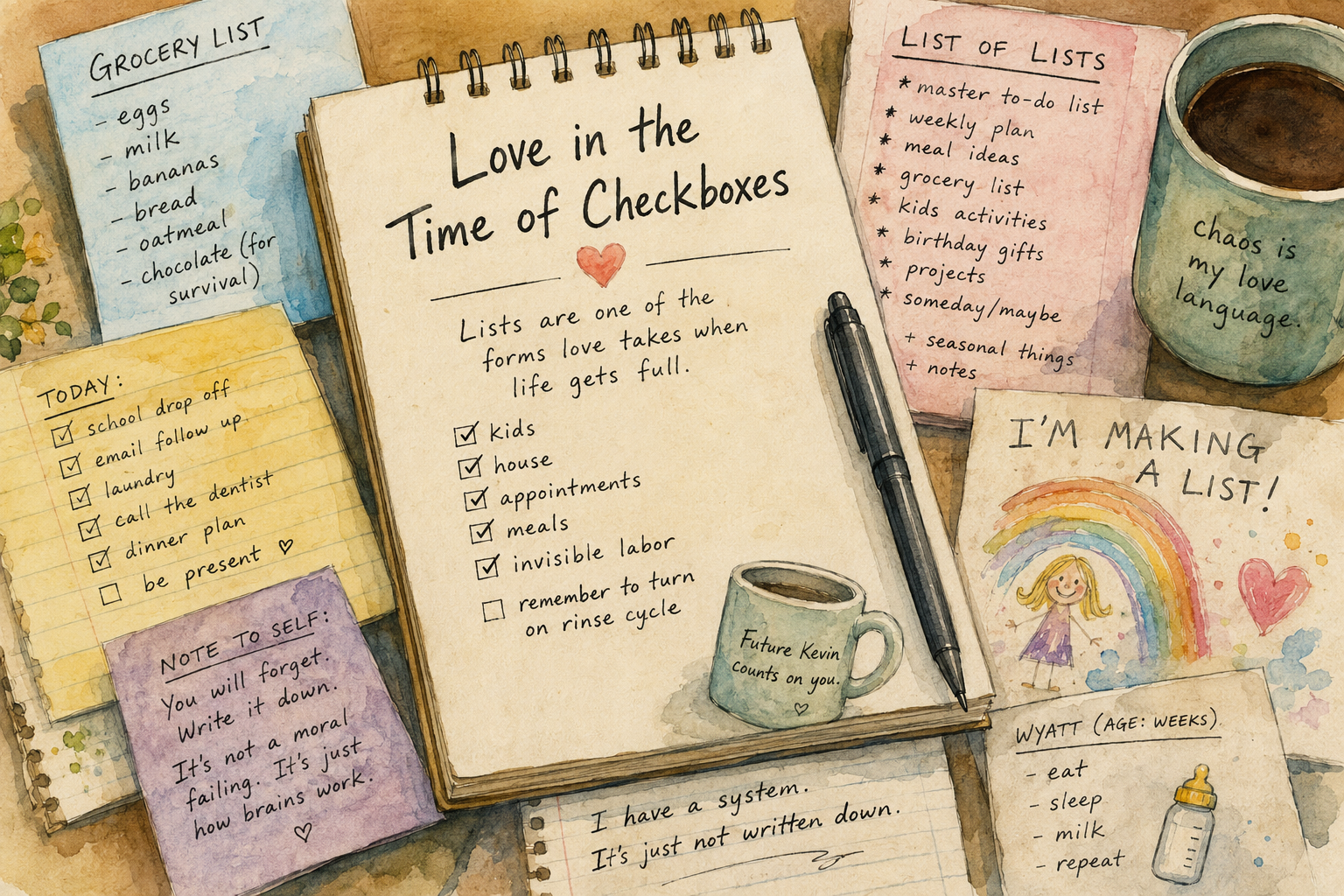
I don’t mean Christa occasionally writes down groceries like a normal, reasonably organized adult. I mean Christa has lists the way some people have hobbies, or unresolved childhood wounds. Lists for home. Lists for work. Grocery lists. To-do lists. Lists for the week. Lists for the day. Lists created to support other lists that were, apparently, no longer emotionally prepared for the burdens placed upon them.
At one point she made a list of lists, and I realized I had married someone who could run a small airport.
I say all of this with love. Deep love. Admiration, even. Also with the honest recognition that my wife’s relationship to lists is a highly functional flavor of unhinged.
The truly annoying part is that it works.
I Married a Clipboard With Great Hair
Christa’s lists do not feel controlling in the sinister sense. They feel like care wearing sensible shoes.
A list, for her, is a way of refusing to let the day mug us in broad daylight. It is a way of saying, “There are too many moving parts, and I am going to pin them down before they start reproducing.” She meets chaos by writing it into submission.
My method is different.
I am not a list person. I am an organized chaos person. I am the kind of person who says, with full sincerity, “I’ll remember that,” and then immediately hands the memory to a raccoon and watches it disappear into the woods.
Christa used to redo homework if she made one tiny mistake.
I used to solve that problem by not doing my homework.
That difference has been with us from the beginning. This is not some cute little opposites-attract thing. This is a philosophical split. Christa believes reality can be managed with enough attention. I believe reality can maybe be charmed into cooperation if I keep moving and don’t make any sudden admissions.
This is not always a winning strategy.
The Rinse Cycle Incident
Christa makes lists to prevent problems.
I avoid making lists and then act shocked when problems arrive, as if they are rude for showing up unannounced.
If I do not write something down, I tell myself it is because I am flexible. Free. Creative. Open to the living moment. Then I forget the thing entirely and discover that I was not being flexible or free. I was just failing in an abstract, slightly theatrical way.
A recent example: I forgot to turn on the rinse cycle on the dishwasher.
This is not a major crime. No one is calling Dateline. But it is exactly the sort of tiny domestic failure my personal system produces. I did not forget because I don’t care. I forgot because I believed, wrongly and with confidence, that the task had been safely stored inside my head.
My head, as it turns out, is not a secure facility.
That is really the core of my system. It runs on vibes, misplaced confidence, and an almost spiritual devotion to Future Kevin, who is constantly being assigned tasks by Present Kevin and almost never asked how he feels about any of it.
He feels bad, as it turns out.
The irritating part is that Christa’s lists are not merely efficient. They are protective. They reduce friction. They keep ordinary life from turning into a long chain of tiny preventable disasters, which is apparently my preferred artistic medium.
There is even a research term for this sort of thing: cognitive offloading. We use the world outside our heads—notes, reminders, calendars, grocery lists, alarms—to reduce the demands on memory. In other words, Christa is not just making lists. She is creating an external brain because she wisely does not trust the internal ones in this household to handle everything alone.
Rude, but fair.
A Small Domestic Horror Story
Sometimes I’ll hear that Christa is making a list and ask, casually, like a man trying not to startle a wild animal, “What kind of list?”
Then she’ll explain it, and I’ll realize it is not a grocery list, not a work list, not a calendar, not any normal list. It is a list of lists. A meta-list. A supervisory document. A paper-based middle manager whose only job is to remind her which other documents exist.
At that point, I stop feeling judgment and start feeling awe.
Also fear. Some fear.
Because beneath the joke is something I know is true. Her list-making does not just keep her life in order. It keeps our life in order. It keeps the wheels on the entire family operation: the kids, the house, the appointments, the errands, the meals, the school stuff, the invisible labor, the thousand loose threads that would otherwise drift straight into my so-called organized chaos and never be seen again.
There is a special kind of love in that. Slightly alarming, yes. Still love.
Charlotte Joins the Movement
Now comes the part that really concerns me.
Charlotte has started wanting to “make lists.”
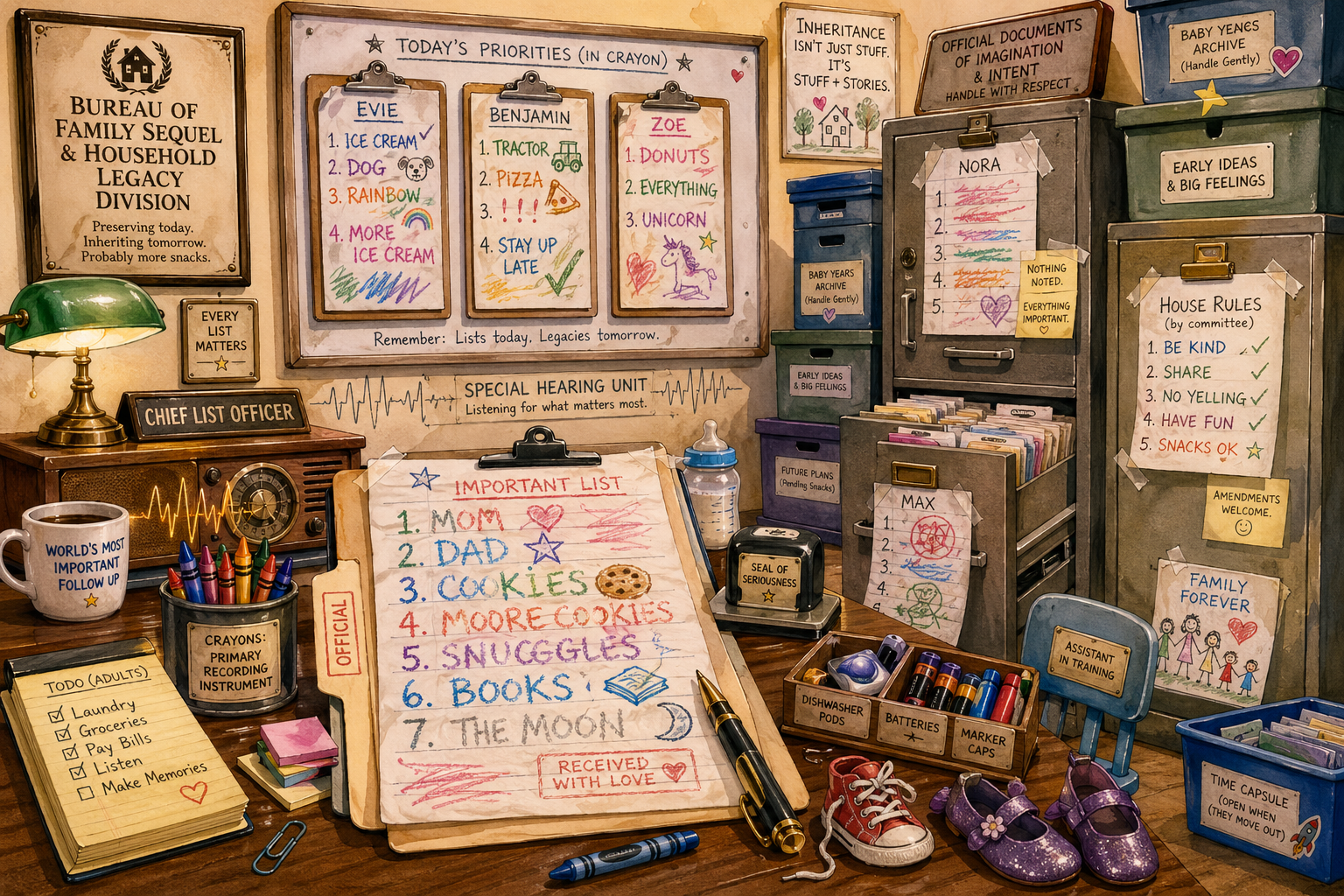
She cannot really write in the practical sense yet, not the way she means it. Right now, making a list is mostly coloring with authority. It is a page full of marks infused with intention. It does not help anyone and yet somehow carries the exact energy of administration.
That is what gets me.
She doesn’t say, “I’m drawing.” She doesn’t say, “I’m coloring.” She says, “I’m making a list.”
Of course she does.
This is how these things spread. Not through lectures, but through atmosphere. Through a child seeing that one of the adults in the house writes things down with purpose and deciding, very reasonably, that this must be what competence looks like.
To be clear, she is not copying me.
If she were copying me, she would wander into a room holding a marker cap, a broken sticker, and something mysterious from under the couch, then announce, “I have a system,” before immediately losing all three.
No, she is copying Christa. She is copying the ritual of making order. The gesture of taking the invisible and pinning it down on paper.
It is adorable.
It is also how dynasties begin.
Rowan Remains Uncommitted
Then there’s Rowan.
Rowan also can’t write yet, which means it is still technically possible that she’ll avoid all this. She remains, for the moment, a free agent. A wildcard. A small person standing at the edge of a great organizational inheritance, unaware that clipboards may already be gathering in the distance.
Maybe she’ll join Charlotte and the two of them will start producing pages of ceremonial toddler administration, each of them solemnly “making lists” with the confidence of very small middle managers.
Maybe she’ll go the other way and become my representative in the field, the lone child who understands that a thing can be deeply important without ever being written down.
Or, maybe I’m kidding myself and the whole household is slowly becoming a tiny branch office run on love, crayons, and checkboxes.
At this point, I have to admit the odds are not in my favor.
Wyatt Does not yet Know About Office Supplies
Then there’s Wyatt.
Wyatt is only a few weeks old, so he does not know much yet. He does not know about lists. He does not know about bins. He does not know that his father is losing a generational war against household administration.
He mostly wants milk.
Honestly, this makes him the wisest person here.
Still, I have hope. Maybe he’ll grow up and take after me. Maybe he’ll look at the family’s clipboards and checklists and shared notes with polite skepticism. Maybe he’ll sense, deep in his bones, that some things are better handled through instinct, vibes, and a dangerous amount of confidence.
Maybe he’ll be my last ally.
Or, maybe even now, while he is blinking at the world and requesting milk through the subtle communication style of a tiny air raid siren, he is absorbing the energy of the house. Maybe one day he’ll be the most advanced of them all, a tiny administrative savant who asks for a whiteboard before he can read.
If that happens, I will become the lone holdout in a household of gentle bureaucrats.
Christa will be calmly directing traffic. Charlotte will have moved from pretend lists to real ones. Rowan will be in there somewhere, either helping run the operation or sabotaging it in solidarity with me. Wyatt will probably have strong opinions about pen quality before kindergarten.
I’ll be nearby insisting, against all available evidence, that I have everything in my head.
This is not impossible.
This is, in fact, probably the most likely outcome.
The Annoying Part Where Christa Is Right
Here is the truth I keep trying to dodge with jokes.
Lists are not the enemy.
Lists are one of the forms love takes when life gets full.
Christa makes lists because she cares. Charlotte imitates lists because she is paying attention. Rowan may yet reveal herself as either a co-conspirator or my last real hope before Wyatt enters the chat. Wyatt has no idea what’s going on, which honestly might be the closest thing to enlightenment in this house.
Even my resistance comes from a related place. I want to believe I can carry things in my head because I do not want to drop anything important. I want to believe presence can substitute for systems.
Sometimes it can.
Often it absolutely cannot.
The fuller our life gets, the more obvious this becomes. More kids, more logistics, more moving parts, more things that matter. My family does not need me to become someone else. They do not need me to alphabetize the pantry or join the church of labels.
They just need me to meet them halfway.
They need me to admit that “organized chaos” sounds charming right up until it becomes somebody else’s unpaid internship.
So, I’ll keep some of my chaos. I’ll keep my improvisation. I’ll keep the looser, more instinctive way I move through the world.
I may write a few things down.
Not because lists are salvation.
Because this life is full, and loud, and funny, and easy to lose track of in the best and worst ways. Because I love these people. Because memory is not a moral achievement. Because sometimes the most loving thing I can do is stop pretending I’ll remember and just make the list.
2. The Sequel Has Notes
For a while now, the household narrative has been running dangerously in Christa’s favor.
I don’t mean morally. Christa deserves a favorable narrative in the broad sense. She is patient, capable, funny, loving, and somehow able to do the amount of family logistics that would make a normal person fake their own disappearance and start over under a new name in Vermont.
But, in the ongoing documentary of our marriage, she has become a little too obviously correct.
She is the one with the receipts. The one with the lists. The one with the bins. The one who remembers which absurd slogan actually existed, which childhood product I probably hallucinated, where the kids’ shoes might be, and whether we own enough fruit snacks to survive the next twenty minutes.
In The Bureau of Things That Actually Happened, I already admitted that Christa often comes into our tiny marital debates like an undercover auditor from reality itself. I come in with confidence, texture, vibes, and a memory that feels true because it has excellent production design. She comes in with the calm cruelty of being right.
Then, in The Bins, I documented her committed relationship with containers: the baskets, the kid-stuff bins, the bin on the stairs, the forty-seven different places a single object can now be “put away” while still being, for all practical purposes, missing.
And, lately, of course, there are the lists.
The lists for work. The lists for home. The grocery lists. The to-do lists. The lists created to support other lists that apparently collapsed under the pressure of being lists. At one point Christa made a list of lists, and I realized I had married someone who could run a large business and also gently judge its snack drawer.
So, the evidence has not always favored me.
Christa is order. I am improvisation with a pulse.
Christa is infrastructure. I am commentary.
Christa is the person who remembers to turn on the rinse cycle. I am the man who forgets the rinse cycle and then has to look at dishes like they have personally betrayed me.
Something has shifted.
The children gave me hope.
Which is probably how most bad ideas begin.
The House Has Started Quoting me Back
Charlotte quoted me a couple of times the other night.
Not in the vague way all kids quote their parents because children are basically surveillance equipment with applesauce on their shirts. I mean she quoted me in a way that had my cadence in it. My rhythm. My little sideways angle of remark.
That is both flattering and terrifying.
Because you never really know what parts of you are being absorbed. You hope your children pick up patience, kindness, resilience, maybe a decent sense of humor. Then one of them says something in your exact tone and you realize your personality has left the building and is now asking for a snack.
It is a strange feeling to hear yourself come back smaller.
Not worse. Not better.
Just smaller, louder, and probably holding a marker cap.
And, I’ll be honest: I liked it.
I shouldn’t like it too much. That way lies vanity, and eventually a four-year-old who thinks every room needs a commentary track. But, still, there was something wonderful about it. I spend so much of my time feeling like the least systematized adult in the house, the one whose contributions are harder to file under “useful.” Then Charlotte borrowed a little of my voice, and suddenly I had proof that the weird stuff counts too.
The tone counts.
The timing counts.
The way a person notices a room counts.
Unfortunately, this also means I am now responsible for my own influence, which feels unfair.
Mommy Was Being Silly, According to the Junior Analyst
Then Charlotte said Mommy was being silly.
For the record, Mommy probably was being silly.
Christa can be silly. This is important for the public record. Yes, she can organize the household like she’s managing a regional supply chain during a minor international crisis. Yes, she can remember the exact location of something I would have sworn had been reclaimed by the earth. Yes, she can generate a list so powerful it requires its own table of contents.
But, she can also be ridiculous.
She contains multitudes, and one of those multitudes occasionally makes a face, says something goofy, or does a bit that fully justifies commentary from the preschool demographic.
The important part was not that Charlotte noticed. The important part was how she noticed.
“Mommy is being silly” is not a list. It is not a system. It is not a fact in the cold bureaucratic sense. It is a tonal judgment.
That is my territory.
That is not the Bureau of Things That Actually Happened. That is the Bureau of What Kind of Thing Is Happening.
A much less funded department, but one with better jokes.
Charlotte wasn’t just reporting reality. She was classifying the vibe of reality. She was standing half a step outside the moment and naming its flavor.
This is exactly the kind of thing I do, which means Christa may have a problem.
Because if the kids start inheriting her competence and my commentary, we are no longer raising children.
We are raising extremely small critics with operational support.
My Hearing Has Entered the Lore
Then Charlotte mentioned that my hearing is probably special.
That one got me.
First, because it was sweet.
Second, because it was oddly perceptive.
My hearing does feel strange sometimes. I don’t mean I have comic-book hearing, which would be a deeply disappointing superpower unless the villain was whispering in the next room about where he put the remote. I just mean I catch things. Small sounds. Textures. Shifts in tone. Little audio details other people seem to miss.
My body has had some systems underperform over the years, so maybe some internal committee decided to move extra funding into the sound department. I don’t know. I’m not a doctor. I’m barely a reliable dishwasher operator.
But, Charlotte noticed.
Or, maybe she didn’t notice in a precise adult way. Maybe she just heard me mention it, held onto it, and gave it back to me later, which is its own kind of noticing. Children do that. They collect phrases, gestures, fragments of adult explanation. They don’t always understand them fully, but they carry them around until suddenly they become language.
This is how “making a list” becomes crayon marks with authority.
This is how “Mommy is being silly” becomes field reporting.
This is how “Daddy’s hearing is probably special” becomes a tiny diagnosis from someone who still needs help with pajamas.
And, because I am me, I immediately found it funny and moving at the same time.
My favorite emotional category.
The Administrative State Has a Leak
This complicates the household map.
Until now, I thought the children might sort naturally into camps.
There would be Christa’s camp: lists, bins, follow-through, clean categories, remembered tasks, the ability to know where anything is without conducting an emotional excavation.
Then there would be my camp: tone, pattern, instinct, narrative, side remarks, misplaced confidence, and the willingness to insist that something could have existed even if reality has chosen not to cooperate.
Charlotte seemed to be drifting toward Christa for a while. She has already started wanting to “make lists,” which, as I’ve said before, is adorable in the way a toddler wearing a judge’s robe would be adorable. She cannot really write lists yet, but that barely matters. The spirit is there. The authority is there. The tiny administrative energy is there.
Early writing research would probably call this emergent literacy, because children imitate the writing they see around them and begin learning that marks on a page can carry meaning. I call it “the clipboard phase,” and I am watching it with concern.
Rowan can’t write yet either, so she remains under review.
She might become Team Christa. She might become Team Me. She might reject the entire binary and become something more powerful, like a child who both knows where her shoes are and can destroy you with one accurate sentence.
Wyatt is still only a few weeks old, so his position is also unclear. At the moment he seems concerned with milk, sleep, and filing urgent complaints when either is delayed. This is respectable. Narrow platform, strong messaging.
This makes me wonder if I’ve been framing all of this wrong.
Maybe the kids are not choosing sides.
Maybe they are becoming hybrids.
Which is funny, because hybrids are usually designed to be efficient.
Christa Built the System, I Installed the Commentary Track
Here is the annoying truth.
Christa and I both pay attention.
We just pay attention differently.
Christa pays attention to what has to happen. She tracks the physical and logistical world. The appointments. The snacks. The laundry. The objects. The forms. The school things. The thousand little pieces of family life that, if ignored, do not become poetic. They become everyone crying near the door.
She makes life livable.
She makes space.
She makes the house function even when the house is actively resisting function.
I pay attention to tone. I notice when the room tilts. I hear the slight change in someone’s voice. I catch the weird phrase. I feel the emotional direction of a conversation before it gets there. I can often tell what Christa is about to say because I’ve lived beside her long enough that her thoughts leave footprints.
This is useful.
Not always in a measurable way. Nobody is handing out medals for “caught the vibe early.” There is no household spreadsheet column for “prevented conversational sprawl at 10:47 p.m.” But, it is useful.
At least, I’m going to keep saying that until the family agrees to formalize my department.
Christa sees the thing.
I see the thing behind the thing.
Christa knows where the scissors are.
I know why the sentence got weird.
Both matter, though only one helps when someone actually needs scissors.
The Sequel Has Better Handwriting
This is why Charlotte’s little remarks landed so hard.
She wasn’t just copying language. She was copying attention.
She was noticing tone, absurdity, and trait. She was watching the adults as people, not just as Mommy and Daddy. She was seeing that Mommy can be silly. That Daddy’s hearing has become part of the family mythology. That a phrase can be borrowed and reused. That life is not just a sequence of events, but a sequence of events with commentary available.
That feels like me.
Or, at least it feels like one of the better parts of me.
Not the part that forgets the rinse cycle.
Not the part that confidently misremembers possible leather toddler blocks.
Not the part that thinks Future Me is a dependable employee despite decades of evidence to the contrary.
The better part.
The part that watches carefully. The part that names what is happening. The part that catches the comic shape of a moment without flattening its tenderness.
If my kids inherit that, I’ll take it.
If they inherit that and Christa’s ability to actually complete tasks, then frankly, I’m obsolete.
A beloved legacy model.
Still supported, but no longer recommended for new installations.
The Bureau may Be Expanding
The real danger is that Christa may have helped raise a sequel.
Not a clone. That would be too much. The world does not need a second me wandering around with half a plan, too many observations, and the ability to turn a minor household failure into a paragraph.
But, a sequel.
A revised edition.
A version with some of my commentary and some of Christa’s structure. A child who can notice the absurdity and write it down. A child who can keep the receipts and make fun of the receipts. A child who can remember where she put her shoes and then describe the whole search operation as “a little unhinged.”
That is not just a sequel.
That is a sequel with studio notes incorporated.
And, maybe Rowan will join in. Maybe Wyatt will too, once his worldview expands beyond milk and outrage. Maybe one day Christa and I will be sitting at the kitchen table while all three kids calmly analyze us in real time.
Charlotte will say, “Mommy is being silly.”
Rowan will add, “Daddy forgot the dishwasher again.”
Wyatt will look up from a snack and say, “This family needs a list.”
Christa will smile, because she won.
I will smile too, because somehow I also won.
That’s the strange part of family inheritance. The kids don’t take one parent or the other. They take pieces. They remix us. They borrow a phrase, a face, a habit, a rhythm, a flaw, a way of noticing. They turn our marriage into raw material. Then they walk around the house saying things that make us laugh and flinch at the same time.
Charlotte sounded like me.
Just a little.
Enough to worry me.
Enough to make me proud.
Christa may still be the household’s Bureau of Things That Actually Happened. She may still control the lists, the bins, the memory palace, and the entire organization.
But, I am no longer just the commentary track.
Apparently, I have syndication.
And, unlike the original, the sequel might actually remember to turn on the rinse cycle.

3. Okay, you “Might” Do That
Every marriage develops its own folklore.
Some couples have songs. Some have rituals. Some have shared phrases that would sound ordinary to everyone else but carry whole private histories inside them.
We have that too.
We also have a few recurring household phenomena that deserve formal recognition, and one of them is Christa’s use of the word “might.”
Christa does not use “might” the way the English language intended.
Normal people use “might” to suggest possibility. Uncertainty. Openness. The door remains slightly cracked. A thing may happen, or it may not.
Christa uses “might” as a ceremonial courtesy extended to reality moments before she overrules it.
“I might do laundry.”
You mean you are doing laundry.
“I might run to the store.”
No, what you mean is that you have already spiritually backed out of the driveway.
“I might clean this up.”
Wrong again. It is already clean in your mind. The task has crossed the border. The only unresolved question is whether the rest of us will manage to get out of the way before the operation begins.
At this point, when Christa says she “might” do something, what she really means is: I have already made peace with this task and would simply like to pretend, for one elegant second, that fate still has options.
It is honestly kind of beautiful.
It is also a little terrifying.
Because once an action crosses the border from thought into sentence, it is basically done. Her “might” is less uncertainty than a thin layer of politeness spread over inevitability. It is the linguistic equivalent of a judge saying, “I may issue a ruling,” while already holding the gavel.
The Woman Has Never “Mighted” a Thing in Her Life
I’ve been thinking about this because it fits too perfectly with the larger pattern.
This is the same woman who makes lists of lists. The same woman who can remember a slogan that sounds too stupid to have existed and then be completely, maddeningly correct. The same woman who has already starred in multiple household essays as the reigning empress of systems, receipts, bins, and follow-through.
The bins piece made the case plainly. The sequel piece complicated the family mythology by suggesting the kids may have inherited some of my commentary-brain, which is both flattering and medically concerning. The Bureau of Things That Actually Happened remains, unfortunately, a strong legal document against me.
“Might” is simply the latest exhibit.
Christa does not really “might.”
That would imply a level of indecision that does not match the rest of the file.
I, however, actually do “might.”
I might do a thing. I might not. I might think about doing it for forty-five minutes and then get distracted by another task, a side observation, or some totally separate realization about how a phrase sounds. I might have excellent intentions and no completed action. I might accidentally convert a simple task into a loose philosophical mood.
That is real might.
That is artisanal might.
Christa’s version is counterfeit. Fake might. Decorative might. A little verbal throw pillow placed on top of an already completed internal decision.
I love her for it.
I also feel compelled to point it out every time.
Because there is something very funny about hearing someone say, “I might,” in the same tone a queen might use to say, “We may consider annexing that territory.”
The Thermostat Has Been Framed
The other recurring issue is heat.
Specifically, Christa’s conviction that it is hot in here.
Now look. I am not denying that temperature is subjective. I am not trying to become some kind of anti-science husband sitting in the kitchen saying, “Actually, according to data, you are wrong to sweat.”
Bodies vary. People run warm. Life has layers, movement, hormones, stress, chores, children, and a thousand other variables that complicate the matter.
Still.
Girl, no. It is not hot in here.
Not in the conditions under which this statement is usually made.
The fan is on.
The AC is on.
Air is moving with purpose.
The room has already entered into a formal treaty with modern cooling systems.
Yet, somehow, from three feet away from the stove, while moving at the speed of a person who has voluntarily accepted six tasks in seven minutes, Christa will say it.
“It’s hot in here.”
Then I am left sitting there like the weary administrator of an already overperforming climate regime.
What more would you like from me? A dedicated household wind tunnel? A personal cooling technician? Should I call a tiny man with a clipboard to certify that the vents are doing their best?
Yes, I can turn it down more, I guess.
At a certain point, though, I have to gently submit a few alternate theories.
Maybe stop orbiting the stove like it has gravitational pull.
Maybe remove a layer.
Maybe do not declare a thermal emergency while actively conducting kitchen business in the warmest square footage in the house.
Maybe the room is not hot so much as you are currently participating in heat-generating behavior.
Christa Versus the Laws of Thermodynamics
This is where I get myself into trouble, because I always think I am making an observational point and then realize, halfway through the sentence, that I sound like a man who enjoys sleeping on the couch.
Let me be careful.
I am not saying Christa is wrong to feel warm.
I am saying Christa has a remarkable ability to generate the exact circumstances under which a person would feel warm and then speak as if the room itself has betrayed her.
That is different.
It belongs in the same category as the “might” issue. A small gap between language and reality. Not a lie, exactly. More like a phrasing choice that benefits from scrutiny.
“It’s hot in here.”
No. It is hot where you are speed-running domestic life in long sleeves next to active cookware.
The house itself has done nothing wrong.
If anything, the house has been trying.
The house has fans. The house has AC. The house is basically panting.
Still, Christa will say it with a tone that suggests we are all trapped inside a casserole.
The Loving Truth Is That she Is Usually Doing too Much
Of course, beneath the teasing, I know what is actually happening.
Christa says she “might” because she is constantly carrying a thousand moving parts and somehow trying to present the load in a civilized tone.
Christa says it’s hot because she is usually, at that exact moment, doing too much.
That is the thread running through both habits.
She is in motion. She is handling things. She is moving the day forward with that specific Christa energy that looks almost casual until I stop and realize she has quietly done the work of three people and is considering a fourth task “just in case.”
Yes, sometimes the “might” is fake.
Yes, sometimes “it’s hot in here” is an accusation aimed at a room that has already done all it can.
Both are also signs of Christa being Christa: competent, moving, carrying, doing, already halfway through the next thing before the sentence has finished.
Maybe that is why they make me laugh instead of making me crazy.
Well.
Not instead of.
Alongside.
A Few Notes for the Record
For the integrity of the archive, I should say a few things plainly.
First, Christa is often right in categories where I am spectacularly not right. That has been documented. The Bureau of Things That Actually Happened exists for a reason.
Second, her bins and lists and systems remain more useful than my vibes have ever been, though I continue to believe vibes deserve some credit as soft infrastructure.
Third, the sequel essay deserves a small place in this case file, because it revealed the most alarming possibility of all: the kids may inherit both sides. Christa’s systems and my commentary. Her memory and my side-eye. Her ability to organize reality and my ability to narrate why reality is being ridiculous.
Fourth, I understand that if I were the one running around the house doing seventeen things, hovering by the stove, keeping civilization intact through willpower and note-taking, I too might occasionally speak in a tone that implied the thermostat was failing democracy.
This is not a complaint.
It is a loving field report.
A document from inside a marriage where one person says “I might” when she absolutely will, and says “it’s hot” while actively creating one of the few warm microclimates left in an aggressively cooled home.
The Marriage Is Still the Joke and the Miracle
That is probably why this belongs with the others.
Like the bins, and the lists, and the reality disputes, this is not really about being right.
It is about the tiny repeated ways a person becomes themselves in front of you over years.
It is about learning someone’s language so well that you can hear the difference between true uncertainty and decorative uncertainty.
It is about recognizing that “I might” can mean “clear the runway,” and “it’s hot in here” can sometimes mean, “I have been doing too much for twenty minutes and have only just now noticed I am a body.”
It is about affection getting sharper instead of thinner.
I love that Christa says she might.
I love that she then immediately does the thing.
I love that she can be in the one warm zone of a cool house and announce a heat event with complete sincerity.
I love that I get to notice these things at all.
Because this is what a marriage becomes, if you are lucky.
Not one grand understanding, achieved once.
A hundred tiny translations.
And, if I am being honest, the next time she says, “I might do that,” I am still going to say it.
Okay, you “might” do that.
Because some jokes stop being jokes and become a form of devotion.
4. The Bureau Opens a Color Division
I regret to inform the public that Christa has won again.
This time, the matter before the court was color.
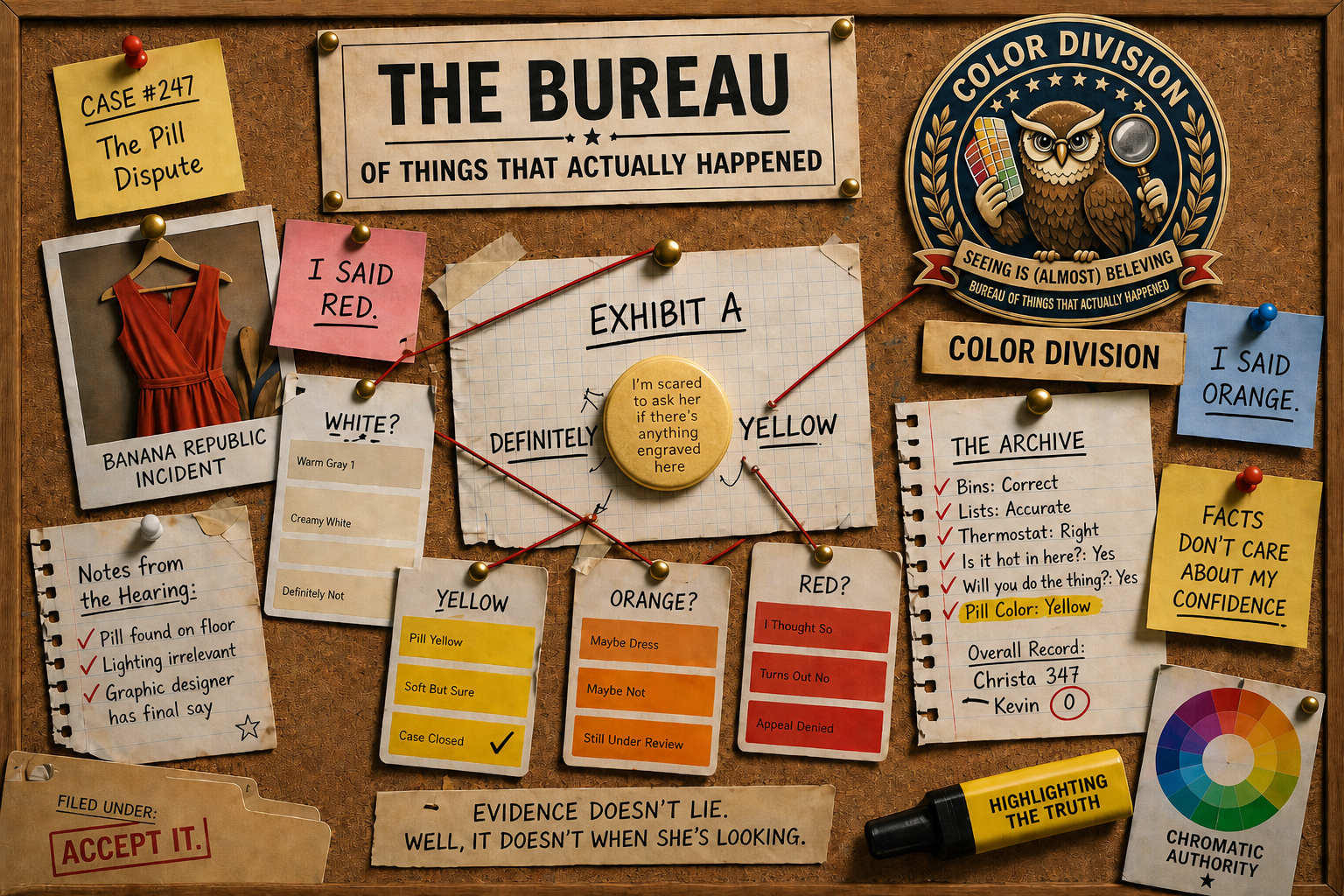
For a while now, I had been operating under the sincere belief that my clonazepam pills were white. Not “basically white.” Not “white-adjacent.” White. I had a whole internal certainty about it. I would not have called it a belief. I would have called it reality.
Then Christa found one on the ground and said it was yellow.
I did what any reasonable husband does when his graphic designer wife declares a color ruling.
I resisted.
Not strongly. Not in a way that would require mediation. More in the light, doomed way a person resists gravity, taxes, or the fact that his wife has spent years professionally understanding color while he has spent years confidently misidentifying objects in his own house.
Still, I really thought I had this one.
Then I looked again.
Yellow.
Not aggressively yellow. Not cartoon banana yellow. Not school bus yellow. Soft yellow. Pill yellow. The kind of yellow that waits patiently for a man to ruin his own credibility.
Now I can’t unsee it.
Banana Republic may Need to Reopen the Case
This is not the first time Christa and I have gone to war over color.
Years ago, we were in a Banana Republic, because apparently every marriage needs at least one quiet retail-based courtroom drama, and there was a dress on a rack.
I thought it was red.
Christa said it was orange.
At the time, I treated this as one of those charming little marital disagreements where both people are technically allowed to believe they are right, even though one of them is married to a graphic designer and the other is me.
Now, after the pill incident, I am starting to worry that she may have been right about the dress too.
Worse, I am starting to worry that I may be wrong about the argument itself. Maybe I thought I said red, but I said burgundy. Maybe she said coral. Maybe the dress was not even at Banana Republic. Maybe Christa will read this and calmly explain that I have misremembered every relevant detail except the part where she was right.
That would honestly be consistent with the larger body of evidence.
The Lead Is Becoming Embarrassing
This is how she gets you.
Not with one giant victory. Not with some dramatic final argument. She wins through accumulation.
A bin here.
A list there.
A thing she “might” do that she immediately does.
A room she insists is hot while standing near the stove.
A pill I thought was white until she said, “No, that’s yellow,” and reality quietly changed teams.
The Bureau of Things That Actually Happened has now opened a color division, and frankly, I am concerned about staffing. Christa already runs facts. She already has a strong lead in systems, bins, lists, follow-through, and general household reality. If she gets color too, I may have to retreat fully into tone, vibes, and abstract commentary.
Which, to be clear, remains my jurisdiction.
I still know when something feels off. I still know when a phrase sounds wrong. I still know when a room has a weird emotional texture. I can identify the vibe of a situation with real confidence.
I just apparently cannot identify yellow.
I Would Like Partial Credit for Eventually Seeing It
To be fair to me, I did eventually see it.
That should count for something.
Not as a victory. I’m not delusional. The victory is hers. She found the pill. She named the color. She was correct. The graphic designer won the visual dispute against the legally blind writer, which is exactly the kind of matchup the universe enjoys scheduling for comedy.
Still, there is a little dignity in surrender.
I looked again. I admitted it. I saw the yellow.
That is growth.
Small growth, but growth.
The problem is that now I have to live in a world where Christa was right about the pill, probably right about the dress, and possibly right about my memory of the dress argument. She is not just cementing her lead. She is building a parking garage on top of it.
I would object, but I’m not sure what color the parking garage is.
And, Christa probably knows.
This woman I'm with
The mother of my children
The truth moves toward her
She's got four. I’ve got just one.
But, hey, she’s more than earned it