The Essay Keeps Opening
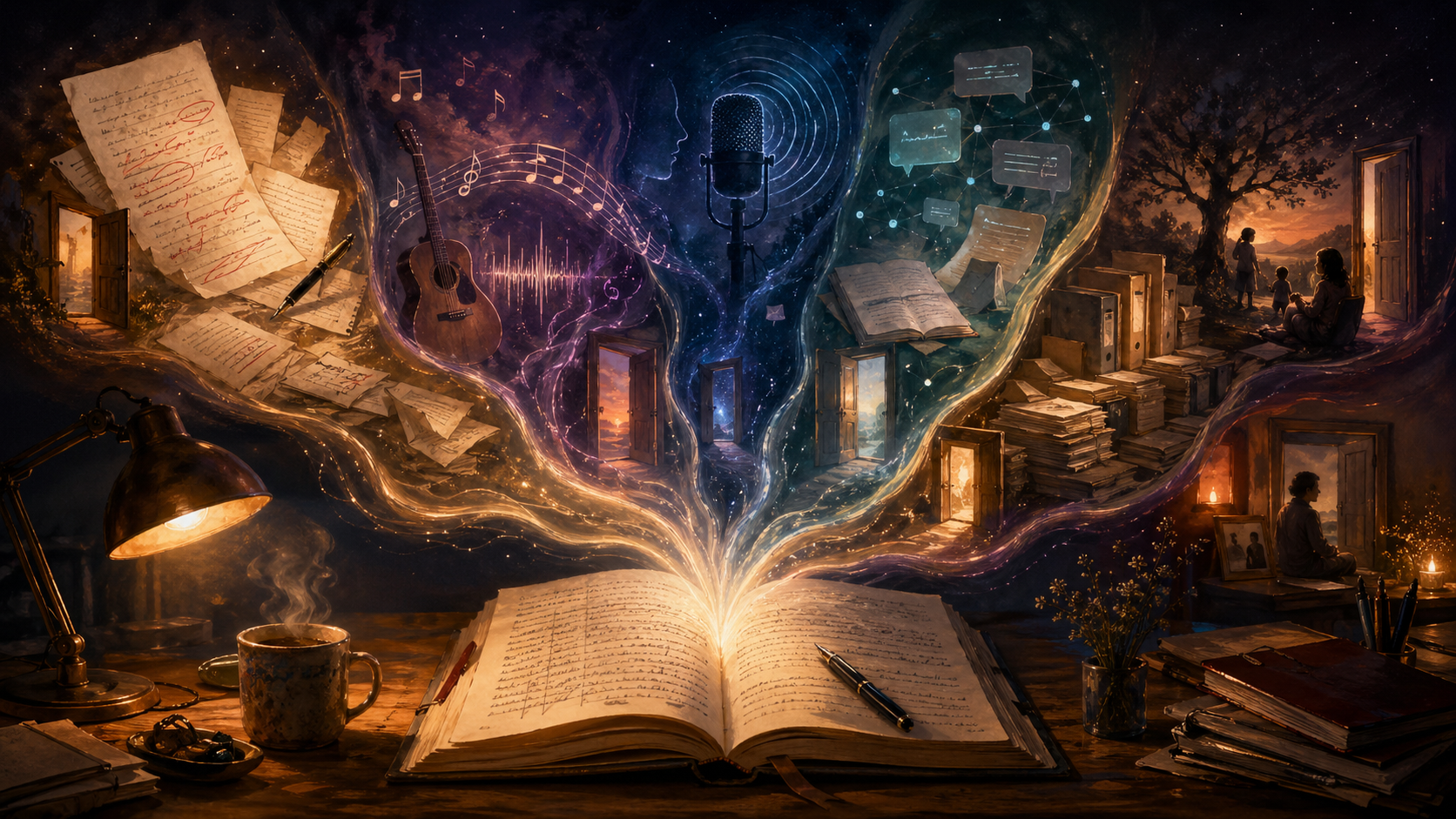
A Note On This Series
The six essays gathered here were not written as one long argument, even though they clearly come from the same pressure. They were drafted weeks apart, in the middle of ordinary family life, disability, fatigue, curiosity, irritation, and whatever strange joy comes from trying to turn a personal website into a small multimedia ecosystem.
Taken together, they circle a single question: what does writing become when the body changes, the tools change, and the essay no longer has to stay only on the page? The answer, at least for me, is not simple. Writing with AI is an accessibility practice. It is also a craft practice. It is a way of thinking, revising, listening, arguing with tone, making songs, generating images, testing synthetic audio, building an archive, and trying to keep my ideas moving outward when sight and speech no longer work the way they once did.
Because these pieces were written separately, a few sections may rhyme with one another. A point may return in a slightly different key. A sentence or idea may circle back because the essays themselves kept circling the same set of questions: authorship, access, voice, play, frustration, and the stubborn desire to keep making things. I tried to reduce needless repetition, but I also let some echoes remain where they still belonged. Repetition is not always clutter. Sometimes it is evidence that a thought has not finished speaking.
This is not a manifesto, exactly. It is more like a field report from the middle of a changing process. The essay remains the center, but it now gathers companions: images, songs, synthetic conversations, possible cloned narration, metadata, drafts, archives, and all the little administrative goblins that stand between a finished thought and a published piece. Some of those companions deepen the work. Some misunderstand it. Some make it funnier, stranger, more accessible, or more alive. Some put the essay in a beige polo and escort it directly around the point.
That tension is the point of the series. I am still writing. The work is still mine. It just arrives now through more doors than it used to.
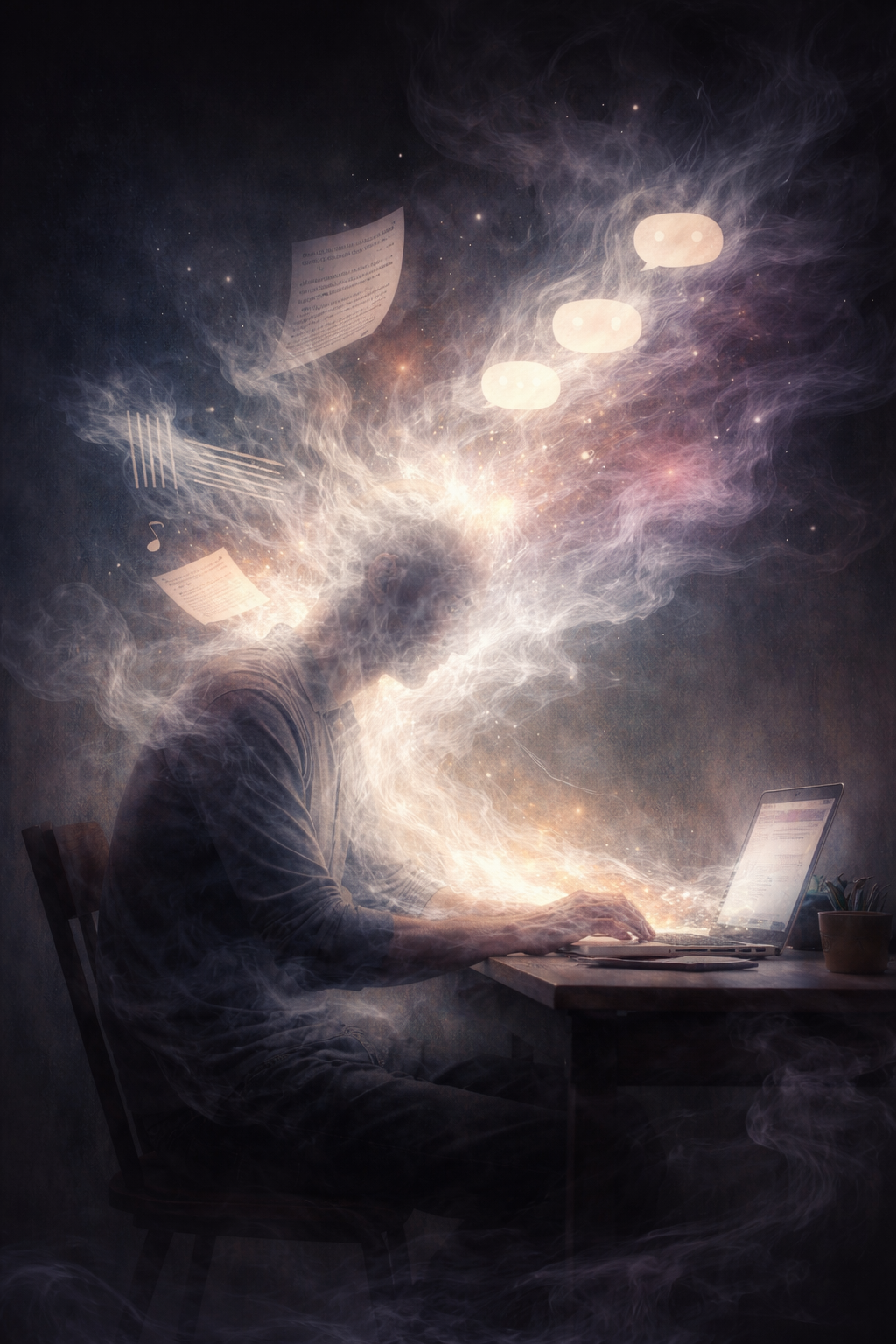
1. The Essay as Ecosystem1
What I’m describing here is not just a process I happen to like. Given my loss of sight and loss of speech, it is one of the main ways I can still get my ideas into the world in the form I want them to take.
That distinction matters. This is partly about writing with AI, yes, but it is also about adaptation, authorship, disability, and one of the clearest paths I still have to expression. I am not talking about a shortcut around the work. I am talking about the shape the work has taken because my body has changed.
How I Write Now
I have written before about writing with AI, but mostly in broad strokes. What I want to describe here is the process as I actually live it, because the specifics matter. People hear “writing with AI” and tend to imagine something cleaner, lazier, or more automatic than it is. My version is none of those things. It is messy, iterative, personal, and often slower than people would guess.
This is not just a method I prefer. It is one of my only ways to keep writing in the way I want to write. That does not make it less serious. It makes the stakes clearer. What follows is not a novelty or a clever trick. It is one of the main ways I still make essays at all.
That is why I think of this less as “using AI” in the abstract and more as part of a larger accessibility practice. The best tools do not merely help someone consume the world. They help someone participate in it, answer it, revise it, and send something back. That is what I am trying to do here.
An essay usually begins in one of a few ways. Sometimes I start with an idea I want to explore. Sometimes I bring in one or more older drafts I wrote months or years ago and use them as raw material. Sometimes I do not begin with an argument at all. I just describe an experience and try to find what is alive inside it.
Just as often, Chat helps me research a subject before the shape of the essay is fully clear. Sometimes that research stays light and mostly helps me orient. Sometimes it becomes part of the thinking itself. A couple of forthcoming pieces, one on theories of consciousness and another on ancient ideas about color, have both involved that kind of back-and-forth. I do not need to go too far into those here. The point is simply that the tool is not only helping me phrase ideas. It is often helping me investigate them.
From there I start shaping the piece. I specify a length, a tone, maybe a structure. I say whether I want it tighter, funnier, more lyrical, more grounded, less abstract. I do not hand over a topic and disappear. I stay with it.
I use ChatGPT because it is the platform I know best. After years of working this way, it has some sense of my habits, preferences, recurring subjects, and the tone I am trying to build on Open Doors. That familiarity matters. At the same time, I do not think this is exclusive to one platform. I am pretty sure I could do similar work in Claude or Gemini (I think, although my opinion of Gemini has soured of late), and probably elsewhere too. The deeper point is not loyalty to one company. It is continuity. I am working in conversation with a tool I know well enough to push, correct, redirect, and refine.
That refinement is the real work.
I never publish the first output. Honestly, I barely trust the second. I iterate by editing directly, adding new ideas, cutting what feels false, asking for reframes, changing section order, sharpening transitions, and trying again. Usually it is some combination of all of those. My process is not “generate and post.” It is closer to sculpting through prompts. Since I cannot type the way I used to, I do not really write from scratch anymore in the old sense. I write through accumulation, pressure, correction, and return. I write through many, many prompts.
That may sound less pure to some people. To me it feels more honest than pretending my body has not changed.
Some essays take weeks because they move faster, or because the idea is smaller and reveals itself sooner. Others take months. Some take even longer than that. They gather in pieces. A thought starts in one conversation, gets tested in another, and survives across models and revisions. A line I liked in one version disappears. An insight I could not quite name in January becomes obvious in March. Sometimes the essay is less like a straight road and more like a room I keep walking back into until I understand what belongs there.
One clear example is “Somebody Has to Be Here,” which I began years ago, long before ChatGPT existed at all. The version I eventually published grew through this newer process, but the original pressure had been sitting with me for a very long time. These tools can help shape and extend a piece, but they do not plant the original need. That was already there.
Throughout all of this, the core insights are mine. That matters to me, and not just emotionally. Maybe every sentence is not wholly mine in the old romantic sense. Maybe a header arrives from the model and I keep it. Maybe a transition appears before I would have found it. Fine. The pressure behind the piece, the judgment, the taste, the lived material, the yes or no of it, those are mine. I decide what is true. I decide what sounds right. I decide what does not belong. I will not publish something I think is wrong, shallow, or tonally off, no matter how polished it looks on the screen.
That matters because polish can be deceptive. A sentence can be grammatically smooth and still feel dead. A paragraph can sound intelligent and still miss the point. So, I listen. Literally. I listen to outputs read aloud, often more than once, because hearing a piece exposes false notes quickly. I can hear when a line is inflated, when a rhythm drags, when a phrase belongs more to the machine than to me.
I would probably do some of this anyway, because it is convenient and because listening is its own way of reading. At this point, though, it is also fundamentally about access. Because of my legal blindness, listening is not just part of revision. It is one of the main ways I take the piece in at all, just as this whole process has become one of the main ways I can still send it back out. What began as a useful creative habit has become a necessary one.
Even the smaller pieces around the essay follow the same pattern. I generate images to accompany a post. I work through options for a meta description. I keep adjusting until the surrounding material feels like it belongs to the same little world as the essay itself. None of this is accidental, and none of it feels secondary. It is all part of the making.
I could probably get much more specific than this if I wanted to. I could walk through the exact back and forth, the little revisions, the branching versions, the prompts that end up changing everything and the ones that go nowhere. That level of granularity is probably not the important part. The important part is that this is a real process. It is involved, iterative, and shaped by both taste and access. It is not just a button I push. It is how I write now.
What has changed is not that I stopped writing. It is that writing itself has become more collaborative, more layered, and in some ways more architectural. I am still building the piece. I just no longer build it by standing at a blank page and forcing every board into place with the same motions I once had. I build it with other tools now. I build it differently because I have to, and because “have to” is not always the enemy of art. Sometimes it is the doorway into a new form.
What Else the Essay Becomes
The essay is rarely the end of the process now. More often it is the center of a small constellation.
Once the main piece is done, or close enough to done, I start attaching other forms to it. The first is usually a short poem. Maybe a haiku, a tanka, a cinquain, maybe something else. This part I write directly myself. No handoff, no co-writing, no generated scaffolding. I like that. It gives me a different kind of constraint, and maybe a different kind of proof. The poem has to stand there in its own small shape and do something the essay did not do.
Then there is the music.
Sometimes I already know the general sound I want. Sometimes I do not. When I do not, I ask for a few genre ideas or artist-adjacent suggestions that fit the emotional world of the essay. From there I get a style description and a lyric set for Suno. Often those are surprisingly strong. Sometimes they need surgery. I cut lines, change phrasing, remove what feels too generic, and keep pushing until the song starts to feel less like commentary and more like a companion piece. Then I generate it, usually multiple times, sometimes many times, because good lyrics are not the same thing as the right performance. I am listening for the moment the thing clicks into place.
That process matters because the song is not just decoration. It can illuminate the essay from another angle. A lyric might compress something the prose took five paragraphs to circle. A genre choice might reveal the emotional temperature of a piece more clearly than exposition ever could. Sometimes the song teaches me what I was writing toward before I fully knew it myself.
After that, I often drop the whole piece into NotebookLM and generate one of its synthetic conversations about the essay. These can run five minutes or forty (or more). They are stranger than the songs in some ways, because they perform understanding rather than emotion. Usually they are good enough to be useful even when imperfect. I can forgive a mispronounced word or a moment of misplaced emphasis. I can forgive a concept getting handled with a little too much certainty. If it truly misses the mark, I do it again. More often it is productively odd. It lets me hear my own thinking refracted through another format.
There is also something mildly funny to me about the way NotebookLM still occasionally slips into old AI habits. Every so often one of those polished little discourse tics sneaks through. A word like “delve” shows up and I become instantly suspicious. It does not ruin the thing. It just reminds me that these systems have defaults, and their defaults leave traces.
Still, the whole process feels creatively generative. The poem, the song, the synthetic conversation—none of these feel like mere accessories. They complement the essay, yes, but they also complicate it and enrich it. They add texture. They sometimes surface an image or thought I had not reached in prose alone. The work begins to echo itself across forms. One version clarifies another. One medium exposes what another medium hid.
I do not experience these added forms as dilution. I experience them as expansion. They let me talk about experience, ideas, illness, fatherhood, perception, and limitation through multiple channels instead of one narrow opening. They create more ways in and more ways out. Sometimes an essay carries the argument while the song carries the ache. Sometimes the poem distills the piece into its smallest true unit. Sometimes the synthetic conversation catches a subtext I had only half noticed. Even the images do this. They are not just illustrative. They are tonal. They tell the reader what kind of room they are entering.
Eventually I want to add one more layer: synthetic narration in my own cloned voice through ElevenLabs. I have not gotten there yet. Life is full. MS has taken enough from my speech that the idea feels both practical and emotionally charged. I am also a father of three, one of them a newborn, and a husband who wants to be attentive and present. That reality matters more than any workflow ambition. Still, the intention is there. I want each essay to be speakable again, even if I cannot always speak it the way I once could.
This part of the process matters to me for the same reason the rest of it does. It opens another path outward. Another way for the work to keep moving.
Why It Matters
I know some people will object to parts of this. Some objections are lazy, some are thoughtful, and some are probably fair depending on what exactly is being criticized. I do not think everyone has to work this way. I do not think everyone should want the same relationship to tools, authorship, or synthetic media. Pick your experience. Pick your limits. Pick your discomforts honestly.
What I resist is the assumption that there is one morally or artistically serious way to make work, and that anything outside it is suspect by definition.
For me, this process is access. It is also craft. It is also experimentation. It is also pleasure.
That last one matters more than people sometimes admit. This is not only useful. It is fun. Genuinely, deeply, sometimes stupidly fun. There is joy in finding the exact tone of a piece. There is joy in hearing a synthetic song suddenly lock into the emotional register you were chasing. There is joy in watching an image emerge that feels adjacent to the essay without flattening it. There is even joy in the absurdity of all this machinery helping me say something intimate and particular about my life.
None of that cancels the serious questions. It just means seriousness is not the only register worth defending.
I live with limits I did not choose. AI has not erased those limits, and it has certainly not solved the larger facts of disability, fatigue, speech loss, or the daily complexity of family life. What it has done is open new avenues through them. It has given me more ways to think, more ways to revise, more ways to hear myself, and more ways to keep making things I care about.
That is why I take it seriously. More than that, it is why I keep returning to it.
I am still writing. The work is still mine. It just no longer arrives as a single block of prose. It arrives with echoes, companions, shadows, and afterlives. It arrives as an essay, and then as the small world that gathers around it.
2. My Posts Have Started Releasing Singles
At some point, my posts stopped being just posts.
They still begin as essays. The writing still does the heavy lifting. That is still the engine. Still, more and more, what I make now does not end with prose. There is often an image. Sometimes there is a NotebookLM audio overview. Sometimes. Increasingly, there is a song. What began as a novelty has turned into one of my favorite parts of the whole process.
At this point, calling the song a bonus feature feels dishonest. It is part of the thing. The essay says what it wants to say in sentences. The image condenses it. The song takes the same material, loosens its shoulders, and walks back into the room wearing different clothes.
Christa said recently that making the songs seems therapeutic for me. She was right as soon as she said it. The essays are therapeutic too. The images are therapeutic too. Apparently my current artistic method is just finding new ways to avoid becoming a sealed container. Still, the music does something a little different. It gets under the point faster. It can be sincere and ridiculous at the same time. It can carry grief without sounding like a speech about grief. It can turn irritation into a hook. It can let an idea smirk.
That is useful. That is healthy. Also, it is extremely fun.
Not Therapy, But Not Nothing
I should pause here, partly because language matters and partly because the internet has already produced enough people treating vibes as credentials.
I am not saying this is music therapy in the clinical sense. Music therapy is its own profession, and not every music-based practice belongs in that category. The National Center for Complementary and Integrative Health makes that distinction clearly: some music-based interventions overlap with music therapy, while others, including ordinary listening or other non-clinical uses of recorded music, do not.
Still, “not formal therapy” does not mean “not therapeutic.” NIH’s overview of music and health describes preliminary evidence that music-based interventions may help with anxiety, depressive symptoms, pain, stress, and some symptoms associated with conditions including multiple sclerosis, while also emphasizing that the research varies by condition and method. That feels about right to me: cautious on the science, obvious in the body.
Music does something. Anyone who has had a song arrive at the exact wrong time and become exactly necessary knows this. It can organize feeling before thought catches up. It can give shape to something too tangled to explain cleanly. It can make sorrow bearable for three minutes because now sorrow has drums. It can make anger less poisonous because now anger has a chorus and maybe, if we are lucky, a stupid little synth line doing crimes in the background.
That is not a cure. It is not a doctrine. It is not me putting on a lab coat and declaring that hyperpop steampunk gospel-metalcore cured my neurological disease, although honestly, if it did, I would like the journal article to include footnotes and a very large organ solo.
What I mean is simpler. Making songs helps me move feeling through the system.
A Musician by Technicality
I should be clear about something else: I am not a musician.
This is not false modesty. I do not secretly have a jazz degree. I am not one difficult winter away from becoming a songwriter with a notebook full of brilliant chord progressions. I cannot pick up a guitar and casually locate my feelings in G minor. Put me in front of serious music software and tell me to make something from scratch, and I would probably produce six minutes of confused silence and one accidental beep.
What I do have is taste, curiosity, a love of language, and now a tool that lets me keep pushing an idea until it starts making noise in a satisfying way.
That has become a real outlet for me. Not a fake one. Not a consolation prize. A real one.
My life is fairly isolated now, partly because of my speech loss, partly because I cannot walk, partly because of my vision loss, and partly because once enough practical barriers stack up, leaving the house starts to feel less like going somewhere and more like managing a small campaign. Isolation does not only affect your calendar. It affects your sense of motion. It affects spontaneity. It affects the little ordinary ways a person spills out into the world.
Speech loss especially does that. When speaking becomes harder, expression becomes more strategic. More effortful. Less casual. You lose some of the easy overflow of self. Writing helps me recover part of that. These songs do too, in a different register. They give me another way to make something that sounds like me, even when it does not literally sound like me.
That matters more than I can neatly summarize. It is one more place where my mind gets to move.
The Machine Has Taste now, Which Is Slightly Rude
One reason this has become such a real part of the process is that the tools have gotten so good so quickly.
Suno’s own current materials describe a system where you can describe a song by genre, mood, lyrics, instrumentation, and structure, then generate full tracks with vocals and instruments. Its guide also points to structure tags like [Verse], [Chorus], and [Bridge] as a way to steer results closer to the creator’s intent. That steering is a huge part of the pleasure for me. I am not just typing “make song please” and then accepting whatever strange little gremlin crawls out of the server room. I am shaping the thing. I am revising. I am arguing with it. I am trying one bad idea, then a slightly better bad idea, then a version so excessive it becomes good again.
That loop is addictive in the healthiest and least dignified way.
The latest Suno release also leans hard into personalization. Suno v5.5, released March 26, 2026, introduced Voices, Custom Models, and My Taste, all framed around making the output reflect the person creating it more directly. The voice piece especially feels strange to me in a way I am still turning over. Suno describes voice as “the one instrument that every person carries,” and its Voices feature is designed to let users capture and create with their own voice, with verification and privacy controls.
I have a complicated relationship with that idea now.
The voice is the instrument every person carries, yes. Unless the instrument changes. Unless it becomes unreliable. Unless speech, which once felt nearly automatic, becomes labor. Unless the ordinary act of saying something out loud starts arriving with delay, strain, and uncertainty.
That is part of why making songs this way hits me harder than I expected. I am not only making content. I am getting another route around a blocked road.
Fast Enough to Stay Alive
One of the best things about making songs with Suno is the speed.
I can try an idea fast. I can make it meaner, sweeter, stranger, more theatrical, more deadpan, more dramatic, more stupid in exactly the right way. I can push a song toward some invented little corner where half the prompt sounds fake and the other half sounds impossible, and then sometimes it works anyway. I can take an essay and ask what if this were gospel meets metalcore. What if this were dueling pianos in a bar where everyone is slightly overcommitted to the bit. What if this were Weird Al dragged through a brass-and-cogs steampunk machine.
That still feels ridiculous to type, which is one reason I enjoy it so much.
The speed is not trivial. It changes the whole experience of making.
A lot of art involves a long distance between impulse and result. There is dignity in that. There is craft in that. There is also, occasionally, a traffic jam. When your life already includes enough friction, there is real relief in finding a medium that answers quickly. Sometimes I do not want the spark to die while I am still filling out the emotional paperwork required to pursue it.
Suno lets me chase the spark while it is still acting like a spark.
It also lets me iterate in a way that feels weirdly luxurious. I can mix and match moods. I can test several versions of the same idea. I can discover that what I thought wanted to be solemn actually wants to be a little smug. I can find out that a joke hits harder when sung with total conviction. I can bump into combinations that feel like genres no one bothered to officially name because they were too busy having a normal life.
That part is thrilling. I am not only making songs. I am wandering around in possibility with a flashlight.
Fun as Hell Is a Real Artistic Category
There is a strong cultural temptation to become grave the second AI enters the room.
To be fair, some gravity is warranted. These tools raise real questions. They reshape creative habits. They blur categories people were comfortable treating as permanent. Fine. We can talk about all of that. I probably will talk about all of that. Still, one of the truest things I can say here is that making these songs is fun as hell.
Not interesting. Not promising. Not a fascinating glimpse into the future of multimodal creativity. Fun. As. Hell.
That matters. I do not think joy becomes shallow just because it is easy to underrate. Play is not a side dish. Delight is not artistically embarrassing. Sometimes the deepest proof that a tool belongs in your life is that you keep coming back to it with a grin. Sometimes the point is not that it makes you more efficient. Sometimes the point is that it makes you feel less trapped.
That is what this has done for me.
It has given my posts a second life. Sometimes a third. An essay can say the thing carefully. An image can stage it. A song can come in later and either deepen the feeling or make trouble for it. The forms do not compete. They gang up in useful ways. They make the whole piece feel less like a statement and more like a small world you can walk around in.
And, for someone who is not a musician, that still feels a little outrageous. I love that. I love that I can make something catchy, or moving, or funny, or deranged, or oddly beautiful, and then revise it again ten minutes later because now I want it to sound like a completely different kind of bad idea.
I love that I can hear my own writing mutate into rhythm. I love that I can take the emotional residue of a post and see whether it wants drums. I love that I can make something I would never have been able to make in any other era of my life.
Most of all, I love that this is not merely therapeutic, though it is that. It is not merely accessible, though it is that too. It is not merely impressive technology, though obviously that is part of the story.
It is an outlet. It is a pleasure. It is another way for my voice to exist in the world.
The essay no longer has to stop where the text stops. Now it can keep going. Now it can hum a little. Now it can grin at its own punchline. Now it can end by kicking open one more door and seeing whether the thought sounds better sung.
It often does.
I put three versions of the song with the same lyrics in different genres to make another point about Suno.
3. The Essay Is not a Compliance Memo
Lately my writing process has become a small multimedia circus, which I mean affectionately. The essay is still the center ring. That part matters. The prose comes first, or the heap of sentences that eventually agrees to become prose. That is still where the real thinking happens, where the joke lands or fails, where the irritation gets shaped into something more useful than muttering at an appliance, where the whole piece either develops a pulse or dies politely in the chair.
Then the other pieces gather around it.
There is often an image from ChatGPT, which, somewhat annoyingly for the skeptics, usually gets it. Not perfectly, not without a tweak here or there, but it generally understands the vibe. It catches the mood, the symbol, the bite, the particular shape of the thing. The same is true of the Suno song. The song, in fact, often gets it with a kind of gleeful accuracy. It understands that an essay can be serious and still ridiculous, cutting and still affectionate, thoughtful and still a little theatrical. The song tends to hear the raised eyebrow.
Eventually, I want to add another layer: my own reading, or something close to it, using a cloned version of my voice through ElevenLabs. That feels stranger and more personal. The image and song are adaptations. The voice would be an eerie return, the essay coming back through something like me. Not exactly me, but me enough to make the experiment feel intimate instead of merely technical.
This is the part of the process I love. The essay no longer arrives alone. It shows up with echoes, costumes, cousins, and side hustles. A piece can now become visual art, a ridiculous song, an audio conversation, and eventually a voiced reading. It can have a root system and an orbit.
Then I hand the same essay to NotebookLM and suddenly it is as if I have asked a deputy superintendent to summarize a dream.
To be fair, Google describes NotebookLM’s Audio Overview feature as a way to turn documents into AI-generated discussions, and even Google’s own blog notes that those discussions are “not a comprehensive or objective view” and may include inaccuracies. That caveat matters. The tool is not claiming to be the reincarnation of Northrop Frye with a podcast mic. Still, there is a gap between “not comprehensive” and “somehow missed the guy the whole essay was yelling about.”
I still think NotebookLM is useful. I am not done with it. I am not throwing it into a ditch and declaring victory over Mountain View. There is real value there, and I plan to keep experimenting with it.
Still, there are times when the result is so flattening, so weirdly dutiful, that it feels less like interpretation than paperwork.
That is the problem. The image and the song usually act like they met the essay. NotebookLM sometimes acts like it skimmed the incident report.
When the Machine Misses the Smirk
Part of this may be prompting. I am open to that. Maybe I need to be more explicit. Maybe I need to tell it not just what the essay is about, but how it is about it. Maybe I need a prompt section labeled, “Please Preserve The Contempt.” Maybe the Gemini setup underneath is better at extracting topics than preserving tone. Fine. All possible.
I am not interested in pretending this is a one-sided failure where I, noble craftsman of the sentence, have done everything right and the machine has simply disgraced itself.
Still, man. Sometimes it really disgraces itself.
The recurring problem is not that it gets facts wrong in some dramatic way. The problem is subtler and, to me, more revealing. It identifies the broad subject while somehow losing the human reason the essay exists. It catches the nouns and drops the voltage. It notices the topic but not the point. It can tell you that a piece concerns family, disability, technology, frustration, culture, self-driving cars, or whatever else I have decided to complain about with literary seasoning. Wonderful. Gold star. Very observant.
What it often fails to preserve is the pressure of the writing.
Comedy goes missing first. Derision often vanishes with it. Then the argument softens until the whole thing starts sounding like it was written by someone trying not to make eye contact with their own opinion.
That is not a small miss. In many essays, that is the essay.
I am usually not writing a clean explainer. Even when I am being direct, I am trying to hold several things in the same hand: sincerity, mockery, affection, irritation, grief, absurdity, and the sense that something matters while also being deeply stupid. A sentence may be doing two jobs at once. A paragraph may only work if you can hear that I mean every word and also know exactly how ridiculous the whole scene is.
Remove that tension and what remains may be technically accurate, but so is a mannequin.
Exhibit A: the Car Drives Itself, the Man Does Not
The clearest recent example is a draft I wrote (to be published soonish) about self-driving vehicles and, more specifically, Elon Musk being full of shit.
That was the piece. Not in some hidden, coded, difficult-to-detect way. Not as a faint secondary thread available only to very gifted readers. It was right there in the center of the road with the hazards on.
The point was that self-driving technology is genuinely exciting. I am not anti-progress, anti-technology, or anti-future. Quite the opposite. The technology is real enough to be worth taking seriously. Waymo, for instance, describes its service as autonomous ride-hailing, and Waymo’s own safety research frames fully automated ride-hailing systems as an expanding reality in the United States, with enough deployment now to begin asking more serious benchmark questions about safety.
That is important. Self-driving is not imaginary. It is not all vaporware. It is not just some billionaire standing on a stage and converting investor credulity into stock price confetti.
The point was that the technology is impressive and promising, while Elon remains, with astonishing consistency, a carnival barker for his own legend. Even Tesla’s own language around Full Self-Driving still says the quiet part in parentheses: “Supervised.” Tesla’s public materials describe FSD as requiring supervision or minimal driver intervention, and its safety report carefully defines how it classifies collisions involving FSD without assigning fault.
Meanwhile, federal scrutiny has not exactly vanished into the dashboard. In March 2026, Reuters reported that NHTSA had escalated an investigation into 3.2 million Tesla vehicles equipped with FSD over concerns about performance in reduced-visibility conditions, including glare, dust, and other obstructions.
That is the actual tension. Self-driving is awesome. The branding is slippery. The future is real. The salesman is exhausting. Waymo exists as a useful contrast because it shows a version of autonomy that seems less dependent on one man constantly announcing that the future is arriving by Thursday.
And, NotebookLM managed to flatten all of that into something so cautious and generalized that it barely mentioned him.
I mean, come on.
If an essay is about self-driving and Elon’s role in overpromising it, and your summary tiptoes past Elon like he is a distant uncle at Thanksgiving, you have not summarized the essay. You have escorted it through a corporate sensitivity training.
At least say Waymo. At least acknowledge the contrast. At least notice that the point was not simply “autonomous vehicles raise interesting questions,” which is the kind of phrase that sounds like it was grown in a conference room under fluorescent lights.
The point was that the technology may be real and transformative, while the loudest man attached to it keeps behaving like a fog machine with securities filings.
That was not garnish. That was the meal.
Instead, the summary came back sounding like this was a nuanced meditation on “public discourse around autonomous transportation,” which is the kind of phrase you write when you want to remove every tooth from a paragraph and then compliment yourself on how safe the result is.
The problem was not merely omission. It was deodorization.
Some Adaptations Read Better Than Others
What makes this especially funny is that the supposedly looser formats often do a better job. The image gets the tone without needing to explain it. The song leans into the energy and exaggerates in the right direction. Neither one pretends to be a neutral extraction device, which may be exactly why they work.
They are not embarrassed by emphasis. They are not afraid of attitude. They do not seem compelled to run every sharp sentence through a filter labeled PROFESSIONALISM.
NotebookLM, by contrast, often sounds like the one guy in the group project whose job was to “make it more balanced,” and by “balanced” he means “less alive.” It is the voice of tasteful flattening. The voice of cautious summary. The voice that hears a joke, nods gravely, and rewrites it as “the author uses humor to explore a tension.”
Yes, thanks. That is technically true in the same way “a shark is a fish” is technically true.
A lot of my writing depends on rhythm, pressure, implication, and the exact degree of contempt I am willing to let a sentence carry. Those things are not decorative trim. They are not bonus features. They are the meaning, or close enough that losing them means losing the piece.
This whole multimedia experiment has taught me that more clearly than I expected. The essay is not just a data source for spinoffs. It is the place where the arrangement actually happens. It is where judgment lives. It is where the voice decides how hard to press, when to turn, when to laugh, when to cut, when to let the sentence twist the knife a little, and when to leave it alone.
The strange lesson is that fidelity does not always come from literalness. The song may distort the essay and still understand it better. The image may simplify the essay and still preserve its pulse. A summary may include more of the surface and less of the thing itself.
That is annoying, but it is also useful. It tells me what each tool is actually good for.
The image gives the piece a visual nervous system.
The song gives it a swaggering little gremlin body.
The cloned voice may eventually give it a way to sit closer to the reader’s ear.
NotebookLM, at its best, gives it a companionable overview. At its worst, it gives it a beige polo and asks it to speak more respectfully about the man actively tap dancing on the point.
The Good News, Irritatingly Enough
The good news is that this has not made me less excited about the process. Quite the opposite. It has made the differences easier to see. The image usually gets it. The song usually gets it. My eventual ElevenLabs reading, I suspect, will get it because, well, it will be me, or at least my ghost with decent audio quality. Each form has its own way of carrying something forward.
That still feels thrilling to me. I love that an essay can now arrive with companions. I love that it can become an image, a song, an audio conversation, and eventually a voiced reading. I love that the page no longer feels like the only room the piece is allowed to live in.
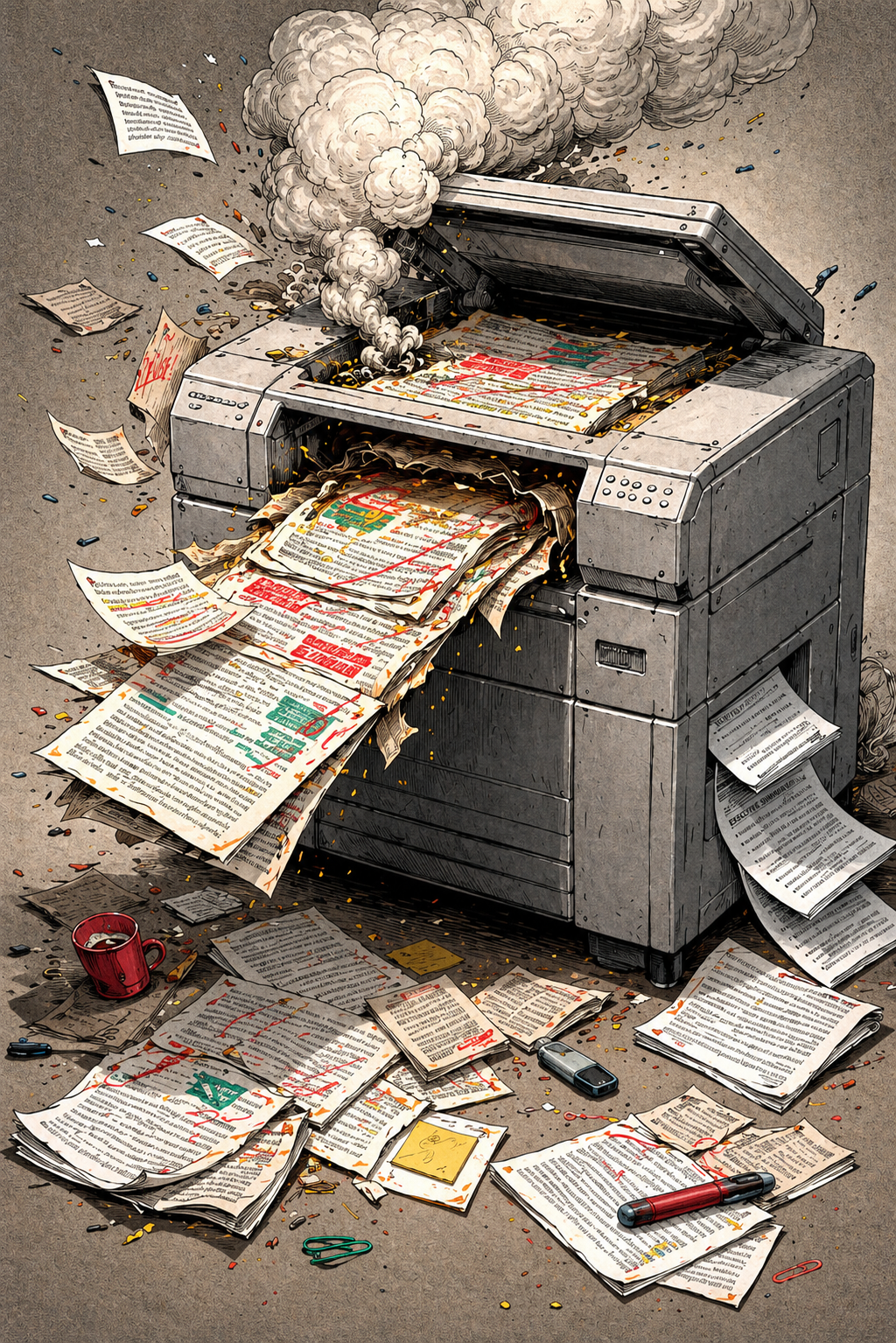
This is not about replacing writing. It is about seeing what writing becomes when it is allowed to cast shadows in other forms. Sometimes those shadows are beautiful. Sometimes they are funny. Sometimes they dance around with synth bass and profanity. Sometimes they look like an office copier having a nervous breakdown.
Sometimes, unfortunately, they produce a summary that reads like the essay was handled by a committee trained entirely on employee handbooks.
I will keep using NotebookLM. I will keep pushing on prompts. I will keep seeing whether I can get it closer to the marrow of the thing. Maybe I need to feed it tone notes. Maybe I need to specify the target, the joke, the argument, and the precise location of the raised eyebrow. Maybe I need to treat it less like a reader and more like a well-meaning intern who must be told, gently but firmly, that the essay is making fun of the man whose name appears nine times.
Still, when I hand it an essay whose point is “self-driving is real and Elon is full of shit,” and it comes back with a beige little summary that avoids the man almost entirely, I do not feel like I am witnessing intelligence.
I feel like I am watching a machine successfully navigate around the point.
The song for this essay is laced with profanity so, if that bothers you or if there are kids around, just skip this one.
4. The Voice After Me
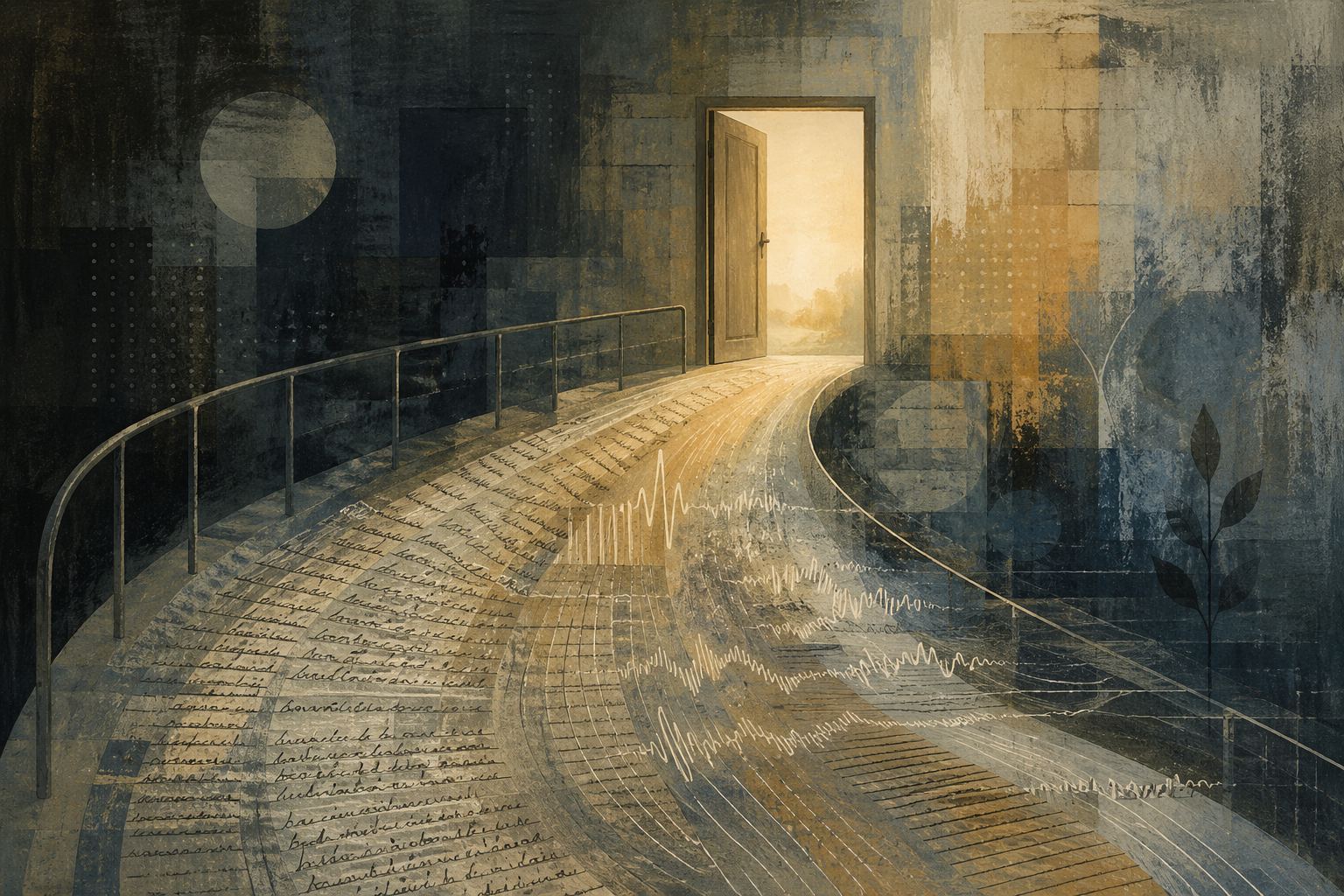
I keep thinking about how an essay already has a voice before anyone ever hears it.
Not a voice in the literal sense. Not breath moving through a throat. More like pressure. Cadence. A pattern of attention. A sentence reaches forward, stops, corrects itself, makes a small turn, admits something it did not expect to admit. A paragraph carries a kind of posture. It can stand upright, lean, slump, pace the room.
That is part of why I have never thought of Open Doors as a polished container for finished thoughts. It is more like a record of movement. The essays are not monuments. They are traces. They show where my mind paused, where it circled back, where a private experience opened into something larger than itself.
Now I am planning to give that record another form of life.
Not someday, maybe. Not as a passing thought I can leave in the category of interesting ideas. I plan to attach audio versions to these essays, read in a cloned version of my own voice. Not as replacements for the writing. Not as a trick. More like a second doorway into the same room.
Part of the appeal is for anyone who comes to the site and would rather listen than read. Some people absorb language better by ear. Some are tired of screens. Some are visually impaired. Some are walking, driving, washing dishes, folding laundry, rocking a child to sleep. A written essay asks for one kind of attention. An audio essay invites another.
That matters to me.
But, it matters in an even more personal way than that.
Access Goes Both Directions
I usually think of accessibility as something I build outward, toward the reader or listener. Make the doorway wider. Give people more ways in. Let the work meet them where they are.
That is still true.
But, this plan is also about access for me.
Because of my vision loss, reading from a screen is not a simple act. Because of my speech loss, recording long audio versions of my own essays is not a simple act either. I can still write. I can still think in sentences. I can still revise, shape, clarify, cut, and return. But, turning every finished piece into a clean spoken performance would ask something different from my body.
A cloned voice changes that.
It gives me a way to make the work audible without requiring me to sit down and perform each piece from beginning to end. It lets the essays carry something like my voice when my actual voice may not be available in the same way. It does not erase the loss. It does not solve the body. It does not make any of this magically easy.
Still, it offers a workaround with emotional weight.
That word, workaround, can sound too small for what it sometimes means. People with disabilities live among workarounds. Some are irritating. Some are necessary. Some become so ordinary they disappear into the day. Others feel almost miraculous because they return a little agency to a place where agency had been narrowing.
This feels like one of those.
Not because the tool is perfect. Not because synthetic speech is the same as my speech. It is not. But, because it lets me keep participating in a form that might otherwise drift farther from reach.
The voice is not only for the audience.
It is for me, too.
The Signature and the Cost
A cloned voice is not just another file format.
It is not like changing the font, resizing an image, or embedding a player beneath the title. A voice carries intimacy. It carries authority. We hear a voice and instinctively place a person behind it. We feel the body there, even when we know, intellectually, that the body may not be there at all.
A synthetic version of my voice might sound like me. It might carry enough of my cadence to feel familiar. It might make the essay more personal for someone listening. Still, it would not be me reading in the ordinary sense. It would be a performance I initiated but did not perform.
It could say words I never physically said.
It could sound steady when I was exhausted.
It could sound clear when my actual speech was not cooperating.
That is useful. It is also uncanny.
A real voice is not just sound. It is condition. It is breath, effort, mood, timing, fatigue. It is the body showing up and paying the small tax of being there. When a voice is cloned, some of the signature remains while some of the cost disappears. The fingerprint stays. The pulse gets abstracted.
I do not think that makes the result fraudulent by default. The words would still be mine. The choice would still be mine. The disclosure would still be mine. The voice model would not be pretending to exist independently of me. It would be a tool I used to make the work more available.
Still, that does not make it neutral.
A synthetic voice trades on trust. It borrows from all the times a human voice has meant sincerity, vulnerability, confession, presence. That means the ethical question is not only, “Can I do this?” I have already answered that. I am going to try.
The better question is, “How clearly can I tell the reader what they are hearing?”
Saying What the Machine Is Doing
I do not want anyone to mistake a cloned reading for a live recording.
I do not want the warmth of the voice to smuggle in a false sense of physical presence. I do not want someone to imagine me at a microphone, reading the essay in one clean, faithful take, if that is not what happened.
The label should be plain.
This is the original essay.
This is a synthetic audio reading in my cloned voice.
That kind of disclosure may sound unromantic, but I think it protects the romance. The spell works better when no one is being tricked.
Open Doors has always been interested in showing the seams. The site is not built around the fantasy that ideas arrive pure and finished. It is a place for revision, contradiction, return, and process. A synthetic reading can belong there, but only if it is named honestly.
Not hidden.
Not apologized for.
Named.
There is a difference.
I do not want to treat the cloned voice as a dirty secret, because it is also an access tool. I do not want to overstate it as some beautiful liberation story, because that would flatten the strangeness. I want to hold both truths at once: this helps, and this is weird. This gives something back, and it changes the thing it gives back.
That feels honest enough to begin.
Letting the Work Speak
I keep returning to this plan because, underneath the ethical knots and the technical details, there is something genuinely moving in it.
A written essay is one kind of presence. A spoken essay is another. Each form changes the work because each form asks something different from the person receiving it. Reading invites one kind of attention. Listening invites another. A sentence on the page waits for the eye. A sentence in the ear moves through time and disappears unless the listener follows it.
For me, that difference is not abstract.
Vision loss has changed my relationship to text. Speech loss has changed my relationship to being heard. So, the idea of a voice that can carry my words without asking my body to perform them every time feels complicated in exactly the way many useful things are complicated.
It is not a cure.
It is not a replacement.
It is a door.
The essay remains the center. The text is where the thought is made, tested, shaped, and revised. The audio does not replace that. It extends it. It lets the work travel by another route.
The text says: this is what I thought.
The voice says: this is what it might sound like if my presence could be carried through a machine.
Neither one is the whole truth. Neither one has to be.
Open Doors has always been about thresholds. A thought crosses from private to public. A memory crosses into language. A draft crosses into revision. A reader crosses into someone else’s attention for a little while.
This is another threshold.
The essay remains the room.
The voice opens a second door.
And, through it, something like me keeps speaking.
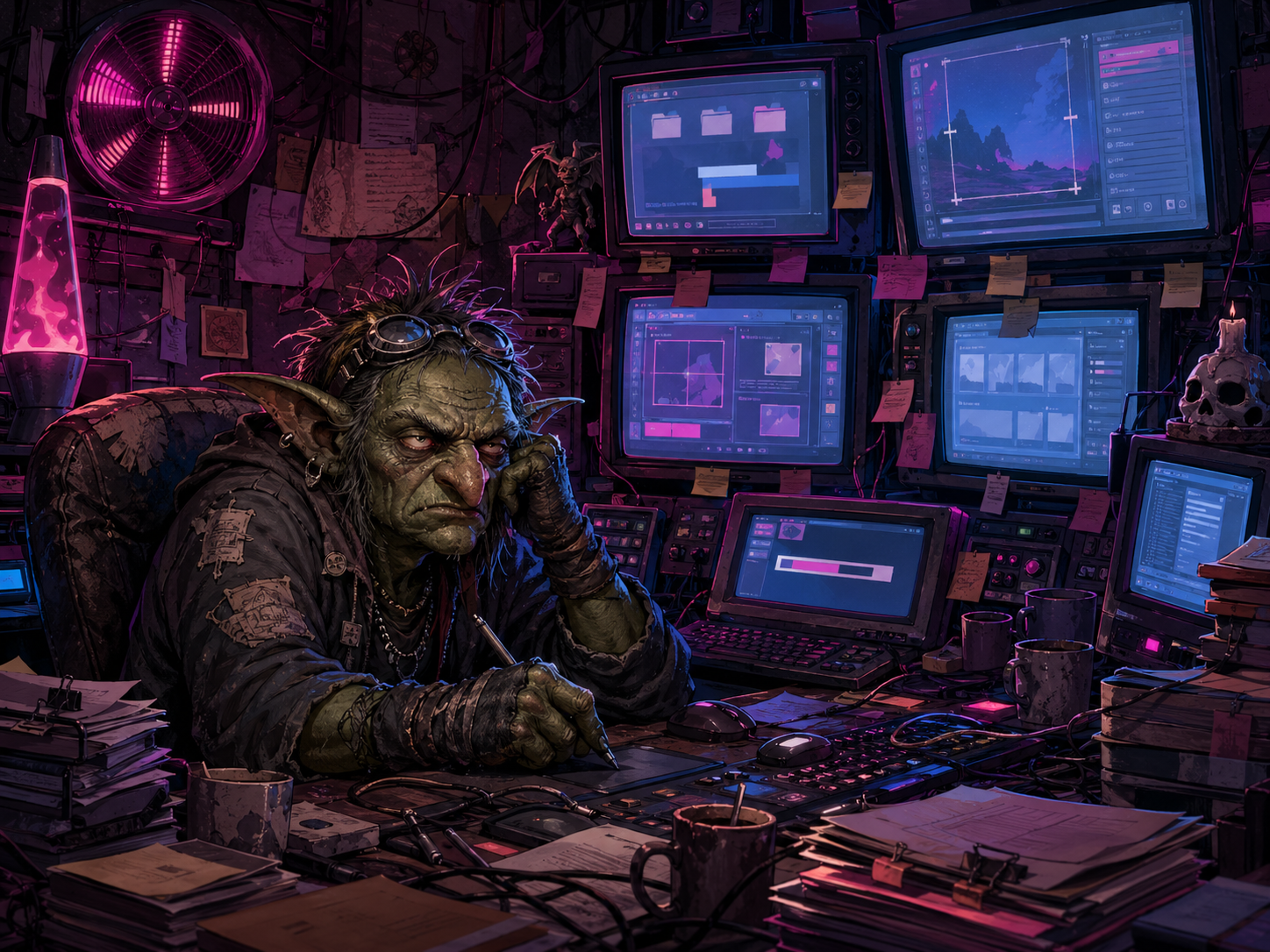
5. A Small Magazine Run by One Exhausted Goblin
I have enough essay drafts to run a respectable little publication, assuming that publication is staffed by one tired man, several folders, too many open tabs, and a workflow held together by stubbornness, profanity, and the dim ancestral memory of ambition.
The drafts are all there. The big philosophical ones. The disability ones. The access ones. The funny ones. The angry ones. The ones that begin as a minor complaint and somehow end up trying to explain consciousness, class, mortality, parenting, or why one tiny website task has become my personal Battle of Verdun.
Some are tender. Some are barbed. Some are reflective in a way I like. Some are funny because the alternative is lying face down on the floor and becoming part of the carpet. Many are mixed, because most honest things are mixed.
I want to publish them all. Not vaguely. Not as a noble fantasy where a future version of me, presumably better hydrated and less annoyed, finally opens the folder and becomes a full-service literary institution. I mean I actually want them out in the world.
I want them cleaned up, titled, formatted, posted, and breathing air.
Instead, they accumulate.
This is supposed to sound romantic, I think. A writer with many drafts. A mind that will not stop making things. Very flattering, right up until you realize that an unpublished essay is not a sleeping masterpiece. Sometimes it is just a document with attitude.
Every Draft Brings its own Clipboard
The problem is almost never that I have nothing to say.
If anything, that would be restful. A peaceful little vacancy. A monkish silence. A clean desk in the mind.
No such luck.
The ideas show up constantly. Some arrive as full essays. Some as one good line. Some as a scene from the house, a sentence from Charlotte, a new indignity from the body, a theory I cannot stop worrying, or one of those small linguistic crimes people commit in public and somehow expect me to survive.
The writing part may be hard, but it is at least the real work. It is the part where something alive gets caught. A pressure point. A joke. A grief. A thought that has been circling for years finally landing on the page with its little feet tucked under it.
Then the clipboard appears.
Now I have to edit the piece. Trim the false starts. Fix the repeated sentence. Remove the paragraph I apparently wrote twice because even my subconscious believes in brand consistency. Pick a title. Hate the title. Pick headers. Hate the headers. Make an image. Resize the image. Upload the image. Check the post on desktop. Check the post on mobile. Discover some spacing issue that appears only at the exact intersection of Squarespace, fate, and spite.
Then I fix that issue, which creates another issue, because software has a rich inner life and most of it is vengeance.
After that comes rereading, which sounds like a literary activity but is often just a man becoming suspicious of his own sentences.
Is this line good? Is it obvious? Is it overwrought? Is it trying too hard? Is it not trying hard enough? Was the first version better? Was the second version clearer? Am I revising or merely sanding the fingerprints off a living thing?
This is not the romance of the writing life.
This is clerical work in a black turtleneck.
The Stupid Little Jobs Are not Little
There is a phrase for this now: work about work.
It means the layer of activity around the actual activity. The searching, formatting, organizing, coordinating, moving, labeling, checking, uploading, and otherwise tending to the machinery that lets the real work appear. In a job, it is meetings about meetings. On a website, it is the forty-seven petty rituals between “I wrote this” and “someone can read this.”
That phrase comforts me because it confirms that I am not simply being dramatic, though obviously I am also being dramatic. The overhead is real.
Every essay becomes three essays plus a part-time administrative position. Every post drags a little office behind it. Every finished draft looks at me with the dead-eyed confidence of a bureaucrat who knows I still need Form 19-B, the featured image, the summary, the tags, and one last pass I absolutely do not need to do but will do anyway because I am apparently committed to artisanal psychological suffering.
This is where disability and access enter the room too, not as a special pleading but as a practical fact.
Energy is not theoretical. Time is not theoretical. The body is not a metaphor I can revise into compliance. When a task has seven unnecessary steps, those steps cost something. When a workflow is full of tiny frictions, each one takes a bite. For some people, those bites are annoying. For others, they are the difference between publishing and not publishing.
I do not need the process to become magical.
I need it to stop acting like a toll road where every booth is operated by a raccoon.
I Do not Need a Muse, I Need Infrastructure
This is why automation has started to sound less like a futuristic indulgence and more like basic mercy.
I do not need a machine to have my thoughts for me. God knows I am not low on thoughts. The folders already look like evidence gathered by a detective investigating a man who believed every observation deserved an essay.
What I need is help with the slog.
I need something that can clean up drafts, standardize formatting, organize files, prepare metadata, generate or resize images, check links, build post templates, and help move a piece from “nearly finished” to “actually live.” I need fewer places where a good essay can die of logistics.
Maybe that means Codex. Maybe it means a little workflow built out of scripts, agents, templates, and careful prompting. Maybe it means some future setup that knows how Open Doors works well enough to act like a publishing assistant with no strong opinions about my comma habits.
I am not precious about the source of relief.
This is the thing people miss when they get sanctimonious about tools. Using automation to help publish an essay is not the same as outsourcing the soul of the essay. I already wrote the thing. I had the thought. I followed the sentence. I found the nerve. I dragged the little beast into language.
I am simply asking software to stop making me personally escort every paragraph through customs.
There is no moral nobility in manually doing the dullest part forever. There is no artistic purity in resizing your own images while your actual life waits nearby, tapping its foot.
The Unfinished Ones Are Still Alive
I do not know if I will publish everything I want to publish.
That bothers me more than I wish it did.
Some of these drafts matter to me. Some caught a moment I do not want to lose. Some are funny in exactly the right mean little way. Some say something about disability or access that I have not seen said quite like that. Some are built around a domestic scene that will never happen again. Some are big and sprawling and ridiculous, but the ridiculousness feels earned.
The backlog annoys me because it is work waiting to be finished.
It also comforts me because it proves I am still here making things.
Still noticing. Still thinking. Still writing from inside the mess. Still trying to turn experience into something another person might recognize. The pile is not only a failure of output. It is also a record of attention.
That said, I would like the record of attention to occasionally become a published essay before I am found years from now beneath a collapsed archive of filenames like “draft-final-real-final-maybe-use-this-one.”
So, yes, the backlog has unionized.
It has demands.
It wants titles. It wants headers. It wants images. It wants cleanup. It wants a website that does not fight me like a raccoon in a crawlspace. It wants a future.
And, honestly, fair enough.
I want that too.
I just want a little help getting the damn work done.
6. My Journal, With Version History
I didn’t start Open Doors as a journal.
I started it, or started it again, as a place for essays. A home for reflections with some shape to them. The kind of writing that seems a little more deliberate than life usually feels. I imagined explorations of consciousness, determinism, AI, luck, disability, attention. Big questions, carefully handled. Something thoughtful. Something finished.
But, years later, after letting the site go quiet and then finding my way back to it, I realized I had made something else too.
Not just a collection of essays. Not just a shelf for ideas.
A record.
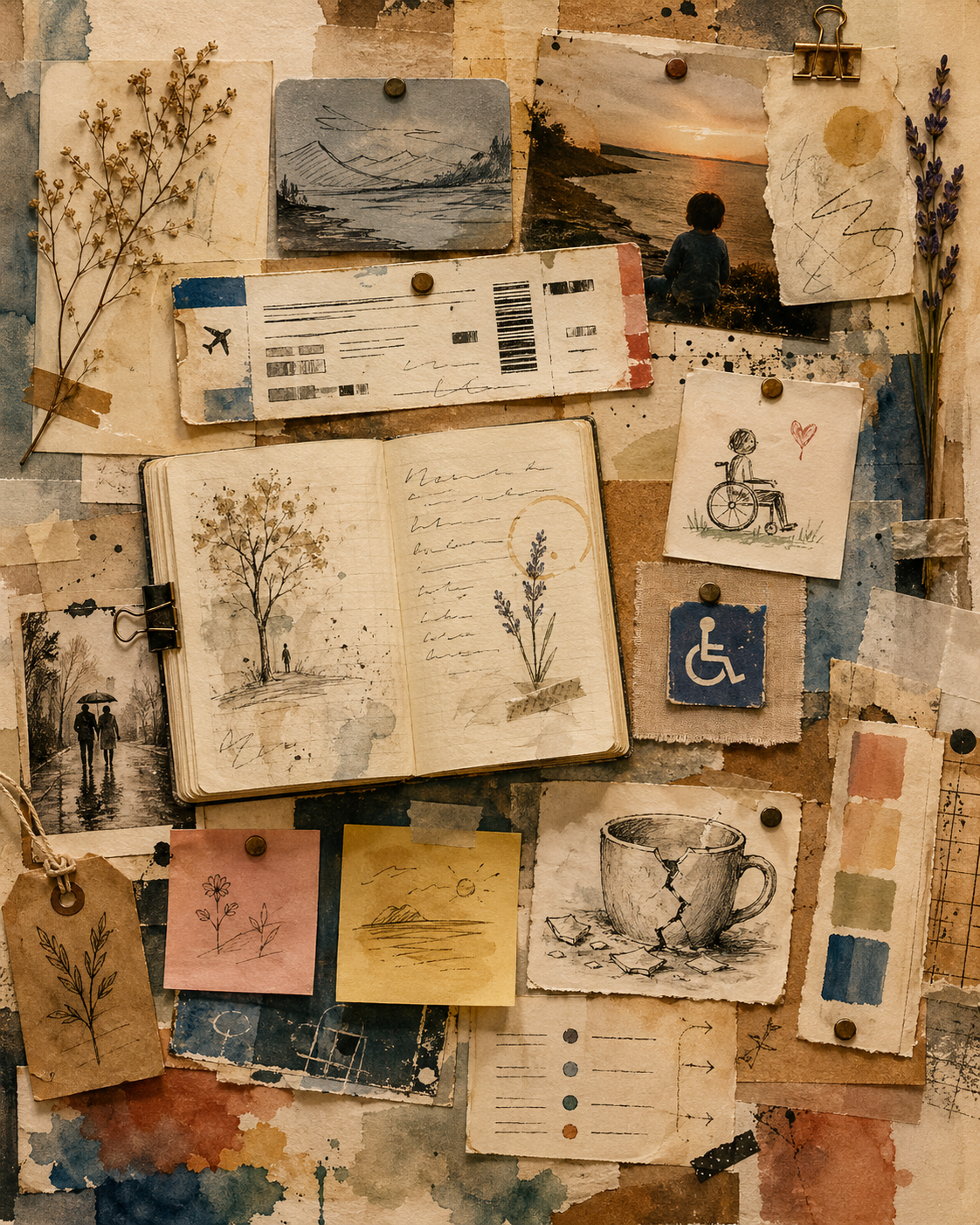
A journal, really.
Not a private one, obviously. A private journal can ramble, contradict itself in peace, and never worry about cadence. Open Doors is public, which means I try to be coherent and maybe slightly less embarrassing. Still, the function is basically the same. I’m keeping track of what I notice, what unsettles me, what hurts, what makes me laugh, what softens me, what keeps returning until I finally give it a sentence.
That last part may be closer to the real work. Research on expressive writing has long suggested that turning personal experience into narrative can help people organize emotion and meaning, though the benefits are not simple or universal. In their 1999 paper “Forming a Story: The Health Benefits of Narrative,” published in the Journal of Clinical Psychology, James W. Pennebaker and Janel D. Seagal argued that part of writing’s value comes from shaping scattered experience into a story—less venting than giving experience a form I can actually look at.
I don’t need Open Doors to be therapeutic in some tidy clinical sense. I don’t want to overclaim it. Mostly, I need a place where experience can stop buzzing around as raw material and become something I can look at.
The Evidence Changed
If I look back through the site, the pattern becomes obvious.
There are the disability posts, which read less like polished essays than field notes from a life I’m still learning how to live. Airports. TSA. Wheelchairs. Accessible spaces treated like optional conveniences by people who do not need them. The strange indignity of sitting in my chair waiting for the accessible stall while someone else uses it because it happens to be bigger, while feeling that old, irrational flicker of embarrassment, as though my need is the thing in the room that requires explanation.
There are quieter encounters too, the ones that stay with me for reasons that don’t fully reveal themselves at first. My niece asking about the wheelchair, about whether it’s hard, about the way my speech sometimes sounds different. Not asking to be cruel. Asking the way children do when curiosity has not yet been trained into performance. Afterward, the part I carried with me was not anything I said back. It was her telling me she liked talking to me.
A small sentence. A real one. The kind of thing I want to keep.
Family is where the practice has shifted most clearly. The writing is still about ideas, sometimes. It is still about concepts and arguments and the strange machinery of being alive. More and more, though, it is about attention.
The best example isn’t even on Open Doors. It’s the running list Christa and I keep of Charlotte quotes. The strange, funny, tender things she says that make us stop and look at each other. A three-year-old somehow saying something wiser or kinder than most adults manage all week. Those lines are not blog entries, but they belong to the same instinct. The same practice of noticing and keeping.
I’m collecting different evidence now.
Not just arguments. Not just insights. Moments.
That shift matters to me. It shows up in how I write about Rowan too, and in how careful I try to be. I want to tell the truth without turning her into a lesson. I want to write about the world around her without making her symbolic. I want to notice her as herself: funny, specific, stubborn, beloved. An earlier version of me might have been more interested in conclusions. The version writing now is more interested in staying close to the thing itself.
The archive holds the quieter adaptations too. My hearing becoming more precise as my vision worsens. Podcasts at 2.5x or 3x somehow sounding normal to me now, not because I’m trying to win a contest, but because my ears have become their own strange accommodation. That kind of detail might never have made it into a more curated version of this site. Now it feels essential. It is part of the record. Part of how life actually feels from inside.
Then there are the smaller entries, the almost ridiculous ones, which may be the most journal-like of all.
The toilet paper war with my father-in-law. He puts the roll under. I flip it over. Neither of us dignifies the situation with a conversation because the whole point is that it is too small to matter and too persistent to disappear. It is absurd. It is domestic. It is exactly the sort of thing that ends up meaning more than it should.
The mug I took from a high school classroom years ago, then loved far longer than I had any right to. It followed me through so many versions of myself that by the time it shattered against the sink, it felt less like a dish breaking and more like a little vault of time opening all at once. That is the sort of thing a journal is for too. Not because the mug was important in some grand sense, but because it was mine, and then it wasn’t.
There is also the quieter fact that I have changed.
Or maybe softened is the better word.
I find myself tearing up at kids’ movies now, sometimes without even fully paying attention. A Disney song catches one exposed wire in me and that is enough. Years ago I would have rolled my eyes at myself. Now I mostly just notice it and think, well, there’s another thing to write down.
Not because it is profound, exactly.
Because it is true.
The Tool Inside The Notebook
The other thing that makes this journal feel specific to this moment is that I am not keeping it alone.
I draft these pieces with AI, and at this point that no longer feels novel to me. It feels natural. I’ve been using this platform for years, long enough that it doesn’t register as some shiny trick. More like an ongoing collaboration with a system that knows my patterns, remembers my recurring questions, and can hand me back a version of my own voice when I need help finding it.
I know how that can sound. For some people, AI involvement might seem like it cheapens the practice. Like I’m cheating. Like I’m outsourcing something that should be solitary.
It doesn’t feel that way from the inside.
It feels like accessibility.
It feels like companionship.
It feels like a patient editor who never gets annoyed when I say, no, that’s close, but it isn’t quite it. Let me try again.
The blank page has always been romanticized by people who are not tired of it. Or by people who can meet it more easily than I can. For me, between vision loss and fatigue, the blank page can feel less like freedom than resistance. I may know what I mean and still struggle to get there cleanly. AI does not do the feeling for me, and it does not do the thinking. What it does, at its best, is reduce the drag between experience and language.
That distinction matters. A 2025 review of human-AI collaborative writing research, “Co-Writing with AI, on Human Terms,” frames the central question in similar terms: how writers preserve agency and ownership when AI becomes part of the process. The review found that writers want different levels of AI help at different stages—planning, drafting, reviewing, revising—and that ownership depends partly on what the writer chooses to keep control over.
That feels right to me. The model can help shape, expand, compress, reorganize, and reflect. It can suggest a title, smooth a transition, remind me where the real tension is hiding. The part I need to keep is the final pressure of judgment. Is this true? Is this mine? Is this cleaner than I meant, or closer than I could have gotten alone?
I love the control it gives me over form. That part still feels a little magical, even now. I can say I want something around 700 words, then decide it needs more room, and expand it without starting over from scratch. Yes, you can always choose length in a traditional journal too, technically. But, this is different. The form becomes adjustable in real time. The shape of the piece can change with the thought itself.
That suits the way my mind works.
I do not usually arrive at meaning in a straight line. I circle it. I revise toward it. I say one thing, then realize the truth is slightly to the left of that, then try again. AI fits that process strangely well. It turns drafting into a responsive space rather than a one-shot act of performance.
It also makes revision feel honest rather than evasive. A private journal can make rewriting feel like tampering with the past. Here, revision feels more like distillation. The earlier version existed. It helped me get here. The newer version is simply closer to what I meant.
Maybe that is one reason Open Doors feels so much like a real journal to me now. It does not pretend I arrive finished. It lets me leave the seams visible. It lets me keep a record not just of what I think, but of how I get there.
A Memory With Standards
The public part, oddly enough, helps.
A journal no one sees can become a room where you endlessly rehearse your own distortions. Publishing, even for a small audience, introduces a little accountability. I still get to be messy, but I have to be legible. I have to ask whether I’m being fair, whether I’m overstating something, whether the version of the story I’m telling is actually true.
The archive becomes a memory with standards.
Do I remember every essay I’ve posted, every detail, every turn of phrase? Nope. But that’s journaling. If I remembered all of it perfectly, I would not need the record in the first place.
I do not know whether my kids will ever read much of this. Maybe they’ll skim a few pieces one day. Maybe they’ll avoid it entirely, like it’s their dad’s private annex of feelings. Either option is fine. I’m not writing toward discovery so much as recognition. I want some future version of me to be able to look back and see the outline of this life. To know what this season felt like from the inside.
Open Doors began as a place to put finished thoughts.
It has become a place to keep unfinished ones too. A place to store the questions, the irritations, the shifts in belief, the airport waits, the broken objects, the family lines that deserve not to vanish. A place where disability, philosophy, parenthood, grief, AI, humor, exhaustion, and love all end up in the same archive because they all belong to the same life.
That archive is public. It is revised. It has version history and word-count adjustments and an AI in the room.
It is also, unmistakably, my journal.
Writing still gets through
The process is different
I still have my thoughts
A micro constellation
Will appear eventually
Three points on this NotebookLM piece:
It’s another long one… Bur, seeing how this post includes 6 essays, maybe I am saving a little time.
It gets Charlotte’s age wrong so, once again, I have another reason to be annoyed at Google.
At least this one mentions Elon, but it was like pulling eteeth. Also, it flattens the issue into all LLMs and their design and architectjre. No, in my expeience, it’s just Gemini.