Over, Under, and the Quiet War in the Bathroom
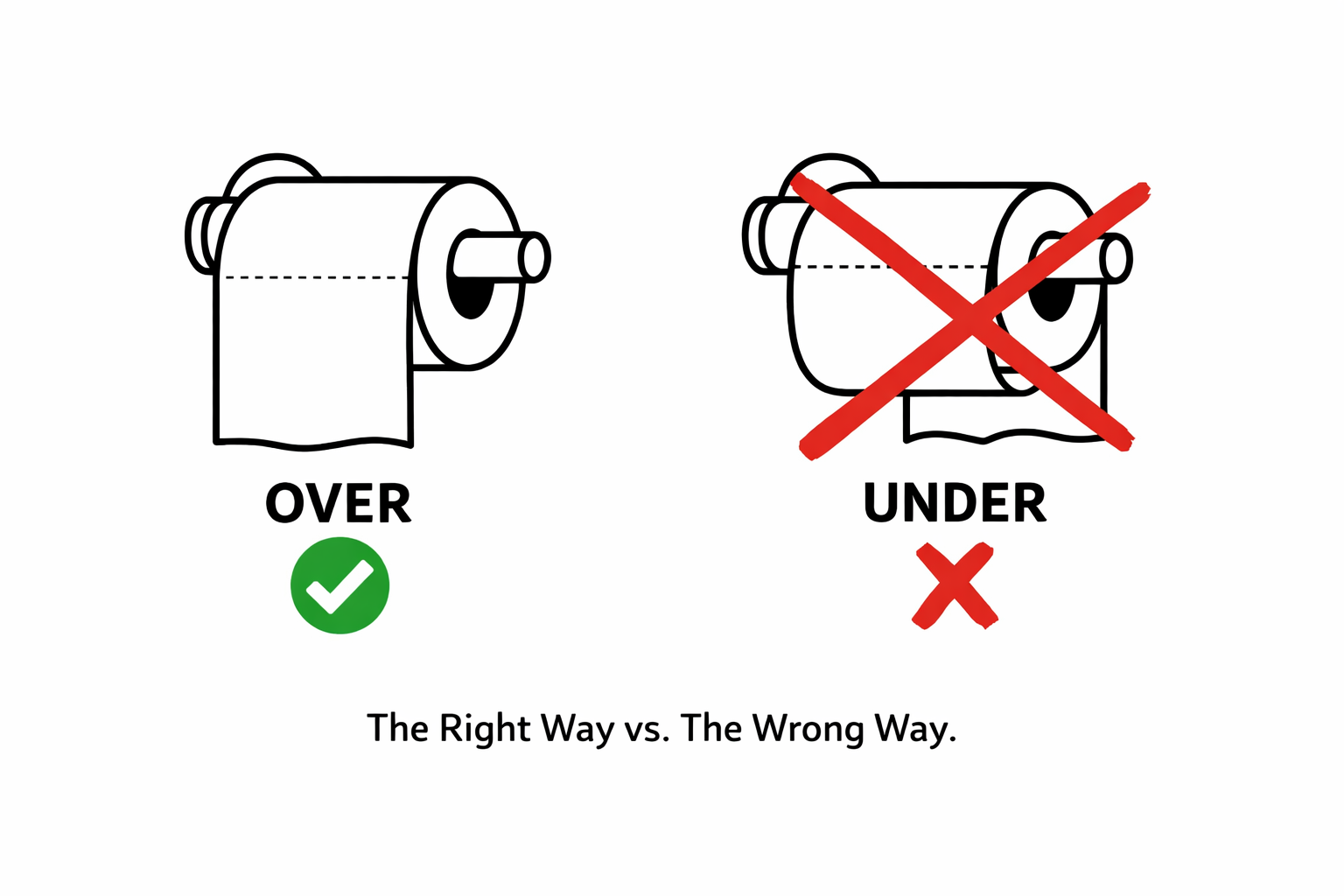
n my house, toilet paper goes over the top.
This isn’t a belief system I advertise, exactly. It’s not stitched onto a throw pillow. I’m not starting a movement. But it is, quietly, one of my small loyalties to order—like returning the shopping cart, or putting the cap back on the toothpaste, or believing that “mute” is a complete sentence.
My father-in-law hangs it the other way.
Under.
Tucked against the wall like it’s trying not to be seen.
I don’t even think he knows he’s doing it. That’s the thing. If he announced it—if he made a case for it, if he held forth in the kitchen with diagrams and moral certainty—then we’d have a proper conflict, something with shape and heat. But he doesn’t. He simply replaces the roll and moves on with his day, calm as a man who has never once considered that a cardboard tube can carry the weight of a worldview.
Then, I roll into the bathroom, and see it.
The paper clinging to the wall. The little tail turned inward, shy, withdrawn. A tiny act of domestic contrarianism.
I fix it.
Not dramatically. Not in anger. Just in the same way you straighten a crooked picture frame at someone else’s house because your body can’t not do it. I lift the roll, rotate it like I’m resetting a compass, and let the sheet fall forward again—clean, simple, ready. A small restoration. A silent correction. The sort of thing no one applauds. The sort of thing no one even notices, except the person who can’t stop noticing.
It’s absurd, of course. Toilet paper is not an ethical dilemma. The world is on fire in a dozen ways, and here I am, performing a tiny liturgy of preference in a room that smells faintly like soap and compromise.
That’s how shared life works, isn’t it?
Most of the time, we don’t clash over the grand stuff. Not in the day-to-day. We clash—if you can even call it that—over the quiet choreography. Over the way a dish towel is folded. Over the volume of the TV. Over whether the scissors belong in that drawer or the other one, and how that becomes, somehow, a question about sanity.
These are the acceptable battlefields. The safe arenas. The places we can exert a little control without naming the deeper truth, which is that living with other people means surrendering, constantly, to the fact that your inner map is not the only map.
I love him (but, thankfully, I don’t have to live in the bathrooms at his house). This isn’t contempt. It’s more like… bewildered affection. The kind you feel toward someone who will help you carry something heavy without being asked, but who also, apparently, wants the toilet paper to unspool like a secret.
So, the war continues—if “war” is the right word for something so soft and comically low-stakes.
He hangs it under. I flip it over.
He never mentions it. I never mention it.
A small loop of human difference. A little paper hinge between two ways of moving through the world. That’s all family is, sometimes, not big speeches or perfect understanding, but these minor, repeated negotiations that say, without saying: I’m here. You’re here. We’ll make room.
Just carrying on
It’s just the way he does it
Over. Way to go