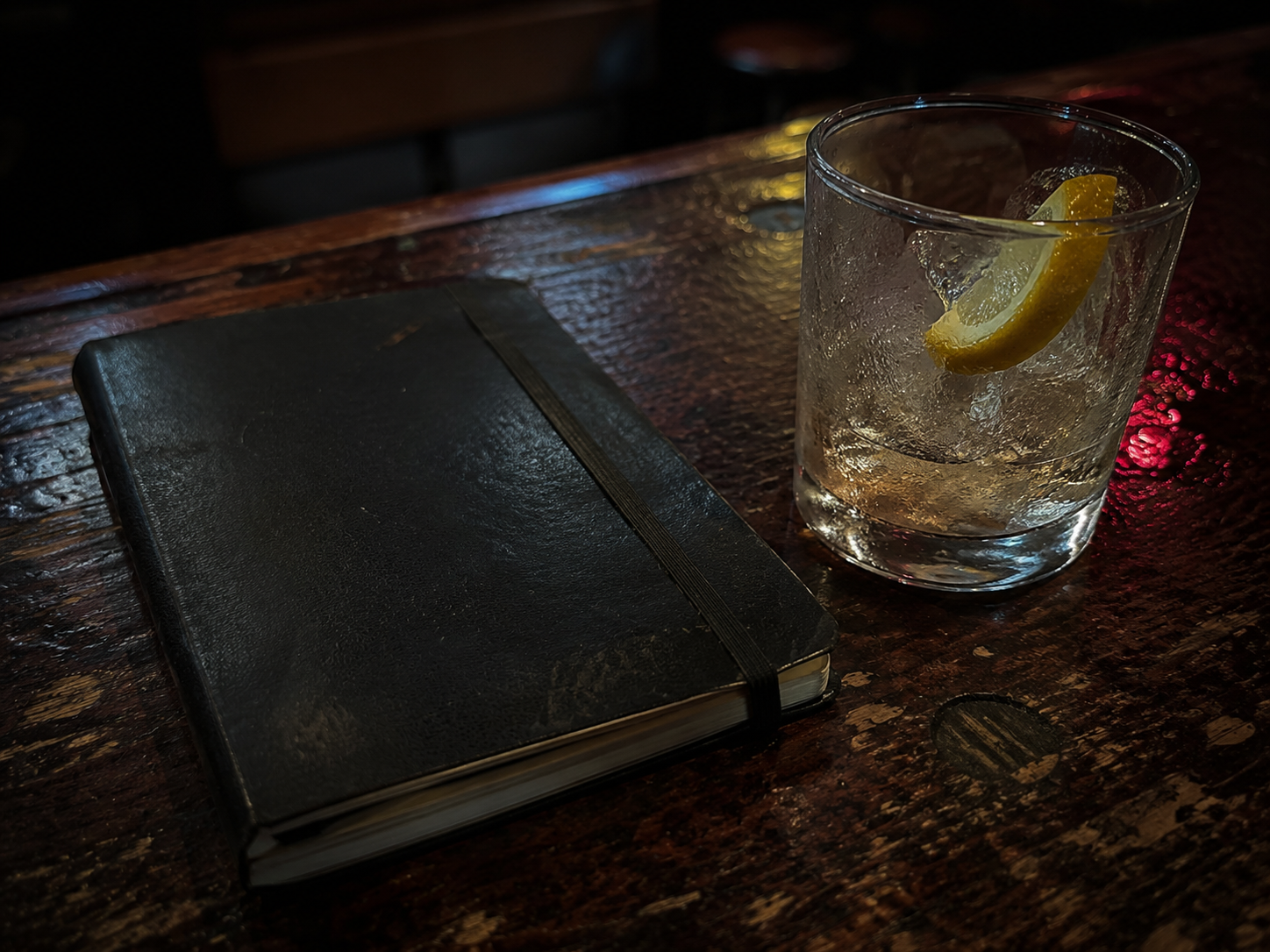
Normally, I come to The Library to pretend to write.
The name is part of the joke. There are no books except for a row of old encyclopedias behind the bar, their pages glued together by humidity and spilled liquor. Most nights, the place is full of students proving they are old enough to drink by drinking like children.
I sit alone with a black notebook and a vodka tonic. The notebook makes me look occupied. It also gives people something to wonder about.
Sometimes a woman asks what I’m writing.
Usually, I say, “Nothing yet.”
This is true more often than I would like.
The couple at the next table is more interesting than anything I could have invented that night.
They are both in their early thirties. The man wears a gray button-down shirt with the sleeves rolled carefully to the elbows. The woman is pregnant, though at first I mistake the curve beneath her sweater for the way she is sitting.
She keeps one hand on her stomach.
The other taps the tabletop.
“I worked it out with the buyer,” the man says.
A girl at the bar screams before I hear the rest.
She is wearing a silver sash that reads 21 FINALLY LEGAL. Her friends lift their drinks and scream with her. Someone rings the brass bell behind the bar.
The pregnant woman leans closer to the man.
I lean closer too.
He glances in my direction, and I look down at my notebook.
I write:
BUYER.
When I look up, the woman is shaking her head.
“I don’t care what she promised,” she says. “There are things you can’t promise.”
“She understands the arrangement.”
“She understands what you told her.”
The man reaches across the table, but the woman pulls her hand away.
A waitress arrives carrying a Pabst Blue Ribbon.
“I didn’t order that,” I say.
She points toward the birthday group. One of the women raises her glass at me.
I look at the beer. Then I look at the vodka tonic already in my hand.
“Send it back.”
The waitress gives me a tired look.
“It’s already paid for.”
“Then she can drink it.”
The couple has lowered their voices.
I catch only the end of the woman’s sentence.
“—starting to show.”
The man looks around the bar.
“I know.”
“It will only be another few months.”
“I know.”
“Has it ever even been done before?”
“I don’t know.”
The music changes. Something electronic begins pounding through the speakers, all bass and breath. The lights above the dance floor flicker on.
The woman says something else, but the music swallows most of it.
I hear:
“Hundred thousand.”
Then:
“Taxidermist.”
I write both words in my notebook.
The man finishes his drink.
“You think we’ll be fine?” the woman asks.
“This isn’t exactly a normal transaction.”
“It will be fine.”
“How do you know?”
“As long as the child is healthy, she’ll take it.”
The sentence reaches me clearly.
Or it seems clear now.
At the time, a dozen other things are happening. The birthday girl is standing on a chair. Someone drops a glass. The waitress returns the beer to the woman who sent it, and the woman laughs as though I have performed some difficult trick.
But I hear the sentence.
As long as the child is healthy, she’ll take it.
The pregnant woman lowers her head.
The man says something I cannot hear.
She begins crying.
Not loudly. Her shoulders move once, then again. The man looks irritated rather than concerned. He checks his phone.
I take a long drink and turn to a clean page.
I write:
UNBORN CHILD
BUYER
$100,000
TAXIDERMIST
I stare at the words.
Then I cross out UNBORN CHILD.
I write BABY.
The woman stands so quickly that the table shifts. Her glass falls onto its side, pouring water across the wood.
The man reaches for her.
She pulls away.
“Don’t,” she says.
Several people turn toward them.
The woman says something louder, but the birthday group erupts into another cheer. She pushes through the crowd toward the door.
The man follows.
I consider following too.
Instead, I finish my vodka and go to the bathroom.
By the time I return, they are gone.
The waitress is wiping water from their table.
“What happened to that couple?” I ask.
She shrugs.
“They left.”
“The woman seemed upset.”
“A lot of people get upset in here.”
“She was pregnant.”
The waitress looks at me.
“Okay.”
“Did you hear what they were talking about?”
“No.”
She lifts their glasses onto her tray.
“Why?”
“No reason.”
I order another vodka tonic.
At home, I search for taxidermists.
There are seventeen within fifty miles.
Most specialize in deer, fish, and birds. One advertises exotic restoration. Another includes a photograph of a mountain lion posed on a false rock, its mouth open and eyes fixed upon something beyond the camera.
I search for the cost of taxidermy.
A deer shoulder mount costs less than a thousand dollars. A full black bear can reach ten thousand. Large exotic animals cost more.
Nothing costs one hundred thousand.
I search for human taxidermy.
The results are mostly jokes, historical rumors, and arguments about legality. Human bodies are embalmed, plastinated, mummified, preserved in medical collections. They are not, technically, taxidermied.
I search for preserved infants.
I close the browser.
Then I open it again.
There are photographs from museums. Anatomical collections. Infants suspended in cloudy jars, curled as if sleeping underwater. Some are centuries old. Their mothers are unnamed.
I search:
CAN YOU BUY AN UNBORN CHILD
Then:
PRIVATE ADOPTION COST
Then:
SELLING BABY BEFORE BIRTH
Then:
TAXIDERMIST ADOPTION
At three in the morning, the words no longer seem connected.
I look at the page from my notebook.
BUYER.
HUNDRED THOUSAND.
TAXIDERMIST.
AS LONG AS THE CHILD IS HEALTHY SHE’LL TAKE IT.
I remember each phrase.
I do not remember everything between them.
That becomes the problem.
By morning, I have constructed the full conversation.
The couple has agreed to sell their unborn child to a wealthy woman. The woman is a taxidermist. She has offered one hundred thousand dollars. She requires the child to be born healthy.
What she intends to do afterward is obvious.
Or it is obvious to me.
I do not go to the police.
I consider it. I even find the non-emergency number.
But I imagine explaining that I overheard several pieces of a conversation in a crowded bar while drinking. I imagine an officer asking for their names, address, vehicle, or any description more useful than gray shirt and pregnant.
I know nothing.
I return to The Library the following night.
The couple is not there.
I sit at the same table and order the same drink. I watch the door.
On Thursday, they are not there.
On Friday, I stay until closing.
Every pregnant woman who enters makes me look up.
None of them is her.
Over the weekend, I try to write the story.
I begin with the taxidermist.
She is an old woman living alone in a mansion filled with animals. Foxes stand beneath lamps. Birds hang in permanent flight. A white bear waits at the end of a corridor.
She has preserved everything except what she truly wants.
I delete this.
I make her young instead.
I give her a dead child.
I delete that too.
The problem is that every explanation makes the story less frightening. A grieving mother is understandable. A collector is ordinary. A wealthy sadist is almost boring.
The sentence itself is worse than any motive.
As long as the child is healthy, she’ll take it.
On Wednesday, I return to the bar.
I tell myself it will be the last time.
The waitress recognizes me now. She brings the vodka tonic without asking.
“You ever write anything in that thing?” she says.
“Occasionally.”
“Anything good?”
“No.”
The man enters alone at nine fifteen.
He pauses just inside the door and looks across the room. For a moment, I think he recognizes me.
Then he walks toward a booth near the back.
I wait until he sits.
My hands are unsteady, though I have only had one drink.
I take my notebook and move into the booth across from him.
He looks up from his phone.
“Can I help you?”
“Where’s the woman?”
His face tightens.
“What?”
“The woman you were here with last week.”
“I don’t know you.”
“I was sitting beside you.”
He looks toward my old table.
Then back at me.
“You were listening to us?”
“What happened to her?”
He places his phone facedown.
“Get out of this booth.”
“You said you found a buyer.”
His expression changes so quickly I cannot name it.
Fear, perhaps.
Or disbelief.
“You need to leave.”
“One hundred thousand dollars,” I say. “That was the price, wasn’t it?”
He slides toward the edge of the booth.
I put one hand on the table.
“You said as long as the child was healthy, she would take it.”
The man stops.
His face has gone pale.
For a second, neither of us moves.
Then he says, very quietly, “What exactly do you think you heard?”
“I heard enough.”
“No. You didn’t.”
“Then explain it.”
He stares at me.
The music is quieter than it was the week before. Around us, people laugh, glasses strike tables, someone argues about a basketball game.
“Who was the taxidermist?” I ask.
The disgust that crosses his face seems genuine.
But disgust proves nothing.
He stands.
I catch his wrist.
He jerks away as though I have burned him.
“Do not touch me.”
“You’re selling your child.”
He looks around the bar.
Several people are watching now.
“There is something wrong with you,” he says.
“Where is she?”
He does not answer.
“Is she still pregnant?”
His mouth opens, then closes.
For the first time, he looks less angry than tired.
“You have no idea what you’re talking about.”
“Then tell me.”
He takes a step backward.
I rise from the booth.
“Tell me what I heard.”
He turns and walks toward the door.
I follow.
A bachelorette party has gathered near the entrance, seven women wearing plastic crowns and matching black dresses. They block the narrow passage while taking photographs.
I push between them.
Someone swears at me.
By the time I reach the door, the man is already outside.
The bouncer places a hand against my chest.
“You can’t leave.”
“I need to talk to him.”
“You need to pay your tab.”
“I’ll come back.”
“No, you won’t.”
Through the window, I see the man turn the corner.
Then he is gone.
The bouncer walks me back to my table.
The waitress sets the bill beside my notebook.
“What was that about?” she asks.
“I think he’s selling a baby.”
She looks toward the door.
Then at me.
“To who?”
“A taxidermist.”
She waits for me to smile.
When I do not, she picks up my empty glass.
“You want another?”
I look down at the notebook.
The page contains the words I wrote the first night.
BUYER.
HUNDRED THOUSAND.
TAXIDERMIST.
HEALTHY.
SHE’LL TAKE IT.
Some are underlined. Some are circled. Arrows connect them in several directions. Between them are sentences added later, explanations written so many times that I no longer remember which parts I heard and which parts I supplied.
Only one phrase remains inside quotation marks:
“As long as the child is healthy, she’ll take it.”
I study my handwriting.
I remember the meaning perfectly.
It is only the words that have begun to move.
“Yes,” I tell the waitress.
She waits.
I realize I have not said what I want.
“Another vodka.”