1
The leaking wall on the far side of Director Matthews’ cabin office had, for three or four weeks, been a mystery. Water, seemingly from nowhere, was seeping through the sheetrock walls, whether it was raining or not. After several failed inspections—one of which resulted in the inspector suggesting he “call a priest”—Matthews gave up. A lost cause. The only “solution” for the sweating wall was a system of waterproof tape and tarp leading to a bucket on the floor. The aging camp director was forced to empty it every three hours.
By the time he discovered it, the water had already soaked through the backing of several frames Matthews hung on the wall—each of the “all-camp” photos he took at the end of the season: the hundred or so kids, their counselors, cooks, the nurse, and Matthews himself. He would develop the film in a darkroom on the grounds, usually as part of an activity for the children interested in such things. And, now, thirty-five years of soggy, wrinkled history was filed away in his desk drawer.
Matthews had founded Camp Hope in the shadow of the Sawatch Mountains on Twin Lakes in Colorado after returning from Germany in 1946. Without family to return to, he decided to forgo a suburban destiny and poured his savings into the formation of the camp, mostly recruiting the children of friends and other veterans. Initially just a place for parents to leave their boys to keep them out of trouble during the summer months, Camp Hope developed into a full-scale sleepaway destination where Director Matthews had found his career.
The trouble was that in recent years, attendance had begun a steady decline in the wake of a multitude of injuries—some involving children as young as six—which were mostly the fault, in Matthews’ eyes, of newer counselors, several of whom attended Camp Hope as children. Without the livelihood his camp provided, and with no familial support, Matthews was facing destitution.
He left the dripping wall and began the walk across camp to the mess. The sun was still rising over the Twin Lakes, casting orange beams through the wisps of early morning fog that hung over the water and into Matthews’ eyes. Soon enough, the humidity would be dizzying and the heat inescapable. The pines were only beginning to recover from wildfires that plagued the region two years prior—thankfully sparing most of the camp—creating a bizarre pattern of black, stripped poles towering above the buildings. Fresh saplings dotted the east side of the mountains. It was during those fires that a thirteen-year-old, nearly trapped, had escaped by wading down one of the many creeks that carved their way toward the lakes.
Matthews had the explicit goal of maintaining the facilities, both functionally and aesthetically. At sixty-five, he considered himself a craftsman. He allowed curious vines to curl themselves up walls and around windows, careful not to disturb the natural order. Over the years, Matthews had done most of the construction himself in the off-seasons: the lone dock that stabbed into the western bank of the Twin Lakes, the gathering of cabins, and Matthews’ own lodging secluded near the crease at the base of the mountains. The entire layout was his design. In recent years, the dwindling population had the unintended consequence of allowing him to focus more on the land itself.
The path to the mess hall revealed itself as a network of trails, the least disturbed of which were being continually reclaimed by the forest. The ever-present needles littered the forest floor, protecting it from the summer sun. Inside, the kitchen staff were nearly finished preparing for breakfast, while one of Matthews’ senior counselors prepared the space—arranging tables and chairs just as he had been shown years prior by the then-enthusiastic director.
“I was starting to wonder when you’d show,” the counselor said, holding the door open. “Took your time this morning!”
“It’s already too hot for a stroll, Dylan. No, it’s the damn wall. I can’t sleep. It’s just dripping. And, dripping. I haven’t slept more than a few hours at a time in damn near a month.”
“It’s seriously—”
“I just don’t know what to make of it. No pipes, no rain, no A/C, no dead animals.”
“Can’t you just take the wall down?”
“No, no. It just doesn’t make any sense. You’ve never seen anything like it. It’s a goddamn miracle, I think. A horrible one at that. You know, if it’s still leaking during the winter session, maybe I can get you and some kids to chisel it away for me during the day.”
“I actually was meaning to talk to you about that. It’s not looking so good for my plans next season.”
At this, thirty or so children marched through the doors accompanied by their counselors—lately only a 5:1 ratio—and drowned out the conversation. With so few of them in recent years, the room’s echo seemed more distinct, the sound reflecting off more open surfaces.
“What do you mean, not looking so good?”
“Look, I’ve just been talking to a few other counselors and I don’t think everyone’s coming back. I’m just looking into some other opp…” A child, maybe ten, pulled on Dylan’s shirt cuff, asking him to come see some trinket he had whittled the night before. “Opportunities. I’ll come by later and we can talk about it, okay?” The child towed him away before Matthews could provide his response.
|||||
The bucket was full. Matthews had waited too long and was now forced to lift it a few inches at a time toward the door, the water sloshing over the edges and leaving a trail of water stains on the wood floor. The bucket dug a trench in the blanket of pine needles as Matthews dragged it through the door and around the side of the cabin. Stiff wind brushed through the trees, renewing the calls of cicadas beginning to finally die down in the late hours. Out of the sound, hurried voices, at first just a murmur from across the grounds, soon elevated into hysterical crying.
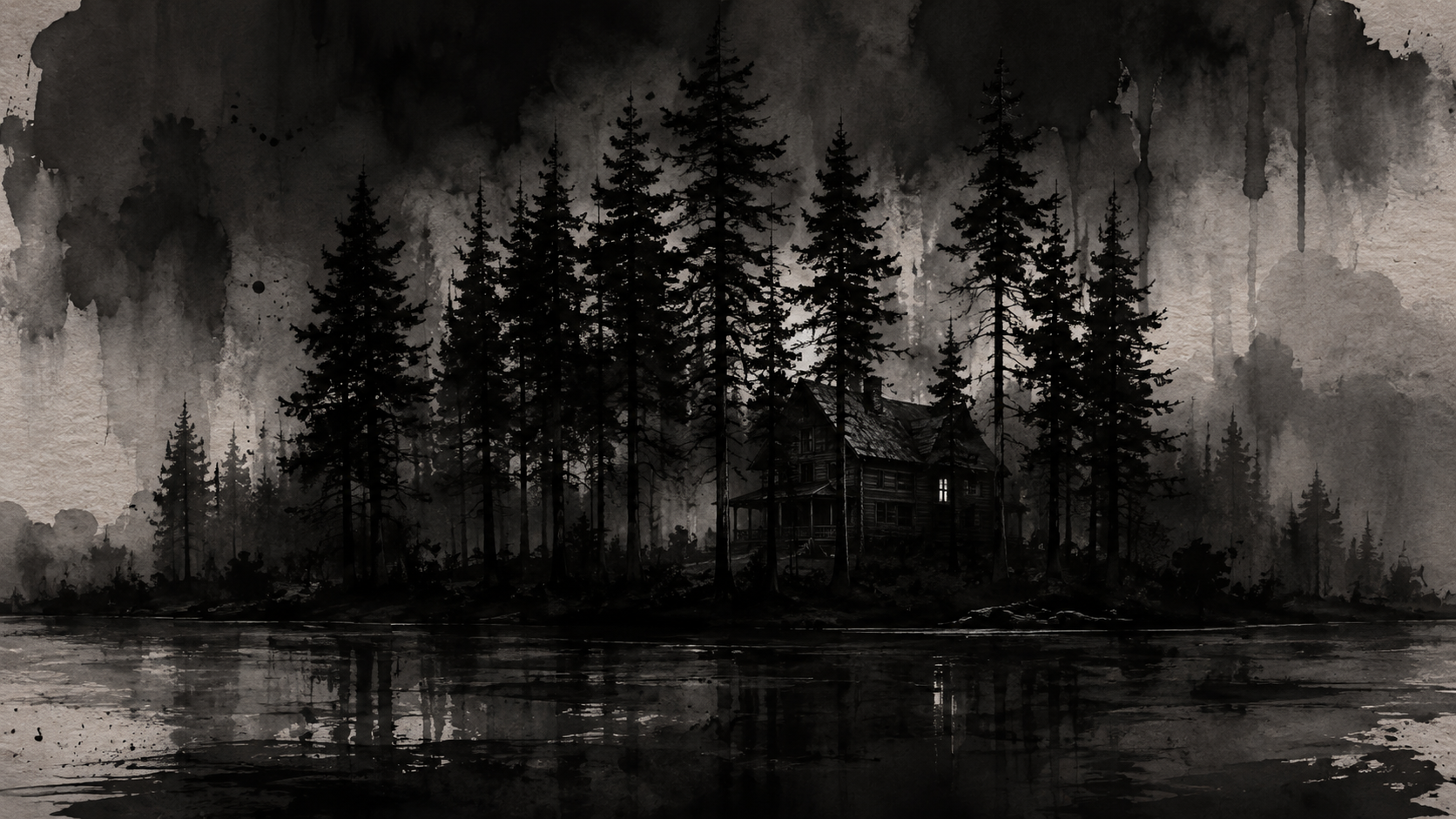
Cutting across the snaking trails, hands in front of his face, defending against raking branches, Matthews traced the intensifying screams to the lake and soon came upon the boys. Three stood crying in swimsuits, their clothes tossed lazily in the dirt at the base of a nearby tree. A fourth lay face-down in muddy shallows, one broken leg twisted awkwardly under the dock. One of the thin planks above the boy’s head was cracked, the end dangling by a few strained threads of wood. Moonlight distorted with ribbons of deep crimson flickered over the water near the boy’s head. A rope swing came to rest near the edge of the lake, just barely dipping into the midnight tide. In Matthews’ cabin, a pool of shimmering water soaked into the floor below the eastern wall, stretching as the breeze pushed in through his open door.
|||||
It was mid-January, well into the winter camping season, and the only footprints in the camp were Matthews’. He maintained the heaters in each cabin—classic Franklin stoves—and cleared the dock of ice as he always had. Unable to cope with the loneliness of the empty camp, he ran it as normal. He staked the seasonal “No walking on the ice” sign into the dirt near the water. He chopped wood for the fire pits that he would light each night. He would ice-fish with no children around to teach. Weekly, Matthews would attempt to clear the cabins of roaches and spiders that had taken up residence for the winter.
He shoveled excess snow from the roofs.
He watched for precarious branches, weakened by ice storms.
He identified winter bird calls.
He ate in the mess and cleaned it each night.
He measured the waxing ice that filled the creeks, now entirely frozen, entombing stray animals that may have fallen in earlier in the year. The ice would preserve them until the distant thaw.
Each night, Matthews retired to his cabin, lit the stove, and chiseled away the patch of ice that formed on the eastern wall. He slept soundly. In the morning, he chiseled again. In time, he embraced the routine of it, preferring the ice to the incessant dripping in the summer months. The cold was distracting and invigorating. It isolated the grounds, and Matthews, and provided an immediacy and focus so that the absence of winter companions became, over time, irrelevant, even welcome. Despite this, Matthews looked anxiously forward to the next season: planning activities, preparing schedules, and waiting near the mailbox for returned RSVP forms.
When the ground began its long-awaited thaw, Matthews determined that a new cabin would be a fine addition. Seeing the camp expand was a joy unto itself. He dug four narrow trenches and within them laid a foundation using the last remaining charred pines.
2
A Hiker disturbs the newly frozen eastern edge of the Twin Lakes. In the ice, like a cracked mirror, he can see the jagged skyline of the Sawatch Range. Autumn is hardening into winter, quieting the nights except for lone owls or the occasional shuffling of deer through the Hiker’s makeshift camps. Enduring the persistent hunger and the growing cold is perhaps the only way to make the events of the previous year seem bearable.
The Hiker had attempted to finish his thesis on Melmoth the Wanderer until realizing that he actually cared nothing for the gothic novel. Damned to hell, Melmoth was trying to escape his self-inflicted fate while the Hiker had done nothing to deserve his. Yet he keeps a copy in his pack. A token of the life he has left behind, or the life taken from him.
After his fiancée was run down by a taxicab outside a Chicago department store, he left the university—as well as a lease; a stray, friendly border collie; his phone, his laptop; and a collection of first editions—walking southwest out of the city—but not before hitting his ATM withdrawal limit. By the day of the funeral, he had reached Peoria and turned west. After realizing this wouldn’t be a short journey, he began gathering supplies.
The Hiker has been camping on the shores of Twin Lakes for three weeks, the first location where he has remained for any extended time. The small towns in the region offer opportunities to resupply with little personal interaction. The daunting Sawatch Mountains are a comfort. The trees of Twin Lakes are a natural windbreak, close enough to the water that he can easily reap the benefits of their shelter while still fishing for mackinaw lurking under the ice.
A particularly violent storm prompts the Hiker to move further east along the coast of the Twin Lakes. Freezing rain coats every surface, creating a dreamlike glare. The thin sheet hampers progress even along gritty terrain, and it is not until the sun dips over the horizon that he encounters a derelict dock which sits confidently above the surface of the frozen lake. It looks as if the freezing rain has re-formed the decaying structure, sealing its numerous cracks and holes. Remnants of what once was a thick synthetic rope dangle lazily from a tree above, conjuring images in the Hiker’s mind of his late fiancée’s cabin in the Missouri Ozarks.
She had invited him to spend a weekend with the family in their lakehouse, which she assumed to be an ideal place to meet her family for the first time. One alcohol-driven discussion—or argument, according to her—about the role of the humanities in modern society devolved into direct attacks on his chosen field of study. All was well after she pulled him from his room that night to swing naked from a rope into the lake. This, of course, only encouraged future debates.
But, there is no longer an opportunity for future debates. Now, he’s standing under the stiff cord and pulls until it tears free from the branch and falls in coils through the thin layer of ice on the water’s surface, splashing into the mud beneath.
In the morning, the Hiker continues west, into a settlement clearly older than the trees it stands among. There is little room to walk between the strange assortment of buildings that litter the area. They form what is almost a maze, with no obvious reason for their location. They all have the same basic design, but face in all directions as if no thought were put into their organization. But, the pines are reclaiming this land, some towering several stories over the small cabins. Despite the early morning sun, the trees cast nearly the entire area in shadow, leaving only dim patches of light scattered here and there. He gazes inside the mostly obscured windows and is surprised by their true state of repair. Though the exteriors are worn and overgrown, the interiors look as if they had only been abandoned in recent years. Bunk beds stand undisturbed, their sheets crisp and made with precision. A desk topped with pen and paper sits waiting for its next occupant. In front of each cabin door is a young adult pine barring entry.
This trend continues as the Hiker shuffles from structure to structure: dilapidated exterior, seemingly clean interior, and entrance blocked by a young adult pine. One building is larger, perhaps a cafeteria, and has a substantial window built into the wall. And, while there are several stones within reach that could be used to shatter the glass, the bizarre, almost alien serenity of the scene compels him not to do so.
Pushing further westward along no discernible trail, there is yet another cabin, this one solitary. He misses it at first, hidden behind a series of trees, younger than the others, in a row along the entire perimeter of the cabin. Though they’re thinner than the others, the pines form a sturdy barrier, blocking all but the lone window near the door. He attempts to peer through the glass, but a layer of ice from the storm obscures his view. Only after heavy breathing, chipping, and rubbing for several minutes does the ice melt away enough to see inside. Inside are the emaciated, even skeletal remains of what he guesses to be a man, kneeling prostrate, arms fully extended before the eastern wall—a wall featuring a long river of ice that reaches from the ceiling to a frozen pool on the floor, encasing the man’s hands.
The interior is unlike the others: scattered with old wool blankets, piles of wood in one corner, and a mess of paper plastered to the walls and floor. The Hiker pulls at one of the pines, and though it flexes, the trunk is too strong to break. He searches for his hatchet and proceeds to chop the trees. One by one, they fall, exposing the wooden door of the cabin. He tries the knob, but it’s either locked or the wood has swollen shut. He kicks at the door, but it holds steady. He steps back and rushes shoulder-first, but it doesn’t budge. The Hiker then proceeds to cut a large hole into the door with the hatchet. The air inside seems to rush out, a warm breeze.
The papers on the floor aren’t simply documents. They’re photographs developed from film, some stained, corrupted, but discernible nonetheless. In each of them, a man stands alone against a backdrop of the lake. In some, his arms are extended outward as if resting on the shoulders of others, while other pictures depict him leaning against a tree, smiling. Digging through the filth of the cabin interior, still more photographs reveal themselves. In one, he looks to the side, smiling; in the next, the man kneels with his arms held wide, excited; in another, he sticks his tongue out at the camera. There are nearly forty in all, split evenly between summer scenes and those with snow. In all, the pines stand tall in the background, his only companions. The threadbare remains of the clothing on the corpse match the photographs.
|||||
The Hiker searches the room for an ID but can’t find one. He looks for information on the grounds, a pamphlet or even a notebook. Using a rusted shovel leaning in one corner, he digs a hole roughly five feet long. And, deep enough. He chips away the ice binding the man’s hands to the floor. The Hiker straightens him, careful to avoid pulling his body to pieces. The man is rolled into his grave, and piles of dirt, needles, and snow are heaped on top. The Hiker stands over the disturbed earth. The dirt, piled unevenly, will soon be indistinguishable from the surrounding forest.