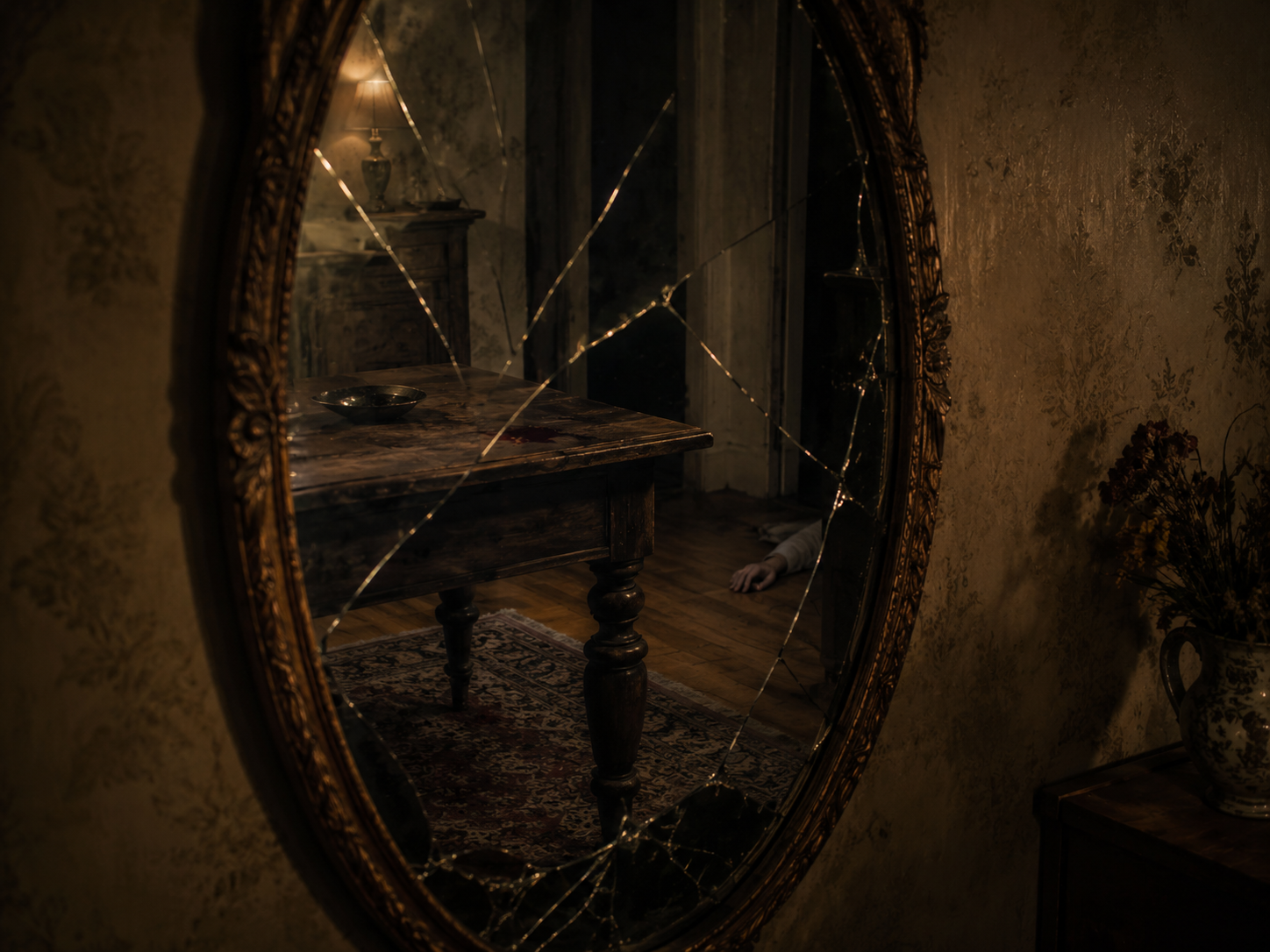
Behind the front door of the red house on Second Street, halfway beneath a foyer table and facedown on a pale green rug, lay the husband of Harriet Murray.
Whatever it isHis name was Hugh.
The police had already reconstructed the evening. A man entered through the rear door shortly after nine. Hugh confronted him in the foyer. There was a struggle. Blood struck the walls, the mirror, and the underside of the table. The intruder escaped with a silver serving tray, two hundred dollars in cash, and a porcelain figurine of a shepherdess holding a lamb.
Hugh did not escape.
His skull met the corner of the table at an unfortunate angle. The official report described the death as accidental within the commission of a violent felony, which
meant murder in language meant for people and something longer in language meant for insurance companies., the way you tell your story online can make all the difference.
The blood on the cracked mirror did not belong to Hugh.
Neither, apparently, did the tooth beneath the radiator.
Terrance read the report twice while Molly drove.
“Always the little porcelain people,” he said.
“What?”
“They never steal the television. Never steal the computer. They steal the little porcelain people.”
“The tray was silver.”
“Plated.”
“You don’t know that.”
“I know trays.”
CrimeRevive had sent them because the police were finished and the family wanted the room restored before morning. The request had been marked urgent, although all death-scene restorations were urgent now.
At midnight, House Resolution 4490, the Deceased Care Act, would take effect. Private companies would no longer be permitted to clean, restore, remove, conceal, transport, reposition, wrap, package, deodorize, beautify, or otherwise alter any location in which a human death had occurred.
The government called this dignity.
CrimeRevive called it bankruptcy.
Terrance called it an unreasonable limitation on craftsmanship.
Their boss had accepted the Murray job at eleven minutes past ten. One final private restoration. One final body. One final room returned to the condition it had been in before it became honest.
“You got plans?” Terrance asked.
“For after midnight?”
“For after we’ve been declared immoral.”
Molly turned onto Second Street.
“I might take a vacation.”
“You don’t take vacations.”
“I could start.”
“You’d get bored.”
“I’d like to know what boredom feels like without a body in the room.”
Terrance looked out the window.
“You’ll miss it.”
“I’ll miss you moving corpses with your foot because you don’t want to put down a paintbrush.”
“That’s efficiency.”
“That’s why the government hates us.”
The red house stood near the end of the block. Its porch light flickered in a slow, deliberate rhythm.
Three times on.
Three times off.
Molly parked the van.
“Is that supposed to mean something?” she asked.
“Loose bulb.”
“It stopped when we pulled up.”
“Then it’s shy.”
The black CrimeRevive van reflected in the front windows. Beneath the company name, painted in clean white lettering, was the old slogan:
NOTHING HAPPENED HERE.
Management had once considered changing it.
Customers objected.
Terrance and Molly sat for a moment with the engine off.
“Last one,” Molly said.
Terrance opened his door.
“Do it right, then.”
Harriet Murray answered on their fourth knock.
She was a small woman in a long cream nightgown. Black tears ran down both sides of her face. A fresh cut crossed her hairline, and one hand remained pressed against it as if she feared her thoughts might leak out.
“I’m dreadfully sorry,” she said. “I tripped over him.”
She stepped aside.
Hugh lay where the report said he would.
One arm reached toward the door. The other was trapped beneath his body. His neck bent sharply against the table leg, forcing his open eyes toward the newly arrived workers.
The rug beneath him had once been pale green. Most of it still was.
“Oh, Hugh,” Harriet said.
She looked at the table.
“Do you think that can be repaired?”
Terrance crouched beside it.
The impact had crushed the corner and split the wood along the grain. Several deep scratches ran across the surface, along with a wet red imprint shaped like the side of Hugh’s face.
“Sure,” Terrance said.
“It belonged to my grandmother.”
“Good wood.”
“She bought it during the war.”
“Which war?”
Harriet stared at him.
Terrance ran a finger along the damage.
“Doesn’t matter.”
Molly opened the service tablet.
“Mrs. Murray, we have authorization for blood removal, structural repair, glass replacement, odor treatment, biological disposal, and scene normalization.”
“Yes.”
“Do you want us to preserve anything?”
Harriet looked confused.
“From the room.”
“No.”
“Any stains, fragments, damaged objects, impressions, outlines, impact marks, or final-position indicators?”
“Goodness, no.”
“Some families do.”
“I want it as it was.”
Molly checked the box marked TOTAL RESTORATION.
The tablet asked:
AS IT WAS WHEN?
Molly selected BEFORE INCIDENT.
The tablet asked:
WHICH INCIDENT?
She looked at Terrance.
He leaned over.
The screen listed seven recorded disturbances associated with the property.
– FALL, STAIRCASE, 1988
– SMALL FIRE, KITCHEN, 1994
– ANIMAL DEATH, ATTIC, 2001
– UNRESOLVED VOCAL EVENT, BASEMENT, 2007
– SELF-INFLICTED INJURY, UPSTAIRS BATHROOM, 2013
– MISSING PERSON REPORT, WITHDRAWN, 2019
– CURRENT INCIDENT
Terrance tapped CURRENT INCIDENT.
The tablet returned to the work order.
“Computers,” he said.
Harriet was watching the body.
“I just can’t bear to look at him.”
“We’ll take care of it,” Molly said.
“And the mirror. Can you replace the glass?”
A web of cracks spread across the foyer mirror. In each broken section, the room appeared at a slightly different depth. Hugh’s body was reflected seven times, though none of the reflections lay in precisely the same position.
Terrance leaned toward it.
One Hugh seemed to have his head turned toward the stairs.
Another had both eyes closed.
“Old glass,” he said.
Harriet touched the cut on her forehead.
“I must have struck it when I fell.”
Molly looked at the mirror, then at Harriet.
“The blood on it isn’t your husband’s.”
“That must be mine.”
“The report says it’s male.”
For a moment, Harriet’s expression became very still.
Then the porch light flickered through the windows.
Three times on.
Three times off.
Harriet smiled faintly.
“Well,” she said, “perhaps the intruder cut himself.”
“That’s what the police think,” Molly said.
“Yes. Of course.”
Harriet set a check on the hallway table.
“I’ll be upstairs. I’ve made tea.”
“That’s kind of you,” Molly said.
“It’s already poured.”
They watched her climb the stairs.
Three cups of tea waited on the dining-room table.
One for Molly.
One for Terrance.
One at the empty place where Hugh usually sat.
“Don’t drink that,” Molly said.
“I wasn’t going to.”
“You drank coffee from the Mercer house.”
“That was different.”
“The woman had been dead for six days.”
“Coffee was fresh.”
They unloaded the equipment.
At ten forty-six, Terrance began repairing the table.
He removed the blood first, applying a clear enzyme solution with a soft cloth. The red imprint lightened slowly. The cheek vanished. Then the ear. Then the suggestion of a closed eye.
Once the surface was clean, he sanded the fractured corner and filled the split with a mixture of resin and powdered oak. He worked carefully, following the grain instead of forcing it.
Molly photographed the mirror before removing it.
In the first photograph, Hugh lay facedown.
In the second, his reflection was sitting upright.
She deleted both and took another.
The third showed only the rug.
“Molly,” Terrance said.
“What?”
“Quit taking pictures and grab his feet.”
They shifted Hugh away from the table.
His body was surprisingly light until it wasn’t. The weight seemed to gather in different places as they moved him, traveling from his shoulders to his hips and then abruptly into his left arm.
“Hold on,” Molly said.
“What?”
“Something’s caught.”
Hugh’s trapped hand had closed around the table leg.
Terrance pried the fingers loose one at a time.
“Postmortem contraction,” he said.
“You say that about everything.”
“Because people keep contracting after they’re dead.”
They laid him on his back.
A red groove crossed his forehead where it had struck the table. His mouth hung slightly open. One front tooth was missing.
Molly looked toward the radiator.
“You think that’s his?”
“The report says no.”
“Doesn’t look like he lost one?”
Terrance leaned closer.
Hugh’s teeth were complete.
They both looked at the small white object beneath the radiator.
“Don’t touch it,” Molly said.
“I wasn’t going to.”
“You were bending toward it.”
“I was observing.”
Molly removed the cracked mirror from its frame.
Behind it, written directly on the wall, were dozens of names.
Some had dates beside them. Some had been crossed out. HUGH appeared near the center in block letters.
Beneath it was written:
NOT YET.
Molly stepped back.
“Was that in the police report?”
Terrance looked over.
“No.”
“You think we need to call them?”
He checked the time.
Ten fifty-eight.
“At midnight, we need to call the federal contractor and wait six to eight weeks.”
“That isn’t what I asked.”
“Could be old.”
“Hugh’s name is there.”
“Hugh lived here.”
“Why is it behind the mirror?”
“People put things in walls.”
“Not lists of names.”
“You’ve never renovated.”
Molly photographed the writing.
This time, every name appeared clearly except Hugh’s.
Where it should have been, the image showed a pale blur.
The service tablet chimed.
UNLISTED SCENE ELEMENT DETECTED.
PRESERVE OR NORMALIZE?
Molly selected PRESERVE.
The tablet changed it to NORMALIZE.
She selected PRESERVE again.
NORMALIZE.
“Might be a screen issue,” Terrance said.
Molly turned it off.
They worked around Hugh.
Terrance matched the stain by eye. He brushed it over the repaired corner until the new section became indistinguishable from the old. Then he distressed it with a short length of chain and the edge of a screwdriver.
Molly watched.
“You’re adding scratches.”
“They’re the right scratches.”
“It’s their last job. It doesn’t need to be perfect.”
“Especially needs to be perfect.”
“Referrals don’t matter anymore.”
“Pride still matters.”
“To who?”
Terrance looked toward Hugh.
“He’s watching.”
Hugh’s eyes were open.
Molly crossed the room and closed them.
She returned to the mirror.
In its fractured surface, Hugh’s eyes remained open.
Molly draped a cloth over it.
“You got plans?” Terrance asked.
“Hawaii.”
“For how long?”
“Until I stop seeing things in mirrors.”
“You won’t find a husband that way.”
“I’m not looking for one.”
“You say that now. Then one day you’re fifty-two, drunk in an airport bar, explaining to a dentist from Cincinnati why you can identify blood types by smell.”
“I would lie.”
“Smell doesn’t lie.”
“Neither do dentists from Cincinnati.”
“You don’t know many dentists.”
“I know exactly enough.”
At eleven twenty, Molly replaced the mirror with a fresh sheet of glass.
Before setting it into the frame, she cleaned both sides twice. She checked for fingerprints, fibers, blood, hair, skin, breath marks, and latent human intention, the last of which had appeared on CrimeRevive’s inspection checklist after a lawsuit in Nebraska.
The new mirror reflected the room normally.
For almost a minute.
Then a hairline crack appeared at its center.
Molly watched it crawl upward.
“Terrance.”
He did not look up from the table.
“Glass settles.”
“It’s cracking.”
“House settles too.”
The crack stopped.
It had formed the shape of a small figure standing with its arms at its sides.
Molly placed a strip of clear resin over it.
The figure disappeared.
They cleaned the walls and ceiling. They removed blood from the floorboards with narrow brushes and cotton swabs. Terrance found a drop beneath the shoe molding and another behind the umbrella stand.
Molly found blood inside the wall clock.
“How does blood get inside a clock?” she asked.
“Pressure.”
“The glass isn’t broken.”
“Time got cut.”
She looked at him.
“You’ve been waiting thirty years to say that.”
“Closer to forty.”
They worked faster as midnight approached.
The room began to look new.
Not recently cleaned. New.
The wallpaper seemed brighter where the blood had been removed. The floorboards shone. The table stood squarely beneath the chandelier, its restored corner holding the same small dents and darkened edges as the rest.
The more they repaired, the less the room resembled a place where anyone had ever lived.
At eleven thirty-five, the CrimeRevive tablet came back on by itself.
RESTORATION AT 81%.
BIOLOGICAL PRESENCE REMAINS.
Terrance looked at Hugh.
“Well, yes.”
Molly began cleaning the rug.
The blood had soaked through to the floor. They lifted one corner and found the boards beneath it scratched with four parallel lines.
Too wide for fingers.
Too narrow for furniture.
The scratches led toward the table.
“Animal?” Molly asked.
“Harriet have a dog?”
“No.”
“Old house.”
They rolled the rug back down.
Molly applied cleaner until the stain faded from red to brown to yellow. The fibers lifted slowly, returning to their original pale green.
The outline beneath Hugh remained.
Even after they moved him.
A human-shaped depression pressed into the rug, complete with the angle of the shoulders and the spread of one hand.
Terrance brushed the fibers against the grain.
The outline disappeared.
Then reappeared three feet away.
Molly watched it settle beside the table.
“Did you see that?”
“No.”
“You didn’t look.”
“Then I definitely didn’t see it.”
At eleven forty-two, Harriet came downstairs.
She had changed into a black dress.
Her makeup had been repaired. The cut at her hairline was gone.
Not covered.
Gone.
She stopped in the doorway and looked around.
“My,” she said.
Terrance was polishing the table.
“Almost finished.”
“You would never know.”
“That’s the idea.”
Harriet approached the new mirror.
Her reflection appeared a second before she reached it.
She touched her forehead.
The reflection did not.
Molly looked away.
Harriet studied the repaired corner of the table.
“Is that the exact color?”
“Best match possible.”
“It seems darker.”
“Old finish changes under different light.”
“Hugh never liked dark furniture.”
Terrance kept polishing.
“You said it belonged to your grandmother.”
“It did.”
“And Hugh?”
“He married into it.”
Behind Harriet, the mirror showed Hugh sitting up.
Molly stared.
His reflected head turned toward Harriet.
His mouth opened.
Nothing came out.
Then the reflection lay down again.
Harriet looked over her shoulder.
Hugh had not moved.
“Is something wrong?” she asked.
“No,” Molly said.
“You seem pale.”
“Occupational.”
Harriet looked down at her husband.
“He was always getting in the way of things.”
The sentence was quiet enough that Molly could not be certain she heard it correctly.
“What was that?”
“I said he always had a way with things.”
Harriet returned upstairs.
At eleven fifty, they deemed the rug unsalvageable.
Its color had been restored. The blood was gone. The fibers stood evenly. By every technical measure, it was clean.
But the human-shaped depression kept changing position.
Sometimes it lay beneath the table.
Sometimes beside the stairs.
Once, while both workers watched, it appeared directly behind Molly.
“Roll it up,” she said.
“With him?”
“With anything.”
Terrance positioned Hugh in the center of the rug.
Together, they folded one side over him and then the other. His body disappeared inside the pale green fabric.
They secured it with three straps.
The bundle moved once.
A small adjustment from within.
Then it became still.
“Gases,” Terrance said.
“Of course.”
“Pressure changes when you roll them.”
“Obviously.”
They carried Hugh through the foyer.
Halfway to the door, the wall clock began striking midnight.
It was eleven fifty-four.
The first chime sounded.
The CrimeRevive tablet flashed red.
SIX MINUTES REMAIN.
The second chime sounded.
The porch light began flickering.
Three times on.
Three times off.
The third chime sounded.
Something knocked from inside the rolled rug.
Molly nearly dropped her end.
“Gases?” she said.
“Probably.”
The fourth chime sounded.
Upstairs, Harriet began laughing.
Not loudly.
Not happily.
The fifth chime sounded.
The new mirror cracked from top to bottom.
The split divided Molly and Terrance from their reflections. On the reflected side of the room, the table remained broken. Blood covered the walls. Hugh lay beneath it, unwrapped and watching them carry something else toward the door.
The sixth chime sounded.
“Don’t look at it,” Terrance said.
They moved faster.
The seventh chime sounded.
The front door would not open.
Molly twisted the handle.
Locked.
“Harriet!” she called.
The eighth chime sounded.
Terrance lowered his end of the rug and pulled the door hard enough to shake its frame.
The ninth chime sounded.
From inside the bundle, Hugh said, “Wrong one.”
The voice was soft and close.
Molly stepped backward.
The tenth chime sounded.
Terrance opened the door.
Cold air entered the foyer.
The porch light went dark.
The wall clock stopped.
Eleven fifty-five.
Neither of them spoke as they lifted the bundle again.
They carried it into the night and placed it inside the van.
Terrance closed the doors.
From the house came the sound of breaking glass.
Then Harriet called down from upstairs.
“Thank you!”
Molly stood beside the van, breathing hard.
“We should call someone.”
“Who?”
“The police.”
“And say what?”
She looked at the house.
In the foyer window, Harriet stood beside the restored table.
A man stood behind her.
He was missing a tooth.
Harriet turned.
The curtain fell closed.
Terrance checked his watch.
Eleven fifty-seven.
“Equipment,” he said.
They returned for their cases.
The foyer was empty.
The mirror was whole.
The table was perfect.
The three cups of tea remained on the dining-room table. Hugh’s cup was empty.
Terrance packed the last brush.
Molly found the tooth beneath the radiator.
She picked it up with gloved fingers and sealed it inside an evidence bag.
“What are you doing?” Terrance asked.
“Preserving an unlisted scene element.”
The CrimeRevive tablet chimed.
RESTORATION COMPLETE.
PLEASE RATE YOUR EXPERIENCE.
Molly selected one star.
The tablet changed it to five.
At eleven fifty-nine, they left the Murray house.
The door closed behind them.
At midnight, CrimeRevive ceased to exist.
The company logo vanished from the van’s exterior. The black paint beneath it was clean and glossy, with no sign that words had ever been there.
Molly sat in the passenger seat holding the bagged tooth.
Terrance started the engine.
For several blocks, neither spoke.
Then Molly said, “Any ideas?”
“For what?”
“What you’ll do now.”
Terrance considered this.
“I hear the Lowe’s by my house is hiring.”
“You think they’ll take you?”
“I know wood.”
The rolled rug shifted in the back of the van.
Molly looked over her shoulder.
“Do they offer dental?”
Terrance turned onto the highway.
“Probably after ninety days.”