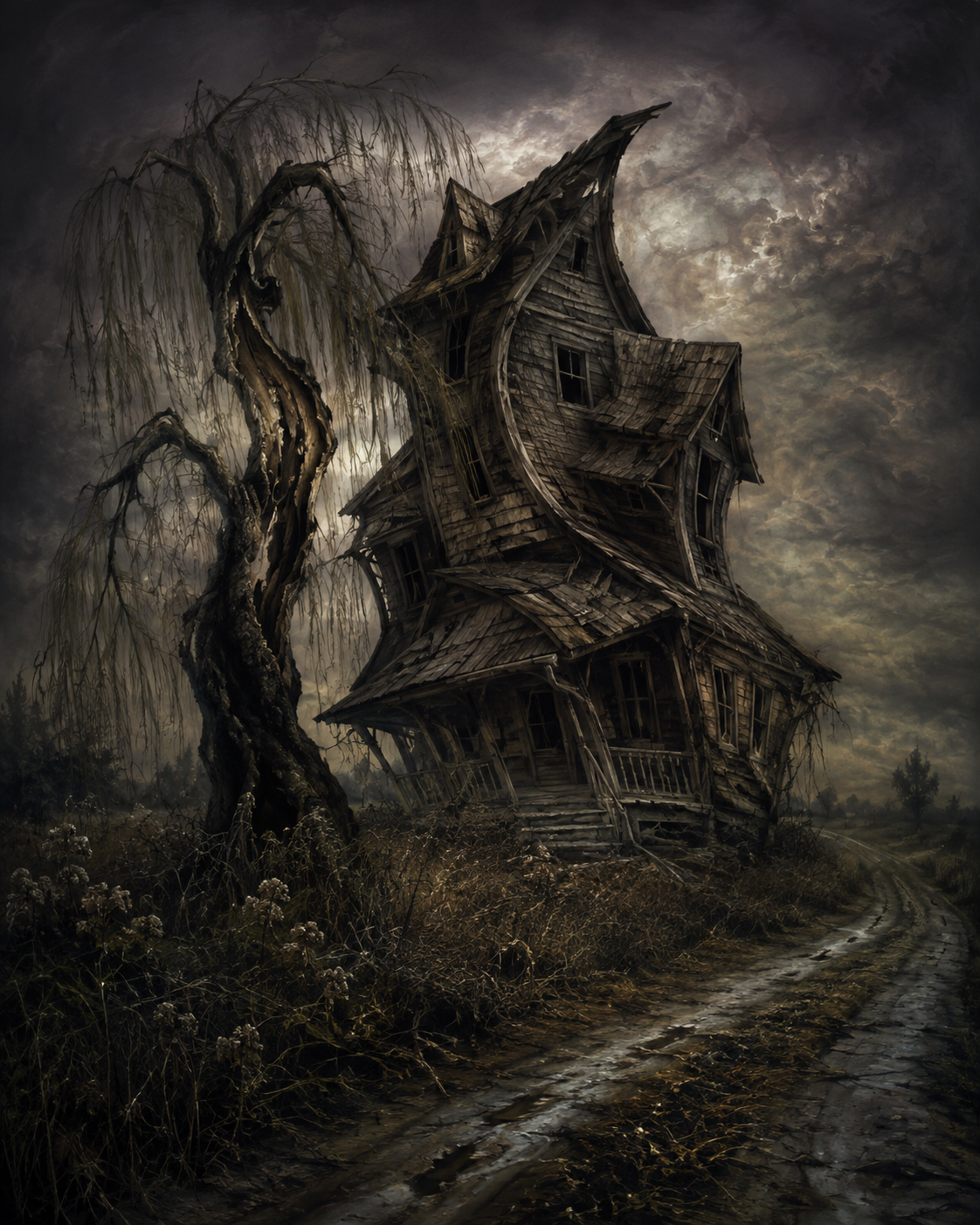
They had lived in the house for nine years when the family returned to remember it.
The house stood beside a county road that had been straightened twice since it was built. Each alteration had moved the traffic farther away, leaving the house at the end of a narrowing strip of gravel and weed, as if the road itself had been trying to forget it.
No one knew its exact age.
The county records listed three construction dates, each decades apart. Beneath the newest siding were cedar planks blackened with pitch. Beneath those, in places where the walls had opened, were rough logs packed with horsehair, newspaper, and a pale fibrous material no one had identified. The stone foundation was older still. Its lowest courses disappeared into the earth at angles suggesting that the house had been built upon something larger, or that something beneath it had once been buried standing upright.
The roof bent in the middle. Several generations of shingles clung to it in overlapping scales: grey slate, green asphalt, split cedar, sheets of rusted tin nailed down with bolts. Moss filled the gutters and grew in thick pads around the chimney. During rain, water did not run from the roof so much as enter the house everywhere at once.
A willow leaned over the west field, its trunk split and blackened in the middle, though every spring it produced leaves. Its roots had reached the foundation years ago. They passed through the cellar walls, lifted the kitchen floor, and entered cupboards in smooth wooden coils. One root had grown through a jar and taken on the jar’s shape before breaking the glass around itself.
Raspberry canes had swallowed the cellar doors. Their thorns were long and dark, and the berries that grew nearest the house were bitter even when ripe.
The porch sagged toward the earth. Its columns had rotted hollow and leaned at different angles. Beneath the boards lay the remains of older porches, older steps, and a narrow stone path that led directly into the foundation wall.
People in town called the place abandoned.
This was incorrect.
Abandonment suggested emptiness. The house was crowded with what it had retained.
Birds nested in the chimneys and fell into sealed rooms. Mice lived between layers of wallpaper. Beetles moved inside the beams with a sound like fingernails dragged lightly beneath a table. Mushrooms grew from the parlor ceiling every autumn. In winter, frost formed on the inside walls in branching white patterns that occasionally resembled letters.
Doors opened after midnight and would not open during the day.
The staircase had thirteen steps when climbed and fourteen when descended.
The narrow room behind the pantry had no window from the outside.
The occupants had never found the rear end of the attic.
Before they came, the house had belonged to teenagers, then to men who slept through afternoons and scratched their arms bloody, then to no one anyone cared to name. The current occupants arrived in October, one at a time, without discussing the arrangement. There were six at first. By the third winter there were four, though the number changed depending on whether the old man in the pantry was counted as living.
They were not a family.
They had no reliable names for one another and no shared account of how they had come to be there. Still, they slept in a heap when the temperature dropped and groomed one another in spring.
The house altered them gradually.
Its ceilings forced them to stoop. Its passages taught them to turn sideways. They learned where the floors would bear weight and where the boards breathed upward beneath their feet. After years inside it, their bodies had begun to resemble the rooms they occupied: crooked, compressed, dark at the edges.
The thin woman had removed most of her teeth with pliers. The few that remained leaned inward, black at the gums. She kept the others in a tobacco pouch tied around her neck. When she became frightened, she counted them with her tongue through the leather.
They called her Thin.
She slept in the cavity between the parlor wall and the chimney, though the space appeared too narrow to hold her. Sometimes, when the others passed through the parlor, they heard her moving inside the wall several feet above the floor.
The man with the split lip had widened the opening himself. He had found a spool of fishing line beneath the kitchen sink and used it to stitch the corners of his mouth farther into his cheeks. The wounds had healed unevenly. When he smiled, his face seemed to divide.
They called him Lip.
He lived beneath the front stairs, where the plaster had fallen away and exposed wooden laths darkened by generations of smoke. He had lined the space with bird skins. Their empty heads faced outward.
The youngest was called Boy, though he had been old enough to shave when he arrived. His back was covered in small round scars. In winter, he collected dead flies from the windowsills and pressed them into the scars with his thumb. Most fell out. Some remained.
Boy slept in the attic, though he rarely used the same place twice. The attic floor rolled gently from one end to the other, like the deck of a ship. Its rafters had been reinforced with timbers cut from older structures, some marked with carved numerals, others with shallow grooves worn into them by ropes. At night, Boy crawled beyond the reach of the others’ voices and returned in the morning with dust on his face and objects no one remembered owning.
A porcelain eye.
A child’s iron shoe.
A spoon sealed in wax.
Once, the finger bone of something too large to have been human.
The old man lived in the pantry among empty jars. He had stopped speaking before the others knew him, but at night he made a wet clicking sound with his throat. Sometimes the others clicked back. No one remembered who had begun it.
Behind him, the pantry wall was soft with damp. Its wallpaper showed faded blue flowers that seemed to change position between seasons. Where his shoulders rubbed against it, the paper had worn away, exposing another pattern underneath: red vines, black fruit, small white animals hanging by their hind legs.
They had rules.
No fire.
No light visible from the road.
No voices above the level of rain.
Nothing that carried a name from before.
They ate what entered the house. Mice. Beetles. Canned goods left by children on dares. A rabbit once. Bird eggs when Boy could reach them. In the warm months, they ate raspberries until their mouths and hands were stained dark red.
They also ate what came off one another.
Scabs were never wasted. Nail clippings were soaked in rainwater until soft. Hair was rolled into pellets and swallowed during the coldest weeks. When Lip lost the top joint of one finger to frostbite, Thin boiled it in a rusted spoon over a candle stub, though fire was forbidden. Each of them took a portion no larger than a kernel of corn.
The old man refused his.
Thin placed it beneath his tongue while he slept.
The house took its portion too.
Blood vanished quickly from its floors. Food pushed into cracks was gone by morning. Once, Boy dropped a dead mouse into a gap beside the chimney and heard chewing inside the bricks.
They spoke in short words because longer ones tended to lead backward.
House.
Eat.
Cold.
Road.
Quiet.
Gone.
Longer words belonged to another kind of life, one in which events followed one another and people remained the same shape from morning until night.
They did not call the house anything.
Naming it would have implied that somewhere there was another place.
On the morning the family returned, Thin saw the first van through a hole in the siding.
The opening was not a window. The house had few usable windows left. Some had been boarded from inside decades earlier. Others were sealed beneath layers of paint, newspaper, insect nests, and cloth. The glass that remained had sagged with age, thickening at the bottom until the outside world appeared stretched and submerged.
Thin watched through a split between two boards.
The first van was yellow and polished. Behind it came a blue van, then a green one, all three moving slowly as if part of a procession no one had warned them about.
She made the sound they used for danger.
It began as a cough and ended in a high nasal whine. Boy had learned it from a rabbit caught in wire. Lip had improved it.
The sound traveled strangely through the house. It left Thin’s throat in the upper hall, passed through the walls, and emerged from the cellar beneath her.
The others came to look through separate cracks.
The vans stopped in the drive. Doors slid open. Children poured into the grass wearing matching cream shirts. Their parents followed, laughing and stretching and holding phones in front of their faces. Last came an old woman, assisted down from the yellow van by two of her sons.
For several seconds the family stood together, twenty-three people arranged around the old woman in a bright, many-limbed body. They touched one another constantly. Hands rested on shoulders. Children hung from adults. A baby moved from one set of arms to another without crying.
Then they broke apart.
The children ran toward the willow. The adults crossed the yard calling out memories.
The leviathan shattered.
“That used to be Dad’s shed.”
“No, the shed was farther back.”
“I swear the porch was bigger.”
“You were smaller.”
“Get one of me by the tree.”
Inside, the four occupants scattered too.
Lip flattened himself beneath the ruined sofa, turning his head sideways so his stitched mouth would fit against the floor. The sofa’s horsehair stuffing had become a nest for silverfish. When he breathed, they moved across his cheek.
Boy climbed into the attic and folded his body between two joists. The boards beneath him were soft and furred with mold. Beyond the last visible rafter, something shifted deeper inside the roof.
Thin descended through the gap in the kitchen floor.
The hole had once been a dumbwaiter shaft, then a chimney, then something else. Iron hooks remained embedded in its sides. She lowered herself hand over hand until her feet reached the cellar.
The old man in the pantry continued chewing the grey strip of cloth he had been working on since morning.
Outside, the family reconstructed the property from whatever pieces made them happiest.
The old woman touched the willow with both hands. She had planted it, she told the children, when she was six. One son said she could not possibly have planted a tree that size. Another told him that was not the point. The children were instructed to listen because this was where their parents had learned everything important.
The painter had learned color in the west field.
The senator had learned responsibility feeding chickens.
The chief financial officer had learned persistence searching for a baseball he had lost in the cellar.
The musician had learned rhythm from rain on the roof.
Their mother listened, smiling politely, as if these were accomplishments for which the house deserved partial credit.
The family did not mention the black water standing beneath the porch.
They did not mention that the chimney leaned away from the house though its shadow leaned toward it.
They did not mention that several upstairs windows were taller than the rooms behind them.
From beneath the sofa, Lip pressed his face to a crack in the floor and watched their shoes cross the porch.
Clean leather.
White rubber.
One child wore sandals that flashed red light with every step.
The porch groaned beneath them. Dust sifted from the parlor ceiling. In the wall behind Lip, something began scratching in answer to the footsteps.
Lip bit down on his tongue until his mouth filled.
He swallowed carefully.
The chief financial officer called his son over. The boy was ten and had been trying to climb the willow in dress shoes.
“Want a mission?” his father asked.
The boy did.
“I lost a baseball down in that cellar when I was about your age. Thought about it for years. You and Caleb go see if it’s still there.”
The musician looked toward the cellar doors, nearly hidden behind raspberry canes.
“Is that safe?”
“We survived it.”
“That isn’t what I asked.”
The chief financial officer laughed. “It’s a cellar, not a war zone.”
He pulled the canes aside.
The iron doors were scaled with rust. One had bowed inward as if struck repeatedly from below. The padlock still hung from the latch, but the screws had torn loose from the wood. When he pulled, the doors opened with the sound of wet boards being pried apart.
Cold air rose from the darkness.
The boys hesitated.
Their father mistook this for imagination.
“Go on.”
They squeezed through.
The cellar was larger than the house.
At least, it seemed so.
Its ceiling disappeared beyond the reach of the daylight. Tree roots entered through the fieldstone walls and hung in black ropes. Shelves leaned against one another without touching the walls. Broken jars stood in the dirt with their mouths filled by pale fungal growth.
There had once been separate rooms, but the partitions had collapsed. Doorframes remained upright with no walls attached. One doorway opened onto packed earth. Another opened onto a staircase descending beneath the foundation.
The boys stood at the bottom of the cellar steps and listened.
Water dripped somewhere.
Wood shifted above them.
Far below, something knocked twice.
Thin heard them before she saw them.
Their voices entered the cellar whole. They spoke in questions and dares. One said the air smelled like a dead refrigerator. The other said refrigerators could not die. They argued about this while moving their hands along the dirt walls.
Thin pressed herself into the corner behind the furnace.
The furnace had not worked in forty years. Its iron body had split down the middle. Roots grew through its vents, branching inside it like lungs.
Thin’s body had become well suited to corners. One shoulder sat permanently higher than the other. Her knees turned inward. Her arms seemed too long only because she rarely allowed them to hang straight. In darkness, she could make herself appear to have more joints than she did.
The first boy found the baseball beneath a collapsed shelf. Its leather had darkened, but the red stitching remained.
“I got it,” he whispered.
The second boy had reached the far wall. His hand found a shoe, then an ankle, then the narrow shin of the old man from the pantry, who had crawled down through the floor sometime during the commotion.
Or fallen.
Or been carried.
His skin was cold but not stiff. His pant leg was wet to the knee.
“Is this a bat?” the boy asked.
Thin counted the teeth in the pouch around her neck.
The boy pulled.
The old man’s body shifted through the dirt with a soft, damp drag. His head turned toward them. Something pale and many-legged fled from his open mouth and vanished beneath a stone.
The first boy dropped the baseball.
It rolled several feet and stopped at the edge of the descending staircase.
Neither screamed. The cellar had taken the shape of their fear too quickly for sound.
The old man’s eyes opened.
He clicked once.
The sound returned from the staircase below.
Thin clicked back.
The boys turned toward her.
She stepped from behind the furnace, unfolding slowly. Her bare feet were wrapped in strips of wallpaper. Three sweaters hung from her body, each visible through the holes in the others. Her hair had been cut close with a knife, except for one long patch at the rear of her skull braided with thread and mouse bones.
The second boy began to cry without moving his face.
Thin smiled.
Her remaining teeth pointed inward.
“Do you live here?” the first boy asked.
Thin considered the question. It contained too much.
“Yes,” she said.
The old man clicked again.
Something clicked below the stairs.
Above them, wood shrieked against wood.
The family had decided to open the back door.
The boys ran.
The first reached the cellar entrance and forced himself through the raspberry canes. The second followed, but his cream shirt caught on a thorn. He pulled once, then twice. The fabric stretched against his throat.
Thin moved quickly.
She placed one arm around his chest and a hand over his mouth. The motion was practiced, almost tender. Boy sometimes woke screaming, and this was how she quieted him.
The child kicked backward. His heel struck her shin.
Thin made a low, pleased sound.
She had forgotten how warm children were.
The back door opened.
It did not swing inward. It peeled away from the frame in strips, dragging lengths of blackened wood with it. A cloud of moths poured from the gap.
Daylight entered the central hall, though very little of it reached the floor.
The house seemed to extinguish brightness as it crossed the threshold. The light struck layers of hanging wallpaper, suspended dust, sagging cloth, and the dark varnish of old water stains. It narrowed into grey shafts and disappeared.
The family stood outside looking in.
The hallway extended farther than they remembered.
Its floor dipped toward the center. The staircase twisted upward, its banister polished black by hands long gone. Portrait-shaped rectangles remained on the walls, darker than the plaster around them. Between them, old wallpaper hung in long curls that stirred though there was no wind.
The ceiling was stained almost entirely brown. In one place, it sagged low enough to resemble a swollen belly.
Water dripped upward from the floor.
The family saw the pale formations the occupants had built along the walls.
They had begun with mouse bones. Ribs fitted into ribs. Tiny skulls nested inside larger ones. Later they added bird wings, beetle shells, fingernails, teeth, lengths of hair, strips of cloth, and objects taken from the pockets of people who had slept in the house before them.
The formations climbed from the floor almost to the ceiling.
Some resembled people kneeling.
Some resembled mouths.
One had been built around the body of a raccoon and wore a child’s pink mitten on each paw.
Roots passed through several of them and continued into the walls.
Lip crouched among the structures near the stairs. He had removed his shirt and rubbed ash into his chest. His split mouth hung open. A grey strand of saliva connected his lower lip to the floor.
Behind him, the staircase rose into darkness.
Its upper landing could not be seen.
The painter said, “Jesus.”
The musician covered her daughter’s eyes.
The senator lifted his phone, then seemed ashamed and lowered it.
The old woman looked past Lip into the house. Her expression was not fear but injury, as if the rooms had altered themselves specifically to contradict her memories.
“It was never this dark,” she said.
No one answered.
A board shifted somewhere overhead.
The old woman stepped closer.
The house exhaled through the open doorway.
The smell reached them all at once: wet plaster, animal musk, old smoke, soil, standing water, something sweetly rotten, and beneath it the mineral cold of a place that had not seen sunlight in generations.
“It’s filthy,” she said. “How could anyone let it become like this?”
Lip’s mouth widened.
One of the children screamed.
Lip screamed back in the same voice.
The sound raced through the house and returned from upstairs, the cellar, the walls, and somewhere beyond the pantry.
The family recoiled.
Then Lip repeated the child’s scream more softly, perfect in pitch and duration.
The child began to sob.
Lip crawled backward beneath the stairs. His limbs disappeared first, then his face, then the white crescent of one eye. The darkness under the stairs seemed to deepen after accepting him.
The chief financial officer’s nephew emerged from the cellar holding the lost baseball. His face was white beneath the dirt.
“You found it!” the chief financial officer said.
The boy looked over his shoulder.
The cellar doors stood open behind him.
Nothing could be seen inside except raspberry canes trembling against the dark.
“Where’s Owen?”
“He went around,” the boy said.
This answer satisfied everyone because no one had been listening closely enough to hear it.
The family moved toward the vans.
They gathered children by shirt color and counted heads by household rather than all at once. The senator insisted on one final photograph with the house behind them.
The old woman stood in the center, surrounded by children and grandchildren, while everyone squeezed together.
Behind them, the house leaned into the frame.
Several of its windows reflected a sky darker than the one above.
From a crack in the siding, Lip watched their bodies form the bright creature again.
“Are we all here?” someone called.
There were several yeses, one maybe, and a joke about leaving Uncle David behind.
The camera counted down.
The family smiled.
Lip smiled with them.
The flash illuminated the upstairs windows.
For the fraction of a second that followed, the senator thought he saw faces in every one.
The vans carried the family away one person lighter and no less complete.
In the cellar, Thin removed her hand from Owen’s mouth.
He did not scream.
He listened to the engines diminish along the county road until the sound became indistinguishable from wind moving through the gaps in the house.
“My dad will come back,” he said.
Thin picked up the baseball. She turned it in her hand, studying the ruined leather and the red threads that had somehow held.
The old man had begun crawling toward them. His legs dragged uselessly behind him. Each movement pushed a small ridge of dirt ahead of his chest.
Behind him, the staircase descended into a darkness untouched by the open cellar doors.
“Everything comes back,” Thin said.
The sentence frightened her. It was longer than the rules allowed.
Owen stared at the old man.
“Is he sick?”
Thin looked down at him.
She could no longer remember the difference between sickness and shape.
The old man reached the boy and rested his face against one polished shoe. His tongue emerged and moved slowly across the leather.
Owen pulled his foot away.
The old man clicked.
From beneath the front stairs, Lip answered.
Then Boy answered from somewhere in the attic.
A third click came from below the cellar.
The occupants fell silent.
The house clicked again.
Thin placed the baseball in Owen’s hand.
Upstairs, Lip forced the swollen door back into its frame. It resisted until something inside the wall shifted, and then the wood closed easily.
The house darkened around them.
Owen asked again whether Thin lived there.
She touched the pouch of teeth beneath her sweater.
Then she opened it and selected the smallest one.
“For you,” she said.
He refused to take it.
Thin pushed the tooth into the red stitching of the baseball until it held.
By the first frost, Owen no longer spoke above the level of rain.
By winter, he had stopped asking when his father would return.
The house taught him where to step.
It taught him which doors led to rooms and which merely led farther inward.
It taught him to sleep through the sounds beneath the cellar and to ignore the slow movement of the walls during rain.
In spring, when his first tooth loosened, Thin tied a length of fishing line around it.
The others gathered close to watch.
The house gathered closer.