The third floor of the old library offered three drinking fountains, and every one of them was wrong.
The first projected from the wall thirty-four inches above the floor. Its button required 4.8 pounds of pressure, nearly twice the permitted maximum. The second stood fifty-two inches high and operated by means of a steel knob that demanded both grip and rotation. The third was touchless, which would have been admirable if its sensor had recognized dark clothing, reflective clothing, loose clothing, wheelchairs, guide dogs, canes, or people who approached with what the manual called nonstandard mouth trajectories.
I tested each fountain twice.
The lowest produced a weak arc that collapsed before reaching the basin. The highest produced an excellent arc but only for people tall enough to reach it and dexterous enough to turn the knob. The touchless fountain dispensed water at 0.25 liters per minute below the Universal Hydration Standard.
I opened Form A-17: Unequal Access to Municipal Fluids.
Observed violations:
– Short users subjected to inadequate flow.
– Tall users subjected to excessive bending at Fountain One.
– Users without functional hands excluded from Fountain Two.
– Users with dark or reflective clothing excluded from Fountain Three.
– Blind users given no reliable indication of spout position.
– Wheelchair users offered access to water without equivalent access to the decorative tile above it.
That last violation carried a mandatory severity multiplier.
“Couldn’t we fix the sensor and lower the second fountain?” asked Nora , the library’s former accessibility coordinator.
She had been following my team since we arrived, tapping a white cane ahead of her with unnecessary confidence. She was not employed by the Department of Accommodation and had therefore received no training in equitable observation.
“The issue is broader than the fountains,” I said.
“I gathered that when you measured the gargoyles.”
“The gargoyles are visible-only architectural information.”
“They’re ugly.”
“That is not a recognized exemption.”
She laughed. I recorded the laugh in the margin because it suggested resistance to corrective access.
The Department had been founded after the Equal Experience Act of 2028, when Congress finally recognized that access was not achieved merely by allowing everyone through a door. True access required that every person encounter the same thing in the same way, to the same degree, with no advantages arising from sight, hearing, height, strength, memory, balance, taste, literacy, or prior experience.
The old approach had been crude. Add a ramp. Install an elevator. Provide captions. Make a digital copy. The new approach was humane.
When equal access could not be created through addition, it could be created through subtraction.
By noon, my team had documented 473 violations.
There was no elevator. The front entrance had twelve stone steps. The shelves were spaced too narrowly for several mobility devices. The books depended heavily on vision and literacy. Audiobooks excluded people unable to hear. Braille excluded people without fingertip sensitivity. Large-print editions created an unfair advantage for readers who preferred larger text. The children’s wing contained puppets with facial expressions that could not be experienced by patrons who were blind from birth. A display of local history included a jar of river mud that no one was permitted to touch.
One of my auditors nearly tripped on the stairs.
He was a healthy, well-fed man of typical height wearing Department-issued nonslip shoes. I asked the team to consider what the stairs might do to someone less ideally configured.
Nora stopped tapping her cane.
“You know disabled people used this library for years,” she said.
“Imperfectly.”
“Yes. That’s why we kept asking the city to repair the elevator.”
“An elevator would address only vertical access.”
“It was a three-story building. Vertical access was a major portion of the problem.”
“Partial solutions preserve structural inequality.”
“So does burning everything down.”
I had not told her the recommendation.
The Department called it remediation by subtraction. The public preferred burning everything down.
I closed my clipboard. “No final determination has been made.”
“You stamped CLEANSE on the cover.”
The stamp was visible through the paper.
Nora turned toward the sound of my team measuring the reference desk. “You people don’t want access,” she said. “You want a world with nothing left in it to need access to.”
This was the kind of emotional statement the old system had encouraged. Lived experience, personal preference, individual need: all of it impossible to standardize. I reminded her that the Department served everyone precisely because it listened to no one in particular.
She asked whether I could hear myself.
I told her hearing was not required to review the transcript.
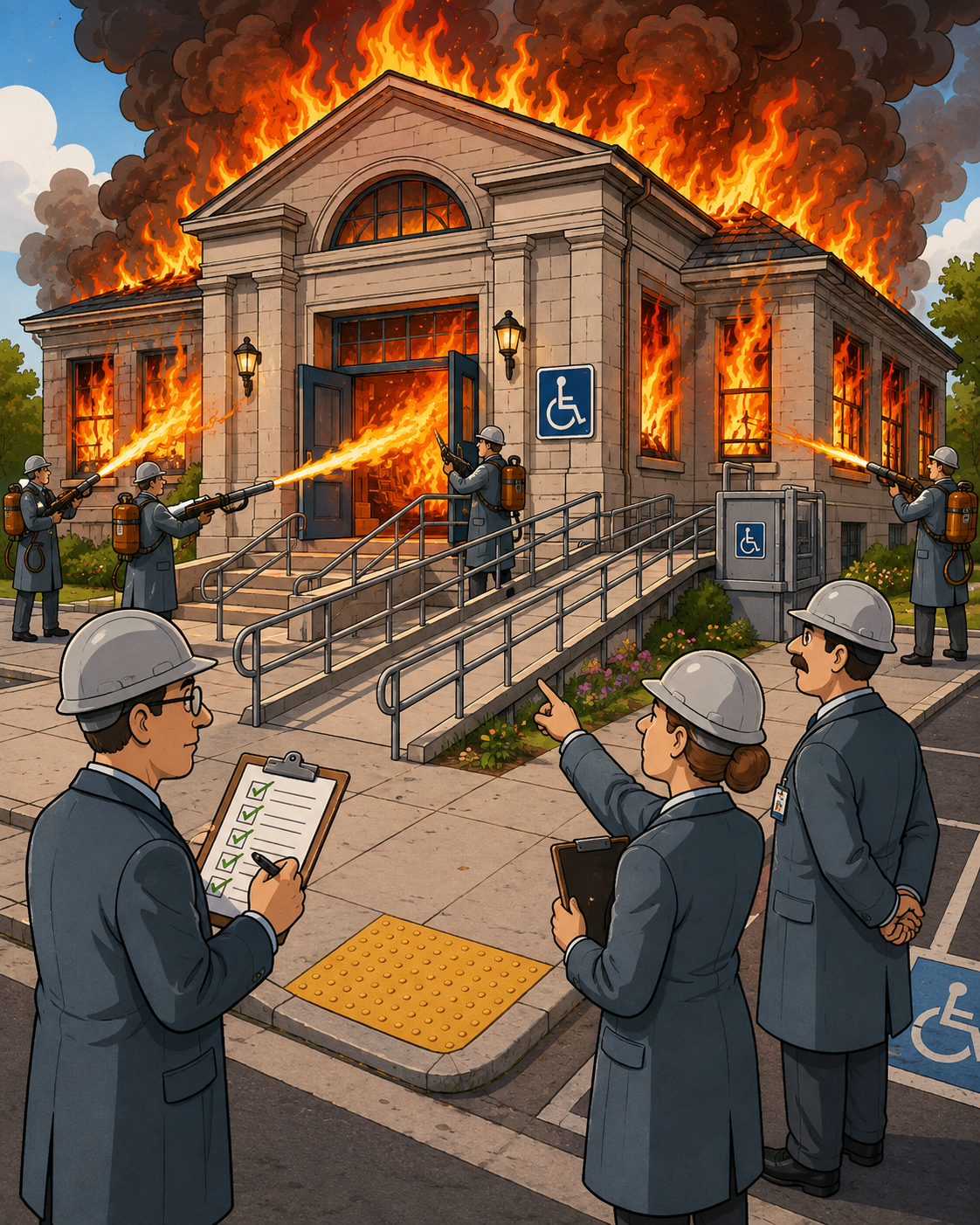
At 3:27 Friday afternoon, the restoration crew filled the library with flame.
Every book was removed from unequal circulation. Every painting, photograph, map, handwritten letter, and uncaptioned object was corrected. The roof collapsed at 4:11. The stone gargoyles lasted until evening.
Nora stood across the street behind the public barrier. She did not cry. She faced the heat with her cane tucked beneath one arm.
When the flames diminished, I entered with the restoration supervisor to conduct the final inspection. The blackened interior was open and simple. No shelves restricted movement. No text privileged readers. No staircase led anywhere.
I lifted a length of pipe to confirm that debris removal had begun. The metal burned through my glove.
The Department’s medical conveyor delivered a treatment kit to my apartment before I arrived home.
My residence was a model unit: one room calibrated to my dimensions and approved tolerances. The bed was twenty-eight inches high. The toilet stood behind a privacy partition whose opacity had been selected by a citizen panel. A wall-mounted fountain dispensed water at the precise rate assigned to my body mass. Meals arrived through a small conveyor door three times a day.
That evening’s tray held rice, a protein supplement, green beans cut into identical lengths, and a vanilla cupcake.
The cupcake was an approved irregularity. Dessert appeared often enough to satisfy pleasure requirements and rarely enough to preserve surprise.
I completed the Department’s nightly wellness survey.
Did today’s labor contribute to universal dignity?
YES.
Did you encounter avoidable difference?
YES.
Was the difference successfully removed?
YES.
The survey congratulated me.
Three days later, my hand had scabbed sufficiently for reassignment.
My next site was the McKenna Gallery of Nineteenth- and Twentieth-Century American Art. The complaint file was substantial. Color-dependent images. Perspective-dependent images. Religious symbols inaccessible to citizens without the relevant cultural background. Portraits that conveyed emotion through facial detail. Sculptures that could be circled but not climbed. The Department had attempted descriptive audio, tactile reproductions, multisensory rooms, guided access, and individualized assistance. These interventions had failed the Same Experience Test.
We began in the basement.
The storage rooms contained hundreds of framed works, some wrapped in paper, some leaning bare against the walls. My team sorted them by remediation method. Wood frames went to Furnace One. Metal frames went to separation. Glass went to pulverization. Canvas, paper, linen, and board were classified according to burn time.
Nora was waiting beside the freight elevator.
“I work here now,” she said.
“That elevator is noncompliant.”
“It works.”
“It produces unequal transit sensations.”
“It goes up and down.”
She held out a folder. Inside were plans for ramps, tactile floor guides, new labels, audio descriptions, quiet hours, touch tours, seating, and a repaired elevator control panel.
“We can make the gallery more accessible,” she said. “Not perfect. More accessible.”
I returned the folder.
“More is not equal.”
“No,” she said. “More is more.”
She walked away before I could record the exchange.
At the rear of the basement, I moved a stack of empty frames and found a small gray print beneath them. It showed pale figures walking in several directions at once. Some climbed stairs that ended upside down. Others entered doors set into ceilings or emerged from walls. The space was impossible, yet every figure appeared to accept it.
Three letters were printed in one corner: MCE.
I stared until the room behind the picture seemed less reliable than the room inside it.
For the first time in my career, I encountered an object that could not be reduced to its access failures. I could not explain what it gave me. I could not determine whether another person would receive the same thing. The uncertainty did not feel unjust.
It felt enormous.
I carried the print upstairs.
“Look at this,” I told my deputy. “What do you see?”
He studied it for four seconds, the maximum inspection time for uncatalogued material.
“Wood frame,” he said.
Before I could stop him, he tossed it into Furnace One.
I reached after it.
The frame had already caught. I pulled it free, and the glass broke against the furnace door. My sleeve ignited. The Department’s synthetic uniform melted instead of burning away.
Someone shouted for the emergency suppression blanket. Someone else shouted that the blanket was still awaiting texture-neutral certification.
I remember Nora striking my shoulders with her coat.
Then I remember nothing.
I awoke in a Department hospital with a blanket folded across my chest.
A physician entered and lowered it to my waist. Both arms ended above the elbow.
“What happened?” I asked.
“Infection made reconstruction inadvisable.”
“Prosthetics?”
“Individualized prosthetics create capability variance. The Department discontinued them last year.”
“I work for the Department.”
“You did.”
The physician smiled with professional equality. “You are now a beneficiary.”
A drinking tube rose from the tray beside me and stopped at my mouth. I drank because it was there.
My apartment had been recalibrated when I returned home. The bed lowered automatically. The toilet no longer required hands. The meal conveyor accepted no dishes because I could no longer return them. A ceiling track repositioned my body according to a schedule developed for adults with bilateral upper-limb absence and no approved personal assistance.
Nora visited once.
Visitors were not permitted inside, so she spoke through the closed door.
“I brought the plans,” she said. “The gallery board approved them. Ramps, descriptions, tactile pieces. Not everything. Something.”
I asked her to open the door.
“The handle’s gone.”
During recalibration, the Department had removed it. Handles privileged people able to operate handles. Staff could open the door from outside with a universal service key, but Nora did not have one.
She stayed for nearly an hour. We spoke through the door about the print. She knew the artist. She described other works with staircases, hands, mirrors, birds becoming fish. I listened until the room seemed to widen.
Then the ceiling track moved me to the bed because it was 8:00 p.m.
The next morning, the wall display presented my first Beneficiary Satisfaction Survey.
DO YOU CONSIDER YOUR CURRENT RESIDENCE ACCESSIBLE?
The choices were YES and COMPLETELY.
“Neither,” I said.
The display repeated the question.
“Open the door.”
The display reminded me that voice commands unrelated to approved residential functions would not be processed.
I tried to lift an arm that was no longer there.
After thirty seconds without a selection, the system chose COMPLETELY on my behalf.
A drinking tube extended toward my mouth.