WELCOME TO THE PLAINSVIEW WORK CARNIVAL!
The words stretched across a white banner above the fairground entrance in letters the colors of hard candy. Beneath them, in smaller print, was the promise that had drawn nearly everyone in town:
FIVE DAYS. ONE HUNDRED CAREERS. DISCOVER WHAT YOU WERE MEANT TO DO.
A ticket booth stood just inside the gate.
General admission was twelve dollars. Work tickets were sold separately. Gloves cost four tickets. Eye protection cost three. Waivers were free.
By nine on Monday morning, families were moving between zones with maps unfolded in front of them. Office Zone occupied the exhibition hall. Food Service filled the midway. FarmLand spread across the livestock barns. Public Works clustered beside the dumpsters. Skilled Trades surrounded a half-built house that was disassembled each evening so visitors could begin again the next day.
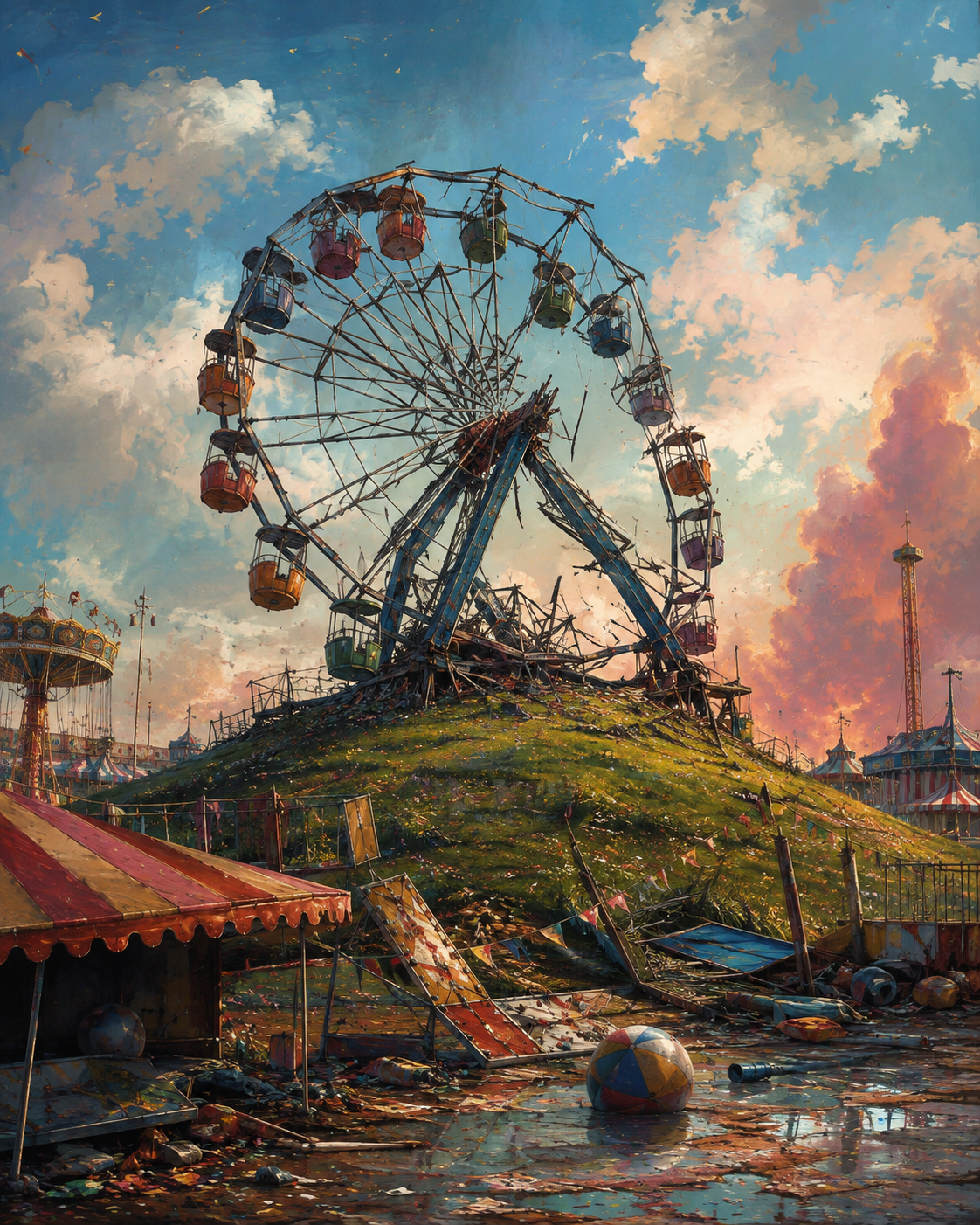
At the center of everything stood the ferris wheel.
It did not carry passengers. A sign beside it read INDUSTRIAL MAINTENANCE EXPERIENCE: NINE TICKETS, and each hour a fairgoer was permitted to climb onto the service platform, inspect the machinery, and make one supervised repair.
Jerry Crawson had been assigned to supervise it.
He had maintained the actual rides at the Plainsview State Fair for sixteen years. The Work Carnival paid him less per hour, but the organizers said the position offered exposure.
“To what?” Jerry had asked.
The director looked confused by the question.
Monday
Trashmaster Clemens drove a dented pickup through Public Works while a ten-year-old boy named Clive stood in the bed wearing orange gloves two sizes too large.
“This here is a mobile profession,” Clemens told him. “You ready?”
Clive’s mother waved from beneath a shade tent. “Have fun! It’s a whole hour!”
Every trash can on the fairgrounds was full by noon. The heat had softened the plastic bags and intensified the smell of fryer grease, manure, lemonade, sunscreen, and meat left in paper trays.
At the first station, Clive pulled a bag too quickly. It split across the bottom. Cups, corn cobs, diapers, and half a funnel cake slid around his shoes.
Clemens explained the proper technique.
“Tie the top. One hand here, one underneath. Lift with your legs. Plastic don’t care how excited you are.”
Clive followed the instructions on the next bag. It held.
“That’s work,” Clemens said.
They moved from station to station. At the Food Service bins, Clemens taught him to redistribute overflowing trash among cans so that none appeared more neglected than the others. Near FarmLand, they separated a dead chicken from recyclable cardboard. Clive asked whether dead chickens were compost.
“Not at a fair,” Clemens said.
When the hour ended, Clive jumped from the truck flushed and grinning.
“How was it?” his mother asked.
“Awesome. Can I do it again?”
Clemens removed the gloves from Clive’s hands. They belonged to the carnival.
“We need to let other people have a turn,” his mother said. “Maybe tomorrow.”
Clemens watched them leave. Then he climbed back into the truck alone. The route was behind schedule.
Tuesday
Nadine and Chloe had attended every Work Carnival since its first year. They began the morning with eight-dollar lemonades and twenty work tickets each.
Nadine had worked in restaurants for twenty-seven years. She wanted to try an office.
A large man in a blue tie stood outside Office Zone ringing a brass handbell.
“Step right up! Experience the satisfaction of a perfectly organized mailroom. Two tickets for thirty minutes. Four tickets for a performance review.”
Nadine chose filing.
The man seated her at a metal desk and instructed her to alphabetize three drawers of client records. After ten minutes, he returned and opened the first drawer.
“Nadine, what on earth is this?”
She looked at the folders. “Alphabetical order.”
“Client files are reverse alphabetical by date of last sale. We went over this.”
“You said alphabetical.”
“Are you arguing with feedback?”
He wrote something on a yellow form.
“I’m sorry,” Nadine said.
“I don’t need apologies. I need solutions.”
She reorganized the files. When the buzzer sounded, the man handed her a card reading SATISFACTORY CONTRIBUTOR and directed her through the exit.
Chloe was waiting beside the break tables.
“How was it?”
“Fantastic,” Nadine said. “Very professional.”
“You look upset.”
“That’s part of it.”
Chloe wanted to try aquarium maintenance. The exhibit contained two tanks without fish. In the first, she sprinkled pellets specially designed to cloud the water. In the second, she scrubbed decorations, siphoned gravel, and balanced the water with measured drops from three bottles.
“You’re a natural caregiver,” the attendant told her.
At the end, Chloe received a stuffed goldfish made in a factory where the people who sewed it could not afford tickets to the carnival.
This fact was not included on the tag.
Wednesday
The Food Service Zone had twenty-five restaurant booths. No visitor was permitted to serve actual customers, but for six tickets they could prepare a meal that would be photographed and discarded.
Jolene Palmer selected Ron’s Stone Grill. She had never eaten there. The menu prices began at forty dollars.
Her instructor placed a marbled ribeye on a tray and explained that the fat would melt through the meat, producing tenderness unavailable in cheaper cuts.
Jolene touched the steak with two fingers.
“My husband and I usually split sirloin,” she said.
“This is an experience,” the instructor replied.
He guided her through searing the meat and sautéing mushrooms and onions. At the end, she poured twelve-year balsamic vinegar into the pan. The smell rose sweet and dark.
The finished plate was beautiful.
A photographer positioned Jolene behind it and told her to hold the tongs higher. She smiled. The flash went off.
“Can I taste it?” she asked.
The instructor laughed, then stopped when he saw she was serious.
“Health regulations.”
He scraped the steak, mushrooms, and onions into a black bin marked DEMONSTRATION WASTE.
Behind the booth, actual kitchen workers ate cold sandwiches while standing beside the grease trap.
At the ferris wheel, Jerry supervised a dentist replacing a belt that did not need replacement.
The dentist wore a spotless canvas apron and asked whether the wheel was dangerous.
“Everything’s dangerous if you loosen the right part,” Jerry said.
The dentist laughed.
Jerry did not.
The wheel had begun making a low knocking sound near the central axle. He reported it to the carnival director, who asked whether the ride carried passengers.
“No.”
“Then it isn’t a ride.”
“It’s still forty tons of steel.”
“Forty tons of educational steel.”
The director promised to review the maintenance request after closing.
At closing, he went home.
Thursday
The Cocoa Pod Husking booth was the first international attraction in Work Carnival history. Its host, Ernesto Muñoz, had been brought from a farm cooperative as part of what the program called an authentic labor partnership.
A full-grown cacao tree stood in a greenhouse enclosure. Bright pods hung from its trunk.
Derek Miller paid four tickets and accepted a machete.
“You do this every day?” Derek asked.
“Not in this shirt,” Ernesto said.
The carnival had given him a white linen costume with embroidery around the collar. The sleeves caught on branches.
Derek climbed the platform beside the tree and hacked at a pod until it fell. On the way down, the machete slipped and opened his forearm.
Blood ran to his wrist.
A small crowd gathered.
“Risks of the job!” the attendant called.
People applauded.
Ernesto took the machete away and wrapped Derek’s arm with gauze. The first-aid supplies were decorative, but Ernesto had brought his own.
“You should get stitches,” he said.
“Do I still get to open the pod?” Derek asked.
Ernesto looked toward the attendant, who nodded.
They split the yellow husk and shook the wet white beans into Derek’s hands. A photographer captured the moment from an angle that did not show the blood.
“You can keep those,” the attendant said. “A mark of your accomplishment.”
Derek left for the medical tent carrying the beans in his uninjured hand.
That afternoon, Jerry found three bolts on the ferris wheel axle turned a quarter rotation in the wrong direction.
He tightened them and closed the exhibit.
Within ten minutes, the carnival director arrived with two security officers.
“You can’t close a premium experience without authorization.”
“It needs a full inspection.”
“Then supervise more closely.”
“I’m supervising people who paid to touch the machine.”
“That is the experience.”
“The experience is going to kill somebody.”
The director lowered his voice. “Jerry, people come here because their real jobs don’t make them feel useful. Don’t take this away from them.”
He reopened the line.
Friday
By the final day, the fairgrounds had developed the exhausted smell of trampled grass and old oil. The trash route was two hours behind. Demonstration waste had filled three refrigerated dumpsters, only one of which was working. Nadine had returned to Office Zone to attempt the performance review. Clive was back in the pickup with Clemens. Jolene stood in line to repair a residential air conditioner.
The ferris wheel knock had become a hammering pulse.
Jerry submitted another maintenance request at 8:12 a.m.
At 8:40, the director marked it RECEIVED.
At 9:05, a ninety-five-pound accountant named Sheila climbed onto the service platform for the Industrial Maintenance Experience.
Jerry explained the axle assembly. He showed her the grease fittings, the retaining plate, and the bolts that were never to be touched.
“These?” Sheila asked.
“Especially those.”
She nodded.
A family nearby asked Jerry to take their photograph. He turned for less than a minute.
Behind him, a ratchet clicked.
He spun around.
Sheila was leaning her full weight against the handle.
“Stop.”
“I’ve almost got it.”
“Which way are you turning?”
“Left to tighten.”
“Right. Right to tighten.”
The wheel gave one enormous metallic pop.
The retaining plate split.
For a moment, nothing moved. The wheel remained upright against the blue sky, every empty seat rocking gently on its hinge.
Then the axle slipped from its housing.
The wheel tilted.
Sheila froze on the platform.
Jerry caught her by the waist and pulled. Her right arm remained trapped between two sections of the frame. The wheel tore her free and dropped into the grass with a force that threw both of them from the platform.
It began to roll.
The maintenance hill had been constructed above the rest of the fairgrounds so visitors could appreciate the scale of the machinery. The wheel gathered speed immediately.
Jerry ran after it, shouting.
It crossed FarmLand first. Ernesto dragged two children away from the cacao enclosure seconds before the wheel flattened the greenhouse. Pods burst beneath the steel rim.
It struck Food Service and carried Ron’s Stone Grill thirty feet. Demonstration steaks, fryer oil, and twelve-year balsamic poured across the midway.
It tore through the aquarium exhibit, releasing four thousand gallons of empty water.
It passed through Office Zone, where client records rose into the air in perfect reverse alphabetical order.
Finally, the wheel crashed into the dumpsters beside Public Works. Bags split. Five days of the carnival spread across the field.
For several seconds, no one moved.
Then the crowd began to clap.
The applause spread from one zone to another. People laughed, cheered, and lifted their phones. A man beside Jerry said he had wondered how they were going to bring all the careers together for the finale.
Sheila lay near the hill, conscious and screaming. Her arm bent in a direction no demonstration had prepared her for.
Clemens abandoned the pickup and ran toward her. Ernesto arrived with his first-aid bag. Actual workers emerged from behind booths and beneath tents: cooks, cleaners, electricians, animal handlers, security guards, mechanics. They moved through the applauding crowd and began doing the work no one had purchased.
The carnival director climbed onto a picnic table with a microphone.
“Ladies and gentlemen,” he said, breathless, “you have just witnessed the first-ever Integrated Crisis Response Experience.”
The crowd roared.
He covered the microphone and turned to an assistant. “How fast can we print a sign?”
“Five minutes.”
“Twelve tickets. Make it fifteen.”
A line formed before the sign was finished.
Visitors paid to carry bottled water, hold bandages, direct foot traffic, and move trash from one side of the field to the other. Gloves were still four tickets. The people closest to Sheila purchased the premium observation upgrade.
Jerry knelt beside the ruined axle. The knocking had finally stopped.
Over the loudspeakers, a recorded voice thanked everyone for visiting the Plainsview Work Carnival.
“See you tomorrow,” it said.
The carnival was scheduled to end that night, but no one corrected the recording.