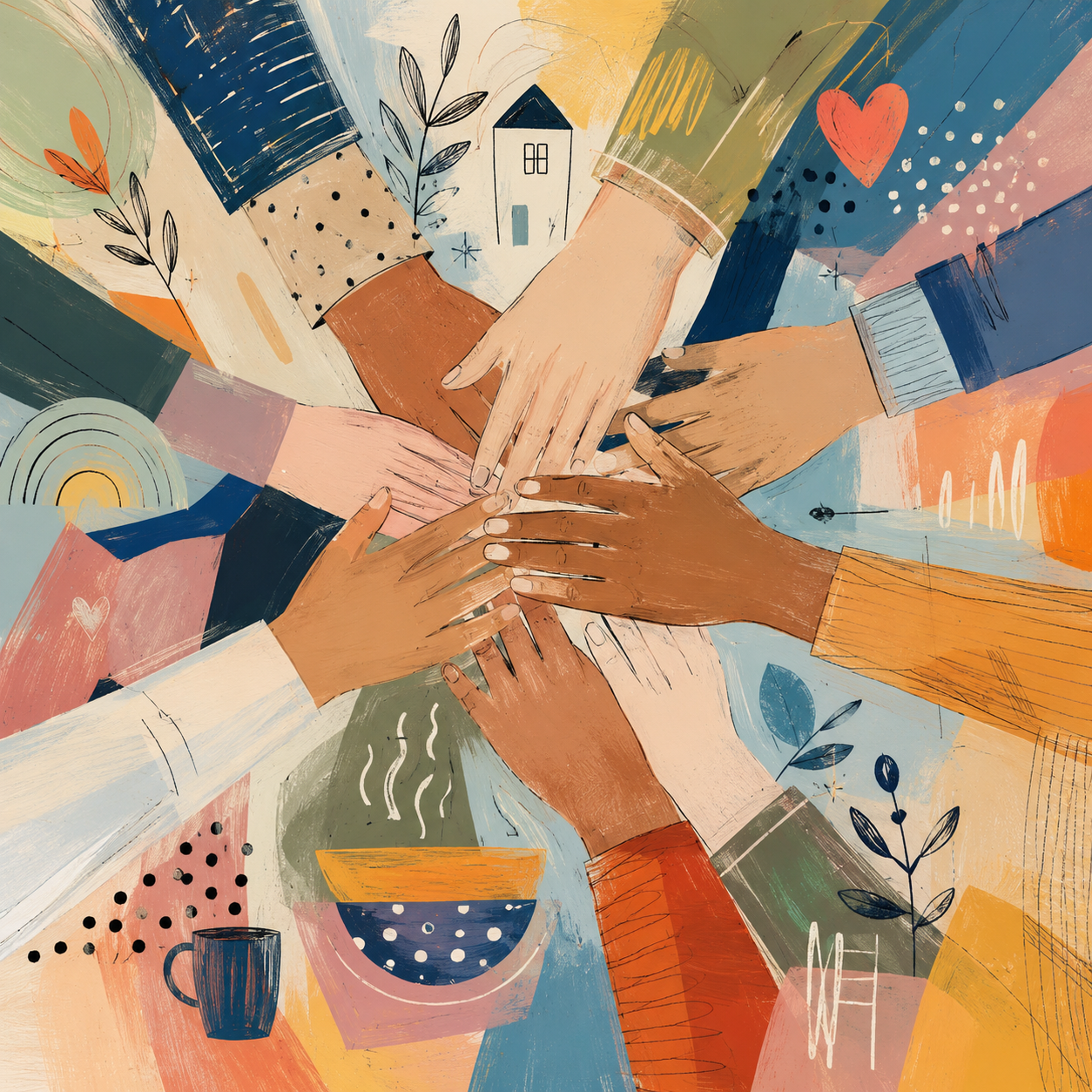
For the past couple of months, since Wyatt was born, my parents and Christa’s parents have been coming over almost every night to help with dinner and bedtime for the girls.
That sentence is plain, but the thing itself has not felt plain.
It has meant bodies in the house at the hardest hour of the day. It has meant plates on the table, children being carried upstairs, pajamas found, teeth brushed, somebody answering the question that was just asked six times in a row. It has meant one adult taking one child while another adult takes another child while a newborn makes his small, absolute claims on the room. It has meant the difference between a difficult evening and an impossible one.
I have said thank you. I have said I love you. I meant both.
Still, the words kept feeling inadequate.
Not false. Not empty. Just too small for the thing they were supposed to hold.
“Thank you” is a good phrase. I do not want to become so suspicious of ordinary language that I dismiss one of the few decent phrases we have. It matters to say it. It matters to let people know their care has not gone unnoticed. Gratitude should not have to infer itself from silence.
Still, there are forms of help that seem to exceed the sentence meant to carry them.
Someone comes over again. Someone holds the baby. Someone distracts Charlotte. Someone helps Rowan through whatever the evening requires. Someone keeps the house from becoming nothing but need. You say thank you, because of course you do. Then they come back the next night and do it again.
After a while, the words feel less like an answer than a hand reaching toward something still in motion.
I had wanted to write about this for a while. I could feel the shape of it, but I could not find the angle. Every version became either too sentimental or too obvious. Yes, family helps. Yes, parents help their children. Yes, grandparents show up. None of that was wrong, but none of it seemed to name the ache I kept feeling after saying the words.
Then my sister landed in the ICU.
A Name too Clean for What Happened
What happened to her has a medical name: spontaneous coronary artery dissection, or SCAD.
The name is almost offensively tidy. It sounds like something that belongs in a chart, which of course it does. It does not sound like a wife and mother of two suddenly being pulled out of ordinary life. It does not sound like CPR. It does not sound like sedation. It does not sound like everyone trying to understand the difference between “awake,” “aware,” “stable,” and “recovering” while the mind keeps attempting to make those words into guarantees.
I later learned that SCAD often affects women who do not fit the usual picture people carry around of heart disease. The American Heart Association notes that patients are often postpartum or postmenopausal women, frequently with few or no traditional heart-disease risk factors. That fact does not explain what happened in any satisfying human sense, but it does name part of the bewilderment. A body can be young, loved, needed, and still become suddenly vulnerable.
For a little while, all language became practical.
What did the doctors say?
Who has the girls?
Who is going where?
What does the baby need?
What time is the next update?
Who can be at the hospital?
Who can be at the house?
Christa and I were not the only ones helping. I want to be careful about that. Emergencies can distort memory, and I do not want to turn a communal response into a story where we were somehow the center of it. We were one part of a larger network. One pair of hands among many.
Still, we were able to help watch my sister’s girls. Christa had frozen milk that helped keep my sister’s newborn fed. While we were helping there, Christa’s parents were helping with our girls. My parents were helping too. Other people were doing their parts. Care moved in several directions at once.
That was when the essay finally opened for me.
I had been thinking of gratitude as a problem of expression. How do I say thank you in a way that is large enough? How do I make the sentence match the gift?
The emergency changed the question.
Maybe the deepest thank-you was never going to be hidden inside better phrasing. Maybe, in a family, gratitude is not something you complete in language. Maybe it is something you enter.
The Family as a Circulation System
There is a dry phrase for this kind of thing: social support.
I understand why researchers use it. They need language that can be studied, measured, compared, and written into a paper. Social support can mean emotional concern, practical help, information, companionship, material resources, the presence of people who make suffering less solitary. Studies after heart attacks have found that people with lower perceived social support tend to have worse health status, lower quality of life, and more depressive symptoms during recovery.
That is important. It is also nowhere near strange enough for what it feels like from inside a family.
From inside, it does not feel like a variable.
It feels like someone opening your front door at five o’clock. It feels like a freezer full of milk becoming, unexpectedly, not just a private supply for your own baby but a way to keep another baby fed. It feels like one household leaning toward another while a third household leans toward yours. It feels like love developing extra hands.
No one was keeping score. No one was balancing a ledger. The help my parents and Christa’s parents had been giving us every night was not sitting there as a debt, waiting for some grand repayment. It was already changing the structure of our days. It was making us more able to stand.
Then, when my sister’s family needed help, some of that steadiness moved through us and outward again.
Not repayment.
Not obligation.
Not virtue.
Just love continuing.
That may be the part I had not understood yet. I thought my problem was that thank you felt insufficient. The deeper problem was that I had mistaken thank you for a container, when maybe it is more like a doorway. You say it, and then you walk through it into the life it implies.
Gratitude, at its best, does not end in appreciation. It becomes availability.
Research on gratitude has shown something close to this in its own careful way: gratitude can make people more willing to help, even when helping costs them something. That sounds familiar to me now, though I would translate it out of the lab and into the kitchen. Gratitude is not just the warm feeling after receiving care. It is the strange new readiness to become useful when the next need appears.
Love in Ordinary Clothes
I keep returning to the same thought: love is often much less dramatic than the word love.
That does not mean smaller. It may mean the opposite.
Love is dinner. Love is bedtime. Love is a text message answered quickly. Love is a car seat moved from one vehicle to another. Love is someone knowing where the pajamas are. Love is a baby fed by milk that was stored for a different baby. Love is grandparents showing up again, tired but present. Love is standing in a living room and quietly recalculating everyone’s evening because the old plan no longer matters.
Love is not always a speech. Sometimes it is logistics.
I think I used to feel a faint embarrassment about that. Not consciously, maybe, but somewhere underneath. Logistics sounds like the opposite of transcendence. It sounds like schedules, errands, pickup times, dinner plans, bags packed badly, someone asking where the wipes are.
Yet this is where most of love actually lives.
Not all of it. I do not want to reduce love to utility. There are moments of tenderness that have no practical purpose and need none. A hand held in a hospital. A child asleep against your chest. Someone saying, “I’m here,” and meaning it. Those things matter too.
Still, when life becomes frightening, love has to become functional. It has to take shape in the world. It has to make a bottle, watch a child, clear a path, send a message, drive the car, hold the household together for one more night.
There is a kind of grace in that, though not the kind that glows. More like a hinge that keeps working. A table that holds. A handrail exactly where the hand reaches.
Maybe this is why thank you felt too small. I was trying to answer a structure with a phrase.
My parents and Christa’s parents were not just helping with tasks. They were helping build a temporary architecture sturdy enough for us to live inside. Then, during my sister’s emergency, that architecture expanded. It made room for another family’s crisis. It became, for a little while, something larger than any one household.
What I can Say Now
My sister is awake now. Aware. Recovering at a pace that feels remarkable after the terror of those first hours and days.
That does not mean everything is fine. I do not want to write one of those clean recovery sentences that rushes past the actual recovery. She has not made a full recovery. Everyone is still tired. The body keeps its own timeline. Fear does not vanish just because relief has arrived.
Still, awake and aware are not small words.
They are enormous words.
They are words a family can live on for a while.
In the space opened by those words, I have found a better version of the essay I had been trying to write. Not a complete answer, but a truer one.
I still believe in saying thank you. I will keep saying it. I will say it to my parents and to Christa’s parents and to everyone who showed up in the ways they could. I will say I love you too, because love should not have to decode itself from usefulness alone.
Yet I am less troubled now by the insufficiency of the phrase.
The insufficiency is not a failure. It is a clue.
Some things are too large to be finished in language because they are not meant to be finished there. They are meant to keep moving. Through dinners. Through bedtimes. Through hospital waiting. Through frozen milk. Through children being watched by one set of hands while another set of hands reaches somewhere else.
Thank you is still the right thing to say.
It is just not the whole thing.
The whole thing, or something closer to it, is familial. Communal. Practical. Repeated. It is what happens when care received becomes care offered, not because anyone has calculated the exchange, but because love has made people available to one another.
I do not want to pretend I have found some final wisdom here. I have not. I have only found a better understanding of why the words felt too small.
They felt too small because they were.
They were supposed to be.
A phrase can mark gratitude, but it cannot contain it. The real thank-you keeps going after the sentence ends. It becomes a person at the door. It becomes a freezer opening. It becomes grandparents at bedtime. It becomes nieces held close while their mother heals. It becomes one family helping another family while being helped in turn.
It becomes love, not as an idea, but as a thing people do.
I will still say thank you.
Now I understand that sometimes the deepest version is not spoken once.
It is lived forward.
Ir Kept Moving:
I am seeing this again now as we prepare for my trip to Mayo. Christa has been extraordinary, not only in the obvious ways, though those matter too, but in the quiet administrative ways that become their own kind of love. Forms filled out. Calls made. Details remembered. The invisible scaffolding of a trip like this, especially one tangled up with illness and uncertainty, does not assemble itself. Someone has to hold the dates, the costs, the questions, the logistics, the fear. She has been holding so much of it with me, and sometimes for me.
What has surprised me, though maybe it should not have, is how quickly the circle widened. Family and friends have offered help before I even knew exactly what to ask for. Some of it has been practical. Some of it has been monetary, help with food, travel, the strange extra expenses that appear whenever medical care requires leaving home. Some of it has simply been people saying, clearly and without performance, we are here, tell us what you need, we want to help somehow. It is humbling. It lowers me out of the illusion that I am supposed to carry this neatly. It reminds me that the thank-you is still moving, still becoming a ride, a meal, a message, a little money passed along, a hand placed under one corner of a weight that was never meant to be lifted alone.
Keeps moving forward
A more circular forward
akin to pure help