The Shape of Repair
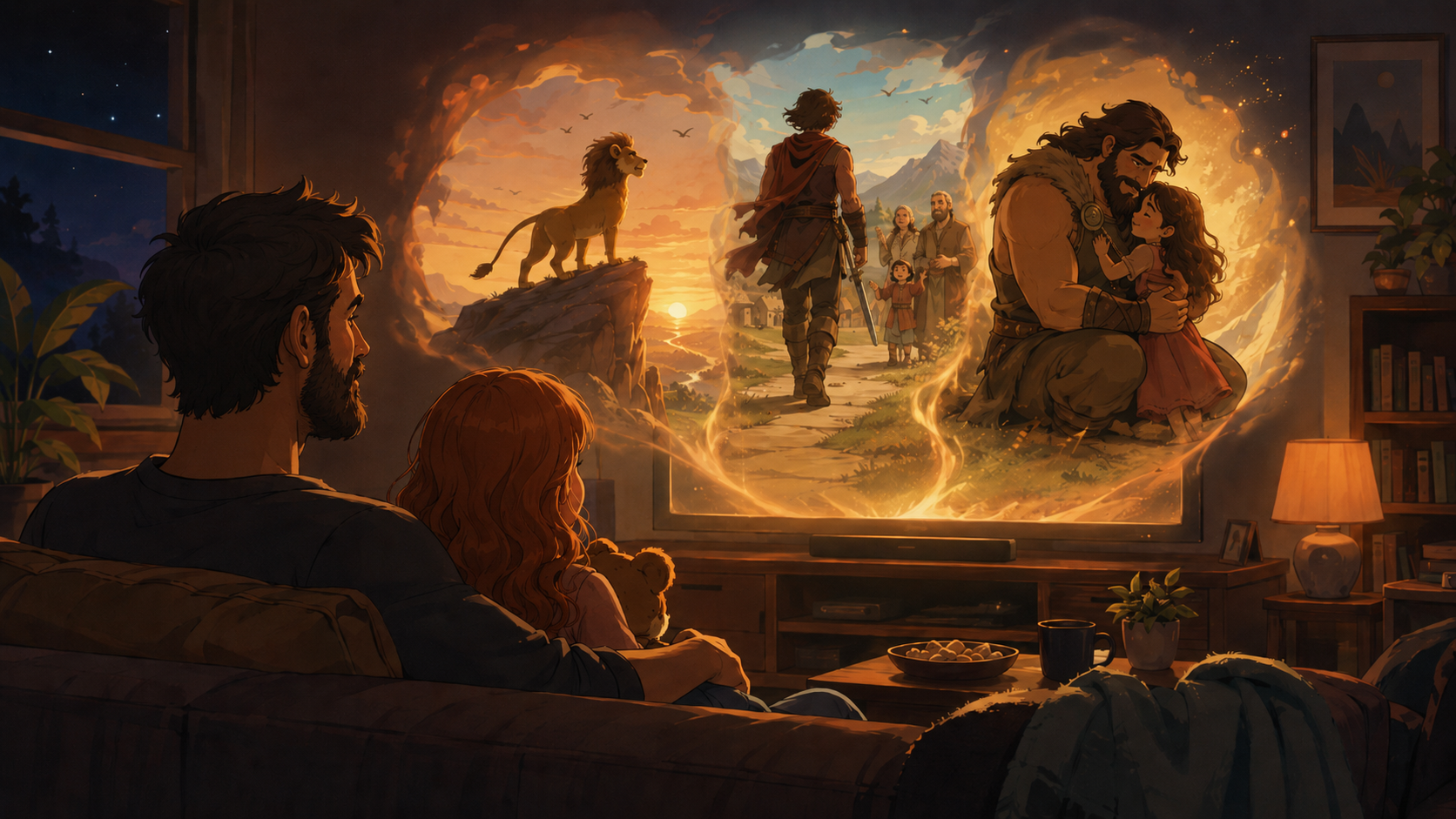
We finally let Charlotte watch The Lion King. (okay, not "we" really because I basically unilaterally decided. We were waiting because there are more sad/scary parts than the other movies. But, she could handle it).
This feels like a small parenting milestone, though of course it is also just a child watching a movie with lions in it. Parenting is full of these double meanings. Something happens in the living room, and part of me is simply the father watching my daughter watch a movie, while another part of me is suddenly standing in some older room inside myself, remembering what the movie meant before I had language for it.
With The Lion King, Charlotte has now watched my three favorite Disney movies: The Lion King, Mulan, and Hercules. I do not know why I had never lined them up that way before. Favorite things often live in us without being sorted. They are not arguments yet. They are not essays. They are just places we keep returning to.
Then I noticed the obvious thing.
All three are redemption stories.
Not in the same way. Not with the same wound. Not even with the same idea of what redemption means. Simba, Mulan, and Hercules are not walking the same road. One runs from a guilt that was planted in him. One hides in order to reveal herself. One tries to earn his way into heaven and has to learn that worth cannot be measured by applause.
Still, all three stories turn on some version of return. Someone is exiled from himself, herself, or home. Someone believes the wrong story about who they are. Someone has to pass through shame, concealment, failure, longing, or grief and come back changed.
Maybe that is what I loved before I knew I loved it.
Not the songs, though the songs are obviously doing a lot of work. Not the jokes, though I still believe Hercules is funnier than it gets credit for. Not even the animation, though I could make a whole separate case for the opening of The Lion King as one of the great introductions in movie history.
What I loved, I think, was the shape.
The person leaves. The person breaks. The person returns.
I am less sure that redemption is the right word for what I want.
Three Ways Back
Simba’s redemption is the most direct, and maybe the most brutal. He is a child when he is made to believe that he has destroyed what he loves. Scar does not simply lie to him. He gives him a story to live inside. That may be the most frightening kind of lie: not the kind that asks to be believed for a moment, but the kind that becomes a room.
Simba grows up inside that room. Hakuna Matata is charming because it is charming, but it is also a philosophy of avoidance dressed in bright colors. No worries. No past. No responsibility. No grief that has to be touched directly. It is not nothing. It helps him survive. There are worse things than finding a way to breathe after horror. There are worse things than laughter, friendship, food, and distance.
Still, distance is not freedom.
The past keeps its hand on him. It waits in the body. It waits in the face of someone who knew him before he disappeared. It waits in the voice of his father, or maybe in the part of himself that can still recognize his father’s voice. Simba does not become redeemed because he wins a fight. The fight is the theatrical part. The real turn happens before that, when he stops treating shame as the whole truth.
Mulan’s story is different. She is not running from a crime or a lie planted by someone else. She is trapped in a world too small for her. The crisis is not that she does not know who she is. The crisis is that there is no approved shape for what she is.
That is what makes her arc feel so different from a simple disguise story. Mulan hides, yes, but the hiding is also a form of revelation. In trying to protect her father, she steps outside the life assigned to her and discovers capacities nobody around her had known how to see. Maybe she had not fully known how to see them either.
Her redemption is not a return to obedience. It is not the restoration of the old order with a small exception carved out for one impressive girl. The emotional power comes from recognition. Her father sees her. The emperor sees her. The people see her. More importantly, she sees herself without needing to shrink back into the earlier version of the room.
Hercules may be the strangest of the three, because his wound is wrapped in comedy. He wants to belong somewhere. He wants an origin that explains him, a home large enough to hold his difference. His whole story seems to be about becoming a hero, but the movie spends most of its time showing how easy it is to mistake performance for worth.
He becomes famous. He becomes strong. He becomes admired. He has merchandise. He has a song. He has the ancient Greek version of a personal brand, which is to say he has already lost the plot.
His redemption comes when he gives up the thing he thought would save him. He does not become a true hero because he performs heroism correctly. He becomes one because he loves someone more than he loves his own elevation. He lets go of the scoreboard. He stops trying to prove he belongs among the gods and becomes, for once, fully present on earth.
I did not think about any of this when I was a kid.
As a kid, I loved the lion reclaiming the kingdom, the girl saving China, the awkward demigod becoming whole. Now I watch them with my daughter and realize I was watching three versions of the same impossible hope.
Maybe you can come back.
Maybe what was hidden can be seen.
Maybe what was broken can still move toward love.
What Redemption Gets Wrong
The word redemption is not quite right for me.
That is partly because redemption sounds moral. It suggests guilt, debt, sin, wrongdoing, failure, some fall from grace that must be answered by transformation. In the stories, that makes sense. Simba has to face what he believes he has done. Mulan has to face the consequences of breaking the rules of her world. Hercules has to learn that chasing glory has kept him from understanding love.
But, that is not exactly the chord those stories strike in me now.
I am not thinking of redemption because I believe I did something in the past that I need the world to forgive. I am not looking for a public clearing of the record. I am not trying to turn my life into a courtroom drama with better lighting and a final speech.
The thing I recognize is deeper and less clean than that.
I recognize the longing for repair.
That is different.
Disability is not a moral failure. Illness is not a character arc. A body that becomes harder to live in has not done something wrong. Vision loss is not shame. Fatigue is not a flaw. Pain is not a verdict. There is no original innocence to recover by becoming braver, kinder, more disciplined, or more worthy.
This is where redemption stories can get dangerous if I take them too literally. They can make healing look like a final victory. They can imply that if the story is told well enough, what was broken will be restored in a way everyone can see. The lion returns. The emperor bows. The gods open the gate.
Life with disability does not usually move like that.
There may be no restored kingdom. No old body waiting on the other side of effort. No single moment where the music rises and the wound becomes meaningful enough to justify itself. Some losses do not become beautiful just because I learn how to live with them. Some pain remains pain. Some limits remain limits. Some days ask for more than I have and do not apologize for asking.
So, no, redemption is not quite the word.
Repair is closer.
Healing is closer.
Not because healing means cure. Not because repair means I get to become the earlier version of myself again. I do not want a cheap version of hope, where everything hard is secretly a gift and every loss is just a lesson with better timing than I can understand.
I want a hope that can survive contact with the actual life.
Healing, for me, is not the reversal of disability. It is the slow work of living honestly inside a changed body and still finding ways to love, make, notice, laugh, parent, rest, and return. It is not being fixed. It is becoming less divided from the life I have.
What my Daughter Was Watching
Charlotte was not watching all of this, of course.
She was watching animals and songs and jokes and danger. She was watching the movie as a child watches a movie, which is to say more purely than I can. Children do not need to translate everything into an argument about shame, embodiment, disability, and repair. They receive the story before it hardens into interpretation.
I envy that a little.
I also love being on this side of it. I love watching her meet the stories I have carried for years. There is something strange and tender about introducing your child to an old favorite. You are not just showing them a movie. You are offering them a small piece of your own interior architecture and hoping they find a room in it they like.
She does not need to love them the way I do. She does not need to inherit my meanings. In fact, I hope she does not. I hope she gets her own stories from them. I hope she sees things I missed. I hope she notices some tiny gesture or joke or image that never mattered to me and makes it hers completely.
Still, I could not help seeing the pattern once it appeared.
These three movies stayed with me because all three are about a life refusing to end at the point of rupture. Simba’s life does not end with the lie. Mulan’s life does not end with the role she was handed. Hercules’ life does not end with being admired for the wrong things.
Something in them keeps moving.
That is the part I want to believe in.
Not redemption as a grand announcement. Not the clean ending. Not the lifted crown, the bowed emperor, the glowing stairway to Olympus. Those are beautiful images, and I am not immune to them. I am exactly the kind of person who is vulnerable to them. Give me the music at the right moment and I will apparently spend the next thirty years carrying the story around inside me.
But, the part I trust more now is quieter than that.
The return.
The turn back toward what matters.
The refusal to let pain become identity.
The refusal to let limitation become the whole story.
The refusal to confuse being whole with being unbroken.
Healing Is Another Kind of Return
I do not think I am looking for redemption.
I think I am looking for repair.
That may sound smaller, but it feels more honest. Redemption belongs to the public shape of a story. Repair belongs to the daily texture of a life. Redemption asks whether a person can be restored. Repair asks what can still be made livable, tender, useful, and true.
I can believe in that.
I can believe in the kind of healing that does not erase disability but changes my relationship to it. I can believe in tools, accommodations, rest, stubbornness, humor, medication, therapy, family, and the thousand small adjustments that make a life more possible. I can believe in learning the new map of the body, even when I resent the fact that I need one.
I can believe in a healing that includes grief.
That matters to me. Any version of healing that cannot make room for grief is too fragile to trust. I do not need optimism that asks me to clap for everything that hurts. I need optimism that can sit beside the hurt and still say: this is not the whole of you.
Some nights, the best version of me is not heroic. It is tired. It is frayed. It is running on fumes and love and whatever small reserve remains after the day has taken its share. There are moments when the only thing I can still offer is presence, and even that may be imperfect. A song before bed. A kiss blown from the doorway. An “I love you.” A “thank you.” A willingness to try again tomorrow without turning that tomorrow into a guarantee.
That is not a redemption arc.
It is not cinematic enough.
Nobody gives you a medal for adapting. Nobody bows when you use the tool that helps you read, or rest before the crash, or admit the thing you can no longer do the same way. Nobody sees the private negotiations between pride and need. Nobody applauds the moment you stop pretending that pushing harder is the same as being strong.
Still, those are returns.
Small ones. Unseen ones. Repeated ones.
A life may be changed less by one dramatic homecoming than by a thousand quiet returns to what is still possible.
That is what I hope Charlotte sees someday, though not yet. For now, she can have the lions and the songs and the funny sidekicks. She can have the thrill of the story before it becomes a mirror. Childhood should get to receive beauty without immediately being asked to explain it.
I will do the explaining over here, probably too much, because that is one of the ways I have learned to live.
I watched my daughter watch The Lion King, and I realized that three of my favorite childhood movies had been telling me the same thing in different languages. Come back. Be seen. Love more than you want to be admired.
I do not know if that is redemption.
I know it sounds like repair.
And, for now, repair is the story I can believe.
We were both watching
Neither of us the same thing
She gets her own