A Shape Attention Takes
The Envelope Was not Just an Envelope
I did not expect stationery to get me.
That feels safe to admit. There are plenty of things I expected to care about: books, music, movies, strange philosophical arguments that ruin a normal afternoon. Stationery was not on the list. Typography was barely on the list, except in the vague way anyone who writes eventually develops a few preferences and mistakes them for principles.
Then I married someone who can look at paper stock, spacing, ink, margins, and the small ceremonial architecture of an invitation and see a whole world of decisions.
At first, I thought I was watching taste at work.
I think now I was watching attention.
That distinction matters. Taste can sound like preference dressed up for company. I like this. You like that. One person loves ornament. Another wants everything stripped down to its bones. Fine. Everyone gets an opinion and nobody has to be wrong.
Aesthetics is something else. Not completely separate from taste, but deeper than taste. It asks what a thing is doing, how it is doing it, and why its form matters.
In philosophy, aesthetics is the study of questions around beauty, art, taste, perception, experience, and value. That sounds abstract because it is, but the basic questions are immediate. What makes something beautiful, ugly, graceful, awkward, moving, cheap, balanced, strange, or sublime? Are those judgments only personal reactions, or do they point to qualities we can discuss and argue about? The Stanford Encyclopedia of Philosophy notes that the term “aesthetic” has come to refer not just to objects, but also to kinds of judgment, attitude, experience, and value. In other words, aesthetics is not only about whether we like something. It is about how appearance, perception, feeling, and meaning become tangled together.
A margin can be generous or cramped. A typeface can welcome you in or keep you at a distance. A piece of paper can feel cheap, ceremonial, playful, severe, delicate, or false. A sentence can move like thought, prayer, panic, testimony, machinery, gossip, scripture, or a joke told by someone trying not to laugh.
None of that is accidental once you begin to see it.
This was the surprise for me. I had not dismissed aesthetics exactly. I had taken philosophy courses in undergrad. I had read arguments about art and beauty and interpretation. I knew, at least in theory, that aesthetics was a serious field. Still, there is a difference between knowing a thing belongs to philosophy and watching your wife make choices about paper that somehow change how an event begins before anyone has arrived.
The invitation is not the marriage. The envelope is not the event.
Still, it matters.
It tells you how to arrive.
The Sticks on the Beach
In college, I read Arthur C. Danto’s The Transfiguration of the Commonplace: A Philosophy of Art, or at least enough of it for certain questions to get lodged permanently in my head.
Danto was an American philosopher and art critic whose work became central to twentieth-century conversations about art and aesthetics. The Transfiguration of the Commonplace, first published by Harvard University Press in 1981, asks what makes something art when it may look exactly like an ordinary object. The problem is not just whether a painting is beautiful or skillful. The deeper problem is why two visually identical things can belong to different categories: one merely an object, the other a work of art. Harvard’s description of the book frames it around recent developments in art that produced works that cannot be told from ordinary things, which made a new theory of art necessary.
The example I remember most vividly may be a classroom example attached to Danto rather than Danto’s exact example, but the shape of it stayed with me.
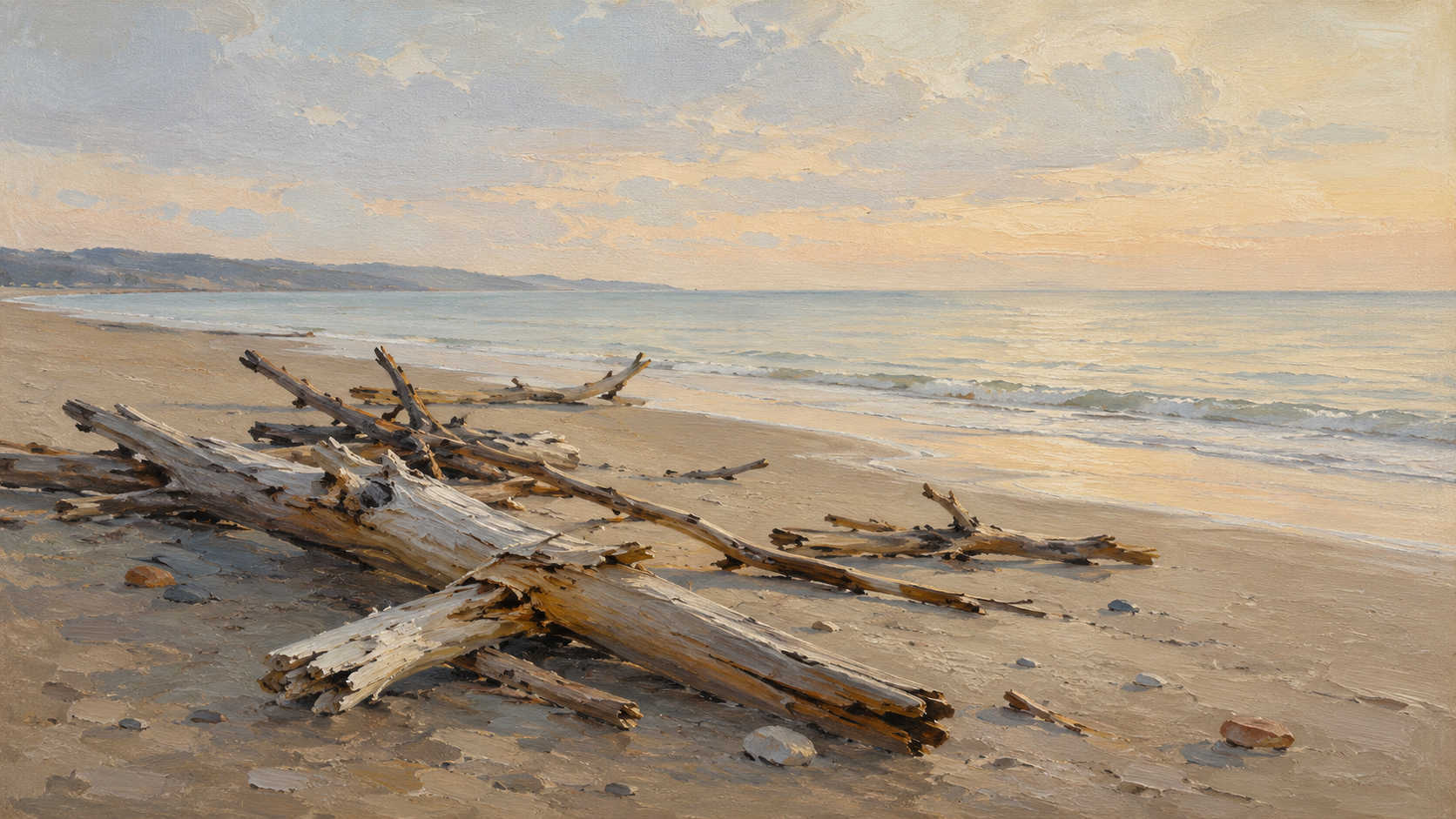
Imagine sticks washing up on a beach and forming a recognizable pattern.
Is it art?
At first, the answer seems obvious: no. The sticks just landed that way. Nobody arranged them. Nobody meant anything. They are a coincidence with good spacing.
Now imagine someone arranging identical sticks into the same pattern.
Has anything changed?
Visually, maybe not. The sticks are still sticks. The beach is still a beach. The pattern is still the pattern. Yet something has shifted. Intention has entered. Framing has entered. A human being has made a decision and asked the world, however quietly, to look.
That is where aesthetics gets interesting. Not in the easy cases, where a painting looks like a painting and a sculpture looks like a sculpture, but in the borderlands where a thing and an artwork might appear identical from the outside.
Danto’s larger point, as I understand it now, was that art cannot be defined only by what something looks like. Two objects can be visually indistinguishable, yet one can be art and the other not, because history, meaning, context, and interpretation change what the object is.
That idea still feels useful. Maybe more useful now than when I first encountered it.
Because life is full of things that change depending on the frame.
A soup can in a grocery store is one thing. A soup can in Warhol is another. A urinal in a restroom is one thing. Duchamp’s Fountain is another. A pile of sticks on a beach is one thing. A pile of sticks arranged, titled, photographed, remembered, argued over, and placed in a gallery of attention becomes something else.
The object does not have to change for the encounter to change.
That is also true outside museums. A wedding invitation is a piece of mail, except it is not only a piece of mail. A book cover is packaging, except it is not only packaging. A font is a font, except it carries an entire mood before the first word has done any work.
Aesthetics is what begins when appearance becomes meaningful.
That does not mean every pleasing accident is art. It does not mean every pretty thing is deep. It means the question is not settled by looking once and shrugging.
The sticks may not be art.
The question is why we feel the need to ask.
Style Is Thought With a Body
Writing makes this impossible to avoid.
There is a lazy way to talk about style as if it were the outfit meaning puts on after the real work is finished. First you have the idea. Then you decorate it. Then you decide whether the prose should be plain, ornate, funny, solemn, spare, maximalist, or strange.
This is wrong, or at least not wrong enough to be useful.
Style is not the surface added to thought. Style is the way thought moves.
David Foster Wallace does not sound like Cormac McCarthy. McCarthy does not sound like Borges. Borges does not sound like Chekhov. Chekhov does not sound like any of them. The differences are not ornamental. They are not interchangeable coats hung over the same skeleton.
Wallace’s sentences often feel like consciousness trying to catch itself in the act. They loop, qualify, reverse, accuse themselves, open trapdoors, apologize, refuse the apology, and keep going. His style is not just “long sentences.” It is a moral and psychological condition made grammatical.
McCarthy’s prose often feels carved rather than written. His sentences can move with biblical force, then narrow suddenly into plain brutality. He can make landscape feel ancient and indifferent, then place one human gesture inside it like a match struck in a cave. His style is not merely “serious” or “violent” or “beautiful.” It is a worldview made rhythmic.
Borges can make a paragraph feel like a labyrinth disguised as a summary. He writes as if the essay, the fable, the archive, the dream, and the theological joke were always secretly the same room. His style is thought folding itself into a smaller and stranger shape.
Chekhov is the miracle of restraint. Nothing appears to be forced. Nothing announces itself as profound. A person enters, speaks, fails to understand themselves, leaves, and somehow the whole machinery of human longing has been placed on the table. His style can seem almost invisible until you realize the invisibility is the discipline.
This is why aesthetics is not mere opinion. Preference matters, of course. You can love one writer and bounce off another. You can admire Wallace and still feel exhausted by him. You can recognize McCarthy’s power and still need to leave the room. You can find Borges dazzling, chilly, funny, sacred, or all of those at once.
Still, the differences can be discussed. They can be felt and examined. They can be argued over with something more substantial than “I liked it” or “I didn’t.”
A sentence has weight, velocity, grain, pressure. It has timing. It has breath. It has a relationship to silence.
A short sentence after a long one is not only shorter. It changes the room.
A paragraph break is not empty. It is a hinge.
A repeated word can be lazy, musical, comic, obsessive, holy, or unbearable depending on where it lands.
Once you begin noticing these things, writing becomes inseparable from design. The page is not just carrying the work. It is part of the work. The sentence is not a container for meaning. It is one of meaning’s forms.
This is why typography, which once seemed to me like a neighboring country I would never need to visit, now feels closer to home. Type is not writing, but it changes how writing arrives. It can make a sentence feel official, intimate, childish, severe, cheap, sacred, mechanical, or alive. It can slow the eye down or shove it forward. It can turn a phrase into a whisper or a command.
The same words in the wrong shape are not quite the same words.
The Machine That Makes Pretty Things
AI-generated art and writing complicate all of this in ways I do not think we have fully absorbed.
The easy argument is that AI makes fake art. The equally easy argument is that AI is just another tool. Both arguments contain some truth. Both also flatten the problem.
What AI does, at least at the surface level, is produce aesthetic effects at astonishing speed. It can generate an image with dramatic lighting, textured brushwork, cinematic framing, and emotional atmosphere. It can produce a paragraph that sounds lyrical, clear, funny, academic, intimate, or severe. It can imitate a sonnet, a movie poster, a watercolor, a corporate apology, a bedtime story, a grant proposal, or the general vibe of a writer who has spent decades becoming recognizable.
That is strange.
Not because tools are new. Art has always involved tools. Brushes, lenses, pigments, presses, synthesizers, cameras, software, microphones, notebooks, studios, fonts, and editing programs have been altering the relationship between intention and result for a long time.
The strangeness is that AI can imitate the trace of attention without possessing attention in the human sense.
It can make something that looks cared for.
Sometimes it is empty. Sometimes it is useful. Sometimes it is tacky in ways that reveal the statistical mush beneath the polish. Sometimes it produces an image or phrase that genuinely moves me before I have time to defend myself against it.
That is the wrinkle.
With the sticks on the beach, the question is whether a pattern without intention can be art. With AI, the question is almost reversed: if a system produces the appearance of intention, where is the attention actually located?
Is it in the person prompting?
In the person choosing one result from fifty?
In the revision?
In the training data, which contains the residue of millions of human choices?
In the viewer, who may encounter the finished piece before knowing how it was made?
In the whole strange loop of tool, archive, user, accident, and selection?
I do not think the answer is simple.
When I use AI in writing, I do not feel like I am encountering an author in the ordinary sense. I feel like I am working with a strange instrument made from language. It can surprise me, but not the way another human surprises me. It can produce a sentence with force, but the force does not come from lived experience inside the machine. It comes from relation: my question, its pattern-making, the human archive behind it, my judgment, my revision, my willingness to accept, reject, sharpen, or throw away what appears.
The attention is distributed.
That may bother people. It sometimes bothers me. It should bother us in certain contexts, especially when labor, credit, consent, and livelihood enter the conversation. Those questions are real. They should not be waved away by calling everything innovation.
Still, the aesthetic question remains.
If an AI-generated image moves someone, what happened?
If an AI-assisted sentence clarifies a thought the writer could not quite reach alone, where does authorship begin and end?
If a machine generates twenty beautiful surfaces and a human being chooses the one that matters, is that selection a form of attention?
I am not asking these questions to collapse all distinctions. I do not think a generated image is the same as a painting made by hand. I do not think a prompted paragraph is the same as a paragraph written from memory, grief, obsession, failure, and revision. The histories are different. The stakes are different. The bodies are different.
But, I also do not think the answer is as simple as saying the old categories still hold untouched.
AI does not end aesthetics.
It makes aesthetics harder to dismiss.
It forces the hidden questions into view. What do we value in a work? The object? The process? The artist’s intention? The difficulty? The originality? The emotional effect? The story of its making? The human hand? The human eye? The human wound? The human choice?
Most of us value some unstable mixture of all of these, though we may not admit it until a machine starts producing things that resemble the outcome while scrambling the path.
The machine makes pretty things.
The question is whether pretty was ever the point.
Two Windows Into the Same Room
Reading and listening have also changed how I think about aesthetics.
A book on the page and a book in the ear are not identical experiences. They may contain the same words, but they arrive differently. The page gives you shape, punctuation, spacing, paragraph breaks, the visual architecture of thought. You can stop on a sentence and look at it. You can see its length before entering it. You can sense a chapter ending before it happens. The page has rooms and corridors.
Audio gives you breath, pace, emphasis, grain, hesitation, performance. A narrator can reveal the comic timing in a line you had treated as merely informative. A voice can make a difficult passage suddenly navigable. It can also flatten something that needed more silence around it. Some books bloom when heard. Some resist. Some become almost different works.
This is not a hierarchy. It is a reminder that art is not only the object. It is also the encounter.
A McCarthy sentence on the page can look stark, almost geological. Heard aloud, it may become incantatory. Wallace’s syntax on the page can look intimidating before it becomes funny; in audio, the momentum can carry you through the turns before you have time to be scared of the semicolons. Borges can feel like a lecture delivered by a ghost who may be joking. Chekhov can become even quieter, because a good narrator knows not to press too hard.
The mode matters.
This is true everywhere. A song is not the same through phone speakers, headphones, a car stereo, or a room full of people singing badly and meaning it. A painting is not the same as a reproduction on a screen. A poem heard once at a funeral is not the same poem read years later at a kitchen table. A wedding invitation held in your hand is not the same as a PDF proof, though the proof may contain all the visible information.
Aesthetic experience is not sealed inside the object like a prize in a box.
It happens between.
Between maker and material. Between form and context. Between work and witness. Between what was intended and what was received. Between the thing itself and the life of the person encountering it.
This is another reason “it’s all subjective” feels too thin. Yes, experience varies. Yes, we bring ourselves to what we see and hear. Yes, no two people encounter the same work in exactly the same way.
But, variation is not emptiness.
The fact that a room sounds different depending on where you stand does not mean there is no music.
The Attention Left Behind
I keep returning to the envelope.
Not because stationery is the secret center of aesthetics, though Christa may have a stronger argument there than I once would have granted. I return to it because it gives me a small, ordinary object where the larger question becomes visible.
An envelope can be nothing. It can be trash before it reaches the table. It can be a carrier for logistics: date, time, place, names, dress code, RSVP.
It can also be the first physical gesture of an event.
It can say: this matters. You matter. The day has a shape before it has arrived.
That is not decoration. That is meaning taking form.
Maybe this is what I missed when I thought aesthetics was mostly a matter of taste. I imagined beauty as something added to the useful world, a layer of polish over the real structure of things. The more I pay attention, the less that division holds.
The way something appears is already part of what it means.
A sentence does not carry meaning like a truck carries furniture. A sentence makes meaning through its movement. A painting is not an idea wearing color. A song is not a message with a melody attached. A typeface is not a neutral tube through which language flows. An invitation is not only information in a decorative costume.
Form thinks.
Form remembers.
Form invites or refuses. It opens, narrows, slows, insists. It tells us how to approach before we know what we are approaching.
This does not make every aesthetic choice profound. Sometimes a font is just ugly. Sometimes a generated image is just shiny nonsense. Sometimes a sentence is long because nobody cared enough to make it shorter. Sometimes the sticks are only sticks.
Still, I like that the question remains open.
I like that a pattern on a beach can trouble the border between accident and art. I like that a wedding envelope can teach me something I should have already known from books. I like that AI can make the old questions feel newly unstable. I like that reading and listening can reveal different lives inside the same sentence.
Most of all, I like the idea that attention leaves traces.
Not always noble traces. Not always beautiful ones. A careless thing leaves a trace too. Haste does too. Vanity does too. Love does too. Reverence does too. The desire to be understood does too.
Aesthetics is one way we learn to read those traces.
It is not only the study of beauty. It is the study of how meaning becomes visible, audible, tangible, and felt. It is the place where thought takes on pressure and shape. It is the discipline of noticing that the surface was never merely the surface.
The sticks may wash ashore by accident.
The envelope may arrive in the mail.
The sentence may appear simple until someone reads it aloud.
The image may come from a hand, a machine, a prompt, an archive, a memory, or some uneasy collaboration among them.
The question is not only whether the thing is beautiful.
The question is what kind of attention made it possible, and what kind of attention it asks from us in return.
The common looks plain
But, it goes far beyond that
We can make meaning