Buried With the Name of Man
“All the trouble I ever was in was caused by gettin caught.”
N. John
What Getting Caught Means
That line comes early in Child of God, when Lester Ballard, the novel’s central figure and its protagonist though not in any clean or heroic sense, is in jail after being charged with rape, assault, and battery. The man in the opposite cell has committed a worse crime, or at least claims he has. Lester waits for the man to ask what he has done, but the question never comes. Finally, Lester volunteers the answer anyway. He says he was supposed to have raped a woman. Then he falls back on a piece of borrowed masculine wisdom: all the trouble he has ever been in was caused by whiskey or women or both.
The narration quietly tells us he has heard other men say as much.
That detail matters. Lester is not simply speaking. He is rehearsing. He is trying on the language of ruin because he does not yet have his own. Whiskey and women. Trouble and jail. A man’s life explained by appetite and bad luck. He wants to belong to the old story of men undone by vice, which is almost funny because he has not yet become terrible enough to deserve the category he is reaching for.
Then the man across from him gives the better answer. All the trouble he has ever been in was caused by getting caught.
There is a whole moral education in that line, though not the kind Sunday school would approve of. The trouble is not the crime. The trouble is exposure. The trouble is consequence. The trouble is the moment when private appetite enters the public record.
McCarthy will return to this idea later in The Sunset Limited, where Black talks about men in prison who are not sorry for what they did so much as sorry they were caught doing it. That later work turns the thought into chamber drama, theology, argument, and witness. Here, in Child of God, the idea arrives in a jail cell, crude and funny and almost tossed away.
That is one of the unsettling things about this short, ugly, astonishing book. McCarthy is already finding pieces of the future inside the filth of the present. The later structures are not fully refined yet, but the ore is here. The voices. The jokes. The sudden metaphysical pressure. The way a line of country talk can open like a trapdoor.
Child of God is often described by its horrors, which is fair enough. Lester Ballard is a necrophile, murderer, voyeur, thief, cave-dweller, and social outcast. The book makes no serious attempt to redeem him. It does not psychologize him into innocence. It does not explain him until he becomes manageable. It does not ask us to love him.
It does something worse.
It asks us not to remove him from the human category too quickly.
The title is the pressure point. “A child of God much like yourself perhaps.” That perhaps is one of the most dangerous words in early McCarthy. It does not absolve Lester. It does not baptize the horror. It simply denies the reader the comfort of total separation. Whatever Lester is, the book insists he is not from elsewhere. He is not alien. He is not a demon in any clean supernatural sense, even when McCarthy repeatedly makes him seem devilish, trollish, goblin-like, or risen from some underworld. He is a man. He is local. He is known. He is watched. He is avoided. He is made of the same matter as everyone else.
That may be the bleakest thought in the novel.
Not that monsters exist.
That they are neighbors.
A Man Everyone Knows
Part One of Child of God is mostly preparation, but preparation is too gentle a word. McCarthy places Lester under one light after another. Public, comic, sexual, legal, religious, communal, practical. Each scene is short. Each one cuts.
The novel opens with the auction of Lester’s property. The scene begins in present tense, which immediately matters. McCarthy does not merely tell us that Lester lost his land. He stages the loss in front of us. The auctioneer talks. The crowd gathers. Musicians arrive like a carnival troupe. Lester stands at the barn door, “small, unclean, unshaven,” already a figure of public humiliation before we know much else about him.
Then the book shifts mostly into past tense. That movement from present to past is easy to miss, but it feels central to the novel’s method. The past tense carries the story forward. The present tense pins certain moments to the page. It removes the cushion of recollection. It makes us stand too close.
The auction is not simply a plot point. It is a civic ritual. The county takes Lester’s place, and the crowd watches him being separated from one of the last social facts that held him in place. He is not yet the cave thing he will become, but the first removal has already happened. Land goes first. House will follow. Then prizes, rifle, arm, body, and finally the last poor fiction of selfhood.
This selective use of present tense returns around moments that feel emblematic more than merely important. Lester’s care for his rifle receives that same kind of attention. He cleans and tends it almost tenderly. The rifle is not just equipment. It is one of the few things in his life that answers him reliably. It gives him reach. It gives him competence. It gives him a way to act on the world at a distance.
In Part One, that competence is almost comic. He shoots frogs to eat. Reubel asks him when they will shoot rats again, as if Lester’s usefulness can be reduced to vermin control and entertainment. At a fair, he shoots so perfectly that he is run off for being too good. He wins teddy bears and other prizes, useless objects that seem to matter because they are proof. He has beaten the game. He has something to carry. He has a visible sign of victory in a world that gives him almost nothing else.
Those prizes are pathetic, but they are not meaningless. They become part of the inventory of Lester’s soul.
McCarthy is very good at this kind of inventory. A rifle. An axe. A pocketknife. A stuffed tiger. A cave. A corpse. A ruined house. An arm gone from the body. The objects are never only objects. They are extensions, substitutions, poor companions, proofs of damage. In The Orchard Keeper, the pit gathers meanings until it becomes grave, altar, kiln, archive, evidence, and misreading. In Child of God, Lester himself becomes the pit. Everything falls into him and comes back wrong.
That wrongness is visible almost from the beginning, but it is not yet fully legible. The early sexual scenes are ugly and sometimes grimly funny. Lester does not have a quarter to see a woman’s breasts. He does not even have enough for the proposed half-price version. The joke is crude, but McCarthy lets it carry real information. Lester’s depravity is already there, but so is his poverty. He cannot even afford degradation.
Then comes church. Lester sits in the back snorting and making himself impossible to ignore while nobody wants to turn and face him. That is one of the first perfect images of his relation to the community. He is present, but not received. Known, but not acknowledged. A disturbance everyone hears and no one wants to look at directly.
Again and again, this is how Part One works. Lester is not hidden from Sevier County. People know him. They talk about him. They remember his father. They remember the fair. They know he can shoot. They know he is trouble. The sheriff knows him well enough to guess murder may be next on the list. That line is legally casual and narratively prophetic. It also reveals the county’s strange half-knowledge. Lester is overread and underread at the same time. Everyone knows he is dangerous. No one yet knows what kind of danger he is.
That is one of the book’s deepest social horrors. Lester is not invisible. He is merely unabsorbed. The community can see him without knowing what to do with him. It can jail him, mock him, avoid him, use him, gossip about him, and tell him to go home. It cannot convert him into relation. It cannot transform him. It cannot even fear him accurately until too late.
The jail scene makes this especially clear. For nine days, punishment is almost mercy. Lester eats better there than he does outside. He even likes the coffee. In Outer Dark, Culla’s punishment briefly works the same way. A sentence of labor barely differs from his ordinary life because he is already hungry, homeless, and looking for work. Punishment simply formalizes survival. For Lester, jail offers food, drink, containment, and a structure the open world has not given him.
This is one of McCarthy’s cruelest early recognitions: institutions can fail at justice and still briefly succeed as shelter.
That shelter does not change Lester. Nothing does. Not jail. Not church. Not the sheriff. Not the forge.
The forge scene is one of the strangest and most revealing in the novel because it gives us a different kind of attention than Lester’s. He takes his axe to be sharpened, and the smith essentially reforges it. The work slows the book down. Fire, metal, edge, hand, judgment, transformation. McCarthy makes craft feel almost spiritual, as if the old human world of making and mending has briefly opened in front of Lester.
Then the smith asks if he could do it himself.
Lester says, “Do what?”
That answer is funny, but it is also devastating. The scene has offered Lester a moment of transmission: watch this, understand this, learn this, receive this. He misses it entirely. He can use tools. He can maintain a rifle because the rifle serves his appetite and will. But he cannot enter the human world of craft, apprenticeship, and shared care. The smith sees transformation. Lester sees only utility.
Part One ends with all the pieces in place. Lester is poor, obscene, skilled, humiliated, funny, dangerous, socially known, and spiritually unreachable. McCarthy has not explained him. He has arranged him.
Then Part Two shows what that arrangement was holding.
Descent Does not Begin Where we Think
The first full horror of Child of God comes when Lester finds a dead couple in a car and takes the girl’s corpse. It is tempting to treat this as the hinge, the moment he becomes the Lester Ballard the novel is infamous for. But the scene remains in past tense, and I think that matters.
McCarthy does not stage this moment like a transformation. He narrates it as disclosure.
Lester does not become something new when he finds the dead girl. He reveals what was already waiting. The earlier scenes of sexual frustration, poverty, animal killing, social exclusion, and failed relation were not merely local grotesquerie. They were evidence. The horror was latent. The corpse makes it visible.
That is why the present-tense thread is so useful. McCarthy does not use present tense for every major plot event. He uses it when he wants to make us look at an emblematic act outside ordinary sequence. The auction. The rifle. Later, a brief flicker of chaos. But the first necrophiliac act stays in the past because it is not a ritual of becoming. It is the first unveiling of a condition.
After the house he’s living in burns down and Lester loses the dead girl, he saves what he can: tools, rifle, and the carnival prizes. That inventory is almost too perfect. Survival, violence, status. The things he rescues are the things that still allow him to continue as himself. The corpse is gone, but the implements remain.
Then he moves into a cave.
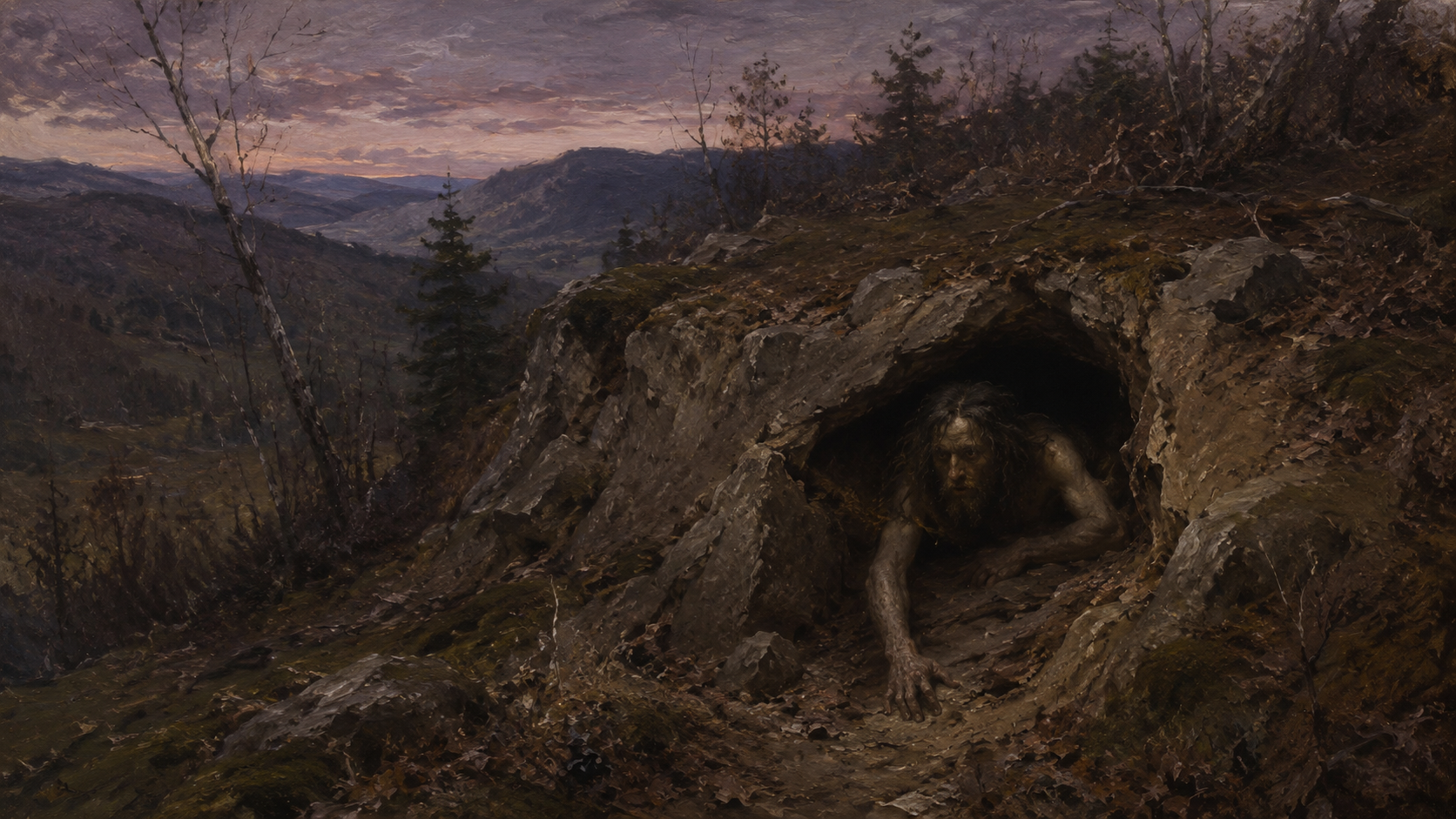
Here Child of God comes closest to folklore. Lester is described as a crazed gnome, then later as a crazed mountain troll. He becomes small and subterranean, then larger and more dangerous, a creature out of old stories and darker hills. The comparison that came to mind for me was Gollum. Not because McCarthy is doing anything like Tolkein, but because both figures are degraded around possession. Both live in caves. Both are pitiful without being innocent. Both force the question of what pity can and cannot do.
Gandalf tells Frodo that pity stayed Bilbo’s hand. Child of God is not so merciful a book, but it has its own terrible version of that question. What does pity mean when the pitiful person is also monstrous? What does human recognition require when recognition cannot become excuse?
The title keeps pressing there. Child of God. The phrase becomes more unbearable the farther Lester descends. A child of God loses his house, carries stuffed animals into the mud, defiles the dead, murders the living, and crawls into the earth. The book does not let the title become comforting. It becomes more like a nail driven deeper with every scene.
Part Two is short, but it drops the novel through a floor. Lester moves from found death to made death. The first corpse is discovered and desecrated. Later, he kills. He murders a young woman with the rifle and likely kills a child by burning the house. The rifle, which began as skill and status, becomes the instrument of predation.
Yet even this instrument starts to fail him.
That was one of the details that surprised me most on this listen. Early Lester is an astonishing shot. He can shoot a spider out of a web. He can win the fair game until the fair itself rejects him. But as the novel darkens, his accuracy seems to degrade. He nearly misses the young woman he kills. In Part Three, when he murders the couple in and near their truck, he does it at point-blank range, where marksmanship hardly matters. Later, when he shoots the man who confronts him, he wounds but does not kill, and the man is able to shoot Lester back.
The rifle begins as mastery and becomes compulsion. Then it becomes the instrument through which violence returns to Lester’s own body.
That is McCarthy’s cruel symmetry. The object that gave him distance finally costs him flesh. He loses an arm to a gunshot wound. The marksman is maimed. The weapon that once extended the body now participates in its subtraction.
The fair prizes travel through this collapse too. Lester carries them after the house burns. He carries them muddy through flight, cave, woods, and stream. Then he loses them in the water. It is absurd and awful at once. The little trophies of his public competence are dragged through murder and washed away. First land, then house, then corpse, then prizes, then rifle as mastery, then arm.
The world keeps taking away the props by which Lester can pretend to be a person among persons.
This stripping links him to Culla Holme, though the two men are damned in different registers. Culla descends by evasion. He tries to flee the fact of his child, and the world answers by removing the supports of ordinary life: shelter, wages, safety, shoes, name, relation. Lester descends by exposure and appetite. He does not flee guilt so much as burrow beneath the world where guilt could reach him. Culla keeps saying he has to get on. Lester says he has to go, but the movement feels less like evasion than failure of relation itself. He cannot stay because staying would require some mutual world he has never really inhabited.
Culla is devilish as a fallen and evasive man, a figure the world seems to recognize without knowing his crime. Lester is devilish in another way: not grand, not cunning, not metaphysical like the bearded one or the Judge to come, but degraded, creaturely, appetite wearing a human shape. If Culla walks through judgment, Lester crawls beneath it.
I do not know which novel is bleaker. I am not sure that question matters. Outer Dark may be more cosmically bleak because even the child’s innocence cannot save him. Child of God may be more intimately bleak because innocence hardly has room to appear. Its world feels less like a parable without mercy and more like a county record contaminated by nightmare.
Both books are tracking collapse. Outer Dark tracks the failure of names, kinship, shelter, and judgment. Child of God tracks the failure of community, recognition, and human category. One asks what happens when a child is not named. The other asks what happens when a man keeps being named human after everything human has been ruined in him.
County and Cave
McCarthy does not let Lester carry all the wrongness alone.
That is one of the reasons the conversations around Sevier County matter so much. Retrospective local voices do not simply provide color. They place Lester inside a history of talk, memory, violence, rumor, and damage. People speak of him after the fact, but they also speak around him, through him, beyond him. They remember his father. They remember White Caps. They remember fairs and floods and fires. They speak as if the county itself has been storing trouble for generations.
One conversation near the end feels especially important. The sheriff talks with a shopkeeper after a robbery, and the talk moves through rain, flood, and the history of Sevierville burning and flooding. Then comes the speculation that maybe there are places God never intended people to live.
That line widens the novel’s judgment. Lester is not excused by place, but he is also not dropped into a neutral world. Sevier County is not merely backdrop. It has its own history of ruin. Fire and flood have marked it. The town has been damaged repeatedly. The people know this and half-joke, half-wonder whether the whole place is misbegotten.
That thought belongs beside the title. If Lester is a child of God, what does that make the place that made room for him? What kind of creation includes him? What kind of county knows him for years and still cannot understand what it knows?
In The Orchard Keeper, the earth keeps the dead. Red Branch seems small until McCarthy opens it into the same order of matter as Tutankhamun and Agamemnon. Kings, drifters, animals, old men, and boys all return to the same archive. The local becomes cosmic because the earth takes everyone.
Child of God is harsher, less ceremonial. Lester returns to the earth too, but not like a king and not like a mythic warrior. He crawls into caves while alive. He makes the ground his shelter, hiding place, passage, and lair. He emerges from the earth near the end like a creature, no longer fully belonging to the surface world. Where The Orchard Keeper gives us the pit as archive, Child of God gives us the cave as degradation. It is not the earth keeping a secret. It is a man trying to become secret before the earth takes him for good.
The ending completes that movement with brutal flatness. Lester comes out from underground and wanders. Eventually he goes to a mental hospital “because he was supposed to be there.” Whether this is court-ordered or somehow voluntary almost does not matter. Both possibilities are chilling. Either society finally assigns him to the proper institution, or Lester himself arrives at the only place left for him. Not repentance. Not understanding. Just arrival. A creature finding the box with his name on it.
Then he is placed near a serial killer who ate his victims’ brains. Earlier, in jail, Lester seemed almost like a poser beside the man across from him. He borrowed the language of whiskey and women. He wanted to sound like a man ruined in recognizable ways. By the end, he belongs beside another grotesque criminal. The category has caught up with him.
Even then, McCarthy does not give him a dramatic moral conclusion. Lester dies. His body is dissected by medical students. Then he is buried.
That dissection is one of the coldest endings in McCarthy. Lester has been called many things by then: child of God, reprobate, gnome, troll, murderer, necrophile, cave creature, local story. At the end, he becomes material for study. The final institution does not save him or damn him. It opens him. Whatever mystery the title forces onto him is not answered. It is cut into.
Then the body goes into the ground.
Here the call back to The Orchard Keeper feels unavoidable, but the register has changed. The dead in that first novel entered the earth as part of a vast, strange continuity. Kenneth Rattner’s body, the pit, the ash, the green under black grime, and the final sweep toward ancient dead all gave the local grave a cosmic scale. Child of God gives us something more abject. Lester is not elevated by burial. He is reduced by it. Yet the reduction is also the point. The earth receives him as it receives everyone else.
No death is merely local once the earth has taken it. But not every return to the earth feels dignified.
That may be the book’s hardest answer to its own title. Lester is a child of God, perhaps. He is also meat, matter, pathology, memory, rumor, and dirt. He is not redeemed by belonging to creation. He is made more horrifying by it.
What the Sentence Makes us Keep
Child of God is a better book than its summary.
That sounds obvious, but with this novel it feels necessary to say. Summarized, it can sound like a catalog of grotesqueries: necrophilia, murder, caves, fire, sexual violence, severed social bonds, a body dissected. Yet the experience of the book is stranger than that because McCarthy’s language keeps giving the horror proportion without giving it pardon.
This is where he has clearly advanced from The Orchard Keeper. The first novel is brilliant and overgrown, sometimes so dense that the prose can overtake the scene. Outer Dark feels more controlled, its nightmare narrowed into a crueler design. Child of God is shorter, meaner, and in some ways more efficient still. The language remains enormous, but the structure is lean. McCarthy can move from slapstick to atrocity in a page. He can let a county voice tell a vulgar story, then let the next scene drop into mythic darkness. He can make a rifle, an axe, a teddy bear, or a cave carry more meaning than another writer might manage with whole explanatory chapters.
The comedy is essential. A lesser writer might keep a book this grim solemn at all times, but McCarthy knows that would be false. People remain ridiculous inside horror. Lester bangs his head in a car. The woman in the sheriff’s office wants to kick his “cods” off. Men tell stories that sprawl and detour. The fair scene is funny until it becomes part of the inventory of a killer. The cave pursuit is frightening and absurd at once. The comedy does not relieve the darkness. It inhabits it.
That may be part of what makes the book so disturbing. McCarthy does not draw clean tonal borders. Comedy touches murder. Craft touches utility. Pity touches disgust. Law touches farce. The human touches the creaturely and does not always win.
The brief present-tense shifts are part of that pressure. They matter because they show McCarthy thinking not only about what happens, but how near the reader should be when it happens. The auction begins in present tense and makes public dispossession immediate. The rifle-care scene uses present tense to make maintenance feel ritualized, almost intimate. In Part Three, during Lester’s frantic movement through mud, water, woods, and cave, the present tense flickers so quickly it almost feels like the narration itself has been jolted. It is no longer only ritual. It is rupture.
The past tense tells us what happened. The present tense makes us look.
That distinction may be one of the hidden engines of the novel. McCarthy does not want Child of God to be received only as report. He wants certain moments to stand there in front of us, refusing to become safely historical. Lester was this. Lester did this. Lester is here.
Future McCarthy will refine many of these methods. No Country for Old Men will turn retrospective law-and-violence narration into Sheriff Bell’s exhausted moral witness. The Sunset Limited will take prison knowledge, guilt, getting caught, and the desire to leave and compress them into a room where speech itself becomes the last form of relation. Blood Meridian will take violence out of the county and give it historical and metaphysical scale until the judge seems to speak for war itself. Suttree (up next) will keep the filth and grotesquerie but widen the tenderness. The Road will strip the world down until the body of a child becomes the place where moral light still has to be carried.
Child of God sits before all of that, but it already knows more than it should.
It knows that social knowledge is not the same as understanding.
It knows that punishment can be kinder than freedom.
It knows that a tool can become a companion when people cannot.
It knows that a man can be seen for years and still not be recognized.
It knows that the earth receives kings, drifters, children, murderers, and monsters without sorting them according to our comfort.
Most of all, it knows that the word human is not a compliment. It is a burden.
That is where the book leaves me. Not asking whether Lester deserves sympathy. That question feels too small, and maybe too morally eager. Sympathy wants to make itself the center. Child of God asks for something colder and harder: recognition without absolution. To see him as human is not to forgive him. It is to accept that humanity contains him.
This is why the title still works after all the horror has done its worst. Child of God does not soften Lester Ballard. It makes him harder to escape. He descends into the cave, loses the prizes, loses the rifle’s mastery, loses an arm, loses the last hiding places, loses the body itself to dissection and burial. Yet the phrase remains above him like an accusation no shovel can cover.
In The Orchard Keeper, the earth kept what happened.
In Outer Dark, the road kept going after judgment failed.
In Child of God, the cave kept Lester for a while. Then the hospital kept him. Then the medical table kept him. Then the ground did.
The book does not tell us what God kept, if anything.
It only leaves the body and the title beside each other, and makes us stand there long enough to feel the trouble.
There is one last private marker here. Child of God was the last novel I read with my eyes before audiobooks became my main way into literature. That does not make this return more important than the others, but it does give it a faint additional charge. I am not only listening back through an early McCarthy book. I am listening back toward the edge of an older way I used to read.
A horrific tale
Of just a regular man
One who descends deep