On Growing Soft
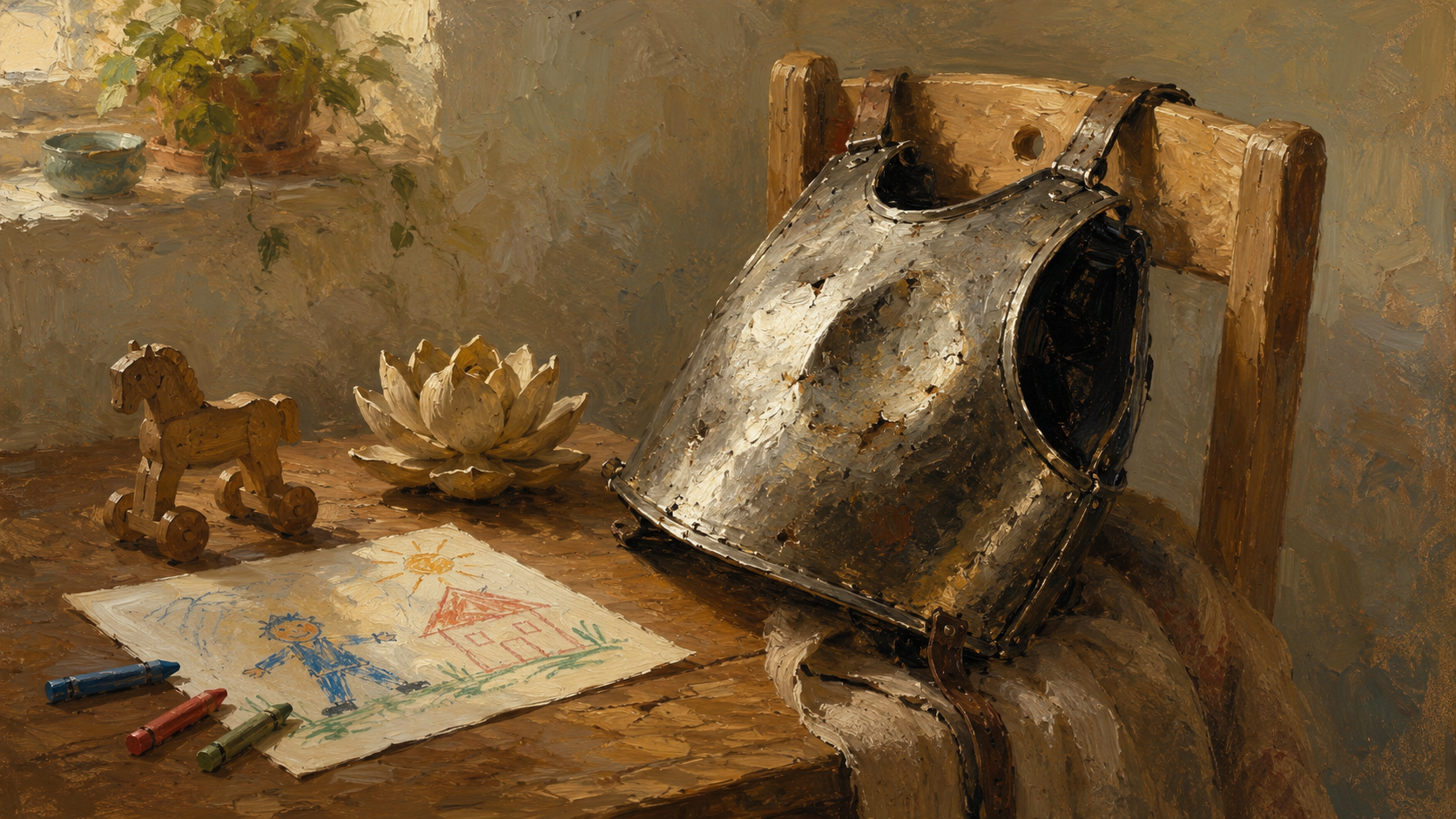
I have become more sentimental than I used to be, which is not a sentence my younger self would have known how to say without smirking.
Not because I was heartless. I don’t think I was. I cared about things. I loved people. I could be moved by music, books, movies, all the usual sanctioned containers for feeling. But, I liked my emotion filtered through intelligence first. I preferred it with a little distance, a little irony, a little trapdoor I could escape through if the room got too sincere.
Sentimentality, to me, used to feel like gullibility. It felt like getting played by the soundtrack. It felt like someone had located a lever in your chest and pulled it for effect.
I still think that can happen. Emotion can be manufactured. A swelling score can do half the work of a scene. Advertising can turn your childhood into a sales funnel. Politics can turn grief into a weapon and compassion into branding. There are plenty of reasons to stay wary around easy feeling.
But, wariness is not the same thing as wisdom.
That distinction has taken me longer to learn than I would like to admit.
Somewhere along the way—through parenthood, politics, meditation, illness, age, and whatever quiet erosion comes from simply living long enough to be changed by the people you love—the old distance started to feel less like clarity and more like a costume.
It still fits if I put it on.
It just doesn’t feel like mine anymore.
The Cartoon That Got Me
Charlotte had Disney’s Tarzan on, and I was nearby in the parent way, which is to say not fully present and not fully gone.
I was probably in the kitchen. I remember the feeling more than the choreography: some ordinary task in front of me, some household thing half-finished, the slight background hum of needing to do four things and actually doing none of them with any elegance. A cup rinsed. A counter wiped. A phone checked. A small attempt to prove I was still an adult with executive function.
I have somehow made it this far without sitting down and properly watching Tarzan. I wasn’t primed by nostalgia. I wasn’t revisiting a sacred childhood text. I wasn’t even following the plot closely enough to pretend I had a strong opinion.
Then the music rose, and I was finished.
Not in a huge, theatrical way. No great sobbing collapse. Just that small betrayal of the body: the throat tightening before the mind has approved it, the eyes stinging before pride can file an objection, the sudden need to become intensely interested in the sink.
Something in the song had brushed against the old parental vow: I will keep you safe. I will keep the world from hurting you. I will stand between you and every sharp edge, every loss, every cruelty, every ending.
It is the promise every parent wants to make.
It is also the promise no parent can fully keep.
That, I think, is what got me. Not the movie exactly. Not even the scene. The movie was just the key that happened to fit the lock.
Nobody noticed.
I did.
I stood there blinking at the kitchen sink while a cartoon I had not earned by attention moved through a gap in me I apparently no longer know how to close.
The Cool Distance
I used to trust distance more than tenderness.
Distance seemed cleaner. Smarter. Safer. It let me notice the mechanism instead of surrendering to the moment. It let me say, “I see what this is doing,” which is a very comforting sentence when what this is doing is working.
There’s a whole personality available there if you want it. The person who spots the manipulation. The person who hears the sentimental line and steps aside before it lands. The person who prefers the sharp joke to the soft admission. The person who can admire sincerity in art but does not want to be caught practicing it in public.
I understand that version of myself. I don’t even dislike him. He had his reasons.
Some of them were cultural. Men are often trained to treat visible tenderness as a kind of reputational hazard. Some of them were temperamental. I liked precision, wit, compression, the clean little blade of a good dismissal. Some of them were protective. Feeling things directly can make you look foolish, and I spent a lot of my life trying very hard not to look foolish.
But, the strange thing about armor is that it does not only keep danger out.
It also keeps contact out.
After a while, you have to ask whether you are protected or merely sealed.
Parenthood Breaks the Abstraction
Parenthood changes the scale of the world.
That sounds obvious, maybe even too obvious to be useful, but I mean it in a specific way. It breaks abstraction. It takes categories you once understood intellectually—danger, love, need, fragility, dependence—and gives them weight. It puts them in pajamas. It gives them a voice calling for you from the next room.
Before children, suffering can remain partly conceptual. You know it matters. You know people hurt. You know parents lose children, children lose parents, families get split open by events no one deserves. You can care about all of it sincerely and still, some part of you, keep it at a distance.
Then a child falls asleep against you with complete trust, and the distance narrows.
Now the news has faces. Stories about harm develop a pulse. The idea of protection stops being an ethical principle and becomes a physical ache.
There is research behind this, though I don’t want to make it sound tidier than it is. Studies of caregiving fathers suggest that parenting is associated with brain systems involved in emotion, vigilance, reward, social understanding, and cognitive empathy; fatherhood is not just a role someone performs but an experience the nervous system learns.
That makes intuitive sense to me. It feels true in the body before it sounds true in a study.
Because parenthood doesn’t only make you afraid. Fear is part of it, yes, and sometimes a miserable part. But, tenderness does more lasting work.
A mispronounced word you hope survives a little longer.
A crooked drawing handed over like a royal decree.
A sleepy child leaning into you as if your chest were a piece of architecture.
A question asked again and again until you finally hear the question underneath the question: Are you still here? Are you still with me? Am I still safe inside your attention?
Stay near that kind of trust long enough and your old postures start to feel theatrical. Irony still has its uses. Distance still has its place. But, they no longer feel like home.
They feel like borrowed clothes.
Contempt Is a Cheap Kind if Smart
I don’t think parenthood started this change. I think it revealed it.
I was already softening, though I would not have used that word at the time. Part of it was political. Not in the sense of switching teams or trading one set of slogans for another, but in the deeper sense of losing interest in contempt as a way of life.
There is a version of political awareness that feels like moral clarity but runs mostly on disgust. It rewards the sharpest dismissal, the darkest read, the quickest exposure of hypocrisy. It encourages you to become fluent in disappointment. It lets you feel intelligent because you are never surprised by human failure.
Sometimes anger is necessary. Sometimes disgust is accurate. Sometimes refusal is the beginning of conscience.
But, contempt expands if you keep feeding it. It stops being a tool and becomes a fixture inside the mind. It starts aiming itself at everyone. It makes people smaller, then mistakes that smallness for insight.
At some point, I wanted less of that in me.
Not less conviction. Not less concern. Less poison.
I wanted a politics that still had room for actual people: tired people, scared people, misled people, grieving people, people who were wrong but not only wrong, people whose lives could not be reduced to their worst opinion.
That kind of politics is harder. It is also less fun at parties and on the internet. Contempt gives you a quick hit. Compassion asks you to stay after the joke ends.
The Practice That Softens
Around the same time, meditation stopped being only a way to calm down.
That is how it begins for a lot of people, I think. You sit. You breathe. You try to stop the mind from turning every inconvenience into a small private opera. You hope to become less reactive, less scattered, less dragged around by your own thoughts.
Useful enough.
But, the traditions I keep circling—Zen, Dzogchen, Mahamudra, Advaita-adjacent inquiry, and the wider Buddhist vocabulary around compassion—don’t let practice stay in the wellness aisle forever. Eventually the question is not just, “Can I feel calmer?” It is, “Can I see more clearly what I am, what other people are, and how much of my suffering comes from pretending we are separate in ways we are not?”
That is where the old words come in.
Metta: loving-kindness.
Karuṇā: compassion.
Muditā: sympathetic joy, the ability to be genuinely glad for someone else’s gladness.
Upekkhā: equanimity, the steadiness that keeps compassion from collapsing into overwhelm.
These can sound almost decorative until you practice them. Then they become more demanding. Wishing well for people you love is easy enough. Wishing well for strangers is stranger. Wishing well for difficult people reveals exactly how conditional your goodwill tends to be.
Research does not prove the whole spiritual architecture, of course. It cannot. But, it does suggest that these practices are not merely ornamental. Reviews and studies of loving-kindness meditation have found links to increased positive emotions and social connectedness, while compassion training has been shown in at least one well-known study to increase altruistic behavior and alter neural responses to suffering.
Again, this does not turn anyone into a saint.
It may just make cruelty a little less comfortable.
It may make the mind less impressed by its own dismissals. It may weaken the old reflex that says distance is always safer than contact. It may make it harder to watch even a children’s movie without letting the obvious thing be obvious: love matters, protection matters, belonging matters, and every creature wants not to be abandoned.
This is beautiful.
It is also inconvenient.
The Science of Being Moved
There is even a name for the feeling that keeps embarrassing me.
Researchers call it kama muta, often translated from Sanskrit as “being moved by love.” It describes that warm, tearful, goosebump-prone feeling that can arise when a bond suddenly intensifies or becomes visible: a reunion, an act of kindness, a child running into a parent’s arms, a community briefly remembering itself as a community. Studies describe it as a positive social emotion tied to closeness, tears, warmth, and the urge to connect or care.
This is both validating and ridiculous.
On the one hand, I appreciate learning that my kitchen-sink Disney problem may belong to a recognizable human pattern. On the other hand, I do not particularly need a formal term for “Dad gets emotionally assassinated by cartoon gorilla tenderness.”
Still, the concept helps.
It suggests that being moved is not simply a failure of defenses. It might be a social emotion doing what social emotions do: pulling us toward connection, reminding us that love is not an idea but a bond we experience physically. The tears are not an error message. They are a signal.
Something has come close.
Something matters.
Sentimental Is not Always Shallow
I still distrust cheap sentiment.
I don’t want to be manipulated. I don’t want to confuse tears with depth or emotional intensity with truth. Some stories work us over with such obvious machinery that resentment feels like the only dignified response. The music swells, the lighting softens, the camera lingers, and suddenly you can feel the invisible hand on the lever.
There is bad sentiment. There is lazy sentiment. There is sentiment that flatters the viewer for feeling the correct thing at the correct time and asks nothing afterward.
But, I used to make the category too large.
I treated too much tenderness as suspect because some tenderness is manufactured. I treated too much sincerity as dangerous because some sincerity is performance. I treated being moved as something to defend against because sometimes people try to move you for reasons that are not worthy of your trust.
But, the answer to manipulation is not numbness.
The answer is discernment.
There is a difference between being played and being reached. There is a difference between emotion that bypasses thought and emotion that reveals what thought has been circling from a distance. There is a difference between a cheap tear and an honest one.
The honest ones, I think, often arrive with a little embarrassment attached. They catch you before you have arranged yourself. They make no argument. They simply appear, and now you know something about yourself.
Stable Tenderness
There is a danger in romanticizing softness.
Softness is not automatically wisdom. Feeling deeply is not the same as seeing clearly. Being porous to the world can exhaust you, especially in an age when every device is willing to deliver more grief than any nervous system was built to metabolize.
The goal cannot be to feel everything all the time.
That way lies collapse.
This is where equanimity matters. Not as coldness. Not as detachment in the old armored sense. Equanimity is not the refusal to care. It is the steadiness that allows care to remain useful.
Compassion without steadiness becomes panic.
Equanimity without compassion becomes distance with better branding.
What I want, though I fail at it constantly, is the meeting point: stable tenderness. The ability to be affected without becoming useless. The ability to stay open without being swept away. The ability to love my children fiercely while knowing I cannot build them a world without pain.
That may be the hardest part of parenting for me. Not the diapers, the logistics, the noise, the sleep deprivation, though those are all real enough. The hardest part is the vow I keep making in forms large and small, knowing it is only partly within my power to honor.
I will keep you safe.
I will fail.
I will keep trying.
What This Softness Is Made Of
So, what is this softness, really?
Age, probably. Time makes a quieter argument than youth knows how to hear.
Parenthood, obviously. Once a child has loved you with that total, unguarded trust, certain internal arrangements become hard to maintain.
Politics, likely. I have less appetite than I once did for the satisfactions of contempt.
Practice, for sure. If you spend enough time rehearsing compassion, even clumsily, it would be strange if some of it did not start leaking into ordinary life.
Disability and illness, too, though I am still learning how to say that without making it either too grand or too neat. Limitation changes attention. It makes fragility less theoretical. It can make the world harsher, but it can also make ordinary sweetness harder to dismiss. A voice in the next room. A child’s hand. A familiar song. The body learns, sometimes unwillingly, that nothing has to be dramatic to be precious.
Underneath all that, there is something simpler.
I am less interested than I used to be in seeming untouched.
I am more interested in being available to what is actually here.
That includes beauty. That includes grief. That includes absurdly sincere Disney scenes I would once have mocked from a safer distance. That includes my kids. That includes strangers. That includes the old wish, renewed daily and doomed to incompletion, that the people I love might somehow be spared.
A Better Kind of Embarrassment
When Charlotte watches a movie, she is not watching like a critic.
She is watching as someone learning what loyalty looks like. What fear looks like. What comfort looks like. What it means for someone to stay. The stories may be broad. The songs may be obvious. The emotional machinery may not exactly be hidden. But, something real is still happening.
I don’t want to stand outside that with a smirk.
I want to be the kind of adult who can stay near her openness without stealing it. I want to be steady enough to protect her where I can, honest enough to know where I can’t, and soft enough not to confuse love with control.
That seems harder than irony.
It is easier to be sharp. Easier to keep one eyebrow raised. Easier to name the mechanism and refuse the invitation.
It is harder to let yourself be reached and remain steady.
Harder, but better.
So, yes, I am more sentimental than I used to be. I tear up more easily. I feel things in places I once would have considered slightly ridiculous. I am occasionally ambushed by tenderness in the middle of ordinary life. This remains mildly embarrassing.
But, it is a better kind of embarrassment than the older alternative.
Better to be caught feeling too much than to spend your life perfecting the art of feeling too little.
If I am the guy in the kitchen now, standing still while a cartoon soundtrack sneaks past my defenses, blinking at the sink until I recover some measure of composure, that’s fine. I’ll take it.
Because the tears are not really about the movie.
They are about the fact that something in me still answers when love appears in even its simplest forms. They are about the fact that the old armor no longer feels like wisdom. They are about the fact that I have become, against my former preferences and perhaps because of my better ones, more reachable.
And, in a world constantly training us toward indifference, that feels less like weakness than a small, stubborn kind of grace.
Parenthood does this
Or, maybe it was always there
Gorillas too