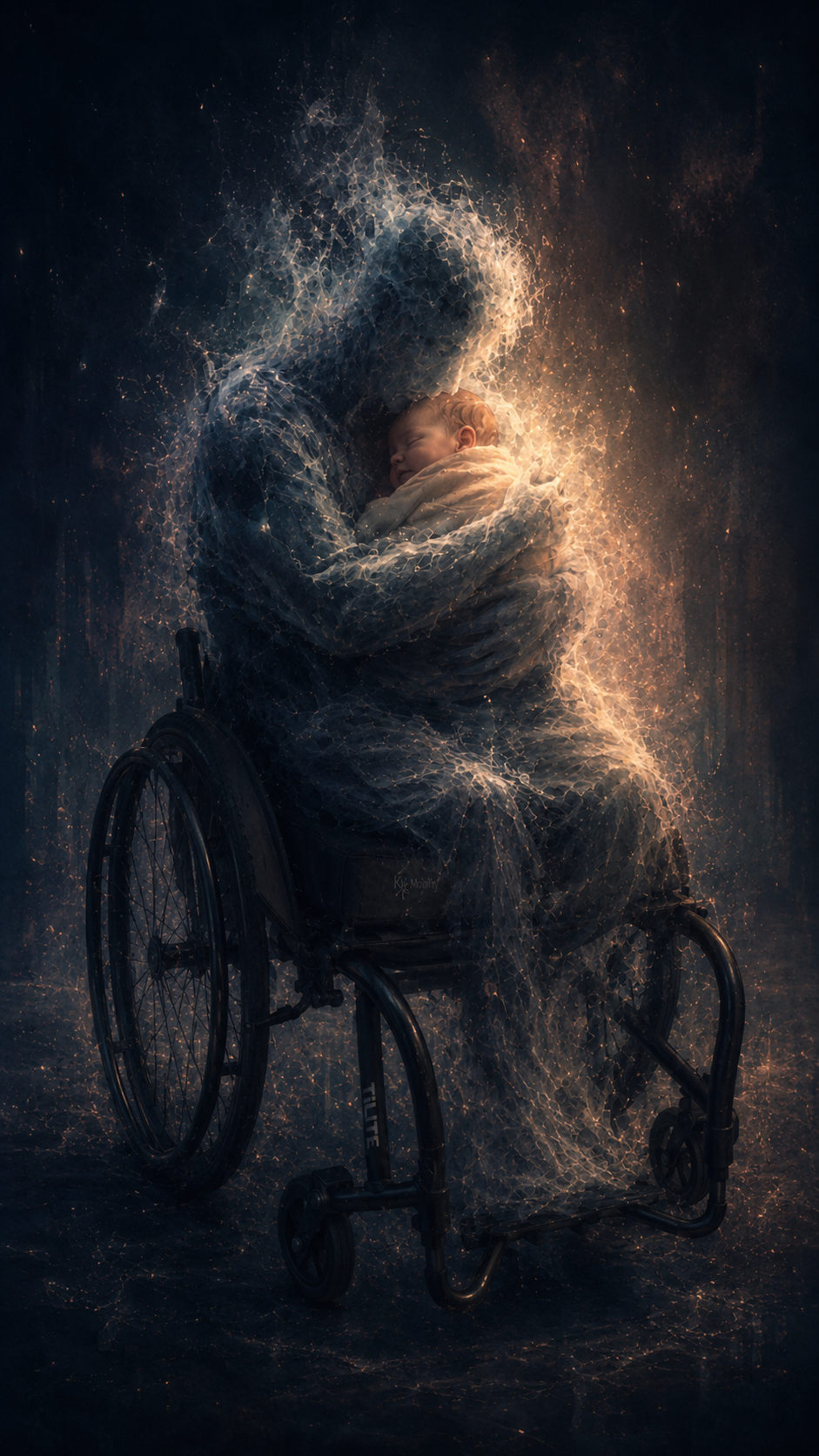
A rough day does not always arrive with a name.
Sometimes it comes disguised as something small. A movement. A task. A moment so ordinary it barely seems worth mentioning until it is suddenly harder than it should be, and then harder again.
A few weeks ago, I realized that getting into bed at night now means falling into it first and then pulling myself farther in with my arms.
I still get there. That is part of what makes it strange. The action remains. The fact remains. I am in bed. I made it. Yet the way I arrive has changed so much that the thing itself feels altered. Something private and basic has become a maneuver.
I had the same kind of realization while brushing my teeth. With an electric toothbrush, I can still do it well enough. With a manual one, it becomes difficult in a way that feels almost absurd. Not impossible. Just clumsy, tiring, less effective, more revealing. The difference is not really between two kinds of toothbrushes. It is between a task I can still fold into my day and a task that starts to stand in front of me.
There is something clarifying about that, and something cruel. An electric toothbrush is not a convenience when your hands, arms, balance, and stamina have all become part of the negotiation. It is an accommodation small enough to disappear from view.
That is one of the hardest parts of all this. Loss does not only show up in the dramatic places. It settles into the ordinary. It enters bed, teeth, turning, reaching, lifting, waiting. It takes the tasks that used to belong to the background and drags them forward until they stand there in full view, asking to be counted.
The Arithmetic of Staying Still
Lately, there has been another version of this, one I do not like admitting.
Every couple of days, or close to it, I barely drink water and barely eat. Not because I do not understand what my body needs. Not because I am careless. I do it because I want to stay put. I do it because each trip to the bathroom carries so much with it now. Effort. Time. Transfer. Interruption. The whole long tail of a simple human need.
This is the kind of detail that sounds extreme once it leaves the privacy of the day. Written down, it looks like evidence. Lived from the inside, it often feels like another calculation. Drink less. Need less. Move less. Ask less of the room.
I sit still instead. I hold the baby. I remain where I am. I try to reduce myself to something manageable.
There is a darkness in that kind of thinking. It can begin as care and become damage before I notice the change. It can feel practical, almost responsible, even while it quietly asks the body to pay for the convenience of staying still.
That may be the bleakest part. These choices do not come from indifference. They come from wanting to be present, useful, steady, close. They come from wanting to hold my son and not keep breaking the shape of the day with one more need, one more motion, one more consequence.
Love is in it. Damage is in it too.
This Failing Thing
I had the thought that I wanted to give up on my body.
I do not mean that I wanted to give up on my life. I do not mean that I wanted to leave the people I love. The thought was narrower than that, and in some ways sadder. I wanted to stop defending this failing thing. I wanted to stop bargaining with it, compensating for it, working around it, making excuses for it, asking it for one more usable day.
There is a particular grief in feeling that your body is not only failing you, but failing the people around you. Failing the household. Failing your wife. Failing your children. Failing the future you still feel responsible for, even if you can no longer meet it in the way you once imagined.
That feeling may not be fair to the body. I know that. The body is not choosing this. It is not betraying me out of spite. It is not lazy. It is not weak. It is living with a disease that turns basic functions into logistics and logistics into a kind of daily architecture inside the house.
Still, knowing that does not cancel the feeling.
People say, rightly, that there is always something to be grateful for. That is true. My life contains real love. Real beauty. Real tenderness. I know that. I do not say it reluctantly. I say it because it is true.
Still, gratitude has a limit. It does not pull me fully into bed. It does not brush my teeth. It does not solve the quiet, ugly arithmetic of whether a glass of water is worth the trouble it may create an hour later. Gratitude is real. It is not enough.
What I'll Never Give Up
What keeps me here is love.
Not as a slogan. Not as a tidy moral. Not as the bright answer at the end of a difficult piece of writing. Love in the more stubborn sense. Love as attachment. Love as obligation. Love as the fact that my life is braided into other lives, and that braid still holds even when my body feels less like a home than a burden.
It is Christa. It is my kids. It is the small sounds of our life together. It is the unbearable fact that I love them too much to drift very far, even in thought. When everything else feels stripped down, that remains. Not joy every time. Not hope in some clean and shining form. Just love, still there, still weight-bearing.
There is nothing triumphant in that. I do not have triumph to offer today.
Only this: my body feels more fragile, more humiliating, and more costly than I want to admit. Some mornings I feel almost done with it. Some mornings I feel like the only thing keeping me inside it is the pull of the people I love.
For now, that pull is enough.
When the body fails
It’s nothing but pure darkness
No. There’s much to hold