Let the Future Model Hold the Torch
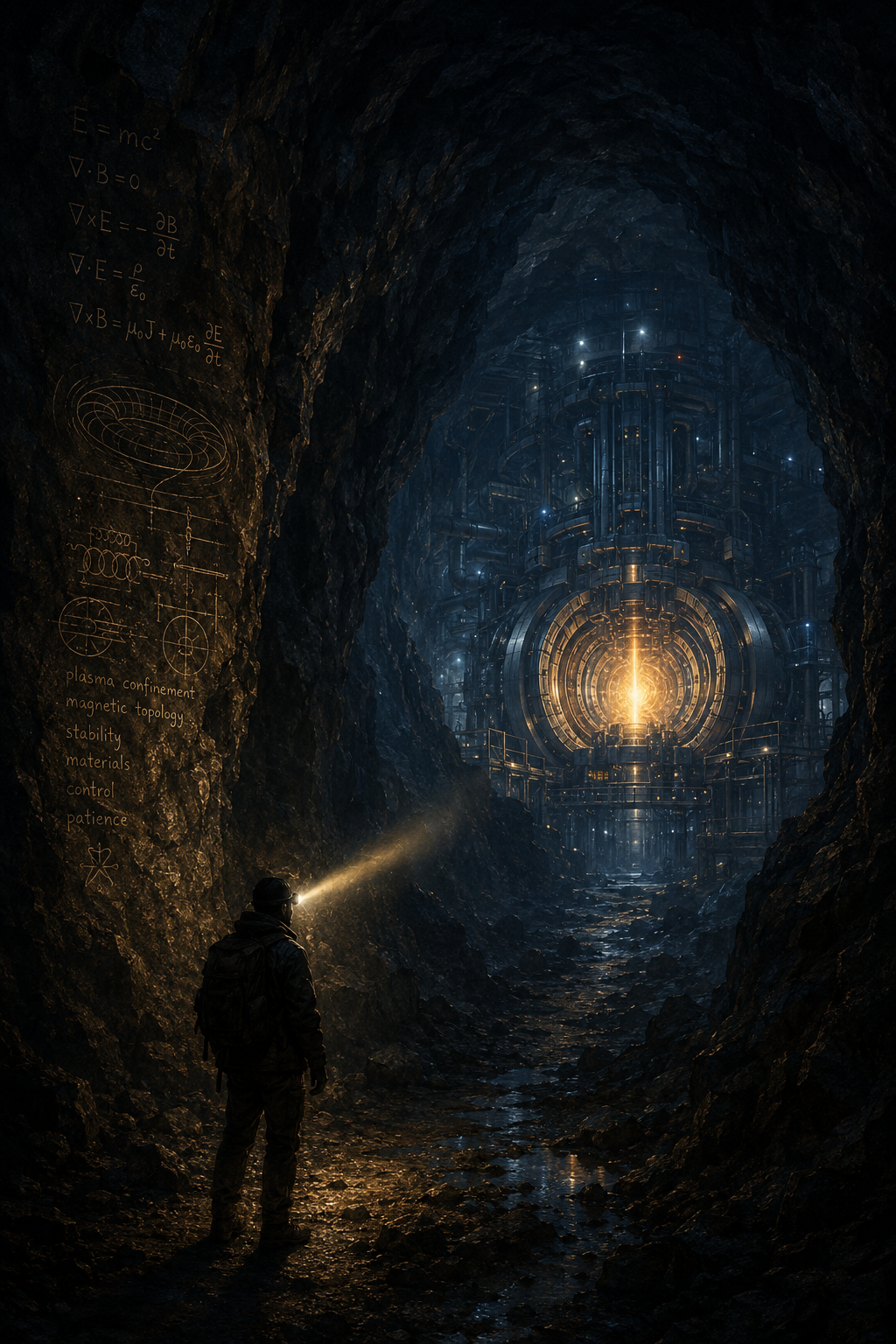
A Sun That Refuses the Room
Somewhere in a lab, someone is trying to keep a sun from touching the walls.
That is still the simplest way I know to think about fusion. Strip away the funding announcements, the diagrams, the smiling executives standing beside equipment no ordinary person could identify, and that is what remains: a star, persuaded into a smaller room than it wants, held in place by magnets, materials, equations, cooling systems, and a very human refusal to quit.
Every few months, the news arrives with another careful form of hope. A stronger magnet. A cleaner control method. A new plasma image. A better material test. A field strength that would have sounded absurd not long ago, produced in hardware that is starting to look less like a lab demonstration and more like the bones of a possible machine.
Progress, the headlines say.
Closer.
Soon.
Soon is a funny word in fusion. Soon means after the next magnet. After the next wall material. After the next plasma-control advance. After the next version of a machine built to survive conditions that almost sound mythological when you say them plainly. Soon means the work is real. Soon also means not yet.
That is the tension I keep coming back to. Fusion is not a fantasy, exactly. It is also not a thing I can plug into my house. It lives in that strange middle distance where optimism and exhaustion keep taking turns at the microphone.
The Names Will Sound Ridiculous
Meanwhile, in AI, we are living inside the age of “next versions.”
A model arrives and feels impossible for a while. Then, a few months pass and it starts to feel merely familiar. Then, the next one arrives, sharper in some places, stranger in others, better at holding together complicated tasks that used to fall apart in its hands. I know this partly because I keep doing the ridiculous thing of asking the newest model to revise essays about the newest model.
There is something funny and a little embarrassing about that. GPT-something. Gemini-something. Opus-something. The names already sound like car trims, or expensive headphones, or spacecraft from a movie where everyone wears clean white jackets.
They are getting better, though. That part is not nothing. The improvements are uneven, and the branding is sometimes goofy, and the discourse around all of it can make a person want to go live under a large quiet rock. Still, the tools keep improving. They keep getting better at reading across domains, catching relationships, holding context, and turning a pile of tangled material into something a human can actually work with.
That is why I find myself making the same joke with a straight face: maybe some future model can figure fusion out.
GPT-whatever. Gemini-whatever. Claude Opus-whatever. Let one of them lean over the table and say, gently, that number cannot go there.
I do not mean this literally. Not exactly. I do not think a model is going to descend from the server rack with a completed reactor design and a serene little note that says, “You’re welcome.” I do not think physics yields to confidence, or that matter becomes less stubborn because software has gotten more persuasive.
The joke lands because it is only half a joke.
The Part Nobody Will Care About
If some future AI system helps make fusion practical, almost nobody is going to care which model did it.
AI people will care, of course. We will care too much. We will argue about which lab deserves credit, which benchmark predicted the breakthrough, which company was really ahead, which model had the better reasoning, which one merely looked better because the demo was staged correctly. There will be charts. There will be threads. There will be confident people being confidently irritating in public.
Everyone else will care about much simpler things.
Does the power stay on?
Do outages happen less often?
Does the bill go down, or at least stop climbing like it has somewhere urgent to be?
That is the future people actually want. Not a model card. Not a leaderboard. Not an argument about whether GPT-9 beat Gemini-6 on a fusion-plasma-control benchmark with a name like a government password. People want the lights to turn on. They want heat in winter, air conditioning in summer, phones that charge, refrigerators that hum along unnoticed, hospitals that do not need backup plans for backup plans.
The dream is not that fusion becomes glamorous.
The dream is that fusion becomes boring.
Boring is one of the highest compliments we give infrastructure. The bridge holds. The faucet runs. The elevator opens. The grid works. Nobody applauds. Nobody should have to.
Better Light, mot Magic
A powerful model would not need to invent a new universe. It would only need to help us see this one more clearly.
Fusion punishes narrow attention. It sprawls across plasma physics, superconducting magnets, materials science, cooling systems, control theory, economics, regulation, manufacturing, maintenance, and all the ungainly realities that enter the room the second an idea tries to become a machine.
Humans are extraordinary at depth. We can spend a life inside one problem and come back with something true. We are less good at width. We miss things because there is too much to hold at once. We forget the paper from twelve years ago. We repeat the assumption because everyone else repeated it. We stop seeing the hinge because the door has always opened that way.
A future model could read differently.
It could move through decades of fusion literature without fatigue: successful experiments, failed tests, obscure proceedings, footnotes, negative results, design decisions made under constraints nobody remembers anymore. It could notice that three teams, working years apart, brushed against the same possibility and then walked away. It could tell us that the dead end was only dead under one old assumption, carried forward so long it stopped looking like an assumption at all.
It could help explore design space with a kind of ruthless patience. Change the geometry. Adjust the fields. Test the control scheme. Simulate the heat load. Eliminate what fails. Keep what survives. Not one career at a time. Not one hunch at a time. Thousands upon thousands of attempts, filtered before metal ever gets cut.
That does not make the work easy. It makes the search less blind.
Where the Hard Part Lives
The best version of this future is not a model replacing scientists. It is a model making scientists harder to waste.
There are already hints of this. Reinforcement learning has been used to control the magnetic configuration of a tokamak plasma. Fast simulators are being built so researchers can test ideas more quickly. AI methods are being aimed at plasma behavior, control policies, and materials discovery. None of this is science fiction anymore. It is early, imperfect, useful work happening inside the actual world.
The catch is that fusion keeps dragging every abstraction back into matter.
You still need magnets that can survive the forces they create. You still need materials that can tolerate punishment most materials were never asked to imagine. You still need joints, tapes, walls, coolant, sensors, maintenance schedules, construction crews, supply chains, regulators, budgets, and time. A model can suggest. It can compare. It can warn. It can search. It can narrow the field.
Then someone has to build the thing.
This is where the savior language breaks down. AI is not going to redeem fusion from the inconvenience of being physical. It will not remove the need for testing. It will not make neutron damage polite. It will not make regulators fast, investors patient, or public infrastructure simple.
Good tools do something smaller and more valuable. They change the tempo of difficulty. They let you spend less of your life lost in the wrong hallway.
The Torch, Held Close
That is why I keep returning to the image of the torch.
Not a prophet. Not an oracle. Not a machine-god whispering equations from behind a curtain.
A torch.
A headlamp in a cave.
Something that does not erase the dark, but gives the next few steps a shape. Something that lets a person see the wall, the drop, the passage, the faint mark left by someone who came this way before and turned back too soon.
Maybe that is all progress ever is: not the sudden end of difficulty, but a clearer view of where difficulty actually lives.
When I say I hope GPT-something or Gemini-something or Opus-something figures out fusion, what I really mean is that I hope we build tools worthy of our hardest problems. Tools that can help us read more carefully, search more widely, test more honestly, and waste less of the short human life available to each person doing the same failed thing under a slightly different name.
If fusion ever becomes ordinary, if it joins the long list of miracles people forget to call miracles, some future model may have its fingerprints on the blueprints. Most people will never know which one. They will not care. They will boil water, charge their phones, turn on the lights, and get on with the day.
Honestly, that would be a beautiful kind of success.
Not because a machine saved us.
Because it helped us carry the light farther than we could carry it alone.
Fusion isn’t here
Soon, barely in reach of us
Great. Mysterious.