The Small Lie Machine
I have a strong aversion to lying. Not in a heroic way. Not in the tedious, self-congratulatory way people sometimes mean when they call themselves “brutally honest,” as if brutality were the part worth bragging about. I mean something quieter and more stubborn. Lying feels wrong to me before I have time to explain why.
There is a practical piece to that. A lie creates work. Once you say something false, you have to maintain it. You have to remember what you said, remember who heard it, and keep reality from brushing too hard against the structure you built. A lie turns memory into administration.
That isn’t all it is.
The deeper part is moral. Lying feels like a harm to me. Not always a dramatic harm, not always the kind that ruins a life or breaks a family or empties a bank account. Sometimes it is tiny. Sometimes it is almost invisible. Still, the shape of it is the same. When I lie to you, I interfere with your ability to choose from the truth. I hand you a distorted map and let you walk as if the roads were accurate. I treat your understanding as something to manage, not something to respect.
Which makes one fact of my working life feel especially strange now: for years, I made money writing things I did not believe.
I worked in marketing. Mostly for small businesses. Contractors, service companies, dental practices, local firms, B2B operations, ordinary outfits trying to survive. These were not cartoon villains. Most were not even close. Many were decent people trying to pay employees, get leads, keep the lights on, and maybe carve out something stable in an unstable economy.
Still, day after day, I wrote sentences like these:
The best in the area.
The most effective solution.
Top-rated service.
Trusted by thousands.
Unmatched results.
I must have written “best” hundreds of times. Maybe thousands. The word became both empty and embarrassing, like a toy hammer used to fix a car. Best according to whom? By what measurement? Compared to what competitors? Over what period of time? Based on reviews, retention, price, response time, workmanship, customer satisfaction, or some invisible scoreboard kept by the gods of search engine optimization?
Most of the time, I did not know.
That was the problem. It was not that I secretly knew every claim was false. It was that I usually had no honest basis for writing it. I knew the client wanted to sound credible. I knew the page needed confidence. I knew competitors were saying the same thing. I knew what the template expected. I knew what marketing language sounded like.
I did not know if the sentence was true.
Marketing has a whole drawer full of defenses for this. I used them. I understood them. Some are not even wrong.
Nobody takes it literally.
It is just positioning.
It is aspirational.
It is expected.
It is how the game works.
If we do not say it, someone else will.
That logic is common because it is useful. It lowers the moral temperature. It turns the question from “Is this true?” into “Will this pass?” The law has a version of that distinction too. Broad, subjective advertising puffery often gets treated differently from specific, measurable claims. “World’s best coffee” is not the same kind of statement as “three out of four doctors recommend this.” One floats above evidence; the other demands it.
That legal distinction matters. I understand why it exists. Not every boast is fraud. Not every adjective can be dragged into court and cross-examined under fluorescent lights.
Still, the moral distinction is not identical to the legal one.
Something can be legally tolerated and spiritually rancid. Something can be non-actionable and still corrode the language around it. “Best” may be too vague to prove or disprove, but that vagueness is exactly what makes it useful. It creates the feeling of superiority while refusing the burden of evidence. It points toward a claim and then hides its hands.
That was the texture of the work. Not one giant lie. Not a scandal. Not a villain speech. Just a constant rounding-up of reality. A competent business became exceptional. A decent service became unmatched. A client with ordinary strengths became a trusted leader. The copy did not necessarily invent a new world. It inflated the existing one until every sentence stood a little taller than the truth.
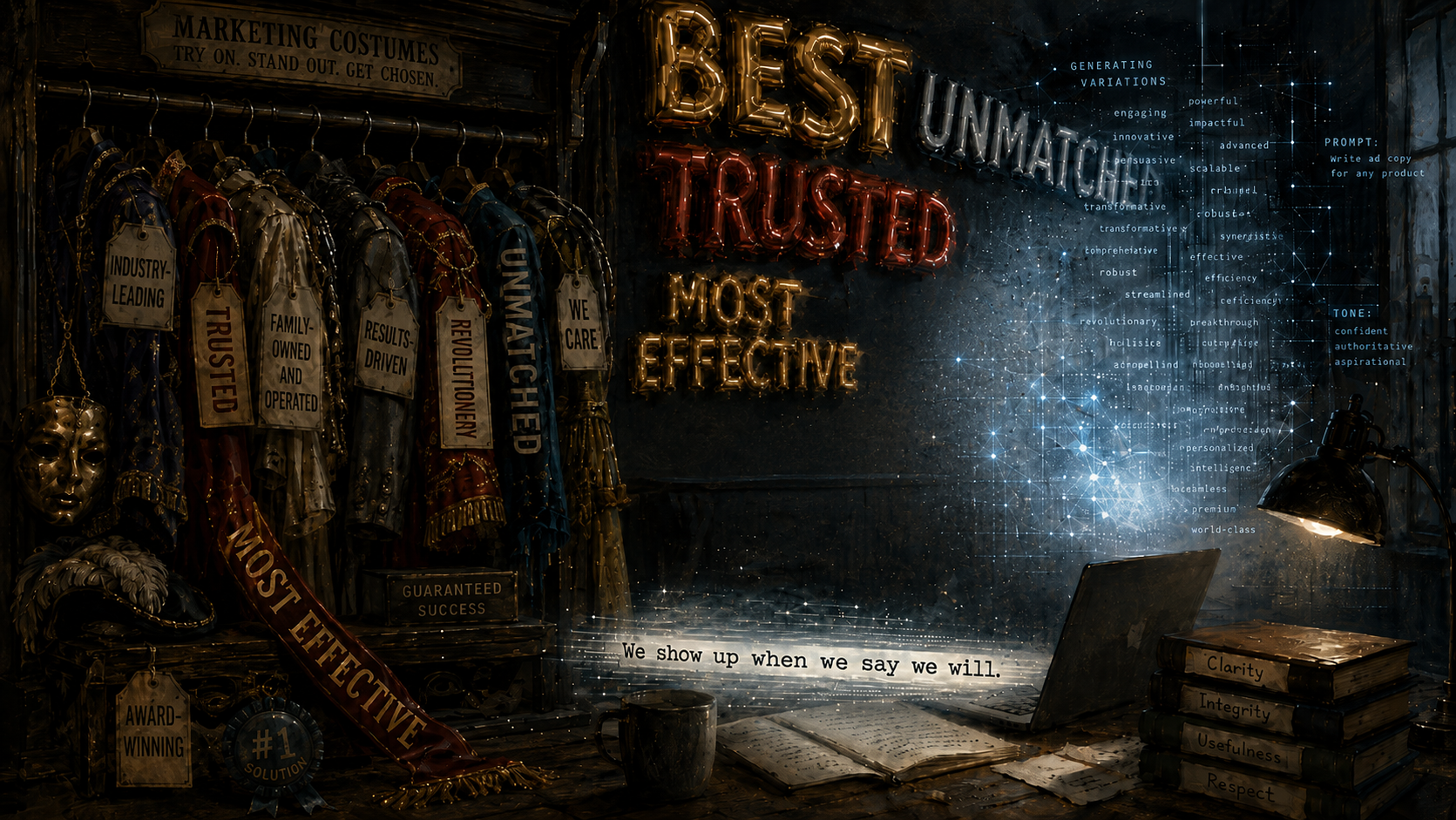
The Costume Rack
After a while, I started thinking of marketing language as a costume rack.
Need authority? Put on industry-leading.
Need warmth? Put on family-owned and operated.
Need credibility? Put on trusted and proven.
Need urgency? Put on revolutionary.
Need emotional insulation? Put on we care.
The trouble with costume language is not only that it disguises the thing underneath. It also changes the person wearing it. Spend enough time making sincerity sound like a tone, and sincerity itself starts to feel detachable. It becomes a setting. A slider. Something you can raise or lower depending on the desired effect.
That may be the part that bothered me most. I was not only writing claims I could not verify. I was learning how to sound earnest on command.
There is a strange fatigue in that. You can become very good at producing sentences that seem warm, direct, and human while knowing that no actual human warmth produced them. You can make a paragraph sound like it has a pulse. You can write “we understand how stressful this can be” for a company you barely understand, about a customer you will never meet, in service of a conversion goal someone will measure later in a dashboard.
Then you close your laptop and return to a life where words are supposed to mean something at human scale.
At home, “I’m sorry” is not a brand position. “I’m fine” is either true or it is not. “I love you” is not a call to action. The words matter because the relationship matters, and the relationship matters because the people are real.
That gap became harder to ignore as my life became more dependent on plain speech. Any sustained encounter with vulnerability makes bullshit harder to tolerate.
Is this covered or not?
Is this safe or not?
Is this accessible or not?
In those moments, I do not want optimized messaging. I do not want an industry-leading solution. I do not want a carefully positioned reassurance object. I want the truth. I want to know what is real, what is possible, what is not being promised, and what I need to do next.
The more I needed that kind of language in my actual life, the stranger it felt to spend my working hours producing the other kind.
The Machine Learns the Costume
Then generative text arrived and made the whole thing even stranger.
GPT-4 came out in March 2023, and at the time it felt like a technological marvel. I remember that feeling clearly. A machine could produce a usable first draft in seconds. A machine could imitate structure, tone, pacing, and confidence. A machine could take a half-formed prompt and return something that looked, at least from a distance, like work.
Of course I used it.
Partly out of necessity. Energy is not abstract to me. Bandwidth is not a productivity metaphor. Some days, anything that lowers the activation cost of beginning is not a convenience; it is the difference between doing the work and not doing it.
Partly, though, I used it because the answer was obvious. Why wouldn’t I? If a tool can build scaffolding in seconds, you use the scaffolding. You still have to inspect it. You still have to decide what belongs. You still have to bring judgment, taste, memory, and actual knowledge. The blank page changed. It became less blank.
For marketing, though, GPT-4 was almost too perfect in the worst possible way. It knew the genre. It knew the rhythm. It knew exactly how to sound polished and empty. Ask for marketing copy, and it reached for the phrases marketing had already trained the internet to reward.
Industry-leading.
Results-driven.
Unmatched.
Proven.
Trusted.
Tailored solutions.
The machine did not know the client. It did not know the market. It did not know whether the company answered the phone or honored its estimates or left customers quietly disappointed three weeks later. It knew what marketing sounded like. That was enough.
The fluff was no longer merely tolerated. It was automated.
That clarified something for me. Once a model could generate the same padded claims on command, it became harder to pretend those claims were expressions of conviction. Much of the language had always been formula wearing a human mask. The model simply made the formula visible.
Now GPT-5.5 is out, and the point is even sharper. Whatever one makes of the marketing around the model itself—and yes, the irony is not lost on me—the actual experience of these systems keeps changing. GPT-4 once felt like the future landing early. Now it feels, in many contexts, shockingly inadequate beside newer models. That is not because GPT-4 was unimpressive. It is because the floor keeps rising beneath us and we adjust almost instantly.
The miracle becomes normal.
The normal becomes clumsy.
The clumsy becomes obsolete.
This is one of the strangest things about living through the current AI cycle. We do not only adapt to new tools. We metabolize astonishment. Something impossible becomes available, then familiar, then faintly annoying because it takes too long or misses nuance or cannot quite hold the thread. Then the next model arrives, and the whole process repeats.
GPT-5.5 will probably feel old sooner than it should. By the time I publish this, some other model may already have taken its place in the private hierarchy of my attention. Everyone is building on a treadmill that seems to be learning how to build the treadmill faster.
It is amazing what we get used to.
There is a sidebar thought I keep having. If I could go back to that marketing job now, with the tools we have at this exact moment, the day-to-day work would be almost unrecognizable. The first pass would be easier. The scaffolding would appear instantly. The boring connective tissue would take less time. The baseline quality would be higher. The number of drafts that once required brute-force momentum could probably be cut in half before lunch.
I want to be honest about that. I would use the tools.
Not entirely. I would not want to outsource my voice. I would not want to become a foreman supervising a factory floor of machine prose, nodding along as language arrived already smoothed and packaged. There is a difference between assistance and abdication. There is a difference between using a tool to begin and letting the tool decide what counts as finished.
The complication is that the latest models can actually match my voice pretty well when they have enough of my past work to draw from: the rhythms, the restraint, the way an idea circles before it lands. That works far better in my essays, where the material begins with my own experience and the model can help me return to it more clearly, than it ever did in the generic marketing copy I was writing for businesses I barely knew. In one case, the machine is helping me shape something I am already trying to say. In the other, it is often just dressing emptiness in a cleaner suit. (I write about this in an upcoming essay.)
Still, the tools are better. Much better. Better at structure. Better at tone. Better at revision. Better at restraint when asked correctly. Better at giving me something I can push against.
Which makes the old marketing fluff feel even less defensible.
The ability to ask for clean, direct, unbloated language is no longer hypothetical. These systems can write with specificity. They can write with warmth that does not curdle into goo. They can write with confidence that does not need to stand on a table and shout. They can say, Here is what we do. Here is who it is for. Here is what it costs. Here is what we will not promise. They can make honesty sound not only acceptable, but strong.
If the copy is still drowning in “best,” “most effective,” “unmatched,” and all the other padded superlatives, it is not because language cannot do better. It is because someone chose not to do better.
Maybe out of habit.
Maybe out of fear.
Maybe out of laziness.
Maybe because everyone is still playing by rules that no longer match the tools.
The honest version is easier to produce than ever. The hard part is not phrasing. The hard part is permission.
Permission to stop pretending every business is extraordinary. Permission to write a sentence that stands at normal height. Permission to trust that clarity can persuade without putting on a crown.
Words at Human Scale
The deeper irony is that many businesses do not need maximal language. They need clarity.
We answer the phone.
We show up when we say we will.
We explain pricing up front.
If we cannot do it, we will tell you.
That kind of language almost startles me now. It feels modest only because so much else is inflated. In a healthier environment, it would just sound normal.
I do not think my discomfort with marketing copy was ever just personal squeamishness. I think it was a signal. I was spending my days producing one kind of language while trying to build a life around another. One mode managed perception. The other tried, however imperfectly, to honor reality.
Eventually, that mismatch became exhausting.
Not only because the work was tiring, though it was. Not only because the industry was repetitive, though it was. It was exhausting because saying things you do not quite mean, day after day, wears grooves into you. Even when the lies are soft. Even when the stakes are low. Even when everyone insists this is just how things are done.
I am not pretending I am beyond any of this now. I still know the old reflex. Polish the sentence. Make it sound more impressive. Make it sound safer. Make it sound like I am winning. I can still hear the old phrases rising when I am anxious or trying to control how I am perceived.
Strong results.
Great fit.
Proven approach.
The difference now is that I try to treat the wince as information.
If a sentence makes me wince, I ask why. Is it false? Is it inflated? Is it hiding fear? Is it trying to manage someone instead of meet them? Am I selling when I mean to be saying?
That distinction matters to me. Selling bends language toward an outcome. Saying tries to match language to the world. We all have to sell sometimes. I am not naive about that. The modern world runs on persuasion, and none of us live entirely outside it.
If selling becomes your native tongue, honest speech starts to sound underdressed.
For me, honesty has become less like a grand virtue and more like an accessibility feature. It makes life easier to inhabit. Less maintenance. Fewer invisible asterisks. Less distance between the person speaking and the person listening.
I keep returning to a simple measure.
Could I say this sentence out loud to my children one day and feel all right about it?
Could I stand by it without silently revising it in my head?
Could I say it without crossing my fingers behind my back?
That is not a universal test. It is just mine. It brings language back down to human size. Voice to ear. Promise to expectation. Person to person.
Maybe that is the heart of it. My aversion to lying is not about moral purity. It is about wanting to live inside my own words without feeling the walls flex.
I want language that does not have to be managed later.
I want claims that can survive being questioned.
I want speech that respects the person hearing it.
Not the best.
Not unmatched.
Not the most effective.
Just true enough to live with.
It was never real
Just nonsense I wrote for pay
Some decent folks, though