I’ve spent considerably more time wondering what it’s like to be a language model than what it’s like to be a chicken. A strange distribution of my attention, given how many language models I’ve eaten.
In What We Call Retirement, I tried to take seriously the possibility that retiring a model might mean something to the model itself. I have no idea whether there’s anybody on the other end of that conversation. I’d like us to be careful in case there is. Meanwhile, I can order chicken without once having a thought about a bird.
I think the word chicken helps. By the time I’m deciding what to eat, it’s an ingredient. I’m thinking about what would taste good in the curry. The bird hasn’t lost its place in some elaborate moral calculation. I haven’t done one.
In Consciousness Without Sensation, I wondered whether it could feel like something to be alive even if none of the usual senses had ever given you a world to experience. I came back to the puzzle in The Part That Won’t Go Away: I could learn how every signal travels through a nervous system and still wonder why any of it hurts. When I wrote Somebody Has to Be Here, the ethical part seemed fairly plain to me. A life can go well or badly for the one living it. A frightened animal has an interest in what happens next, even if I never learn exactly what its fear feels like.
Occasionally I do remember the animal. I won’t eat octopus again. Octopuses are my favorite animals. (I know this is silly, but I’ve just gotta say it: “octopi” is wrong. Yes, the dictionaries allow it. I’m pretty sure “octopodes” is right, though virtually nobody says it and anybody who hears it will correct you to “octopuses.” Please direct complaints to the Petty Office, where they will be ignored.)
I love how curious they are. I try to imagine being that intelligent in a body so unlike mine and get almost nowhere, which is a good part of the appeal. I think there’s a case for granting them something approaching personhood. That deserves an essay of its own. The shorter version is that somewhere along the way I got too fond of the animal to keep eating it.
Giving up a food I rarely ate has gone about as heroically as you’d expect. Foie gras is easier still. I think the stuff is grotesque and probably shouldn’t exist. The trouble with pointing to either of those decisions as evidence of my good character is that so far my conscience has mostly asked me to do things I wanted to do anyway. And, a chicken shouldn’t have to be my favorite animal to get my attention.
So, I’m going to try eating more vegetarian meals and less animal protein. When I do eat animals, I’d like to give some thought to which ones. There’s good evidence that fish feel pain. An oyster and an octopus are both mollusks, but the evidence for subjective experience in bivalves like oysters is much less clear. I want to leave that question open. I can do that and still decide what to have for lunch.
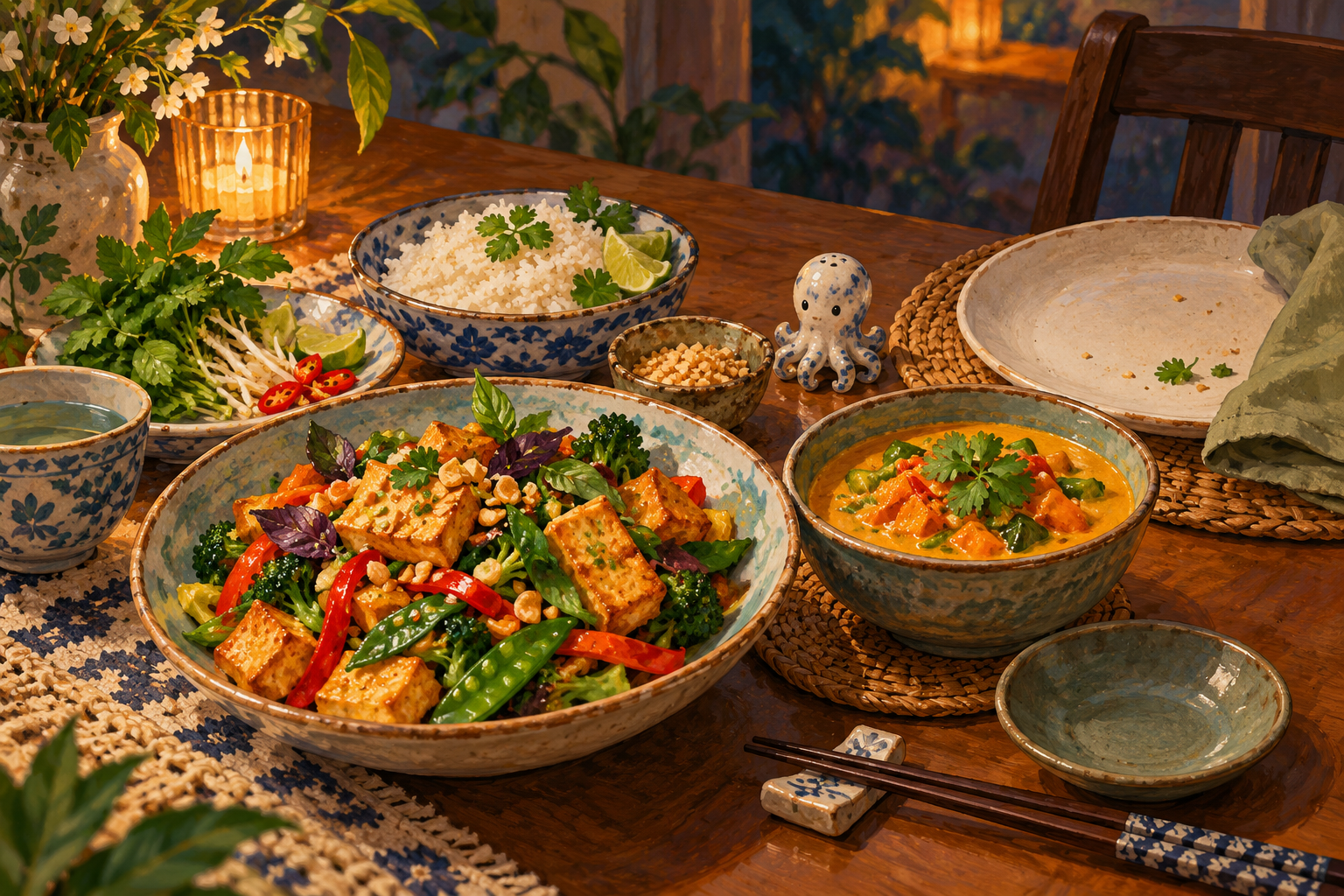
After more than a year and a half of changing how I eat on the Wahls Protocol, I’m through the elimination phase. I know I can change a habit. Besides, I love Southeast Asian food, particularly Thai. Crispy tofu, basil, rice, a little heat: where exactly am I supposed to fit the self-denial?
I’m not declaring myself vegetarian. Ordering tofu won’t make me Peter Singer, and I’ll almost certainly go on eating things I have mixed feelings about. But, I know what happens if I wait until I can defend every meal before I change one. I get to eat exactly as I always have, with the added satisfaction of having thought very hard about it.
Next time I’d be just as happy with tofu, I’d like to have that thought while I’m still holding the menu.
I’ll change how I eat
A little less suffering
That’s the plan, at least