Petty Office: Open
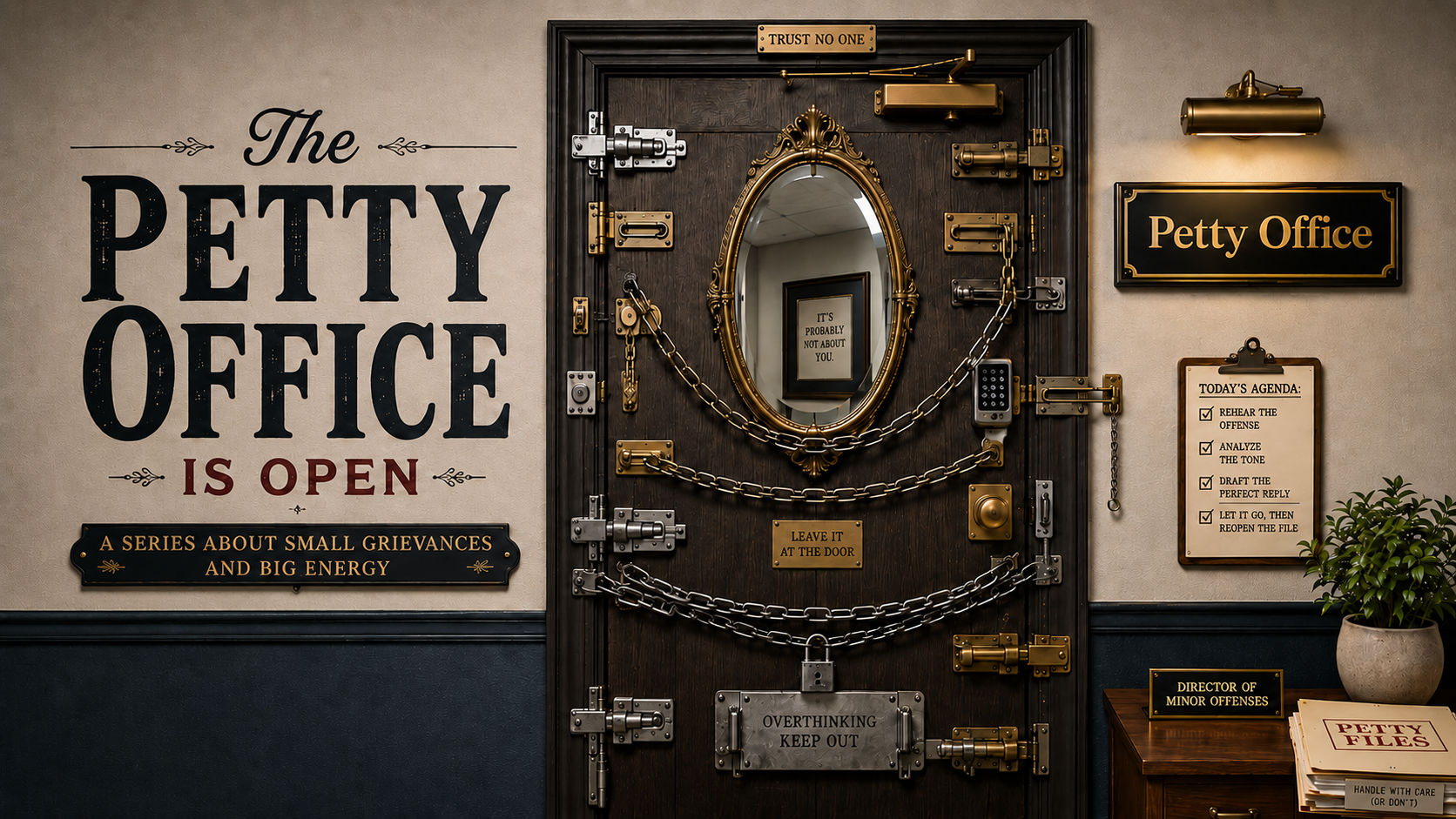
At some point, a person has to publish the complaints before the complaints start publishing the person.
These four essays are not about serious problems, except in the private courtroom of my own skull, where every misused phrase, misplaced question mark, and mangled psychology term arrives in chains and receives a full trial. They are petty. They are sarcastic. They are occasionally profane. They are also, unfortunately, sincere.
I’m sure they will not be the last. That would imply a level of peace I have not earned and do not expect to discover by accident. The world remains committed to producing material, and I remain committed to being disproportionately irritated by it. Still, I have to publish at some point before “negative reinforcement is not punishment” starts appearing on the walls in red string.
Taken together, these pieces are a small defense of precision and a larger confession of ridiculousness. I know language changes. I know people mean well. I know I am almost certainly committing crimes of my own in someone else’s private essay.
Fine. Granted.
Still, come on.

1. Small Hills I am Apparently Willing to Die On
I have pet peeves that are too small to qualify as principles and too persistent to qualify as passing annoyances. They are not moral causes. They are not political commitments. They are certainly not the sort of thing a serious person should carry around with any heat. Yet there they are, rattling around in my skull like loose screws in a dryer.
To make matters worse, a distressing number of them are attached to people I actually know and love. This is, in large part, a list of annoyances I have with my own family and in-laws. I do not say that proudly. I do not say it because I think I am right about everything. I say it because honesty demands it, and because there is something funny about being driven half insane not by enemies or strangers, but by the people who will also hand you a plate of food and ask how you’ve been.
I do not mean this as an attack. Truly. I am not trying to start blood feuds over visor position, steak temperature, food vocabulary, or the misuse of old military phrases at family gatherings.
Still, there comes a point where love itself has to look around and say, come on.
That sentence alone should tell you I am not writing from a position of strength.
Pet peeves are revealing. They show where your brain catches on the world’s burrs. They expose the specific little places where your sense of order, precision, proportion, or basic sanity starts throwing elbows. Mine tend to cluster around one central category: people being deeply, stubbornly certain in ways that make no sense at all.
This is also, unfortunately, a confession that I am one of those people.
Domestic Evidence
The first example comes from inside the house. Or rather, inside the car.
Christa, whom I love dearly, is one of those people who will sometimes drive around with the sun visor down when the sun is nowhere near the windshield. I’m in the passenger seat looking at the road, looking at the sky, looking back at the visor, and thinking: dude. What are we doing here?
The worst version is driving east at sunset, which means the sun is behind us, the visor is useless, and yet there it hangs anyway, like a ceremonial gesture to a problem that no longer exists. At that point it is not sun protection. It is tradition. It is the muscle memory of a past inconvenience being honored long after the facts have changed.
I find this weirdly fascinating because it feels like such a pure little portrait of human stubbornness. A person puts the visor down once and then, apparently, that becomes policy. New data arrives. Reality itself offers a correction. None of it matters. The visor stays down.
There is something almost admirable about that level of commitment, though “admirable” is probably too generous a word when I’m sitting there silently conducting a trial in my own head.
The Oven as Courtroom
The meat issue is worse because it masquerades as science.
There are people in my extended orbit who treat 165 degrees as if it were handed down on stone tablets. Everything must reach that number. Chicken, obviously, but also pork, beef, possibly old shoes. These are people who would turn a beautiful piece of meat into a solemn beige apology and then reassure you it is “safe,” as though flavor were a dangerous lifestyle choice.
To be clear, I understand the concern. I am not advocating recklessness. I am not suggesting anyone lick a raw cutting board and call it freedom. Pathogens exist. Listeria and salmonella are real. I am not out here trying to die for a pork chop.
Here is where the research both helps me and slightly annoys me, which is always the best kind of research. FoodSafety.gov lists 165 degrees as the safe minimum for poultry, casseroles, leftovers, and some other foods, so the number is not imaginary. It is just not a universal meat commandment. Whole cuts of beef, pork, veal, lamb, and similar meats are listed at 145 degrees with a three-minute rest, while ground meats are 160. In other words, nuance exists, and nuance would like to be invited to dinner.
Medium rare, in ordinary steak language, tends to live around 130 to 135 degrees. The official safety recommendation is more cautious than that, and I am not going to pretend otherwise just to win a joke. Still, the difference between “use a thermometer and understand what you are cooking” and “drive everything to 165 because danger lives below it” is the difference between prudence and culinary witness protection.
By the time a steak reaches well done, the microbes are not merely dead. They are legends. They are folklore. Their grandchildren are dead.
I say this, of course, as a man whose own life contains many examples of overcorrection, unnecessary anxiety, and highly specific opinions that would make me unbearable at a cookout. I am not claiming virtue here. I am merely claiming that if we are going to be neurotic, we should at least be accurate.
Chemicals and Other Ghost Stories
A related annoyance is the way people talk about “chemicals” as if the word itself means poison, deceit, or industrial evil. This one never fails. Someone says a thing is bad because it has chemicals in it, which is a little like saying soup is suspicious because it contains matter.
Everything has chemicals in it. You are chemicals. A peach is chemicals. The air is chemicals. Love, sadly, is probably chemicals. The word is doing no useful work there. It has become a spooky sound people make when they want to gesture toward danger without having to be specific.
The same goes for the naturalistic fallacy more broadly. People hear that something is natural and instantly grant it moral dignity, as though arsenic, uranium, and venomous snakes are all just earthy little blessings because no factory made them. Nature is full of astonishing beauty and horrifying nonsense. “Natural” is not a synonym for “good.” It is a synonym for “exists.”
MSG is my favorite example because people still talk about it like it was cooked up in a villain’s laboratory. The FDA says MSG is the sodium salt of glutamic acid, that glutamic acid is naturally present in our bodies and many foods, and that MSG occurs naturally in foods such as tomatoes and cheeses. The FDA also says added MSG is generally recognized as safe, while noting that studies have not consistently triggered reactions in people who identify as sensitive to it.
That does not mean every person must eat it or love it. Nobody has to pledge allegiance to a shaker of white crystals. It does mean the panic around it often has less to do with chemistry than vibes.
Parmesan is delicious partly because it belongs to the same savory universe people act like should be handled by hazmat teams. Tomato sauce, mushrooms, seaweed, aged cheeses—none of these are exactly fringe substances. Humans have been loving that deep, savory flavor for a very long time. We just get weird when the letters get rearranged into something that sounds technical.
This is one of those areas where I become insufferable because I can hear my own tone as I’m having the thought. I know exactly how I sound: like a man one disappointing conversation away from cornering someone at a party to explain basic chemistry against their will.
Nobody wants that guy around.
Least of all me.
Yet he lives here.
Divide, Then Misquote
Then there is “divide and conquer,” one of my favorite examples of people using a phrase in precisely the wrong direction.
I used to think of this as a Sun Tzu complaint, which is convenient because “Sun Tzu” sounds better in a rant than “a broader strategic and political maxim with Latin roots.” Sadly, research exists to make even my pettiness less clean. The phrase is more directly related to divide et impera, or divide and rule: the strategy of weakening groups by separating them so they cannot unite against whoever is in power. Britannica notes the Roman association and gives a Machiavelli example about dividing the enemy’s strength.
This does not ruin my complaint. It improves it by making me slightly wrong while still leaving me mostly right, which is an extremely irritating position to occupy.
The old strategic idea is not “let’s split the chores so many hands make light work.” That may be a perfectly fine way to clean a garage or organize a holiday meal, but it is not what the phrase means. The point is to divide the other side. Break up their strength. Prevent unity. Make them easier to deal with.
Somehow the phrase now gets used as if it means teamwork. “Let’s divide and conquer,” people say, when what they really mean is “let’s each take a task and be helpful.” Lovely sentiment. Entirely wrong phrase.
This one gets under my skin because it combines confidence, usefulness, and total inaccuracy. Nobody is even saying something evil. They are often saying something practical and cooperative. Yet the phrase remains exactly backward. That, somehow, makes it even worse. It is not malicious misuse. It is cheerful misuse. It is an error with excellent morale.
Again, I should be the last person throwing stones. I misuse phrases. I say things wrong. I have probably spent years confidently repeating some fact that turns out to be nonsense. There is almost certainly someone, somewhere, with their own private essay brewing about one of my habits. Possibly several people. Members of my family may already be comparing notes.
That is part of what makes pet peeves funny when they are handled honestly. They are never just evidence that other people are ridiculous. They are evidence that I am ridiculous in a very specific direction.
One not Aimed at the Family
To prove I am not only prowling my own family tree for material, here is one that does not home in on my relatives at all. It is for the wider public. A civic-minded irritation. A contribution to the common good.
I mean, of course, people saying “hone in” when they mean “home in.”
This one bothers me in a very particular way because “hone in” sounds good. That is part of the trap. It has a sleekness to it. It sounds sharpened, efficient, modern. Meanwhile “home in” sounds slightly older, slightly less cool, slightly more like it knows what it is talking about, which, unfortunately for everyone, it does.
You home in on a target. You hone a skill. You hone a blade. These are different jobs.
Yet people constantly say “hone in” because it feels better in the mouth, and usage has now gotten sloppy enough that even the dictionaries have started loosening their collars and letting it slide. Language people have been complaining about this for years while also acknowledging the grim little truth that common misuse, repeated often enough, starts to become usage.
That, if anything, makes it worse. I am not only annoyed at the public. I am annoyed at language itself for rewarding repetition over precision.
This is what I mean when I say my pet peeves are not noble. Nobody is being harmed. Civilization is not collapsing because someone says they want to “hone in on the issue.” I understand that. I even understand the linguistic argument that common usage eventually becomes usage, period.
Fine. Great. Wonderful.
Still, every time I hear it, some small internal clerk in my brain stands up, slams a folder on a desk, and says, no. Absolutely not.
A Modest Defense of Irritation
I do not actually want a world in which everyone agrees with me about steak temperatures, visor etiquette, food chemistry, military aphorisms, or airborne prepositions pretending to be verbs. That would be too much power for one person, and I have already demonstrated I cannot be trusted with ordinary household annoyance, much less universal consensus.
What I do think is that these tiny irritations reveal something real about how people move through the world. We inherit rules, phrases, fears, and habits, and then we cling to them with surprising devotion. We keep the visor down long after the light has changed. We cook the thing to death because once, somewhere, someone said a number and it stuck. We treat “natural” as holy and “chemical” as cursed because those categories feel emotionally satisfying. We repeat sturdy old phrases because they sound wise, even when we are using them backward. We say the sleeker wrong phrase because it has better branding.
I am not above any of this. I am made of the same lazy shortcuts and overconfident intuitions as everyone else. My only special gift, if it can be called that, is an ability to become exquisitely annoyed by them in real time.
That is not wisdom. It is not even particularly good character. It is just one more human flaw, slightly better dressed. Still, I admit I have a fondness for it. These tiny hills are stupid, but they are mine.
My family and in-laws, to their credit, put up with this from me while continuing to feed me, ride with me, and invite me places. That is real love. Real love is not agreement. Real love is allowing someone to have a five-minute internal courtroom drama about a sun visor and still letting him come to dinner.
For reasons I cannot fully justify, I will probably keep dying on these hills. Pettily. Verbosely. With full awareness that I, too, am almost certainly on someone else’s list.
2. The Question Was Already Begged
There are phrases so badly misused that correcting them makes you sound like the worst person alive.
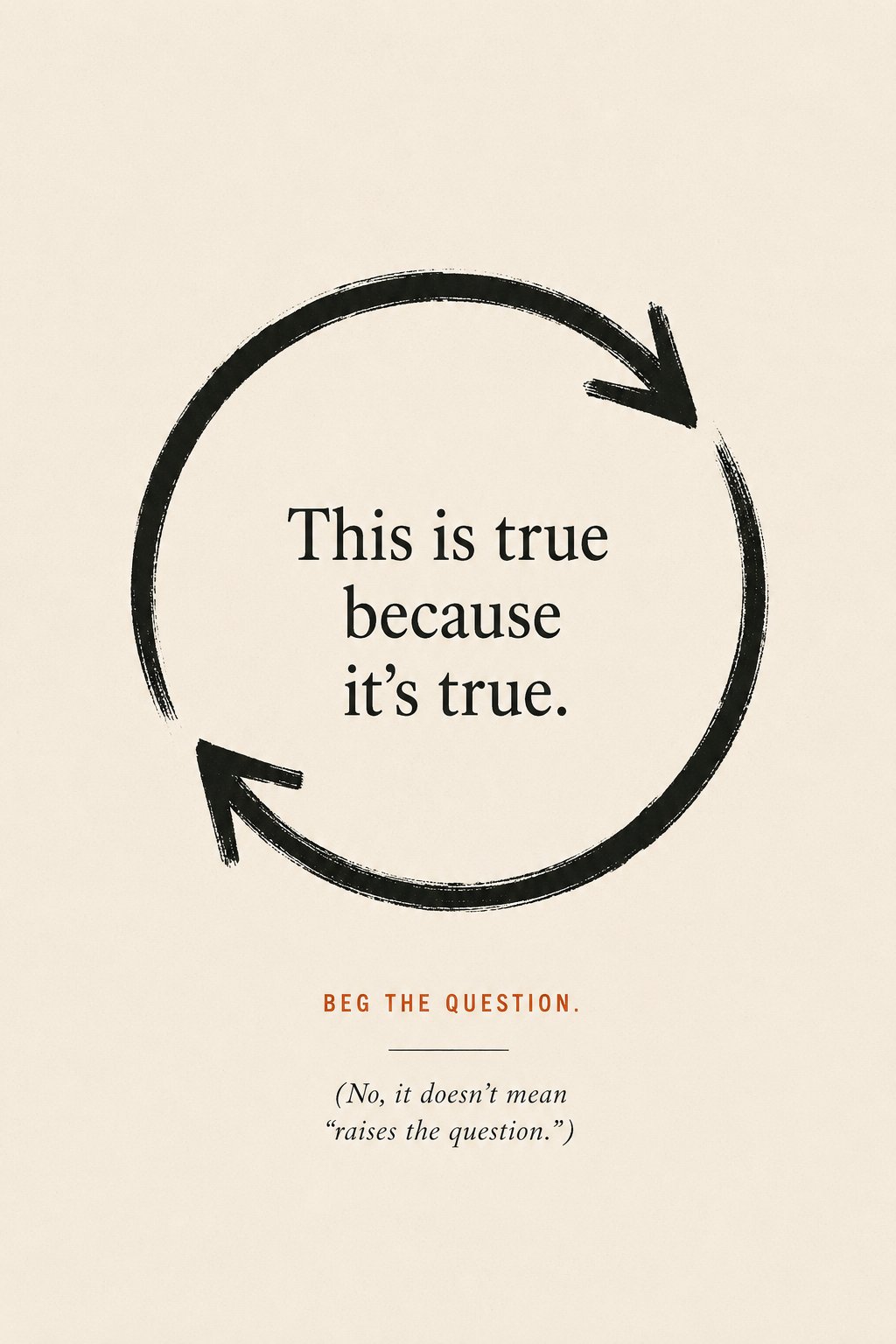
“Beg the question” is one of them.
You hear it everywhere. Someone says, “This begs the question: why did they do that?” Or, “The new policy begs the question of whether anyone thought this through.” Or, “The rising cost of groceries begs the question: are we all just buying one sad tomato and calling it dinner?”
The irritating thing is that I know what they mean.
That is part of the problem. I always know what they mean. They mean “raises the question.” They mean “prompts the question.” They mean “makes you wonder.” Perfectly useful phrases are standing right there, clean and available, holding little resumes, and instead everyone grabs “begs the question” because it sounds smarter and more dramatic.
Which, to be fair, it does.
That does not help.
Circular Reasoning, my Beloved Little Disaster
“Begging the question” does not traditionally mean “raising a question.” It means circular reasoning. It means assuming the thing you are supposed to be proving.
For example: “This policy is good because it is the right policy.”
No. That is not an argument. That is a sentence chasing its own tail and calling it exercise.
Or, “He is trustworthy because he would never lie.”
Great. Incredible. We have proved the sandwich is delicious because it tastes good. Philosophy departments can close. Logic has been solved by a man in a podcast chair.
That is begging the question. The conclusion is smuggled into the premise, tucked in there like nobody will notice. The argument walks in wearing a fake mustache and expects applause.
It is a useful concept. It names a real problem. It lets us spot arguments that look like they are moving but are actually standing in place, doing little rhetorical jumping jacks.
Then people took that phrase and used it to mean “makes me ask something,” because apparently “raises the question” was too exhausted from doing its job.
Yes, I Know Language Changes
At this point, some calm and reasonable person will say, “Well, language evolves.”
Yes. I know.
I hate that you are right.
Language evolves. Usage changes. Words drift. Phrases get softened, flattened, repurposed, turned into decorative throw pillows for thought. I am not standing at the gates of English with a sword and a powdered wig, demanding that nobody ever change anything.
Still, sometimes language does not “evolve” so much as lose a useful tool because everyone kept using it as a spoon.
“Beg the question” had a job. It described a specific logical fallacy. Then people started using it as a fancier version of “raises the question,” and now we are all supposed to nod politely because the wrong usage has good shoes.
Fine. I understand how this ends. The dictionaries will shrug. The usage guides will develop a thousand-yard stare. Some editor somewhere will sigh into a mug and let it pass because there are only so many hills one can die on before the zoning board gets involved.
I m not Innocent
To be clear, I am not claiming purity. I misuse things. I flatten concepts. I probably say some phrase that makes an expert in another field briefly consider walking into the sea.
This is the danger of being alive and verbal. We are all walking around with half-learned terminology, borrowed confidence, and a mouth that gets ahead of the brain.
Still.
There is a difference between being imperfect and grabbing a phrase with a specific meaning, turning it inside out, and sending it into public wearing a little graduation cap.
The issue is not that everyone needs to become a logician. The issue is that language is full of useful distinctions, and once we sand all of them down into “sounds about right,” we are left with a very smooth, very stupid table.
This Raises the Question
Here is my modest proposal: say “raises the question” when something raises a question.
Say “prompts the question” if you want variety.
Say “makes me wonder” if you are feeling human.
Save “begs the question” for arguments that assume their own conclusions. Let it keep its weird little job. Let circular reasoning have one phrase to live in without everyone barging through the door and turning the place into an Airbnb.
I know this is petty. I know the phrase itself is awkward. I know “begs the question” sounds like it should mean “demands that we ask,” which is probably why we are in this mess.
Still, come on.
Not every phrase that sounds fancy is yours to kidnap.
3. Four Buckets and a Folding Chair
Ok, so I hear this one all the time and it drives me absolutely bonkers.I was definitely bonkers/annoyed when drafting this, and for the fourth time now here’s my customary warning about profanity.
The Public Has Been Given Access Again
The nice thing about this annoyance is that it is not about anyone close to me. Nobody in my family needs to look around the room and wonder whether I am taking notes at dinner. Nobody needs to ask whether the sun visor has been mentioned again. This one belongs to the broader world, which is comforting because sometimes the broader world deserves to be yelled at.
Today’s petty hill is this: people using “negative reinforcement” when they mean punishment.
I keep hearing it in podcasts, reading it in articles, catching it
in casual commentary from people who sound very confident, and every time it happens, a tiny man in my brain throws a folding chair.
Negative reinforcement is not punishment.
It is not “being mean.” It is not “doing something bad to someone so they learn.” It is not a stern consequence, a scolding, a penalty, or whatever grim little parental theater someone is trying to describe. It is a specific term from operant conditioning, and the distinction is not obscure. This is not a PhD-level footnote. This is basic high school psychology shit, for fuck’s sake.
The Word Negative Is not a Vibe
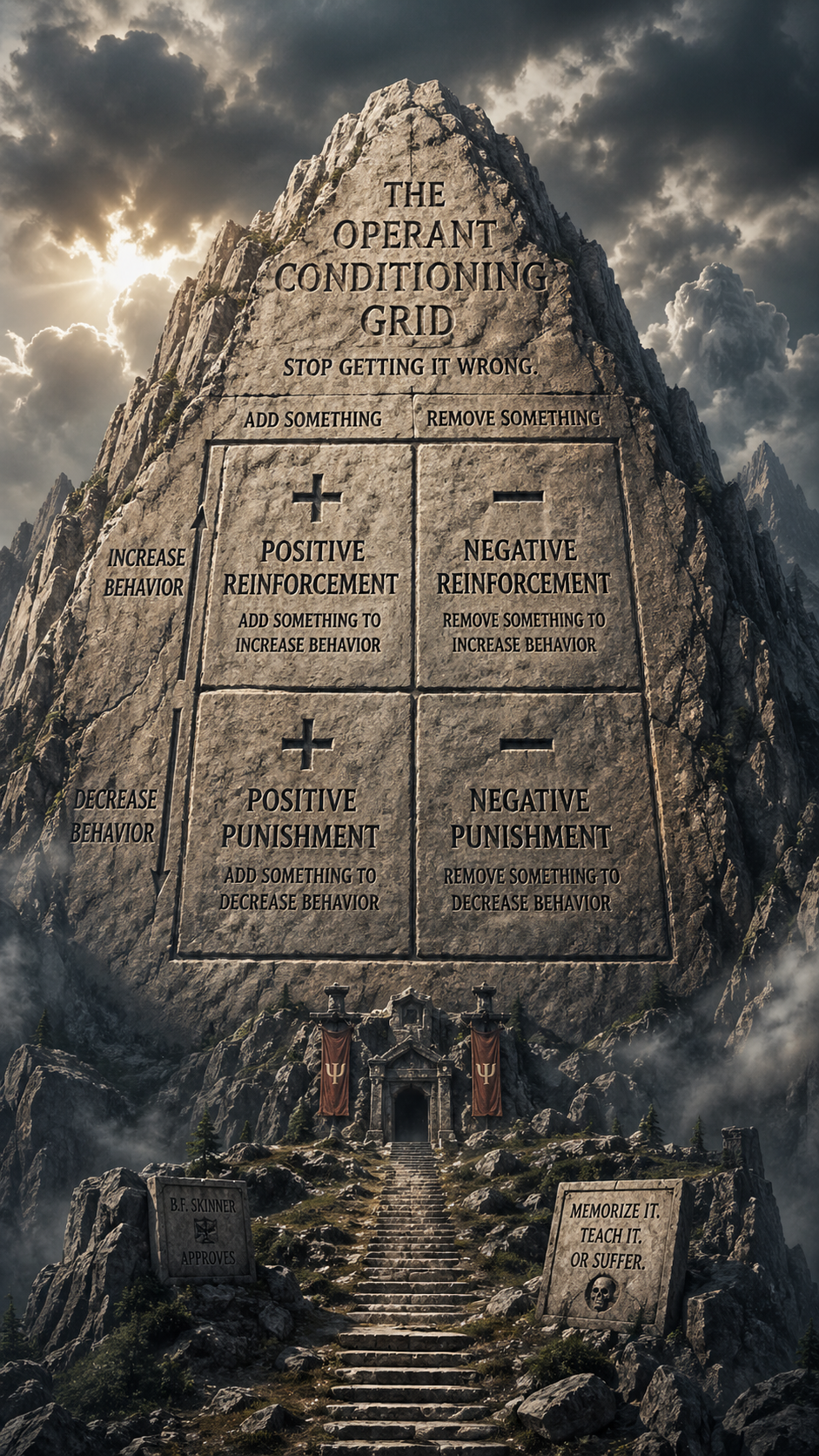
The problem is that people hear “negative” and immediately think “bad.” Which is understandable in ordinary speech and still wrong in this context. In operant conditioning, positive and negative are not moral judgments. They do not mean nice and mean. They mean add and remove.
Positive means something is added.
Negative means something is taken away.
Reinforcement means the behavior becomes more likely.
Punishment means the behavior becomes less likely.That is the whole damn grid. Four boxes. Not a mystical labyrinth. Not a koan. Not some delicate academic orchid that wilts if touched by regular people. A behavior either increases or decreases, and something is either added or removed. Congratulations, we have built the entire machine.
Postive reinforcement: you add something desirable to encourage a behavior. Give the dog a treat when it sits.
Negative reinforcement: you remove something unpleasant to encourage a behavior. The car stops screaming at you when you buckle your seatbelt, so you buckle your seatbelt faster next time.
Positive punishment: you add something unpleasant to reduce a behavior. You make someone do extra chores after they break a rule.
Negative punishment: you take away something desirable to reduce a behavior. You take away the phone, the toy, the privilege, the whatever.
See? Nobody died. No one had to consult a monk on a mountain. We just had to stop treating the word “negative” like it walked into the room wearing a little villain cape.
The Beep Is the Lesson
The seatbelt example is the one that should solve this forever. The annoying beep stops when you buckle up. The removal of the beep reinforces the buckling behavior. That is negative reinforcement.
Not punishment. Not discipline. Not cruelty. The beep goes away. The behavior increases. Negative reinforcement.
I do not understand why this continues to be hard except that language has vibes, and vibes are apparently undefeated. “Negative reinforcement” sounds like punishment. It has the word negative in it. It feels bad. It wears a black turtleneck and looks judgmental. Fine. I get it. The phrase is badly named for casual use.
Still, terms mean things. That is the whole reason we have them. The point of technical language is not to sound fancy. The point is to prevent us from standing around making soft little word noises while confidently meaning the wrong thing.
And, yes, I am sure I do this somewhere else. I am sure there is a term I misuse, a concept I flatten, a field I wander into wearing clown shoes and carrying a megaphone. Somewhere out there, some expert is listening to me say something casually wrong and feeling their soul detach from their body.
Fair.
But, today is my turn to be the asshole with the clipboard.
My Kingdom for a Fucking Quadrant
What makes this especially irritating is that the correct version is more interesting than the wrong one. The actual framework is useful. It gives you a clean way to think about behavior without collapsing everything into “reward” and “punishment” like we are training pigeons with a hammer.
Negative reinforcement is everywhere once you understand it. You take aspirin and the headache fades, so you are more likely to take aspirin again. You clean the kitchen and the gross countertop stops bothering you, so cleaning gets reinforced. You finally answer the overdue email and the low-grade dread leaves your body, which means avoidance has once again been beaten by the sweet, sweet removal of internal screaming.
That last one is not theoretical. That is lived science.
The point is not that everyone needs to become a behaviorist. Please God, no. The world has enough people turning ordinary life into diagrams. The point is that if you are going to use the phrase, use the phrase. Do not grab a term with a real meaning, jam it into the nearest emotional slot, and then wander off like you did language a favor.
Negative reinforcement is not punishment.
Negative means remove.
Reinforcement means increase.
That is it. That is the whole thing. I am not asking society to read Critique of Pure Reason. I am asking people to remember a two-by-two chart from a classroom poster.
Petty? Absolutely.
Vindictive? Maybe a little.
Self-important? Almost certainly.
Still, if I have to keep hearing “negative reinforcement” used as a fancy way to say punishment, then I reserve the right to become briefly, loudly, and embarrassingly correct.
4. Question Marks Are not Mood Rings
There are small writing habits I can forgive because language is flexible, people are tired, and everyone is doing their best inside the collapsing circus tent of modern communication.
This is not one of them.
I am talking about the sentence that is clearly a statement but ends with a question mark.
Not a rhetorical question. Not a sentence where someone is genuinely unsure. Not dialogue where the speaker is confused, tentative, or trying to soften the blow. I mean a plain declarative sentence that gets dragged across the finish line and then, for reasons known only to God and the worst group chats, is handed a question mark.
“I guess we’re meeting at six?”
No. Are we? Or, are you telling me? Pick a lane before I drive this conversation into a ditch.
The question mark is not decorative. It is not seasoning. It is not a little emotional garnish you sprinkle onto a sentence because you want it to feel less aggressive. It has a purpose. It marks a question. That is, I would argue, one of the more discoverable functions of the question mark.
The Voice Does it Too
You can hear the spoken version of this disease, which somehow makes it worse. Someone finishes a statement and their voice lifts at the end like the sentence is nervously raising its hand.
“We already sent the email?”
Did we? Are you asking me whether we sent it, or are you informing me with the energy of a haunted receptionist?
I understand that people use this upward inflection to sound polite, flexible, less harsh, less bossy. I get the social function. I am not immune to softening language. I have probably written “just checking” in emails when what I meant was “answer the damn question before I become legally responsible for my own tone.”
Still, at some point, we have to let a statement be a statement.
Not everything needs to arrive wearing little uncertainty pajamas. Sometimes the sentence knows what it is. Sometimes it has looked within itself and found no question there. Let it stand upright. Let it use a period. Let punctuation perform its ancient and noble duty without being drafted into amateur emotional labor.
Periods Are not Violence
Part of the problem, I think, is that periods have started to feel severe. In texts especially, a period can read as clipped, cold, or vaguely threatening. “Okay.” can feel like a door locking from the inside.
Fine. Tone is real. Context matters. Language changes. I am not trying to run a Victorian punctuation prison.
Yet the solution cannot be to make every statement pretend it might be a question. That is not warmth. That is grammatical fog machine behavior. It turns simple communication into a room full of raised eyebrows.
There are other tools. Use an exclamation point if you must. Add a softer phrase. Rewrite the sentence. Send an emoji if you are among friends and have accepted that society has consequences. Do not take a perfectly innocent declarative sentence and slap a question mark on it like a fake mustache.
I know this is petty. I know there are larger problems. Somewhere, someone is misusing “negative reinforcement” while overcooking a steak beneath a visor that has no reason to be down, and I am only one man.
Still.
A statement is not a question just because you got nervous at the end.
Please stop?
First (and maybe only but probably not) Addendum:
I remembered three more, none of which deserves a full essay and all of which have apparently survived long enough in my brain to file paperwork.
First, “could care less.” I know what people mean. Everyone knows what people mean. That is, frankly, part of the problem. The phrase is “couldn’t care less,” because the whole point is that your care has reached the floor. “Could care less” means there is still care available to remove, which ruins the math and makes some tiny accountant in my skull begin sharpening a pencil.
Second, people putting “and” in the middle of whole numbers. One hundred and seventy-nine. Two thousand and six. Christa said this recently, and I noticed it with the calm, loving, completely unnecessary vigilance of a man who should probably find better hobbies. To be fair, I also do this. The other day I mentioned this Fourth of July being the United States’ two hundred fiftieth birthday, and of course I added the “and” when I said it aloud. I knew better. My mouth did not.
Third, people pronouncing Vrbo like an acronym, as if it belongs in the same category as CIA, FBI, or some agency quietly monitoring vacation rentals from a windowless building. It is “verb-o.” Granted, I only know this because the company advertises on podcasts constantly, so I have been trained by repetition like a house pet with earbuds. In the opposite direction, Rachael Ray saying the letters “EVOO” instead of “extra virgin olive oil” also drives me insane, even though that is technically the reverse complaint. Apparently my position is not consistent pronunciation rules so much as everyone should make the exact choices that bother me least. Still, now that I know these things, I am cursed to know them, and knowing is where most of my problems begin.
Drive East at sunset
Look where the sun is shining
This complaint is true?