A Mind Is not one Mood
Pain Gets There First
If you read only a few of my essays, you’d be forgiven for thinking my mind had narrowed into one dim place.
I can see why. I had a run of a few days that felt nightmarish emotionally, and the essays closest at hand have come out dark, sad, furious, or exhausted. They have been about disability in its harsher forms. Losing speech. Mourning the likelihood that I will not sing with Charlotte the way I used to. Wanting, at least for a moment, to give up on my body altogether.
Those pieces are real. They are necessary. I do not want to write around them, soften them, or pretend they belong to some lesser version of the truth. There are experiences that ask to be named plainly because a prettier sentence would be a kind of evasion.
Still, they are not the whole truth.
Pain gets there first. It pushes to the front of the line. It interrupts whatever else was happening and insists on becoming the main subject. Researchers who study chronic pain often describe it in exactly those terms, not only as a sensation, but as something interruptive and interfering, something that can press on a person’s goals, attention, and sense of self.
That feels right to me. Pain does not merely hurt. It edits. It crops the picture. It makes the rest of life look smaller than it is.
A dark run of essays does not mean all is bleak in my head. It means those things have been pressing hard against me. It means they got to the page first. There is a difference.
The Rest of the Room
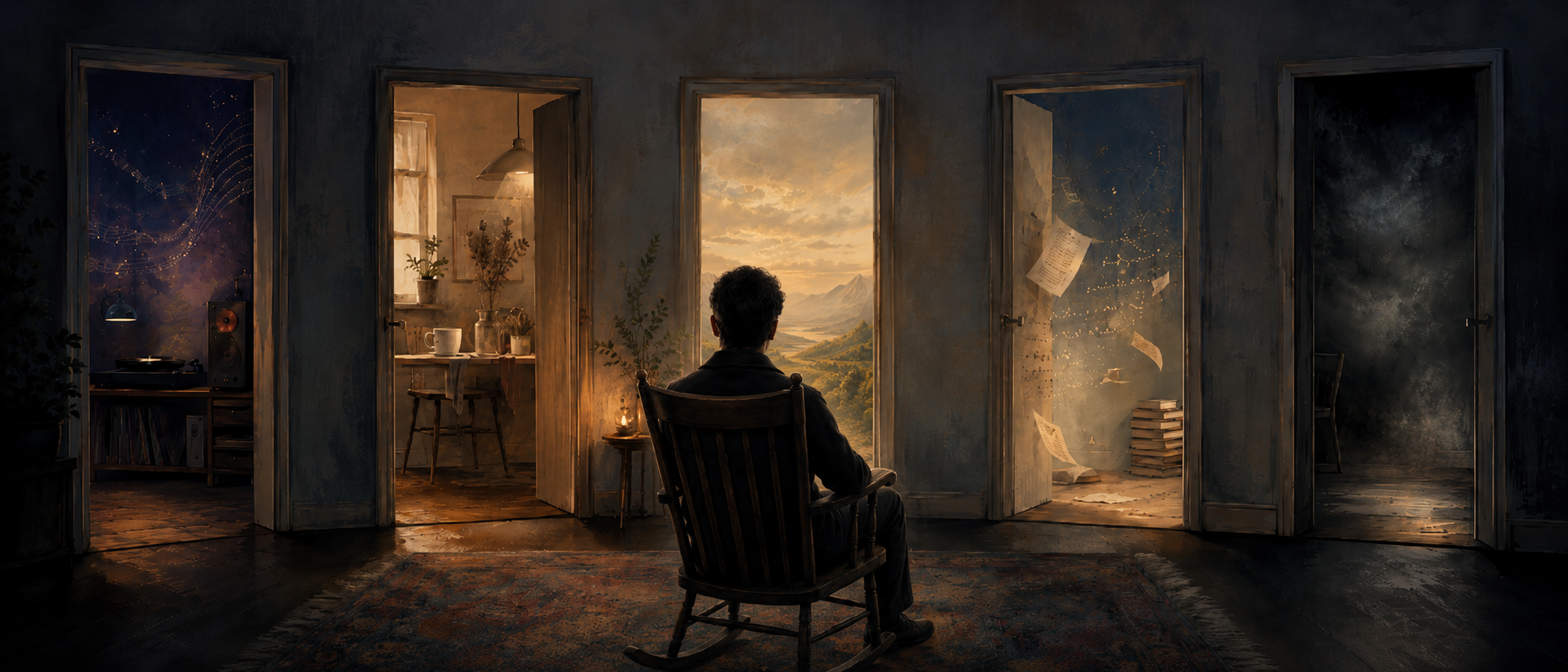
My mind is still full of other doors.
Some of them open onto subjects I have cared about for a long time: language, ancient ideas about the color blue, theories of consciousness, the old human urge to name what cannot quite be held. Some open onto music, which still moves through my days as something more than background decoration. Some open onto the smaller domestic comedy of sharing a life with Christa, who has systems that are both practical and, to me, occasionally funny in the most affectionate possible way.
None of that cancels the harder material. It sits beside it.
That distinction matters because suffering can create a false impression of totality. When the body becomes difficult, it can start to feel as though everything meaningful must now pass through that narrow gate. Yet attention does not work that way, or not only that way. Attention keeps leaping. It keeps collecting. It keeps catching on old philosophical problems, strange phrases, half-remembered songs, household habits, jokes that would sound ridiculous in any more official account of a life.
That persistence is not denial. It is evidence.
The fact that I am still interested in why some ancient cultures did not seem to organize blue as a basic color category in the way modern English speakers often do is not a distraction from my life. It is part of my life. The fact that I can be pulled toward theories of consciousness one week and then into an essay about bins or lists the next is not a failure of seriousness. It is a more complete seriousness.
This is what it is actually like to be a person: wounded and amused, divided and continuous, curious and tired, sometimes furious, sometimes ridiculous, somehow still capable of surprise.
Not a Brighter Lie
I am wary of forced positivity.
That phrase alone makes me suspicious. It can sound like a demand to sand down grief until it becomes more convenient for everyone else. It can sound like a sales pitch. It can sound like somebody standing beside a real wound and asking whether I have tried gratitude.
That is not what I mean here.
I am not trying to pivot away from disability. I am not trying to brighten the room artificially or write some more marketable version of myself. The body is still the body. The losses are still losses. The anger is still anger. The mourning is not a misunderstanding that will disappear if I arrange my thoughts more attractively.
Yet there is a difference between forced positivity and range.
Psychologist Barbara Fredrickson’s broaden-and-build theory argues that positive emotions such as interest, joy, contentment, and love can widen the scope of attention and cognition, helping people build resources over time. I do not read that as a command to be cheerful. I read it as a defense of why small openings matter. Interest matters. Humor matters. Love matters. Not because they erase the bad thing, but because they keep the bad thing from becoming the only available map.
That is the kind of positive I can believe in.
Not optimism as decoration. Not hope as performance. More like breadth. More like proof that the mind has not handed every room over to pain.
The Uses of Curiosity
I do not want to become a writer who can only testify.
Testimony matters. Some truths have to be dragged into the open with both hands. I know that. I also want to remain someone who notices, someone who follows an idea because it glows faintly, someone who lets music or language or a funny domestic pattern interrupt the larger story of decline.
There is dignity in that interruption.
Curiosity has always been one of the ways I know I am still here. It does not always arrive dramatically. Sometimes it is almost petty. A phrase irritates me. A song catches in my head. A theory of mind seems both brilliant and incomplete. Some argument about ancient color terms returns because the old question is still alive: how much of the world do we see because we have learned how to name it?
Those questions do not fix anything. I do not need them to. They keep the inner life from shrinking to the dimensions of damage.
A life is not organized by genre, even if a blog is. The categories help. Explorations. Reflections. Fiction and poetry. The wounded pieces. The observational ones. The philosophical ones. The funny domestic ones. The drafts built from music, language, memory, annoyance, or some small thing that turned out not to be small after all.
Actual experience is messier. Grief shares a wall with curiosity. Anger sits down beside absurdity. Love keeps making room. Thought goes on.
The Household Keeps Talking
This is why the domestic essays matter to me.
Christa’s bins and lists are funny because they are specific. They belong to our actual house, our actual life, our actual patterns of affection and mild exasperation. They are not an escape from the harder essays. They are part of the same world.
That is easy to forget. Pain is convincing. It can make every other subject feel minor, decorative, almost embarrassing by comparison. Who cares about color words or consciousness or the structure of a sentence when the body is betraying you? Who cares about a song, or the way your wife organizes the house, or some small family joke that keeps returning because everyone knows their part?
I do.
That is the point.
I care because those things are not separate from the difficult life. They are the difficult life, too. They are what remains active inside it. They are proof that my inner world has not collapsed into one long corridor. There are still rooms in it. There is still movement between them.
Maybe that is part of what I want this site to hold: not a mood, but a record. Not a brand of suffering, or wisdom, or humor, or literary seriousness, but a mind trying to remain honest across several registers at once.
The Whole Map
The darker essays are true, but they are not the whole map.
My body can be hard to live in and my life can still contain humor, fascination, tenderness, and thought. I can write about losing things and still remain interested in what stays. I can be brokenhearted and still curious. I can be angry and still attentive.
This does not make the pain smaller. It makes the record larger.
That feels important right now. Not because I need to reassure anyone. Not because I owe the reader a lighter piece after a run of difficult ones. I need it because I do not want pain to become the only recognized authority in my own work.
The disability pieces belong. The mourning belongs. The frustration belongs. The anger belongs. The essays about music belong. The strange old questions about language and mind belong. The funny domestic pieces about Christa and her bins and her lists belong. The heaps of other unwritten things belong, too.
A more positive piece does not betray the darker ones. It completes them. It says the wound is real, and it is not the only thing here.
A mind is not one mood. A life is not one note. A record worth keeping should leave room for the thing that hurts, the thing that thinks, the thing that laughs, and whatever in us keeps turning toward the next open door.
More than the darkest
Night is not the only thing
Pain but also beauty