When the truck driver falls asleep at the wheel after driving almost nonstop from Anchorage, he crushes Laurel’s mother against the highway median. Dead instantly. Her younger brother, Isaac, doesn’t make it through the night.
Not long after, her father loses his job. A structural engineer, he sits at home drawing, designing, and trashing whatever might hold promise. Eventually, a letter arrives explaining how sorry everyone at the firm is, but how an engineer can’t be missing for so many months without even a call. They invite him back at any time.
After Laurel’s sixteenth birthday, they take off in the family van, due west, staying in motels.
“This can be my side of the car,” she says, drawing an imaginary line down the middle of the van with a sweeping motion.
“Deal,” he says, and Laurel can’t tell if he realizes she’s joking.
Their conversations, when they happen, continue this way. Minimal, matter-of-fact.
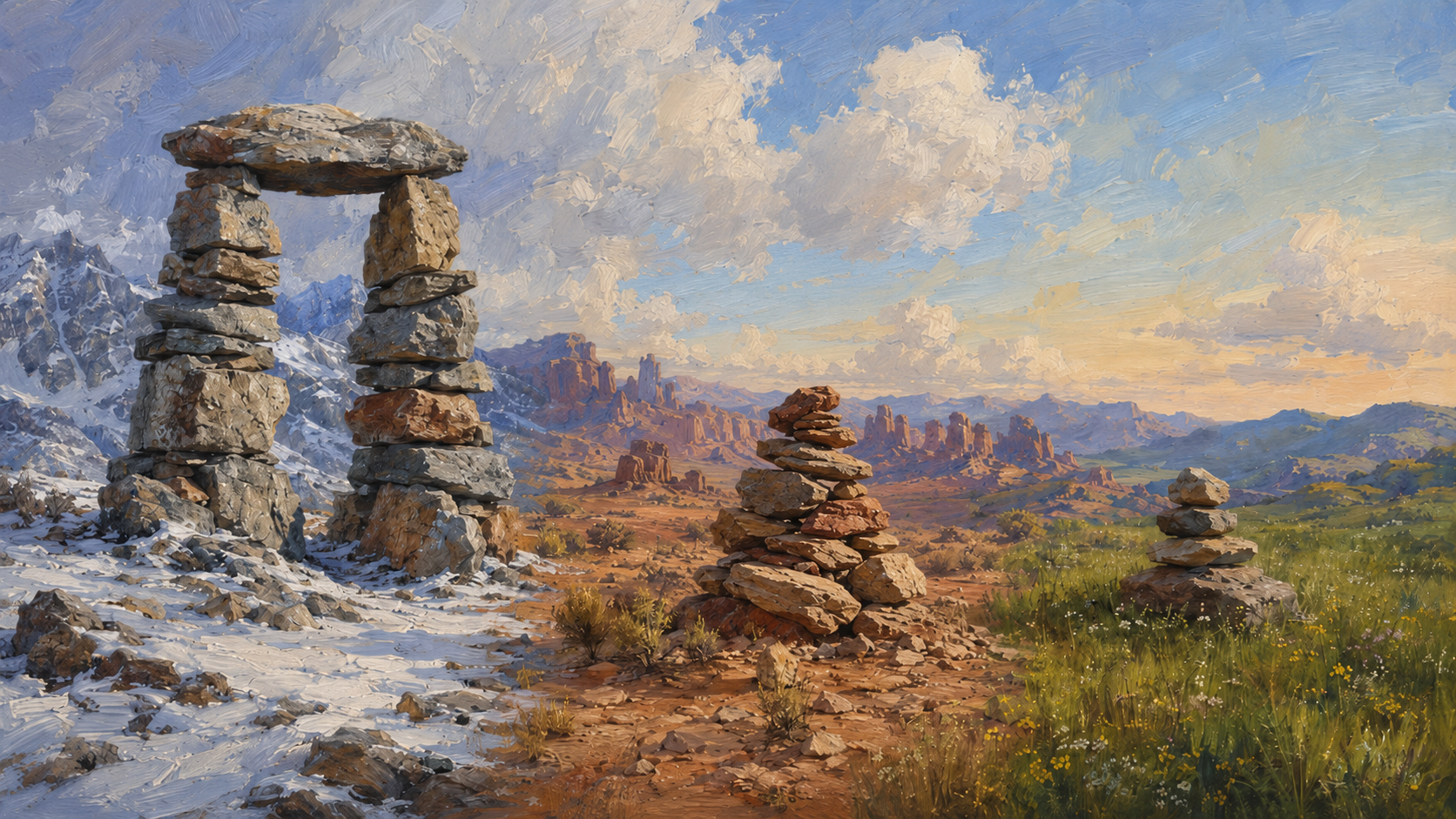
Her father has taken up stacking stones. At first, they are loose piles, becoming more elegant over time. He balances two or three stones into a miniature tower whenever they stay in a park, the towers slowly increasing in size. Camping in the Mojave, under the shadow of the Sierra Nevada range, he starts to build basic scaffolding. Some of the new towers reach over their heads.
They abandon the van. Her father explains that it’s holding them back, that continuing on foot will let them best leave their mark. Though they hardly speak, Laurel marvels at her father’s work, the focus. The focus that seems to replace the grief.
He gathers twenty boulders and stacks them ten feet high, the most massive tower to date. It’s strong, never wobbling, despite the lack of support from smaller stones in its cracks. By a campfire, they stare at the monolithic creation, and he says that it could stand for generations, but that with just a little push it would crash, probably killing the pusher in the process.
The towers, large and small, take on a unique style. He uses as few stones as possible to create the tallest towers. After a while, she and her father abandon established trails and leave their markers along their path. As they approach the Rocky Mountains, they turn north.
The towers, now numbering in the hundreds, form their own trail, stretching from the first piles near their home in southern Missouri to the desert of the Southwest, where they abandoned the van, and now as far north as Colorado. Whenever Laurel asks where they’re headed, he explains over and over that they need to stick together.
An old man in a visitor center asks what brings them to Colorado. Laurel describes the towers. The man calls them cairns and says they’ve been used as trail markers for thousands of years, and sometimes even in religious rituals. Her father says he’s never heard the term.
They pass through a campground with several cabins. Mature pine trees stand in front of each of the doors. One cabin is situated away from the others. They nearly miss it. A series of trees are growing around the perimeter, though they have been cut down in front of its open door.
“We’ll camp here tonight,” he says.
Laurel explores the grounds. She finds a man standing on a dock across the camp. He’s carrying a flashlight and a small backpack.
“Are you following the cairns too?” he says.
Laurel struggles to make out his features, illuminated only by the glow of the flashlight off the dock. He’s thin, perhaps even emaciated under his winter coat, with hair and a beard that reach down past his collarbones.
“No. We’re camping.”
“Would you like to join me? They’re quite beautiful. I’ve been following them for miles. Hundreds of miles.”
“I’m sorry. No. Stay warm.”
“Are you sure?” He shambles toward Laurel and opens his hand, revealing a syringe. “Let me just show you. I’ll share them with you, what I’ve seen.”
Laurel steps back. “Not interested.” She reaches for the knife in her pocket. “I’m going back to my camp now.”
And, with that, he shuffles past her into the dark.
|||||
They camp through the winter, through the spring, traveling slowly. After walking for nearly two years, they arrive in Anchorage and camp just north of the city.
“We’ll stay here a while, I think. I need a rest,” says the father.
But, he doesn’t rest. He spends the summer months constructing his largest tower to date. Laurel doesn’t complain. It’s the longest they’ve stayed in one place since the accident. Soon, small gatherings of no more than five or so people appear around their campsite, none so ravaged as the man in Colorado. They watch the father build with a sort of reverence usually reserved for holy sites.
The locals begin to write about the structure, reporting on a small community of enthusiasts who have followed the five-thousand-mile trail. The final design consists of two towers, each over twenty feet tall and weighing nearly half a ton. He hoists a long stone to connect the towers. Laurel, for the first time since the accident, sees her father content.
“It’s cold, Dad. It’s too cold here,” says Laurel one night in September.
“I think I’ll stay a bit longer,” he says. He hands her a check, already written. Forty thousand dollars. “That should be enough to get you home, keep you safe. I think I’ll keep going north. Fairbanks, maybe.”
She doesn’t fight him. There’s nothing she can think to say that will convince him.
She hitchhikes east, then south. There’s no trail, not really, not for Laurel.
She returns to the site of the first cairn and is disappointed not to find one of her father’s followers waiting for her. Laurel visits the field every few weeks. Her father’s first monument is slowly picked apart—by kids, by animals, by the weather, she can’t be sure—until eventually she cannot place exactly where it stood. She wonders if her father made it to Fairbanks, if he left at all. Without a distraction from her grief, without a monument of her own, she is confronted with it.
She is finally alone.