The Songs Came Back Wearing my Clothes
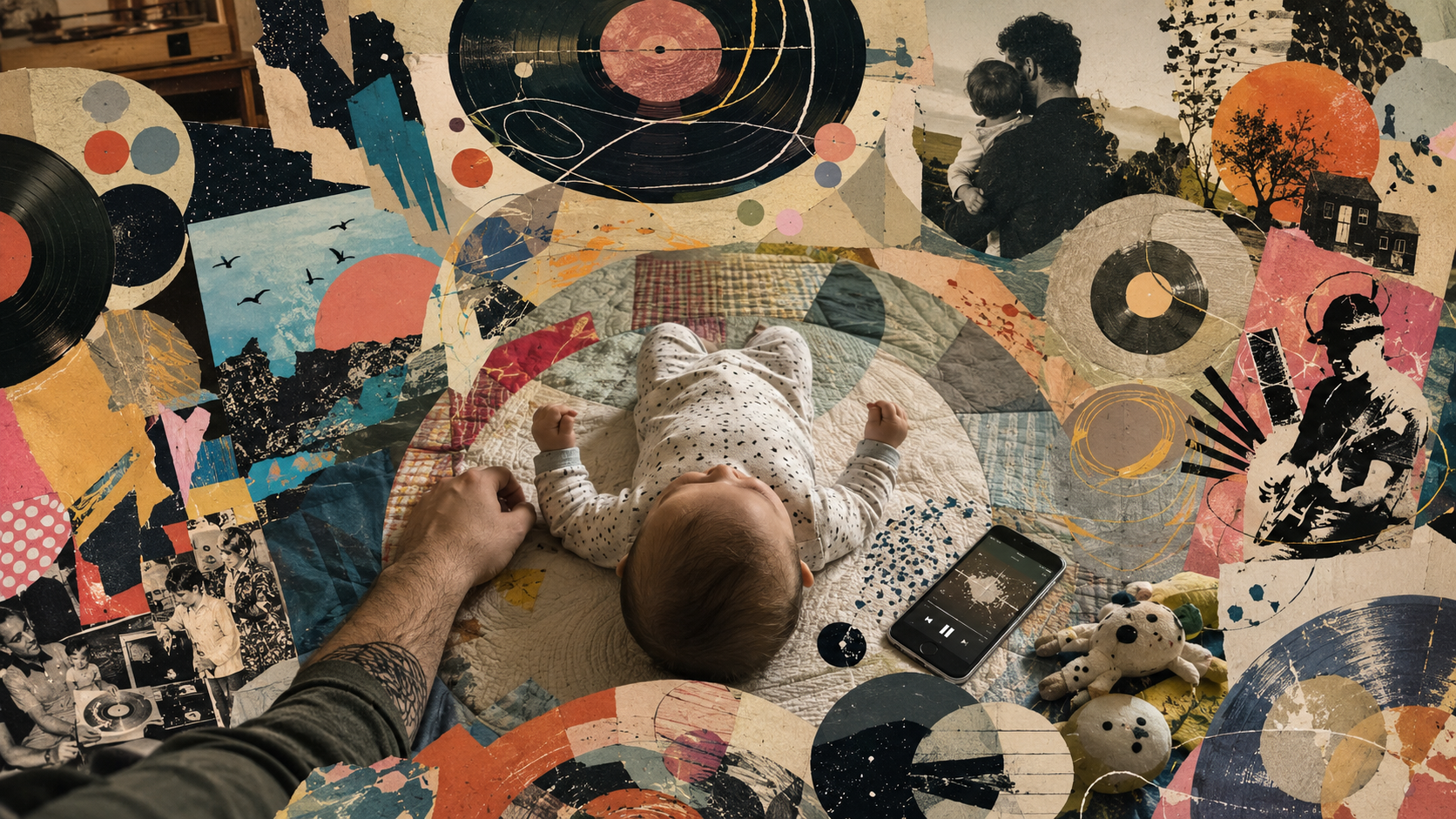
Same Playmat, Different Noise
Christa had taken the girls out to run errands, which means the house briefly became quieter in the way a house becomes quieter when two small children leave but all their evidence remains.
The toys were still there. The crumbs had not packed their bags. The general feeling of recent human activity had not politely excused itself from the room.
Still, for about thirty minutes, it was just me and Wyatt.
That number feels worth saying plainly. Thirty minutes. Not an afternoon. Not a long, suspended stretch of newborn time. Not one of those strange early-parenthood hours where the whole world seems to pause around a sleeping baby.
Thirty minutes.
These days, thirty minutes can feel enormous.
Wyatt was three months old when I started drafting this, which means he was still in that impossible stage where a person is clearly here but not yet fully declared. He had opinions, obviously. Babies have opinions. They just express them with the subtlety of a fire alarm installed inside a marshmallow.
Mostly, though, he was content. He lay on his back on the same playmat Charlotte once lay on, kicking a little, looking around, taking in whatever version of the world was available from that angle.
That detail caught me harder than I expected.
The same playmat.
Not spiritually significant in itself. Not an heirloom. Not some sacred family textile passed from generation to generation by candlelight while a violin weeps in another room. It is a playmat. It has been spit up on. It has known the daily violence of baby feet.
Still, there Wyatt was, in the same place where Charlotte had once been small enough for me to sit beside her and play Radical by Every Time I Die because apparently some part of me thought fatherhood needed more blast beats.
I did not play Radical this time.
I did not put on Matt and Kim either, the way I had with Rowan during the living room walker parade, when the song quickly became less important than her loops through the room.
For Wyatt, I put on songs I had made with Suno.
That sounds, at first, like the least romantic version of this story.
It wasn’t.
The Private Radio Station
The songs came from my phone, which is not exactly the grandest delivery system for a family ritual.
No speakers. No carefully chosen record. No album art. No sense of ceremonially lowering the needle. Just my phone lying nearby while Wyatt lay on the playmat, and this little private radio station of strange, funny, sentimental, profane, oddly specific songs played into the room.
They were songs I had generated for essays.
That is the important part.
Not random songs. Not a playlist the algorithm coughed up because I once listened to one track and it decided I was ready to become a man with a mandolin problem. These songs were tied to pieces I had written, or was writing, or had turned over in my head for weeks. They came from little domestic battles, philosophical tangents, language peeves, family jokes, books I loved, memories I had tried to preserve before they softened around the edges.
They were not handmade in the old sense.
I did not sit with a guitar and work out the chords. I did not write melodies on a piano. I did not spend hours in a studio trying to get the snare to sound less like someone dropping a toolbox down a stairwell.
Still, they were not cheap to me.
That distinction matters.
There is a lazy way to talk about AI-made things, as if anything touched by a model becomes instantly disposable. Sometimes that is true. There is plenty of slop in the world. There was slop before AI, and there is certainly slop now, freshly foamed and served at scale.
This did not feel like that.
These songs were funny because they came out of my life. They were moving because they had hooks into actual days. They were strange because my essays are strange, and because Suno has a marvelous and occasionally deranged willingness to take a domestic irritation and dress it up like a lost radio hit from a parallel universe.
Wyatt did not know any of that.
He did not know the essays. He did not know the jokes. He did not know which song came from which piece, or why one lyric made me laugh, or why another one made me unexpectedly quiet.
He was three months old.
He mostly knew sound, presence, nearness, tone.
That was enough.
Not Inheritance, Exactly
With Charlotte, the music felt like inheritance.
I was playing her a record that had mattered to me before she existed. Radical was loud and unruly and full of life, and I remember feeling the absurd tenderness of placing that sound near a newborn who had no idea what any of it meant. I was not teaching her taste. I was not making a curriculum. I was just letting something that had shaped me share air with someone who would reshape me completely.
The album belonged to my past.
Charlotte belonged to the future.
That was the little hinge of the memory.
With Rowan, the music did not work that way. I tried to put on Matt and Kim, and Rowan immediately became the actual song. She moved through the living room in her walker, circling, bumping, correcting, laughing, making the whole room more interesting than anything coming from the speaker.
The song became background.
The child became the beat.
Wyatt’s version was different again.
These songs were not from before him, exactly, even though some of the essays were. They were not old records I carried out of my twenties. They were not artifacts from the person I had been before children.
They were made inside the life that includes him.
That may be why the moment felt so personal.
By the time a third child arrives, the family does not become less miraculous, but the available time changes shape. There are fewer open hours. Fewer long silences. Fewer clean little scenes where one parent and one baby seem to exist inside a perfect, photographable bubble.
The third child is born into motion already underway.
Sisters are talking. Shoes are missing. Someone needs a snack. Someone has a question about the universe that somehow involves princesses, death, and whether the moon has a mother. Laundry continues its slow campaign against human dignity.
Then, inside all that, there is Wyatt.
Not an addition to a quiet house.
A new center inside an already spinning one.
Maybe that is why thirty minutes mattered. It was not much time, but it was his. It was ours. Christa and the girls were out. The house loosened its grip for a moment. Wyatt lay on the playmat, and I put on the weird little songs that had come out of this whole ongoing attempt to notice my life before it disappears into the next task.
Songs From the Archive
There is something odd about hearing your own writing turned back into music.
Not your exact writing, usually. Not a clean translation. More like the essay wanders into a costume shop, gets a little drunk, and comes out singing.
Sometimes the result is ridiculous.
Sometimes it is better than it has any right to be.
Sometimes it finds the emotional center of a piece by accident, the way a child picks up a phrase you did not realize you had been saying and suddenly reveals your whole personality back to you.
That afternoon, the songs did not feel like products. They felt like postcards from the archive.
Here is one from a joke that got out of hand.
Here is one from a frustration I decided to turn into rhythm instead of just muttering about it in the kitchen.
Here is one from a memory I wanted to keep.
Here is one from love, disguised as an argument about household systems.
Here is one from grief, or attention, or language, or the strange privilege of getting to care about small things because the large things are always too large to hold for long.
Research on music and memory often points out that music does not merely store itself in us. It attaches to scenes, people, moods, and periods of life. A song can become less important as an object than as a doorway back into the room where we heard it.
That sounds right, but I almost want to reverse it here.
These songs were not pulling me back into old memories.
They had been made from memories first.
They were the residue of attention, turned into choruses.
The essays came first. Then the songs. Then Wyatt, lying there under them, becoming part of their meaning too.
That is the strange loop I want to remember.
Not just music making memory.
Memory making music.
Then music making another memory.
The Baby on the Floor
Wyatt did not perform for the essay.
This feels important to say because writing about your children can create a dangerous illusion that their lives are arranged in little scenes for your benefit. They are not. They are not metaphors in footie pajamas. They are not emotional support symbols. They are people, even when they are very new people with very poor neck control.
Wyatt just lay there.
He moved his arms. He kicked. He looked toward the music sometimes, or toward me, or toward whatever astonishing object had entered the kingdom of his vision. The phone played songs that meant nothing to him and everything to me, which is often how parenting works at first.
The parent pours the whole inner life into the room.
The baby looks at the ceiling fan.
Fair enough.
Still, shared attention does not have to be dramatic to matter. Studies and early-childhood guidance on music with infants often emphasize simple things: singing, listening, moving, taking turns with sound, and using music as one more way for parents and babies to regulate, connect, and notice each other.
That is a clean way to describe what was happening, though it sounds more organized than it felt.
I was not doing an activity.
I was not “supporting infant development,” though I am glad infant development is generally in favor of music and not, say, prolonged exposure to leaf blowers.
I was just there.
Wyatt was there.
The songs were there.
That was the whole ceremony.
A phone on the floor. A baby on a mat. A father listening to the strange little evidence of his own life come back through a speaker while his son stared upward, still too young to know how much had already been placed around him.
Not as pressure.
Not as expectation.
As welcome.
The Third Lullaby
I keep thinking about how different each of these musical memories feels.
Charlotte’s radical lullaby was almost comic in its stillness. Loud music, tiny sleeping baby. A record from my life placed beside the beginning of hers.
Rowan’s was kinetic. The music tried to lead, then got joyfully demoted. Her walker became the instrument. Her motion became the song.
Wyatt’s was smaller and stranger.
No album.
No walker.
No long afternoon.
Just thirty minutes and a phone full of songs made from the life we are already living.
Maybe that is what makes it feel like the third lullaby. Not a repetition of the first two, but another turn of the same question.
What do we give our children when we share music with them?
Sometimes we give them the things that formed us.
Sometimes we give them a beat to move against.
Sometimes we give them the sound of our own attempts to pay attention.
Wyatt will not remember that afternoon. Of course he won’t. Three-month-old babies do not file away memories in neat folders labeled “Dad’s Weird AI Folk-Punk Essay Songs, Early Period.”
He may never hear those songs again. Or, he may hear them years from now and think they are funny, embarrassing, weirdly catchy, or evidence that his father needed more sleep.
All possible.
All fair.
The point was not that he would remember.
The point was that I would.
The point was to notice him there, on the same playmat where Charlotte once rested, in the same house where Rowan later circled the room, in the same life that somehow keeps making new rooms inside itself.
I wanted Wyatt to have one too.
Not because the children need matching essays like commemorative plates.
Not because memory is a scoreboard.
Because each child changes the song.
Charlotte taught me that a lullaby does not have to be gentle.
Rowan taught me that sometimes the child becomes the music.
Wyatt, lying there while my strange little Suno archive played from my phone, taught me that a lullaby can also be a record of attention coming back to meet the person who made it necessary.
I am glad Christa took the girls on errands.
I am glad the house gave us thirty minutes.
I am glad I did not dismiss the songs as cheap just because a machine helped make them. They were not cheap to me. They were mine in the way a memory is mine: altered by every tool that touches it, incomplete, imperfect, but still carrying the heat of the life it came from.
Wyatt lay on his back, listening or not listening.
I lay on the floor near him.
The songs played.
For once, nothing bigger had to happen.
He moves
My gratitude
It doesn’t know limits
He won’t remember, but I will
Pure love