The Genre Is yes, Unfortunately
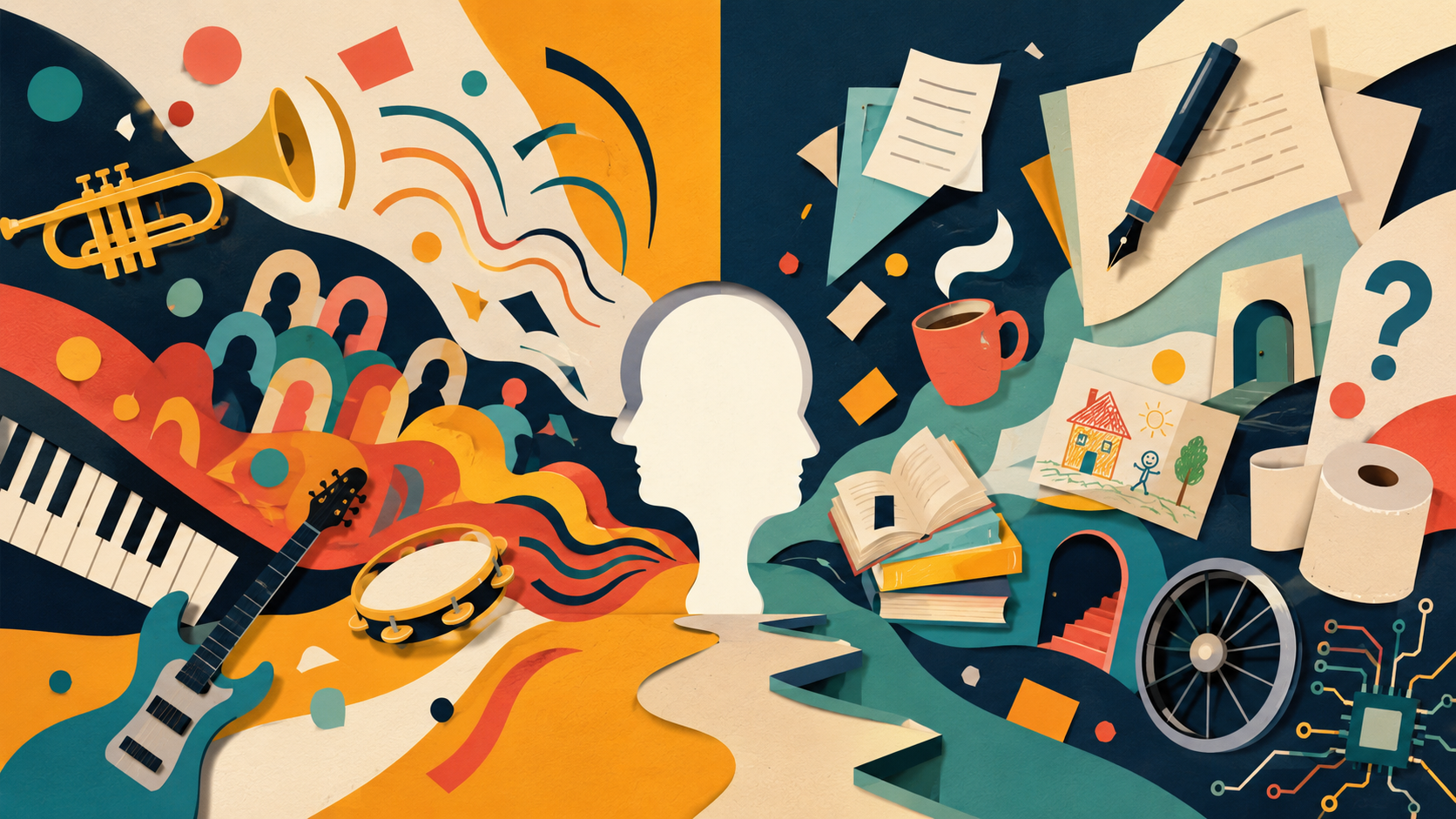
I have recently been forced to confront the possibility that my taste is not eclectic so much as administratively unmanageable. This became obvious while asking Suno to generate songs that combined gospel, hardcore, ska, hyperpop, country, indie rock, and whatever musical tradition best captures the feeling of a trombone being spiritually overwhelmed. At some point, the prompt stopped looking like a set of instructions and started looking like evidence.
The problem, of course, is that this is not only how I listen. It is also how I write. Open Doors has become a place where an essay about consciousness can sit beside an essay about a coffee mug, which can sit beside an essay about parenting, which can sit beside an essay about pain, which can sit beside an essay about why some minor misuse of language has apparently ruined my day. I would love to claim this is all part of an elegant design. In reality, the design appears to be: notice something, overthink it, discover it has trapdoors, and then pretend the resulting pile has a theme.
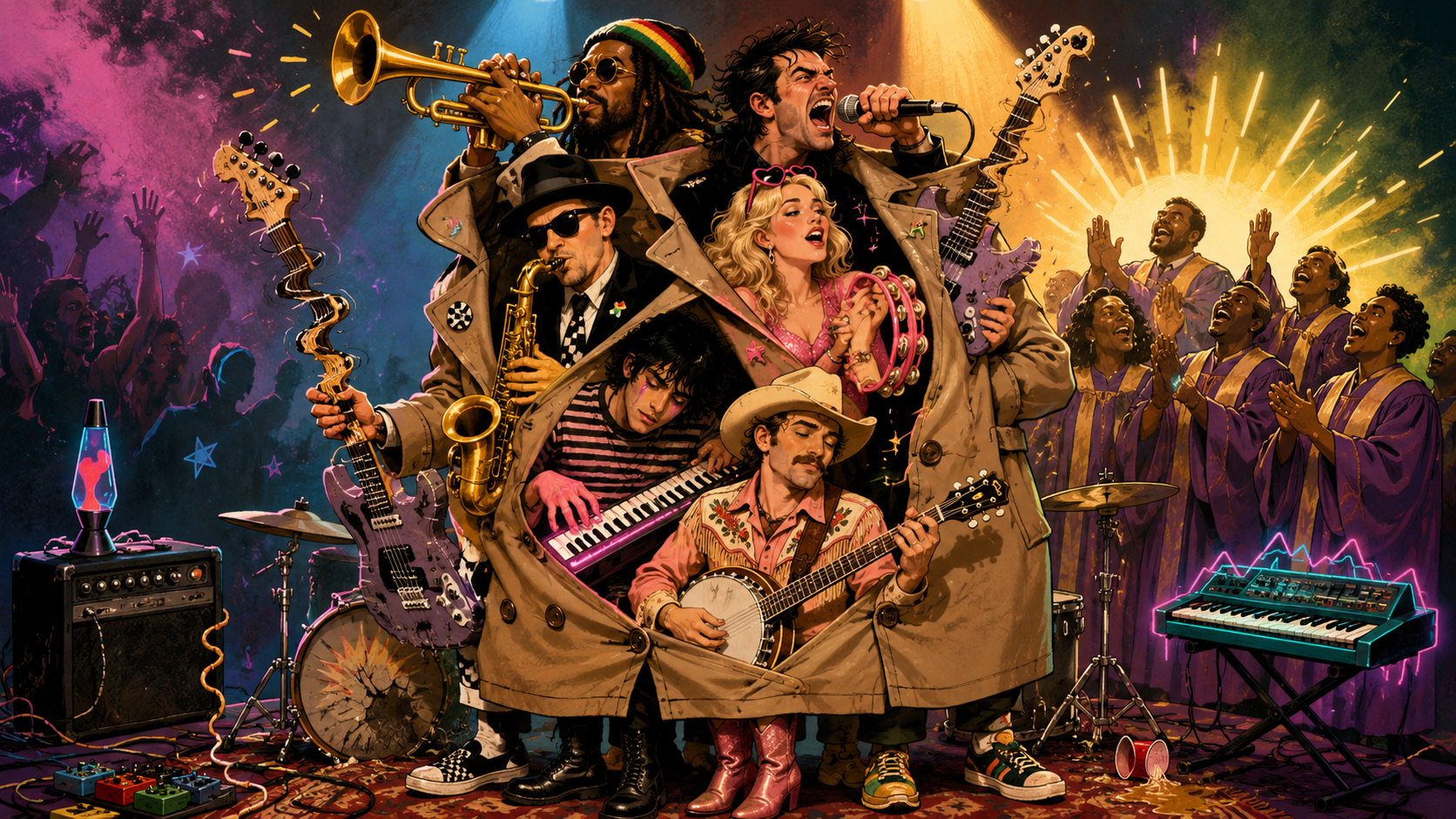
These two essays belong together because they are really about the same embarrassing tendency. I keep trying to make songs and essays do too much, hold too much, explain too much, and occasionally wear too many hats in public. The music version is six bands in a trench coat. The writing version is a junk drawer with footnotes. Neither is especially dignified. Both, unfortunately, feel accurate.
1. My Favorite Genre Is Still a Problem
The Prompt Has Become Evidence
At some point, I looked at the kinds of songs I have been asking Suno to make and realized I may no longer be a person with musical taste. I may be a minor public safety issue.
This should not have surprised me. I already knew my favorite genre was “yes,” which is a convenient way of saying I like too many things and lack the discipline to pretend otherwise. Still, there is a difference between having an eclectic Spotify library and sitting down with an AI music generator and typing something like, “female shouted vocals, riot punk, garage punk, noise rock, sarcastic, rebellious, distorted bass, jagged electric guitars, pounding drums, more screaming, some Korn vibes, gritty club atmosphere,” then immediately turning around and asking for cheesy pop country.
Not country. Cheesy pop country.
There is a level of specificity there that feels less like taste and more like a subpoena.
Suno has become, among other things, a strange little mirror for this problem. Not because it perfectly understands me. It very much does not. Sometimes I ask for one thing and get another thing wearing its hat. Sometimes I request a careful blend of genres and Suno hears, “Please pick the most commercially available cousin of this idea and give it a chorus.” It is impressive, but it is not magic. At least not yet.
That “yet” is important. I have learned to keep the word nearby, like a tiny fire extinguisher for whatever confident claim I am about to make about technology. Suno cannot yet fully generate the kind of unhinged genre chimera I keep requesting: hardcore-ska-gospel-pop-indie-reggae-country-metal-lobby-music-with-a-possible-key-change-near-the-end. Not totally. Not reliably. Not with the exact sense that the drummer is fighting the trombone while a choir tries to save everyone’s soul.
But, the failure is often half the fun.
Six Bands in a Trench Coat
The thing I keep wanting is not fusion in the tasteful sense. I am not sitting here asking for a refined cross-pollination of adjacent traditions. I am asking for six bands in a trench coat to walk into a studio and insist they are one band.
One of them plays ska. One of them screams. One of them has a banjo and suspiciously sincere feelings. One of them is a gospel choir that wandered in from a better life. One of them owns too many pedals. One of them is wearing chrome boots and believes the future can be saved through funk.
This is how my prompts happen. I start with something reasonable, or reasonable-adjacent. Maybe I want a meditative minor-key song. Maybe something soft, maybe something abstract, maybe something with raspy female vocals. Then, somewhere around the second sentence, the steering wheel comes off in my hands.
What if it had a triumphant trumpet?
What if it sounded like Capitol Cities, but also somehow like a church revival?
What if it were Low-adjacent slowcore, but sadder, but also with a chorus that does not completely surrender to despair?
What if it were a riot punk song with gang vocals and profanity, but self-deprecating enough that it does not seem like I am taking my own fake band too seriously?
What if the instrumental interlude sounded kind of like lobby music, but not muzak, exactly, more like lobby music for a hotel where everyone has read Cormac McCarthy and the elevator buttons are judging you?
This is not prompt engineering. This is a raccoon loose in a Guitar Center.
Still, I love it.
I love that I can ask for gospel sarcasm. I love that “cheesy pop country” is not only a phrase I have typed but a phrase I meant. I love that I can ask for big band crooner energy one day and something like a Beksinski painting dragged through a Korn rehearsal the next. I love that there is no responsible adult in the room asking whether these genres belong together.
They do not belong together.
That is why they must meet.
The Machine Is not the Point
It would be easy to make this about AI, and I suppose it is partly about AI. Suno is the tool in front of me. The novelty matters. There is something genuinely strange about being able to describe a song that does not exist and have a version of it arrive a minute later, slightly wrong but alive enough to argue with.
But, the deeper pleasure is older than the tool. The machine did not invent my appetite for mismatched sounds. It just made the appetite easier to embarrass myself with.
Before Suno, the evidence was already there. My listening habits have never suggested a person walking confidently down one aisle. They suggest someone entering the music store, panicking, and buying the building. I have always liked songs for reasons that do not fit neatly inside genre. Texture. Scale. Voice. Sincerity. Stupidity. A drum sound that makes the body sit up straighter. A hook so dumb it loops around and becomes genius. A melody with its hand over its own mouth. A breakdown that sounds like the floor giving up.
Suno just lets me externalize that mess in a new way. It lets me stop pretending I want a song to be one thing.
No, I want the hardcore part.
Also the horns.
Also the handclaps.
Also a female vocalist who sounds like she could either save the song or start a small fire.
Also a male vocalist who understands that he is the problem.
Also a choir, obviously.
Also, if possible, an uplifting key change near the end, because apparently I am not above that. I am not even near above that. I am below it, waving a lighter, asking if the drummer can hit harder.
A Choir Full of Bad Ideas
There is something freeing about being this unreasonable on purpose. Taste can become another little performance of self-control. People ask what music you like, and the respectable answer is usually shaped like a résumé. You mention the right bands, the right eras, the right influences. You signal that you know the difference between liking something and being fooled by it.
I am tired of pretending I am not regularly fooled by things.
I am fooled by giant choruses. I am fooled by horns arriving at exactly the wrong moment and saving the whole song through poor timing. I am fooled by distorted guitars behaving like furniture being thrown down a staircase. I am fooled by gospel harmonies, ska upstrokes, synth pads, banjos, big drums, soft pianos, stupid rhymes, earnest bridges, and any song brave enough to sound like it believes in itself before I do.
This is not a refined aesthetic. It is a buffet plate at a wedding reception where I have put mashed potatoes next to sushi next to cake and somehow decided the plate represents my inner life.
Maybe it does.
Maybe the overstuffed prompt is not just a joke. Maybe it is also a little philosophy of attention. I do not want every song to be everything. That would be horrible. I do not need Gregorian chant trap metal every morning. I am not trying to destroy civilization before breakfast.
But, I like the possibility that a song can make room for contradiction. I like music that changes its mind without apologizing. I like when tenderness and noise sit beside each other. I like when the ridiculous thing turns out to be the true thing because it stopped trying to look dignified.
This is where Suno’s current limits become interesting rather than disappointing. When it fails to fuse all the ingredients, it often reveals which ingredients are doing the real work. Maybe the song ignores the ska and keeps the gospel. Maybe it drops the country and clings to the pop-punk hook. Maybe it hears “hardcore” and gives me something more like a radio-friendly scowl. Fine. Even the miss tells me something.
The prompt was never only a request.
It was a confession with genre tags.
Yes, Wth Drums
I do not know whether this will still feel novel in a year. Probably not in the same way. These tools move quickly, and every “it cannot do this yet” sentence now comes with a trapdoor underneath it. Maybe soon I will ask for hardcore-ska-gospel-indie-pop-country-reggae-metal-crooner-lobby-music and get exactly that: a beautiful monster with polished harmonies and a trombone that understands its assignment.
I hope so.
I also hope it gets at least a little bit wrong.
The wrongness is where my taste keeps showing up. The overreach. The absurd combinations. The cheerful lack of brand discipline. The refusal to decide whether a song should be funny, sincere, loud, soft, holy, stupid, pretty, ugly, or emotionally dangerous.
Yes.
That is still the genre.
Yes, with drums.
Yes, with horns.
Yes, with one more key change than good judgment allows.
Yes, with the choir coming in too early and the guitar too loud and the whole thing somehow holding together because, for a few minutes, I do not have to make myself into a person with a lane.
I can just be the guy typing an impossible prompt into the machine, laughing at myself, and meaning every word.
2. My Favorite Essay Category Is Also Yes

The Site Has Become Evidence
At some point, I looked at the list of things I have written for Open Doors and realized I may not have a website so much as a junk drawer with footnotes.
This is not necessarily a criticism. Some of the best drawers in a house are junk drawers. They contain batteries, pens, takeout menus, old keys, tape, birthday candles, one mysterious screw that clearly belongs to something important, and the quiet confidence that civilization has not fully collapsed because you know where the scissors are.
Open Doors has become that, except the drawer contains essays about consciousness, pain, AI, parenting, disability, Cormac McCarthy, a broken mug, theological uncertainty, terrible corporate language, toilet paper orientation, the self as a verb, and apostrophes.
This is, apparently, my range.
I would like to pretend there is a clean organizing principle here. I would like to say the site is a carefully arranged cabinet of inquiry, with each shelf labeled according to theme, tone, and metaphysical urgency. That sounds respectable. That sounds like a man with a plan, or at least a man with a label maker.
In practice, the plan is closer to: I noticed a thing, and now I need 1,200 words about whether the thing is secretly everything.
Sometimes the thing is suffering.
Sometimes the thing is a sentence from a Buddhist teacher.
Sometimes the thing is my daughter saying something so tender it should be illegal.
Sometimes the thing is the apostrophe in “its.”
I contain multitudes, and several of them are annoying.
The Essay in a Trench Coat
The music version of this problem was easier to describe. I keep asking Suno for songs that sound like six bands in a trench coat. Hardcore, ska, gospel, pop, indie, country, reggae, synth-pop, slowcore, big band, and whatever genre exists between “lobby music” and “minor-key emotional damage.”
The essay version is worse because I am the trench coat.
One arm is reaching for non-duality. Another is holding a coffee mug. There is a small child in one pocket. There is probably a Cormac McCarthy audiobook in the lining. Somewhere near the belt, disability is trying to become a metaphor and I am trying to stop it before it hurts itself. The collar is full of AI ethics. The left sleeve is angry about language. The right sleeve is trying to be grateful without sounding like a decorative pillow.
This should not work.
It does not always work.
A reasonable person might decide to build separate rooms. Here are the philosophy essays. Here are the disability essays. Here are the parenting essays. Here are the literary essays. Here are the tiny, furious essays about grammar and bathrooms and other matters of national importance.
Instead, I keep opening the same door and acting surprised that all of these things are already standing in the hallway together.
To be fair, I did call the site Open Doors. This was either a title or a warning label.
The Ridiculous Taxonomy of Me
The distinction between Explorations and Reflections helps, at least in theory. Explorations are where I follow an idea until it either becomes clearer or bites me. Reflections are where I start with something small and real, then wait to see whether the small thing is wearing a disguise.
That is a good distinction. I stand by it.
It also does not stop the whole project from looking, at times, like the reading list of a person who lost a bet with himself.
One day I am asking what “nothing” means and whether somebody has to be here to notice the absence. Another day I am writing about pain before it had a name. Then I am thinking about AI and selfhood because a software feature made me suspicious about the word “I.” Then I am writing about how temporary hearing loss changed the way I listened. Then I am writing about a mug. Then I am writing about the moral and practical dimensions of the accessible bathroom stall. Then I am writing about why “negative reinforcement” does not mean punishment, because apparently I have appointed myself assistant regional manager of precise language.
This is not a brand strategy. This is a cognitive yard sale.
The objects are not random, exactly. They are connected because I am the one who keeps picking them up. That is either the deepest possible explanation or the laziest. Probably both.
What keeps surprising me is how often the subject matters less than the pressure underneath it. I can start with a mug or a memory or a pet peeve, and somehow the real question is the same old beast wearing a new hat: what does it mean to be a self, to suffer, to love, to notice, to misunderstand, to change, to keep paying attention when attention itself is difficult?
This is a very grand way to justify writing about toilet paper.
Still, I regret nothing.
The Petty and the Vast
I like that Open Doors can move from enormous questions to microscopic grievances without clearing its throat too much. I like that the site can ask what consciousness is and also declare, with entirely too much confidence, that there is a correct way to hang a roll of toilet paper.
This feels honest to me because life does not sort itself by importance before it arrives.
The sublime and the stupid are not separate delivery services. They show up together. One minute I am thinking about mortality, disability, the fragility of language, or the strange fact that any of us experience anything at all. The next minute I am furious that someone used “begs the question” wrong. These are not different people. This is just one person, unfortunately awake.
There is a temptation, especially in essays, to tidy the self before presenting it. To become the kind of writer who has themes instead of obsessions. To arrange the work so that a reader can say, “Ah yes, this is his lane.”
I do not appear to have a lane.
I have a rest area, a side road, a philosophical cul-de-sac, a collapsed bridge, and a small booth where I hand out pamphlets about apostrophes.
Maybe that is the point. The variety is ridiculous because attention is ridiculous. It does not move according to genre. It moves according to charge. Something glows, irritates, aches, rings, embarrasses, consoles, or refuses to leave. Then I follow it, badly at first, until it becomes an essay or until I admit defeat and call it a draft.
A Junk Drawer With a Spine
I do think there is a spine in the mess. I hope there is. I may have to pretend there is for tax purposes.
The spine is not a subject. It is a way of looking. Open Doors is where I try to take whatever has caught me and turn it slowly enough to see what else is attached. Sometimes that means writing about AI. Sometimes it means writing about my children. Sometimes it means writing about pain, luck, work, literature, music, disability, spiritual language, or the tiny moral theater of everyday annoyance.
The genre is not philosophy.
The genre is not memoir.
The genre is not cultural criticism, disability writing, parenting reflection, literary essay, spiritual agnosticism, or the Petty Office of Language Crimes and Domestic Arrangements.
The genre is yes.
Yes to the hard question.
Yes to the dumb hill.
Yes to the tender scene.
Yes to the sentence that will not leave me alone.
Yes to the overstuffed essay trying to pass as a coherent life.
This is probably why I keep writing. Not because I have figured out what the site is, but because the site gives me a place to find out in public. It lets the vast and petty sit at the same table. It lets a broken mug and the nature of consciousness nod politely at each other from across the room. It lets me be serious, then ridiculous, then serious again, which may be the most accurate rhythm I have.
I do not know whether that counts as a niche.
If it does, mine is very specific: one legally blind, chronically tired, overthinking dad attempts to understand existence through essays about pain, children, AI, literature, non-self, household objects, grammar, music, and whatever minor inconvenience has most recently mistaken itself for revelation.
That may be too long for a site tagline.
Still, it is probably closer than “writer.”
It keeps going
My mind never stops
Problem?