Some teachings don’t arrive as thunder. They arrive as a small, steady click in the mind, like a latch finding its groove. This one showed up for me through Vidyamala Burch’s voice—someone who doesn’t speak about pain as an abstract topic, but as something she’s had to live beside for a long time.
Early on, she names the source plainly: the Sallatha Sutta (SN 36.6), often translated as “The Arrow.”
There’s a quiet strangeness in how people describe moments like this—how a teaching “lands,” how it “hits,” how it makes an “impact.” The sutta is about what it feels like to be struck, and how we can accidentally make that experience worse. Still, language does what language does. The point is not the phrasing. The point is the clarity it offers when things get hard.
The Sallatha Sutta, Told Straight
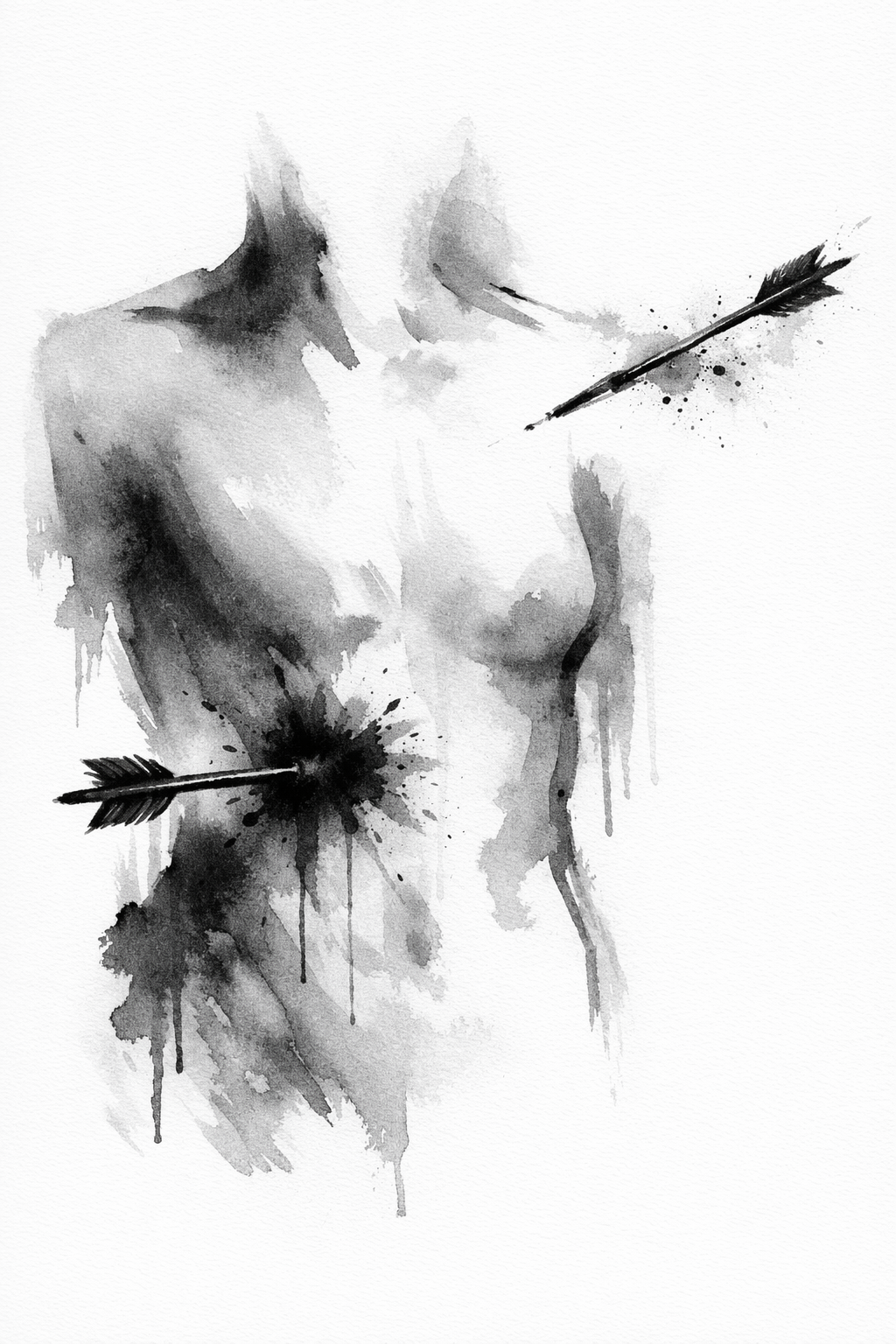
The sutta is blunt on purpose. Imagine a person struck by an arrow. That first arrow already hurts—obviously. Then imagine they’re struck by a second arrow right after. Now they’re dealing with two pains layered together.
The Buddha uses this image to describe how pain tends to work for most of us.
The first arrow is the unavoidable pain of being human—physical pain, sickness, grief, loss, fatigue, limitation, disappointment. It’s the raw fact of it: sensation, circumstance, the body doing what bodies do.
Then comes the second arrow. This one isn’t lodged in flesh. It’s lodged in the mind.
The sutta describes the “uninstructed” person who, when touched by pain, doesn’t just feel it—they compound it. They spiral into distress. They fight the experience, resent it, dread what it might mean, replay what led to it, project forward into worse versions of it. The pain becomes pain-plus.
Then comes the pivot, which is both simple and quietly radical.
A trained person—someone practicing mindfulness and wisdom—still feels the first arrow. This is not a teaching about denying reality. They just don’t automatically add the second arrow. The pain remains painful, yet it isn’t doubled by panic, resistance, and self-attack.r it is, the way you tell your story online can make all the difference.
Why Vidyamala’s Voice Changes the Lesson
All of that can sound like a clever distinction until you hear it from someone for whom pain isn’t an occasional visitor.
Vidyamala Burch has lived with severe chronic spinal pain for decades following major spinal injuries and multiple surgeries. She has also practiced mindfulness and compassion training for a very long time—teaching and exploring these methods for around forty years. So, when she talks about the second arrow, it doesn’t feel like advice delivered from a safe distance. It feels like a map made by someone who has actually walked the terrain.
The tone matters. It shifts the teaching away from “try harder” and toward something gentler and more practical.
You’re already carrying something real.
You don’t need to add extra weight unless you have to.
Where the Second Arrow Shows Up
The second arrow isn’t always loud. Sometimes it’s a whole inner monologue. Sometimes it’s just a flinch. A tightening. A reflexive no.
When chronic illness is part of the picture, the second arrow can become a habit—because the mind is trying to protect you, even when its protection looks like catastrophizing.
It doesn’t just say “this hurts.”
It says
This is going to ruin the day.
This means I’m falling behind.
This is proof my body can’t be trusted.
This is my life shrinking again.
I’m going to disappoint people.
I’m going to lose more than I can afford to lose.
Those thoughts don’t arrive as philosophy. They arrive as a clench in the gut, a locked jaw, a shallow breath. The second arrow is not “just in your head” in the dismissive way people sometimes mean. It spreads into the whole system. It tightens the muscles around the first arrow and, in that way, can make the first arrow feel sharper.
That’s part of what makes the sutta feel so usable. It offers a question you can actually ask in the middle of it.
Which arrow is this?
Sometimes the honest answer is “both.” Sometimes it’s “mostly the second.” Sometimes it’s “I can’t tell yet.” Still, even asking can create a sliver of space between pain and panic, between sensation and story.
That little bit of space—tiny as it may be—is where choice lives.
Not a heroic choice. Not a movie-scene breakthrough. More like
A choice to loosen the grip for ten seconds.
A choice to stop arguing with the present moment.
A choice to let the first arrow be painful without immediately turning it into a verdict.
The Point, in the End
What stays with me, especially hearing it through Vidyamala, is that the teaching isn’t asking for numbness. It’s asking for precision. It’s inviting a clearer look at what’s happening, and what the mind is adding, and whether that extra layer is helping or hurting.
The Sallatha Sutta doesn’t promise a life without pain. It offers something subtler, and in some ways more realistic: the possibility of not being double-wounded.
Don’t keep bleeding
You’ll always get two flying
Dodge the second