Broadcasting From a Cracked Dial
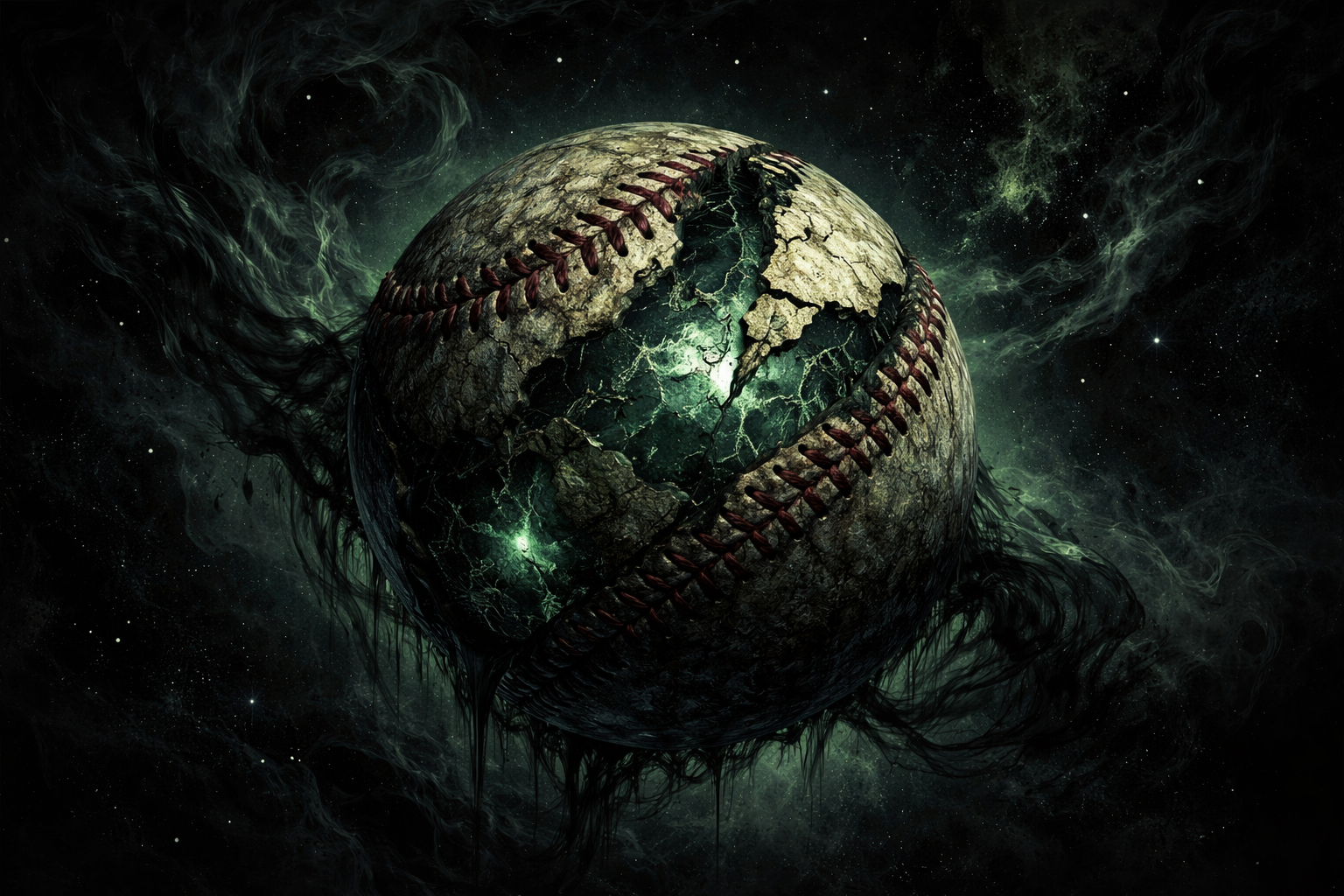
The Station Between Stations
Northwoods Baseball Radio is a fictional play-by-play baseball broadcast made to help you fall asleep. It is, at least on the surface, a fake small-town baseball game presented with the softness of an old AM station: low voices, sleepy pacing, gentle crowd texture, and a signal that feels slightly worn at the edges. No yelling. No loud commercial spikes. No urgent modern podcast energy trying to grab you by the collar. Just innings, sponsor reads, and a voice calmly guiding you through a ballgame that never happened.
That AM texture matters. It blurs the calendar before anything strange even happens. You’re hearing something that could be happening now, or decades ago, or in a town that never fully joined the rest of time. The format does half the haunting before the content even starts.
I’ve made it this far over 2025, barely. When I first drafted this, I was only about to start episode fourteen. By the time I came back to revise it, GPT-5.5 was out, I had inched farther along, and the joke had somehow gotten truer: the models keep changing, the world keeps sprinting, and Northwoods keeps moving at the speed of someone half-asleep with one thumb on rewind. The year has felt fast and slow at the same time, which makes this all feel less like a coincidence than a diagnosis.
The 0.6x Descent
I listen to Northwoods at around 0.6x speed. Ten minutes in, I’m usually on the edge of sleep. Fifteen minutes in, I’m gone. The next night I rewind to find the seam where words stopped being words and became dream material.
At that pace, one episode takes weeks. A season takes months. The show does not move forward so much as circle patiently, like it knows I’ll come back.
That repetition changes the way the broadcast lands. A normal podcast passes through your attention once and disappears. Northwoods lingers. I hear the same half-inning three or four nights in a row, and the details deepen instead of flattening. The announcer’s cadence becomes muscle memory. A line I missed on Monday becomes funny on Wednesday and unsettling by Friday.
There is something weirdly perfect about using a sleep podcast this badly. The show is meant to help you drift off, and it succeeds. Then I return, night after night, piecing together the fragments it helped me lose.
The Sponsors As Soft Evidence
The ads are where the weirdness starts breathing.
At first they seem merely funny: local businesses, small-town promotions, that steady sponsor-read cheerfulness. Then the edges show. There’s a video store specializing in Betamax, plus some DVD-adjacent format that doesn’t quite belong to any decade I recognize. There are products that sound as if they were pitched in one era and recorded in another. There are little details that place the town both behind the times and ahead of them, without the slightest concern for contradiction.
Northwoods never underlines any of this. It doesn’t pause to let the joke land. It just keeps talking, as if it’s perfectly normal to sell yesterday and tomorrow from the same countertop.
That’s what starts making it feel less like comedy alone and more like a signal leaking through from someplace structurally wrong. The sponsor spots don’t interrupt the game. They reveal the town.
The House Of Sleep, Whatever It’s Called
One recurring sponsor has become my favorite small fracture in the whole broadcast: something I hear as “Ed Horton’s House of Sleep.”
The problem is that I’m not sure that’s the name. Horton. Hordon. Horn. The syllables never quite lock. Part of that is the audio. Part of it is the fact that I’m listening half-awake. Part of it, I think, is that the show understands the power of leaving one detail slightly out of reach.
The shop sells rest, which is already a little too perfect for a sleep podcast. Then the ad begins repeating with small variations, the way a dream repeats and swaps out one object just to see if you notice. Sometimes the ad sounds like it’s being read by the owner himself, or maybe by someone else entirely. I genuinely can’t tell, which only makes it stranger.
Sometimes Beatrice makes essential oils. Other times there’s a clear bad edit in the audio, and then the voice says they “don’t have essential oils right now… Beatrice is fine.”
Beatrice is fine.
That was the moment I did a sleepy double take—one of those almost-asleep jolts where your body reacts before your brain can explain why. I rewound it the next night just to make sure I hadn’t invented it. The line was still there, delivered in the same calm tone, which somehow made it worse.
Nobody says that unless the sentence is covering a hole.
The bad edit makes it feel even more suspicious, like the ad itself has been patched over something. Not dramatically. Not in a jump-scare way. More like someone cut out the wrong three seconds and hoped a sleeping audience wouldn’t notice.
The broadcast doesn’t slow down afterward. The inning continues. The tone stays gentle. The sentence just remains there under everything that follows, like a polite little warning pinned to the wall.
Bill, Phil, And The Person Behind The Glass
There’s also the producer, whose name seems to slide between Bill and Phil. Sometimes I think it’s intentional. Sometimes I think I was simply too close to sleep to catch it cleanly. Either way, the show never corrects itself.
That refusal to correct is part of what makes the whole thing feel cosmic rather than merely sloppy. A normal story protects continuity. Northwoods treats continuity like a suggestion. The name drifts. The world holds. The broadcast moves on with the confidence of something that doesn’t believe reality needs only one version of itself.
It begins to feel less like an error than a property of the place.
Maybe there is a Bill and a Phil. Maybe I’m mishearing one name through the soft mush of bedtime audio. Maybe the producer changes because the town changes slightly each time the signal comes through. Northwoods is smart enough not to answer that kind of question. It just lets the name wobble and keeps calling the game.
Next Week, Forever
Then there’s the timeline problem—the one that pushed this from “charming” into “what exactly is this town built on?”
At some point, a new fictional baseball season begins. The broadcast marks it as new. Fresh records. Fresh hopes. The usual promise that time has turned a page.
Then an ad drops in that references a sale or event happening “next week.”
Except “next week” only makes sense in the prior season’s calendar. In-universe, the baseball has advanced, but the commercial is still speaking from an older “now,” insisting that its future is imminent. It keeps happening, too, which is what turns the detail from odd to unsettling. The games move forward. The sponsors loop. The promise stays one week away forever.
That’s when the structure of the show starts to feel exposed.
The game time moves forward.
The sponsor time loops.
My listening time rewinds.
Those clocks do not agree, and the disagreement begins to feel like the point.
Northwoods becomes a town built from overlapping nows. The announcer lives in the game. The sponsors live in an archive. I live in the ten-minute stretch between waking and sleep, arriving each night with just enough memory to be suspicious and not enough to be reliable.
A Town Built On A Quiet Fracture
Northwoods gives you the comfort of routine while quietly suggesting that routine might be the mechanism of the mystery. The innings keep arriving, steady and reliable, and the inconsistencies keep slipping in through the side door.
The dread here isn’t loud. Nobody screams. Nobody runs. The announcer’s voice never sharpens into alarm. The unease is structural. The town feels slightly misfiled in the universe, like it got shelved between categories and never noticed.
That’s why the show doesn’t feel haunted by a monster. It feels haunted by time itself—time reused, time misheard, time replayed, time insisting it’s “next week” forever.
This is also why it works as more than a novelty. The official pitch is sleep, and it really does help me sleep. But the deeper pleasure is the way it rewards drifting attention. You do not have to master it. You do not have to track every player, every inning, every fictional business. You can listen through it, and somehow the throughness becomes the experience. The show passes into the room, into sleep, into whatever part of the mind keeps working after the rest of you has clocked out.
Then one odd line catches there and waits.
The Model Changes, The Signal Remains
I keep returning to the model-version point because it feels connected to the whole strange rhythm of the thing. This essay began a few model generations ago. It is being revised again now that GPT-5.5 is out. It will probably be revised again later, because that is what drafts do and what models do and what years seem to do now: they keep becoming something else before you’ve finished describing them.
In a more practical essay, that would be annoying. Here, it feels thematically appropriate. The tool changes. The draft changes. The fictional season changes. The ad still says “next week.”
There is something almost comforting about that. Not comforting because it is stable, exactly, but because its instability has a pattern. The world does not stop moving, but neither does the broadcast. It keeps murmuring from its cracked little place on the dial, insisting that the game is still in progress, the sale is still coming, the House of Sleep is still open, and Beatrice is fine.
Fine.
I’m farther along now than I was when I first wrote this, but not so far that I’ve outrun the joke. Another episode still takes me weeks. Another season still feels impossibly far away. Another model will eventually arrive and make this version of the essay feel like a preserved layer in the sediment.
That seems right.
The House of Sleep will return, spelled however it’s spelled. Beatrice will be fine, or “fine,” in that careful way fiction says fine when it wants you to keep wondering. Bill will become Phil without explanation. A “next week” sale will echo out of a season that has already ended.
Then a pitch will land on the corner, an out will be recorded, and the world will steady itself again—just enough for the fracture underneath it to sink in deeper.
It’s very strange
Returning to something broken
Not broken, just crossed