The Record Learned to Move
Christa and Charlotte were at a craft fair, somewhere among folded tables and handmade things, woven pieces and carved wood and objects that still carried the trace of the hands that made them. For a little while, it was just me and Rowan at home.
That felt worth noticing immediately, because Rowan is two now, and there is a large difference between being alone with a sleeping infant and being alone with a toddler who has discovered that motion is one of the major pleasures of being alive.
The house was quieter in one sense. Fewer people. Less conversation. No Charlotte narration running through the rooms, announcing reality back to itself with the certainty of a tiny town crier.
Still, the house was not quiet.
It was just the two of us, and Rowan was in motion.
The Room Finds a Beat
I thought about putting something on.
That instinct is old by now. Part ritual, part reflex, part hopeful little superstition. There is a piece of me that still believes music can define an hour, or at least give it a handle, something I can grab later when the day has otherwise blurred into snacks and toys and small negotiations.
With Charlotte, years ago, I wrote about playing Radical by Every Time I Die while she was still in that newborn phase where time turns soft and strange. Christa was out. Charlotte was lying there on her playmat, impossibly small, still figuring out how to be in the world. I looked at the speakers and made the deeply responsible newborn parenting choice of putting on one of the loudest, most chaotic records I loved.
I didn’t crank it. I had not fully lost my mind.
Still, it was not exactly a lullaby.
The funny thing was that Charlotte barely reacted. The music roared, and she remained calm. No flinch. No protest. No tiny hands lifted in complaint. Just this brand-new person resting near me while the room filled with guitars and drums and a voice that sounded like it had lived several lives already.
That memory has a strange stillness to it. The record was loud, but she was not. The contrast is what made it stick.
This afternoon with Rowan had a completely different structure.
I put on Matt and Kim, which felt right for reasons I did not need to defend to anyone. Bright, jumping, a little ridiculous, music that seems to arrive already moving. The sort of thing that doesn’t enter a room so much as start jogging in place inside it.
For a few seconds, I thought I might actually listen.
Then Rowan began making her rounds.
There is no graceful way to describe the sound of a toddler in a walker circling a living room. It is not one sound but many. Walker wheels rolling. Plastic lightly rattling. Soft bumps into familiar furniture. A pause. A correction. A delighted laugh. Then movement again.
The room became percussion.
Very quickly, Matt and Kim moved to the background.
Not because the music failed. Because the room had found a better beat.
Not the Song, the Scene
I tried, for a minute, to keep track of the actual song.
That seems important to confess. I wanted this to be a music memory. I wanted to know which track was playing so I could tuck it away neatly and say, years later, this one. This was the song. This was the Rowan afternoon.
But each time I leaned toward the speaker, Rowan pulled me back into the room.
She looped around the furniture. She bumped a corner and recovered. She stopped to inspect some object on the floor with the full seriousness of a scholar encountering a lost civilization. Then she looked up at me with that toddler expression that somehow contains both question and command.
Are you seeing this?
I was.
That was the whole thing.
Later, when I went looking for language around music and memory, I came across a distinction that felt almost embarrassingly precise: there is a difference between memory for music and memory associated with music. You can remember a song without remembering a scene, and you can carry a scene even after the name of the song has slipped away.
That is exactly what happened here.
I do not remember which Matt and Kim song was playing.
I remember Rowan.
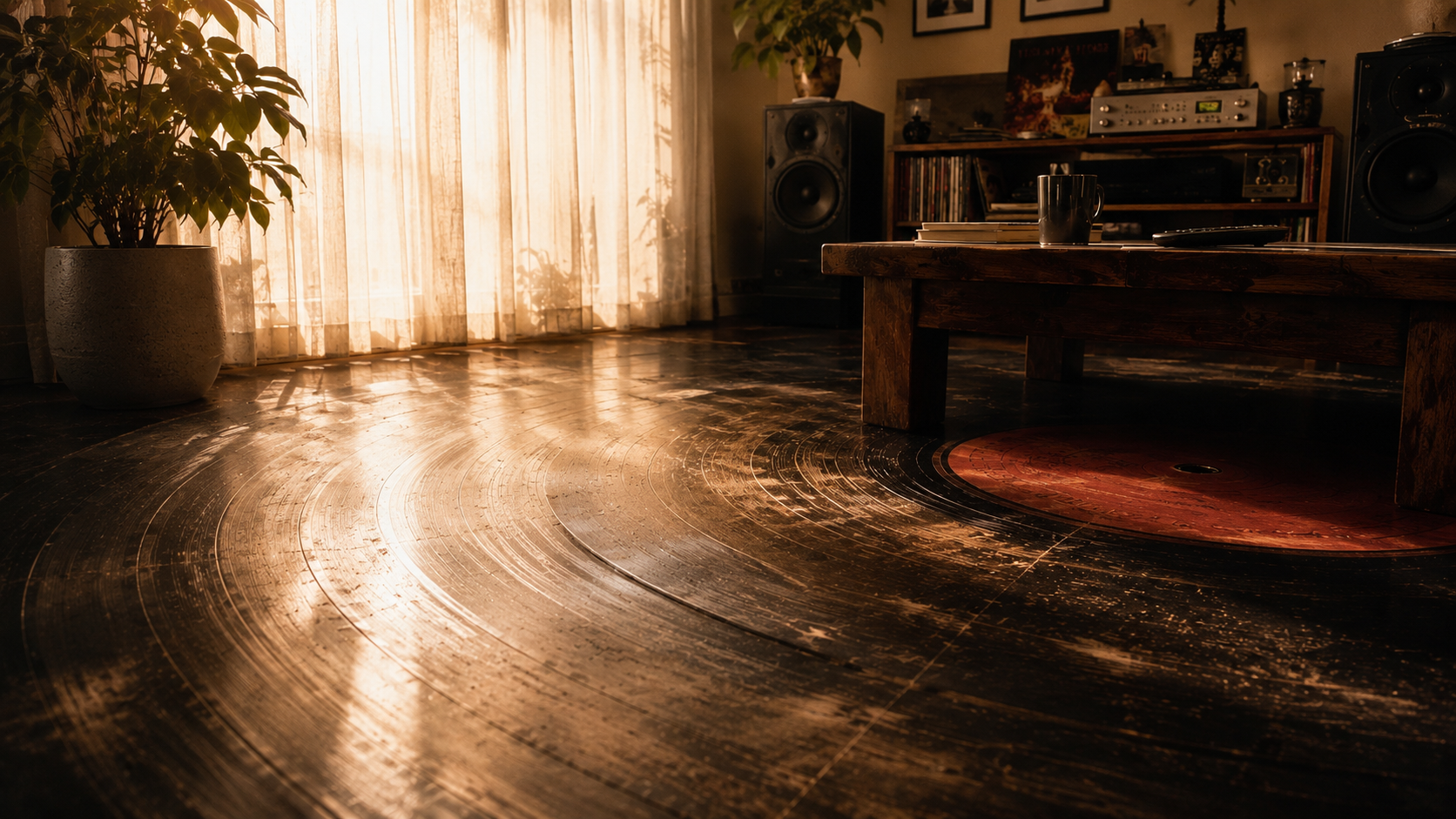
I remember the walker making its small mechanical racket across the floor. I remember her delight in getting somewhere under her own power. I remember the record-like loops she traced through the living room, over and over, as if the floor itself had become a track and she was the needle finding the groove.
The music did what music often does best. It did not dominate the memory. It marked it.
It put a border around the hour.
Then it stepped back.
A Different Kind of Inheritance
There was a season when sharing music with my kids felt like a secret form of inheritance.
Here, I would think, often without saying it even to myself. This is part of what made me. This is what I put on when I was younger and more wrecked and less sure how to carry myself through the world. This is how joy sounded. This is how anger sounded. This is how the inside of my own head sometimes got translated into drums and noise and melody.
With Charlotte, that idea made a certain kind of sense. A newborn is all presence and all future at once. She was already herself, of course, but she was also unknowable in that particular way newborns are. She did not yet have favorite songs or favorite colors or opinions about princess movies or the general emotional climate of the house. She was there, but so much of her was still hidden from us.
Playing music then felt like sending a message forward.
Maybe she would receive it someday. Maybe she would laugh at it. Maybe she would push against it. Maybe she would decide that my beloved records sounded like a dishwasher full of forks trying to unionize.
All of that would be fine.
The point was never really taste.
With Rowan, that future-tense feeling is harder to sustain, because Rowan is not a quiet question on a playmat. Rowan is not theoretical. Rowan is two.
She is here in the most literal, kinetic way possible.
She does not leave much blank space for projection because she keeps filling the room with herself. The child is no longer tucked inside the song. The child becomes the event, and the song has to figure out where it fits.
That feels closer to the truth anyway.
Research on parent-child musical experiences tends to emphasize ordinary shared attention more than grand musical instruction. Not lessons. Not taste-making. Just singing, listening, moving, playing, noticing one another. Music as a way of being together.
That sounds right to me.
I was not teaching Rowan anything about Matt and Kim. I was not expanding her cultural horizons. I was sitting in the same room while she moved through it, and the music helped me notice the shape of the hour.
Maybe that is a kind of inheritance too.
Not the handing down of a record.
The handing down of attention.
What the Walker Knows
I do not want to turn a living room memory into a developmental case study. Rowan does not need every sentence about her to become a paragraph about milestones or therapy or difference.
Still, the walker mattered.
It was not background equipment. It was not a prop in the scene. It was part of the scene’s meaning.
Researchers who study mobility in young children, including children with disabilities, often make a point that seems obvious only after someone says it clearly: movement is not just about getting from one place to another. It is how children explore, play, reach objects, enter interactions, and act on the world.
That was what I was watching.
Not transportation.
Participation.
Rowan was not simply moving around the living room. She was making the room available to herself. She was finding its edges, its obstacles, its repetitions. She was learning what happened when she pushed, stopped, turned, bumped, laughed, and tried again.
The walker made noise because the life was noisy.
That sounds simple, but it moved me.
With Charlotte’s Radical afternoon, I was struck by the weird peace of loud music beside a sleeping baby. With Rowan, I was struck by the opposite: music trying to sit at the center of the room while a child’s motion kept taking its place.
The record learned to move.
Or maybe I learned that it had been moving all along.
The Second Artifact
I think part of what pulled me toward writing this is simple and maybe a little embarrassing.
I wanted Rowan to have one too.
A piece. A record. A little artifact from a day when I noticed her clearly.
Not because love needs receipts. Not because there is some invisible ledger between my children that has to be kept balanced with equal word counts and matching metaphors. That would be insane, and also exactly the sort of thing a tired parent might start privately worrying about at 11:47 p.m.
Still, there is something real about what gets written down and what doesn’t.
The page becomes memory’s accomplice.
Charlotte has Radical Lullabies in my little archive. I can point to it and say, this was a day with her. This was the sound around her. This was what I noticed. This was who I was while I was learning to be her dad.
I do not want Rowan to exist only in the blur between events, even though toddlerhood is almost built out of blur. I do not want her folded into the general momentum of the family, into the background noise of meals and diapers and bedtime and all the tasks that make up a life.
I wanted to stop and say: this too.
This afternoon counts.
Here is Rowan at two, moving through the living room in her walker while Christa and Charlotte are out among tables of handmade things. Here is the music I tried to hear. Here is the music I actually heard.
Here is the daughter who turned the room into a song.
The Other Lullaby
I still do not remember the track.
That is the funniest part. The whole thing began as an attempt to give the moment a soundtrack, and the moment immediately refused to organize itself around my plan.
Good for it.
What remains is not the chorus or the lyric or the exact beat. What remains is Rowan’s delight in motion. The repetitive little loops. The soft collisions that barely counted as collisions. The way she seemed to find the whole setup funny and worth repeating.
What remains is how different love sounds at different stages.
With a newborn, it can sound like stillness holding its own beside noise.
With a two-year-old, it can sound like noise becoming the point.
One is not better. One is not purer. Time just changes the arrangement.
The lullaby changes form.
At first, you think a lullaby is something you play into the room. Later, you realize the room has been making them all along. Some are soft enough to sleep through. Some have walker wheels and furniture bumps and a two-year-old’s laugh running through the middle.
I am glad I put the music on anyway.
I am glad I got to feel the shift that clearly. I am glad I tried to listen to a song and failed for the best possible reason. I am glad Rowan had enough room to move, enough trust to keep going, enough joy to make every lap feel like discovery.
That, more than anything, is what I wanted to leave behind for her.
Not a lesson.
Not a claim about taste.
Not some grand statement about music in our family.
Just this: one day when she was two, it was only the two of us at home, and she was in constant motion, and I tried to listen to a song, and instead I listened to her.
That turned out to be the song after all.
Moving around, fast
You kept appearing in the room
I kept listening