The Orchard Keeper Keeps the Rot
“The bare concrete was visible blackened and encrusted with an indefinable burnt substance that scaled away under the shovel and showed green underneath.”
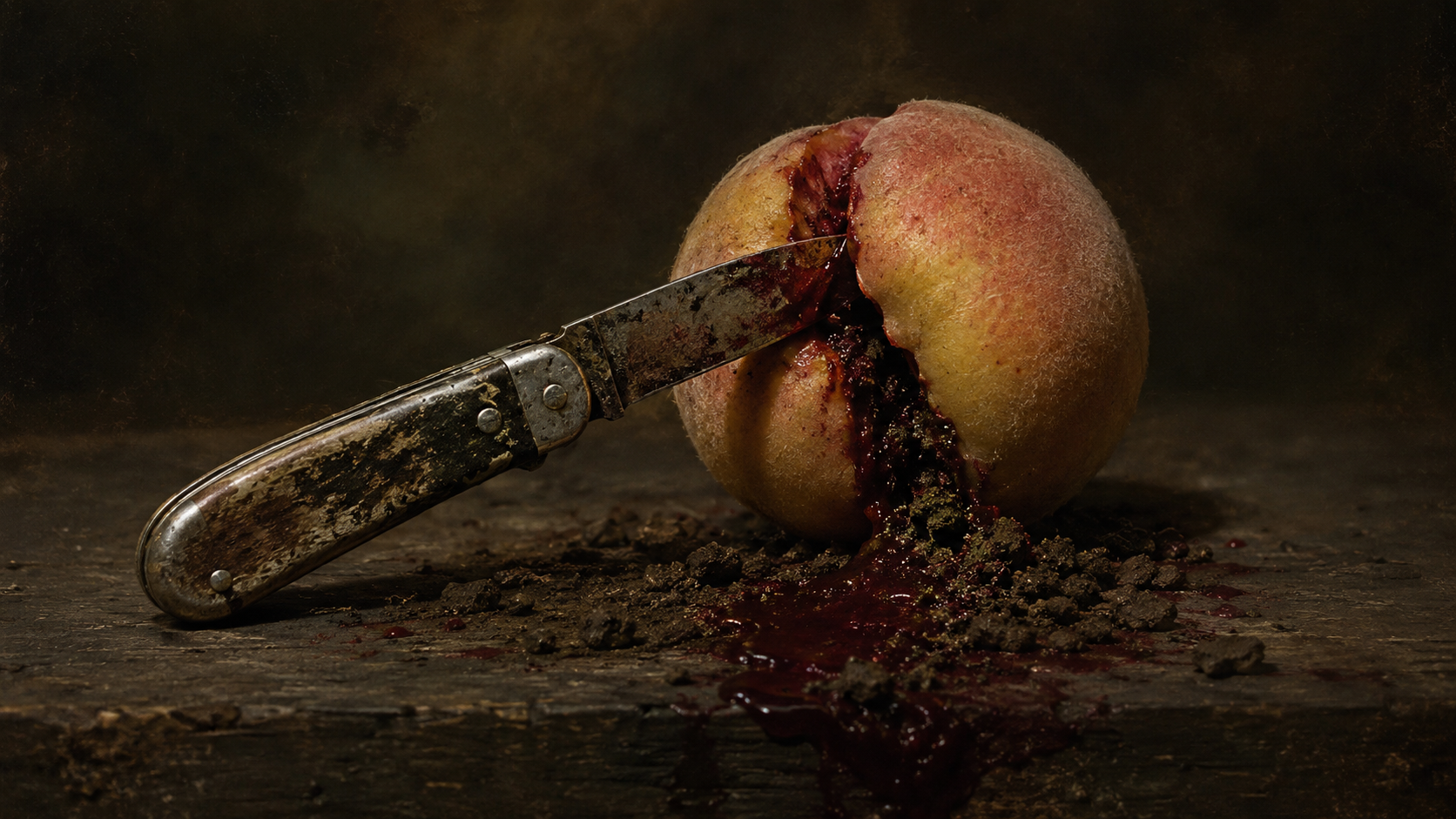
That line arrives near the end of The Orchard Keeper, but it feels like it has been waiting under the whole book.
Concrete. Black crust. Green underneath.
By then, the pit has already been a hiding place, a grave, a ritual site, a kind of private altar, and finally something closer to a cremation ground. The pit sits near an abandoned orchard in Red Branch, McCarthy’s rural East Tennessee setting, and it eventually holds the body of Kenneth Rattner, a drifter and absent father whose death quietly shapes the entire novel. Kenneth’s body passes from flesh into secrecy, from secrecy into ash, from ash into evidence. Men stand around trying to understand what has happened there. Some of them understand more than others. Some know Arthur Ownby, the old hermit who lives nearby, probably did not kill Kenneth. They also know the shape of the world well enough to suspect that innocence may not matter.
The law can find a body and still miss the truth.
That may be the first great lesson of McCarthy’s first novel. Not that truth is unknowable exactly, and not that the world is meaningless. The novel is stranger and more material than that. Truth exists, but it is layered. It is covered over by rain, grime, story, false memory, bureaucracy, family myth, and the stubbornness of the earth itself.
When the shovel scrapes the blackened substance away and finds green beneath, it feels less like a clue than a revelation of method. This is how the book works. One surface gives way to another. What looks dead is still organic. What looks natural has been shaped by violence. What looks like official discovery is only another form of misreading.
I did not love The Orchard Keeper the way I love Blood Meridian, Suttree, The Passenger, or Stella Maris. I am not sure I was supposed to. It is a debut, and it feels like one: strange, dense, overgrown, sometimes difficult to follow in the way difficult music is difficult to follow. There are passages where the language is already astonishing, but the sentence can sometimes take command of the scene so completely that plot and character sink beneath it for a while.
Still, what a debut.
This is not minor work in the ordinary sense. It is early work. That distinction matters. The book is messy, yes, but it is messy the way an abandoned orchard is messy: tangled, alive, rank, full of hidden structures and old damage. You can feel McCarthy learning how to carry his own power. The language is there before the balance is fully there. The eye is there. The violence is there. The comedy is there. The mythic pressure is there. Even the dialogue, which would later become one of his sharpest instruments, already flashes like a blade.
This is McCarthy before he has fully mastered McCarthy.
That may be why it is so fascinating.
The Difficult Music
Listening to The Orchard Keeper is a strange pleasure. Because I take in books almost entirely by audio now, I hear McCarthy first as cadence. That can be an advantage with him. His prose wants to be heard. It has grain, weight, pulse, and sometimes a kind of dark liturgical swing. Even in this first novel, he can make a sentence feel dug out of the side of a hill.
At the same time, the audiobook made clear something I might have missed if I were reading with my eyes: the beauty can overwhelm the narrative thread.
There were moments when I realized I had been listening to the prose almost the way I listen to music. I knew the tone. I felt the atmosphere. I could hear the darkness gathering. Then I had to stop and ask: wait, who is where? Who is talking? What just happened?
That is not only my problem as a listener. I think it is part of the novel’s early imbalance. McCarthy already has the dark lyric force that would later define him, but he has not yet fully learned how to make that force serve every part of the story. In later books, especially Blood Meridian, the ornate language feels terrifyingly controlled. The sentence, the image, the scene, the historical nightmare, and the metaphysical pressure all lock together. In The Orchard Keeper, those elements are present, but they sometimes compete with one another.
The result is not failure. It is wildness.
The book feels overgrown. Its structure is not always immediately legible. Characters emerge through action, rumor, setting, and pressure more than through clean exposition. The land is not background. It is almost a mind. Red Branch, the orchard, the pit, the roads, the rain, the old houses, the burning Green Fly Inn—all of it feels less like scenery than accumulated consequence.
The Green Fly Inn, one of the rough local gathering places in Red Branch, matters because it is more than a bar. It is a communal ruin before it burns, a shabby social center already leaning toward disappearance. Its name even carries the novel’s doubleness: green as life, fly as rot. When it goes up in flames, it feels less like one building burning than a whole local order beginning to announce its end.
That is one of the reasons the novel becomes easier to understand once you stop asking it to behave like a clean plot machine. Its logic is ecological. Things happen, but more importantly, things seep. Violence enters the ground. Stories enter children. Bodies enter pits. Institutions enter mountain life. Water enters machinery. A hidden death reshapes the lives of people who do not even know they are living in relation to it.
The book does not move forward so much as thicken.
Green, Gray, White, Black
I started noticing green early.
At first I wasn’t sure whether it mattered. McCarthy describes the natural world with such density that almost any color could feel important if you pay enough attention. Still, green kept announcing itself. Not a spring-green, not a clean pastoral green, not hope. More like overgrowth, dampness, moss, rot, concealment, vegetation pressing through ruin. Green in The Orchard Keeper feels alive, but not innocent.
That became clearer as the book moved on. Part One felt green to me: rank, wooded, overgrown, full of organic life that can hide death as easily as nurture it. The Green Fly Inn carries that doubleness in its name. Green suggests life; fly suggests carrion, filth, rot, a body already becoming part of the world again.
Then Part Two seemed to gray. Arthur Ownby’s body begins to fail. Arthur is the old man who lives apart from the town, a hermit-like figure whose property contains the pit where Kenneth’s body has been hidden. Old birdshot remains in Arthur from years before. His leg is going, and he worries his head may be going too. A government tank intrudes on the land like a hard modern object forced into an older order.
McCarthy never gives the tank the kind of loving, tactile description he gives to trees, mud, animals, weather, or decay. That feels deliberate. The tank is not alive enough to be granted texture, and not meaningful enough to be explained. I assume it is meant to hold water, but even that feels slightly beside the point. It could be full, empty, useful, useless, forgotten, or waiting. What matters is that it sits there on the mountain: gray, imposed, potentially hollow, an official object without a soul.
Gray becomes concrete, age, metal, fatigue, weathered matter, the drain of color from a world that once seemed merely overgrown.
Part Three brought white, mostly through snow. But, it was not a happy white. Not purity. Not renewal. The snow made the world ethereal and ghostly, but it also covered things. It quieted the landscape without healing it. In a book built around burial, concealment, and misremembering, snow feels like another layer over the real damage. The rot is still there. The dead are still there. The violence has not been absolved. It has only been given a bright surface.
McCarthy’s white is not purity. It is concealment with light on it.
Then Part Four begins to thaw.
The snow melts. The world gets wet, dirty, and confused. Rain falls. Roads become unstable. Water gets into Marion Sylder’s gas tank and helps bring him down. Marion is the bootlegger who kills Kenneth early in the novel, disposes of the body, and later becomes an accidental father figure to Kenneth’s son, John Wesley. Arthur’s confrontation with the police is chaotic and jostled, less like a clean shootout than the old world finally breaking loose from its own rootedness. Everything starts to move: men, animals, mud, evidence, consequences.
The snow does not cleanse. It melts.
Black appears in this later section, but not as a simple symbol of evil or death. It is ash, grime, shadow, dirt, residue, the underside of things. Black is what coats the concrete. Black is what has been burned onto the surface. Black is not the end of the world. It is what the world leaves behind.
By the time the pit is cleaned out, the color pattern has become almost literal. Gray concrete. Black encrustation. Green underneath.
That is the whole book in one scraped surface.
The novel’s elements do not redeem the world. They process it. Green overgrows. Gray wears down. White covers. Rain loosens. Black remains. Dust follows.
The Keeper of What Remains
Arthur Ownby may be the soul of the novel, though not in any clean or comforting sense.
At first, he can seem like one of McCarthy’s old mountain relics: solitary, eccentric, suspicious of authority, half in the world and half in some older order of signs, animals, memory, and ritual. But as the book goes on, Arthur becomes more than a character of regional strangeness. He becomes the keeper of what the world would rather not know it has kept.
His body keeps history. The birdshot in his leg is not just an injury remembered; it is the past lodged in flesh. His mind keeps desire and regret, including a memory of seeing a woman changing through a window and not returning like his friends do. His land keeps Kenneth Rattner’s corpse. His rituals keep the dead from being merely discarded. His old stories keep a vanished world alive for boys who do not yet understand what they are inheriting.
Arthur embodies decay, but not decay as simple decline. In him, decay is archival. The body keeps violence. Memory keeps desire. The land keeps death.
That is why the pit matters so much. Arthur finds Kenneth’s body and does not report it. Instead, he returns to it. He lays wreaths. He tends to the site in his strange way. Morally, this is bizarre. Legally, it is damning. Spiritually, it is harder to dismiss.
Arthur is not solving anything. He is not giving Kenneth justice. He is not telling Mildred (Kenneth’s wife) the truth. But, he is acknowledging the dead in a way the rest of the world either cannot or will not. The authorities will later uncover the body, sift the ash, look for evidence and valuables (included melted fillings), and make their conclusions. Arthur, for all his strangeness, has already understood something more primitive: the dead remain.
That does not make him noble exactly. McCarthy is too sharp for that. Arthur is difficult, damaged, comic, possibly mad, and dangerous. But, he is also one of the only people in the novel who seems to recognize that matter remembers.
His war with the tank belongs to that same logic. Arthur does not merely dislike it. He seems offended by its presence. The thing is never fully explained, and that vagueness gives it power. It is just there: a gray, possibly empty shape planted on the mountain by forces Arthur neither trusts nor recognizes. To shoot it is absurd, criminal, comic, and spiritually coherent all at once. He cannot stop the modern world, but he can mark it. He can wound the metal.
When he is finally questioned by a welfare officer, the scene becomes one of the first bright sparks of McCarthy the master dramatist. The officer is just trying to get Arthur the Social Security benefits he is owed, but Arthur does not care about that. The exchange could have been merely comic: old mountain man versus paperwork. Instead, it becomes a miniature war between realities.
The officer speaks in institutional categories. Arthur answers from a world of land, weather, memory, suspicion, and private dignity. The officer wants facts. Arthur gives him resistance. He evades, literalizes, counters, and nearly turns the interrogation back on the man questioning him.
Arthur is not refusing to answer questions. He is refusing to be translated.
That sentence feels central to the scene, and maybe to the novel. The law can capture him. The institution can confine him. The paperwork can name him. But, none of those translations truly contains him. He remains illegible in the deeper sense, which is both his freedom and his doom.
The scene also anticipates McCarthy’s later dialogue at its best. In No Country for Old Men, the gas station scene works because a mundane exchange becomes metaphysical danger. In The Sunset Limited, two men sit in a room and language becomes a matter of life and death. In Stella Maris, talk becomes a bare chamber where intellect and despair test each other until the walls seem to disappear.
The welfare officer scene is not yet as distilled as those later works, but the engine is already there. One person assumes the right to define reality. Another refuses the terms. The room changes shape.
Arthur’s resistance is not silence. It is counter-interrogation.
That is what makes the scene so good. It is funny, but not merely funny. It is tragic, but not merely tragic. It is a comic scene about paperwork that becomes an existential scene about whether a human being can be reduced to a file.
Fathers, False Stories, and the Boy in Between
John Wesley Rattner grows up inside absence.
His father, Kenneth, is dead before John knows the shape of the story. His mother, Mildred, fills that absence with myth. Kenneth becomes not the shifty, violent drifter we encounter, but a father wronged, a man whose disappearance must be avenged or at least answered. John inherits a story before he inherits the truth.
That is one of the novel’s cruelest structures. Violence is passed down not only through blood or action, but through narrative. Mildred gives John a father made of grief and misinformation. He must then carry that father into the world.
The great irony is that Marion Sylder—the man who killed Kenneth—becomes a kind of father-substitute. He gives John a puppy. He takes him hunting. He brings him into a masculine world of dogs, woods, traps, survival, and outlaw practicality. He gives him more of a father’s presence than Kenneth ever did, and neither Marion nor John knows the full truth of what binds them.
This is where the novel becomes more than a crime story hidden inside regional gothic atmosphere. Its deepest drama is not simply that a man has been killed and buried. It is that the killing generates relationships no one understands. Marion saves himself and becomes bound to the son of the man he killed. John seeks an inheritance and receives the wrong one. Mildred preserves a lie because grief needs a shape.
The book keeps asking what kinship really means in a world where blood has failed and truth is buried.
That question returns near the conclusion, when the dead are placed in a vast register alongside figures like Tutankhamun and Agamemnon. The move is startling, almost vertiginous. Suddenly Red Branch is not merely local. It is archaeological. Mythic. Cosmic and earthy at once.
McCarthy does not simply elevate his rural dead to royal status. He cuts the kings down into the same earth. Pharaoh, warrior, drifter, old man, mother, boy, dog, panther, hawk—all of them belong to the same order of matter, burial, story, and residue.
No death is merely local once the earth has taken it.
The Comedy in the Dark
One thing people sometimes miss about McCarthy, especially if they know him mostly by reputation, is how funny he can be.
The Orchard Keeper is full of darkness, but it is not humorless. The humor is often filthy, local, bodily, and deadpan. June (June Tipton, one of Marion’s rough local acquaintances) telling Marion about sex in what I took to be Arthur’s outhouse is funny not because it breaks the novel’s seriousness, but because it proves the seriousness is not fragile. I probably listened to this part ten times because it is so funny, as McCarthy’s dialogue so often is. McCarthy can let the grotesque and the comic breathe in the same air.
That matters. A lesser writer might decide that a world this violent must remain solemn at all times. McCarthy understands that human beings remain ridiculous even when doomed. They boast. They lie. They lust. They misunderstand. They tell stories with too much detail. They turn private degradation into anecdote. They make jokes in the ruins.
The comedy keeps the darkness inhabited.
You can see the same gift in the dialogue. This is his first novel, but the ear is already there. The Arthur and welfare officer scene is the obvious example, but there are other flashes too: Marion’s evasions, local talk, boys boasting, old men telling stories. McCarthy already understands that dialogue is not just speech. It is pressure. It is combat. It is class. It is a contest over who gets to define reality.
That gift will become almost terrifyingly precise later: the gas station scene in No Country for Old Men, the bare-room metaphysics of The Sunset Limited, the clinical devastation of Stella Maris. But, the spark is already here.
The young McCarthy can already put two people in a room and make language dangerous.
One Hell of a Debut
I do not think The Orchard Keeper is perfect.
Sometimes the prose gets ahead of the story. Sometimes the density overwhelms the human action. Sometimes the novel feels like a maze where the walls are made of beautiful sentences. There are passages where I admired the language before I fully understood what it was doing. There were scenes I had to relisten to, not because I was bored, but because I had been mesmerized and lost the thread.
Still, that feels almost appropriate. The book is messy and strange and labyrinthine because its world is messy and strange and labyrinthine. Hidden bodies. False fathers. Old men. Government tanks. Dogs. Panthers. Boys with traps. Burned inns. Wet roads. Ash in a pit. Green under black grime.
This is not McCarthy at full command yet. It is McCarthy discovering the scale of what he can command.
Reading—or hearing—it after the later masterpieces is fascinating because so much of the future is already present in unstable form. The water points toward Suttree. The violent pairings and outlaw machinery gesture faintly toward No Country. The dread and mythic pressure look ahead to Blood Meridian. The grotesque intimacy has notes of Child of God. Even a phrase like “outer dark” passing through the prose feels like a small flare from a future title, whether or not it means anything more than that.
I do not think he had some decades-long master plan. I do not think The Orchard Keeper is secretly a blueprint for everything that followed. But, it does feel seedlike. The materials are there. The colors are there. The dead are there. The jokes are there. The old men and damaged boys are there. The state is there. The land is there. The sentence is there, already dark and beautiful and dangerous.
What changes later is balance.
He learns how to make the music serve the structure. He learns how to strip away what does not need to be said. He learns how to let dialogue carry theology without announcing itself as theology. He learns how to make violence feel historical, metaphysical, intimate, and immediate all at once. He learns how to turn the pressure of the sentence into something almost unbearable.
But, he did not begin from nothing.
He began here, in the overgrowth. In the gray concrete and black crust and green underneath. In a pit that does not simply hold Kenneth Rattner, but holds the novel’s whole argument.
That is what stayed with me most. Not the plot by itself, and not even the language by itself, but the way the book finally gathers its own mess into image. The pit becomes grave, kiln, archive, altar, evidence, misreading. It is where the old world, the modern world, the natural world, and the official world all come into contact and fail to understand one another.
The pit does not simply reveal the crime. It reveals that discovery and truth are not the same thing.
By the end, the rain has stopped, but there is no renewal. Things dry out into dust. The dead have not been restored. The living have not been made whole. The law has not become truth. The land has not confessed.
It has only kept what happened.
That is enough for a first novel. More than enough.
A young writer does not have to be perfect to be unmistakable. McCarthy was already that. Unmistakable. Overgrown, excessive, brilliant, sometimes imbalanced, sometimes astonishing. A writer not yet fully himself and somehow already impossible to mistake for anyone else.
And, maybe that is where The Orchard Keeper most clearly belongs beside the rest of his work. Not because it is as great as the books that came later, but because it already understands their scale. Red Branch is a small place, but McCarthy never lets it stay small. Its dead belong to the same earth as Tutankhamun and Agamemnon. Its pit belongs to the same human archive as tombs and battlefields. Its mud, ash, dogs, boys, old men, false stories, and buried crimes are not merely local color. They are McCarthy’s first proof that any patch of ground, looked at hard enough, opens into the cosmic.
That is the ribbon tying the debut to the masterwork. The world is local. The sentence is immense. The dead are particular. The earth takes them all.
Green, gray, white, and black
That’s the entire story
It started this way