Too Many Futures at Once
The Crossing Gate
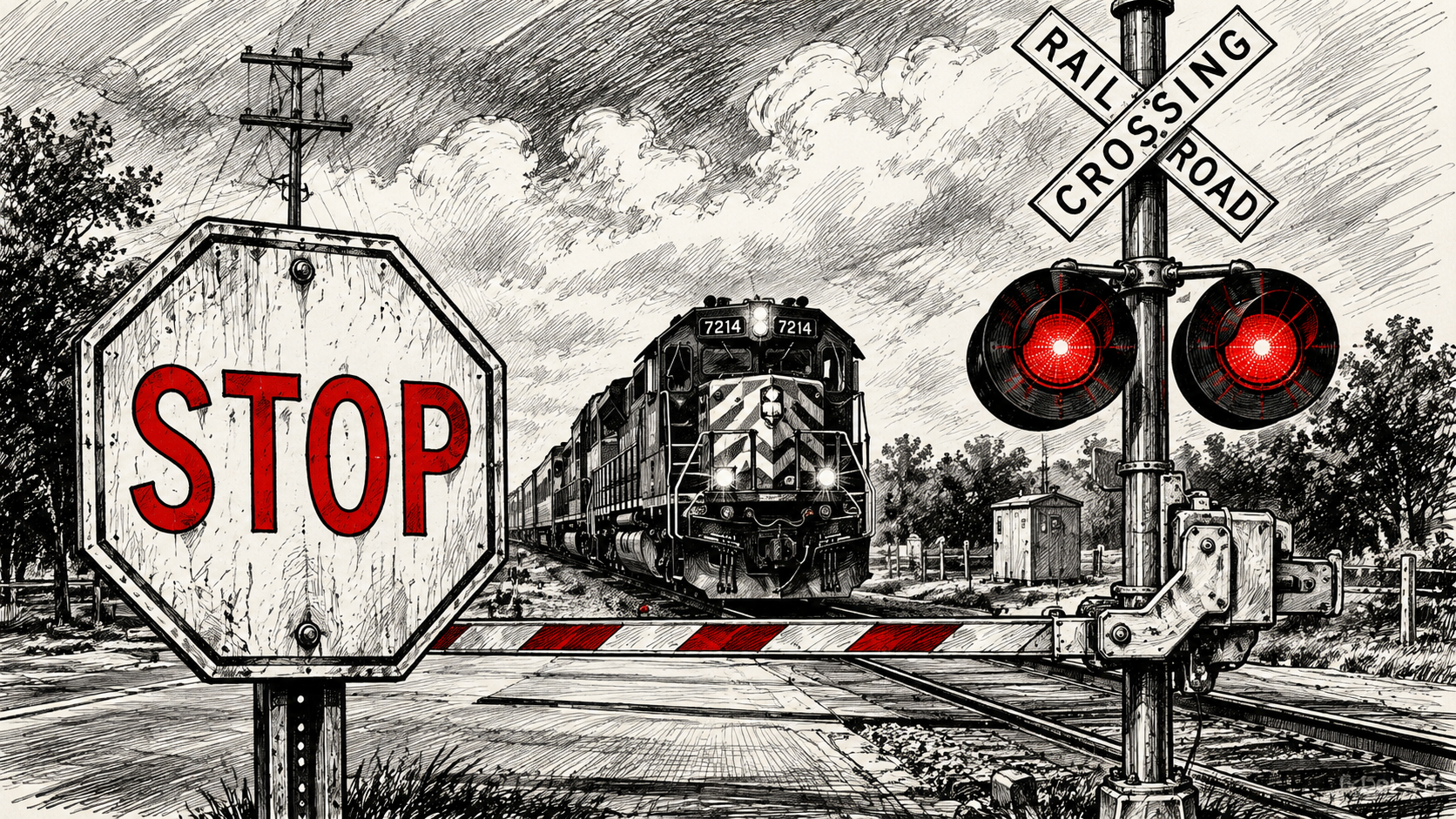
A Tesla owner in Plano, Texas reportedly said his Model Y, with Full Self-Driving engaged, accelerated through a fully lowered railroad gate as a train approached, forcing him to intervene and clear the tracks. That detail matters because this was not some obscure philosophical puzzle for machine intelligence. It was a railroad crossing. Red lights. A lowered gate. A train. One of the oldest instructions in modern life: stop.
I am not against self-driving cars. I am for them, actually. If the technology can eventually reduce crashes, save lives, and expand mobility for people who cannot or should not drive, that would be a genuine human achievement. I want that future. What I do not want is the strange gap between what the technology is, what it is called, and how loudly it gets sold.
Tesla’s own language still says Full Self-Driving is “Supervised,” requires a fully attentive driver, and does not make the vehicle fully autonomous. NHTSA’s own description of Tesla’s system places it in the world of Level 2 partial automation, where the driver remains responsible and must supervise the system.
The Hype Gap
This is where Elon Musk becomes exhausting.
Musk is obviously productive. Pretending otherwise would be silly. He has helped push enormous companies into places most people would not have thought possible. Credit where it is due. Still, productive is not the same as focused. Ambitious is not the same as disciplined. At some point, talking a lot of shit stops sounding visionary and starts sounding like a substitute for finishing the hard, boring parts.
That distinction matters when the product can kill somebody.
Tesla lives in a strange rhetorical split-screen. On one side, the company tells drivers to supervise the system and stay ready to take over. On the other, the feature is still called Full Self-Driving, marketed as something that can drive “almost anywhere” with active supervision, and repeatedly framed by Musk as being on the edge of surpassing human safety. He recently claimed that a future FSD version would “far exceed human levels of safety,” even in unsupervised and complex situations.
That may turn out to be true someday. I hope it does. The trouble is that someday keeps arriving as the next version, the next release, the next demo, the next year. Meanwhile, federal regulators are still examining Tesla’s driver-assistance systems, including an investigation into traffic-safety violations while FSD is engaged and a separate escalated probe involving millions of vehicles over visibility-related concerns. NHTSA’s traffic-law investigation explicitly says it may include situations such as approaching railroad crossings.
The Boring Work of Trust
The problem is not ambition. I like ambition. The problem is prophecy.
You do not build trust by narrat ing ten futures at once. You build it by making the system handle the obvious case every time. You build it through restraint, honesty, repetition, and the deeply unglamorous work of making sure a car understands a lowered railroad gate before anyone starts talking like the robotaxi age has basically arrived.
That is why this story lands so hard. It reveals the gap between the tone and the truth. The tone says destiny. The truth says supervised driver assistance. The tone says history is bending around one man’s vision. The truth says a human being still had to save the machine from the train.
I still think self-driving technology could become remarkable. I still think safer automated vehicles would be worth celebrating. But, come on. Focus. Tighten the circle. Spend less time announcing the future and more time proving the present can be trusted.
A railroad crossing is not the final exam. It is the quiz at the beginning of the chapter. The future should be able to pass that before anyone gets back onstage with a microphone.
Man, just chill
Why does he do this?
It’s not hard