The Last Three Times I Ran
The Emergency Was Probably mot an Emergency
I can distinctly remember running three times.
Not because I only ran three times in my life. I was not born as a man already muttering about parking, handrails, fatigue, and whether a restaurant has the decency to put its entrance somewhere obvious. I ran plenty. I ran as a kid. I ran across parking lots. I ran late to things. I ran for no reason at all.
What I mean is that I remember three runs now. Three specific ones. They have stayed with me in a way most movement does not. The body forgets thousands of ordinary actions. Then, later, when the body changes, it keeps a few bright receipts.
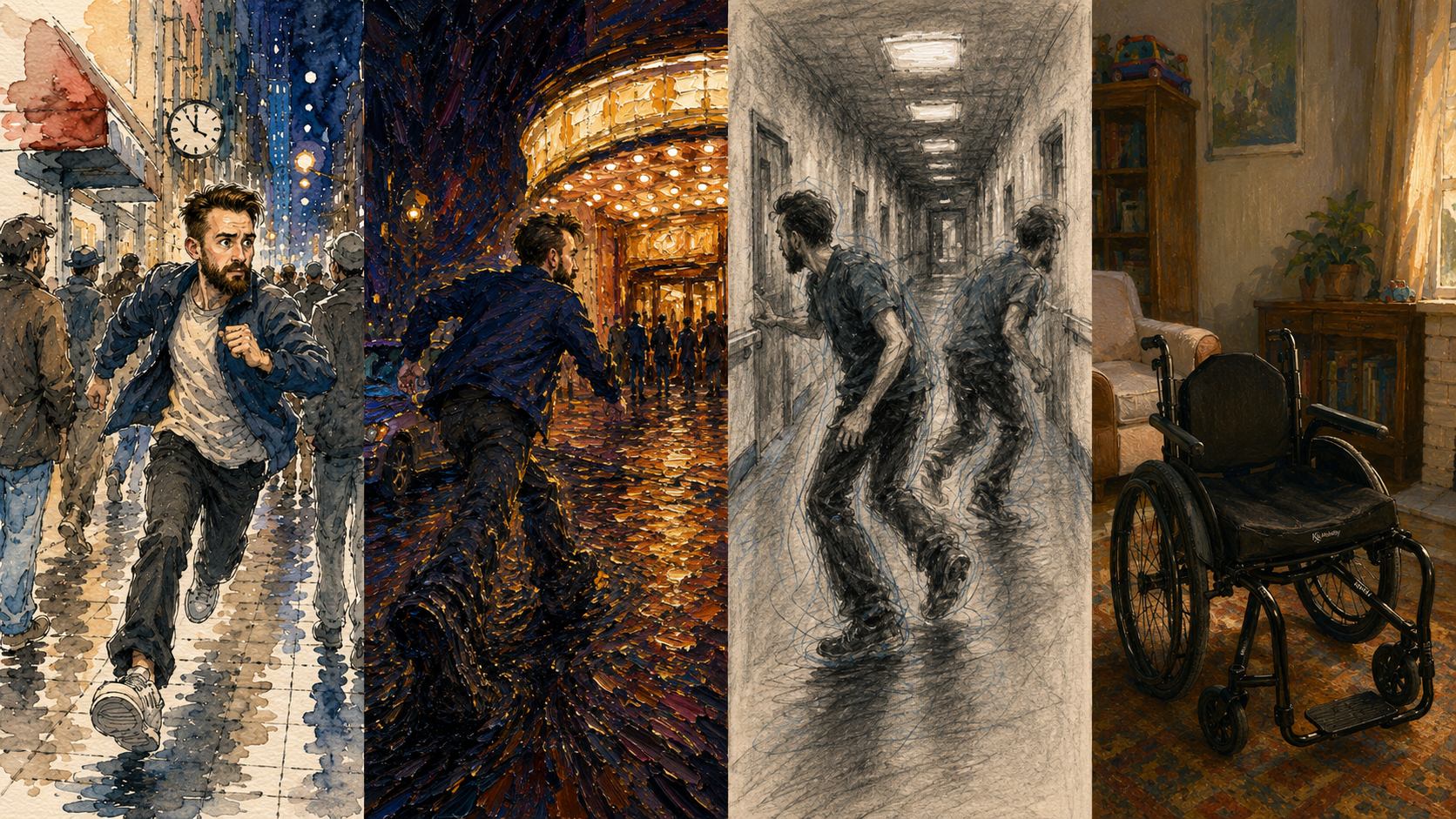
The first one was before symptoms, before diagnosis, before anything had a name. Christa and I were younger, and I was looking for her at something like one in the morning, which is already the beginning of a story where everyone involved could have made better choices.
I knew the name of the restaurant. I did not know which location.
This is an important distinction, especially at one in the morning, when your imagination has decided to help by becoming completely useless. Christa was not answering her phone. I was not panicking exactly, but I was worried in the slightly ridiculous, highly focused way you become worried when someone you love is probably fine but has committed the unforgivable act of being unreachable.
So, I ran.
I remember the sidewalk being crowded. I remember weaving through people, probably bumping into some of them, trying to apologize while still moving forward, which is not really an apology so much as a moral sound effect. Sorry, sorry, sorry, I am being rude for love and mild logistical confusion.
I was fast then. I remember that clearly. Not athlete-fast in any meaningful competitive sense, but fast in the ordinary, unexamined way of a young body that still trusted itself. I could cut around people. I could make adjustments mid-stride. I could move quickly through a crowd and assume my legs would solve the problem under me.
Christa, of course, was not there.
So, I ran back to my car and drove to the next location, where she was, obviously, completely fine.
It is funny now. Mostly. There is a specific kind of memory that survives because nothing truly bad happened. The fear evaporates, and what remains is the comedy of your own urgency. A young man sprinting down a sidewalk at one in the morning because his girlfriend picked the other branch of the same restaurant.
The body in that memory is almost incidental. I was worried about Christa. I was annoyed at the phone. I was irritated by the existence of multiple restaurant locations. I was not thinking about my legs at all.
That may be what I miss most about running.
Not the speed. Not the exercise. Not even the ability itself, exactly.
I miss the time when my body was not the point of the story.
Heavy Feet Before the Name
The second run is harder to place.
I cannot remember whether it happened before my diagnosis or during that strange period when something was clearly wrong but had not yet settled into a permanent fact. I remember the scene more than the date.
Christa and I were going to see The Sound of Music. I dropped her off near the theater and went to park the car. We were almost late. Not casually late. Not the kind of late where the lobby is still buzzing, the house lights are still up, and everyone is politely finding their seats. We were “the curtain is about to open and people with programs are already judging us spiritually” late.
I found a spot farther away than I wanted, because parking is often where the universe stores its contempt.
Then I ran.
Or, I tried to.
What I remember most is not the distance or the theater or even whether we made it in time. What I remember is my feet feeling heavy.
That sounds like a small thing. Feet get tired. Shoes are bad. Pavement is unforgiving. Bodies have off days. There are so many ordinary explanations available that the mind will happily accept almost any of them before it accepts the one that changes the room.
My feet felt heavy.
Not sore. Not weak exactly. Heavy. As if the message from brain to leg had to pass through some extra office where no one was working quickly. I could still run, but it did not feel like running used to feel. The old automatic confidence was gone. Something had entered the movement. A drag. A delay. A question.
I probably did not say much about it at the time. Maybe I complained. Maybe I made a joke. Maybe I filed it away with all the other strange sensations that seemed too vague to describe and too minor to announce.
That is one of the odd cruelties of chronic illness at the beginning. Before the diagnosis, your symptoms can feel like bad metaphors. Your legs are heavy. Your balance is off. Your vision is strange. Your energy is wrong. You reach for language, and language offers you a junk drawer.
A doctor might eventually call it multiple sclerosis. A scan might show lesions. A test might move the whole thing from private confusion into medical reality.
But, before that, there is just the body behaving strangely and you standing there, trying to decide whether this counts.
That run to the theater counts now.
At the time, I was probably only thinking, Please let me get there before the first song starts. Please let me not be the guy crawling over knees in the dark while Rodgers and Hammerstein are trying to solve fascism through melody.
Now I think of it as one of the first memories where running was no longer invisible. My body had stepped into the foreground. It was not failing completely. It was still moving. It was still mine. But it had started to make itself known as a separate thing, a collaborator with notes.
The Last Experiment
The third run was not urgent at all.
That is what makes it strange.
I was in grad school, working my graduate assistantship desk job. Nothing much was happening. No one needed me. The place was quiet enough that my attention wandered into the dangerous territory where a person begins experimenting with being alive.
I decided to run back and forth down the halls.
There was no practical reason for this. I was not late. Christa was not missing. A curtain was not rising somewhere. Nobody had asked me to hurry. I simply had a body, and that body had recently become questionable, and I wanted to see what it could still do.
I think this was shortly after my diagnosis. Early enough that the word MS still felt newly attached to me. Early enough that I could say it and still feel the weirdness of hearing it come out of my own mouth.
So, I ran down the hall.
Or, again, I tried to.
I could still basically run. That is important. This was not a dramatic collapse. It was not cinematic. No swelling music. No single tear. No clean symbolic moment where the old life ended and the new one began.
It was much stranger than that.
I moved, but my legs did not quite behave. They were not doing what I remembered legs doing. They were participating, but with reservations. I could make them go, but I could not make them go naturally. The action had become a negotiation.
I remember thinking it felt wrong. Not painful, necessarily. Not impossible. Just wrong. Like trying to sing along to a song you used to know and realizing the melody has shifted by half a step.
I ran back and forth in those halls because nothing was happening, but something was happening. I was testing the border. I was asking my body a question and getting an answer I did not want.
I think that was the last time I ever ran.
There is no plaque for that kind of thing. No one tells you, Take note. This is the final instance. You do not get a ceremonial last run any more than you get a ceremonial last time carrying your child up the stairs or a last easy walk across a parking lot. Some things leave quietly. They step out while you are looking at something else.
Years later, you look back and realize the door closed.
What Still Moves
Now I can barely walk with a walker.
Most of the time, I get around in my wheelchair. That sentence used to feel larger than it does now. A couple of years ago, I remember saying that I both loved and hated my chair. That was true then. It still is, in some ways, but the sharpness has worn down.
Now the chair is mostly just how I move through the world.
That sounds simple because it is simple, and because it took a long time to become simple. At first, mobility aids can feel like declarations. They announce something before you are ready to announce it. They change the shape of rooms. They change how people look at you. They change how you look at yourself.
Then, after enough time, they also become ordinary.
My wheelchair is not a symbol most days. It is not a defeat. It is not an inspirational object glowing softly in the corner. It is a chair with wheels. It gets me where I need to go. It gives me back distance. It gives me back participation. It lets me be in the kitchen, at the table, outside with my family, in the middle of a life that did not stop just because my legs got less reliable.
I am grateful for it.
I still hate needing it.
Both things can be true without canceling each other out.
My arms are strong now. Probably stronger than ever, to be honest. There is something almost funny about that too. The body renegotiates. It takes something from one place and builds somewhere else. I cannot run down a sidewalk at one in the morning anymore, weaving through strangers and apologizing badly. I cannot sprint from a parked car to a theater. I cannot jog down an empty hallway just to check whether my legs still remember me.
But, I can move.
Differently, yes. Slower in some ways. More mechanically. With more planning and more equipment and more awareness than I ever wanted. Still, I can move.
There is grief in remembering those three runs, but not only grief. There is also tenderness for the person inside each one.
The young man sprinting toward the wrong restaurant because he loved someone and was scared.
The man hurrying toward a theater, already carrying a symptom he could not yet fully read.
The newly diagnosed grad student running down a hallway for no reason except the most human reason there is: to ask, Is this still me?
The answer, annoyingly, beautifully, is yes.
It was me when I was fast.
It was me when my feet got heavy.
It was me when my legs stopped behaving.
It is me now, in the chair, arms stronger than they used to be, still moving through the world, still trying to get where love is waiting.
Three more times
I remember well
I still move