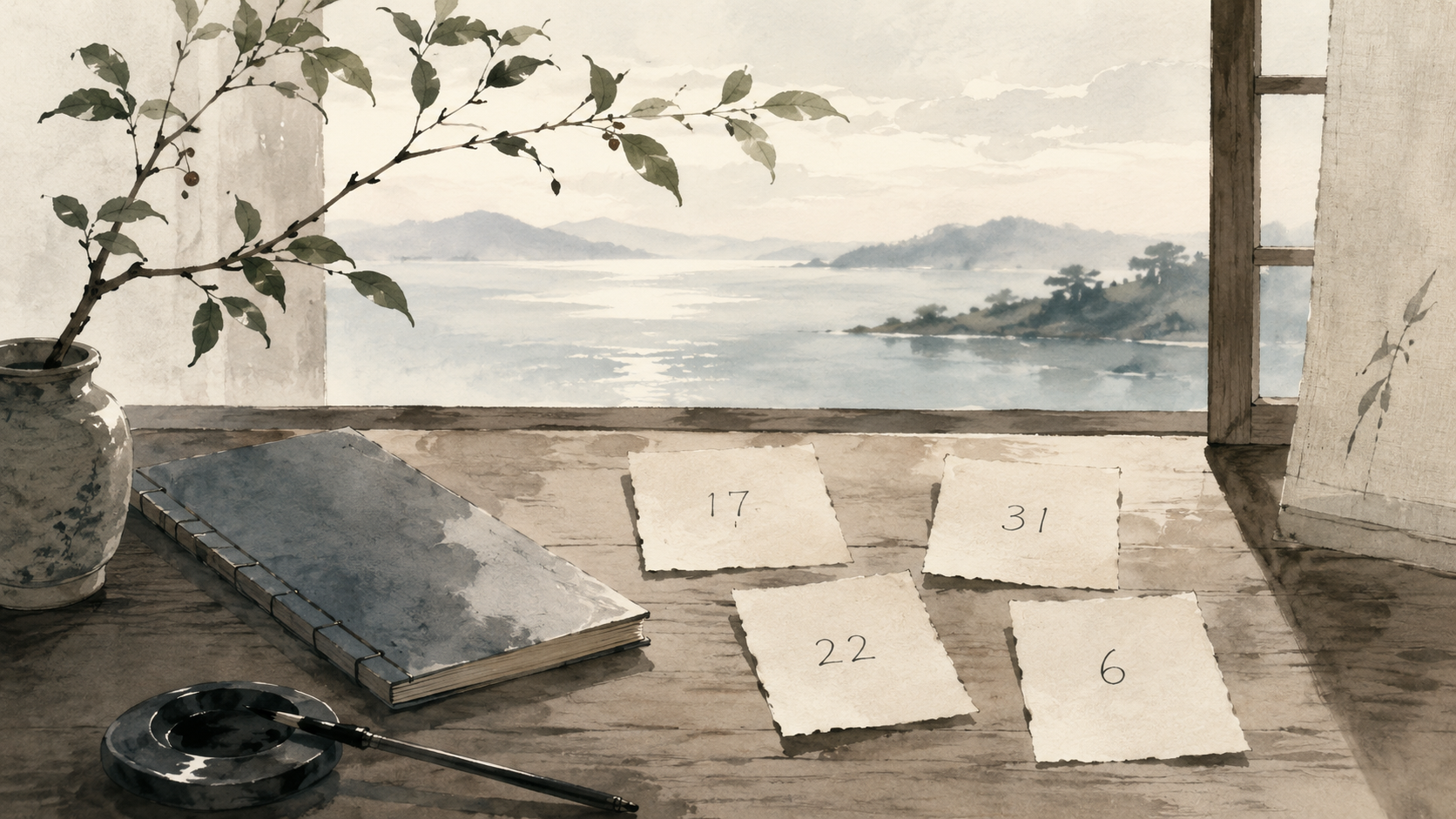
Seventeen, Thirty-One, Twenty-Two, Six
The Forms That Stayed
I’ve always loved the small poem.
Not just admired it. Not just nodded politely at it from across the room. I mean I have felt at home there. Haiku. Tanka. Cinquain. Brief poems that do not sprawl, plead, or defend themselves. Poems that arrive with very little luggage and somehow leave the room rearranged.
I admire longer poems too. That matters to say up front. I am not trying to make a case against scale, ambition, or duration. I love the great long works. Homer’s epics. Dante’s Divine Comedy. Wordsworth when he is following thought and memory out past the place where a shorter poem would have stopped. Some poems need distance. Some need room enough to gather a whole life, or a civilization, or a soul making its difficult way through the dark.
Still, the poems I tend to keep closest are smaller than that. Seventeen. Thirty-one. Twenty-two, if we are talking about the American cinquain. A few lines. A narrow form that somehow makes more room, not less.
Part of this is probably temperament. I like compression. I like restraint. I like the feeling that language has been pared back until every word has to carry its own weight. A short poem can feel less like a performance than a gesture. Not a speech. More like a hand briefly touching your shoulder before letting go.
Attention Before Explanation
Part of my love for these forms also comes from the traditions that shaped me. I’ve been drawn for a long time to Eastern thought, especially the strands that keep returning to the same simple demand: pay attention. Zen, Dzogchen, Advaita, Sufi poetry—different vocabularies, different histories, but again and again there is this invitation to turn toward what is here before the mind begins dressing it up.
That sensibility lives naturally in short poems.
A haiku does not give me much space to hide. The English classroom version is usually taught as 5-7-5, though that is already an imperfect translation of a Japanese form into English speech. The original constraint has more to do with Japanese sound units than with English syllables, and the real heart of haiku has never been arithmetic alone. It is a form of attention. Traditionally, it often leans toward nature, season, and the specific pressure of a passing moment.
A tanka gives a little more room. It is usually understood as 5-7-5-7-7, or thirty-one units, but again the number matters less to me than the shape of the experience. Where haiku often turns outward toward the observed world, tanka feels more willing to turn inward. It can hold the image, then the feeling that rises in response to it. The world first. Then the self standing inside the world, unable to pretend it is separate.
I like that movement. I like the image, but I also like the small human aftershock. The cup in the sink. The blue mark on the wall. The child’s shoe abandoned near the stairs. The ordinary object, and then the quiet recognition that the ordinary object has somehow touched a nerve.
Cinquain belongs here too, though it comes from a different lineage. The American cinquain, associated with Adelaide Crapsey, is a five-line form often built on a 2-4-6-8-2 syllable pattern. It has the elegance of a small staircase: one step, then another, then a widening, then a narrowing again. It can feel almost architectural, but in miniature. A little structure for a little burst of perception.
What draws me to all these forms is not the counting itself. Counting can help, of course. Constraint can be clarifying. A rule gives the mind something to push against. Yet the deeper appeal is the way these forms refuse excess. They ask me to notice before I explain. They ask me to choose. They will not let me build a whole scaffolding of commentary around a moment just because I am afraid to let the moment stand alone.
There is humility in that. The poem does not have to pretend it understands the whole world. It can simply notice one hinge where the world opens. A sound. A shape. A glance. A tiny pressure of feeling.
Enough.
Small Stories, Deep Rooms
This love of smallness is not limited to poetry.
I love the long novel. I love being inside a book for weeks, letting it alter the shape of my attention one chapter at a time. There is a particular pleasure in length: the slow accumulation of character, place, rhythm, and consequence. A great long novel can feel less like something I read than somewhere I lived for a while.
Yet I also love the shorter forms of fiction. Novellas. Novelettes. Short stories. Flash fiction. Even those little six-word stories, especially the one usually attributed to Hemingway in the public imagination: “For sale: baby shoes, never worn.”
Whether Hemingway actually wrote it is beside the point for me here. The story matters because it demonstrates what compression can do. Six words, and the mind supplies the room, the people, the loss, the silence around the object. Nothing is explained. Almost nothing is said. Yet the unsaid portion arrives immediately, maybe more powerfully because the sentence refuses to carry it for us.
That is the strange generosity of small fiction. It gives the reader work to do, but not homework. It does not over-direct the emotional experience. It leaves enough space for the reader’s own life to enter.
A short story can do this beautifully. It can catch a person at the edge of a decision, or after the decision has already been made and the consequences are only beginning to show. A novella can hold more architecture, more shadow, more movement through time, but still retain the pressure of compression. Flash fiction is more dangerous. There is so little room that one false word can puncture the whole thing. When it works, though, it can feel almost impossible: a whole life glimpsed through a keyhole.
I think that is what I love most. The small form does not feel small when it is done well. It feels concentrated. It gives us the visible piece and lets the invisible piece gather behind it.
The Scale of Attention
All of this is to say nothing of drama or screenplay, which are their own fascinating negotiations with compression. A play can let silence carry as much force as speech. A screenplay has to think in image, scene, gesture, cut, and implication. Even there, maybe especially there, the question is often not how much can be said, but how much can be trusted.
That may be the real subject underneath all of this: trust.
Short forms trust the reader. They trust the image. They trust the silence after the line. They trust that a fragment can suggest a whole. They trust that not everything valuable has to be unfolded, labeled, and explained until nothing living remains.
I want that trust in my longer work too. An essay may need room to think. A novel may need breadth. An epic may need the scale of myth, history, wandering, descent, and return. I would never want to flatten all literature into miniature. Some doors are supposed to be small. Others are supposed to open into corridors that seem to go on forever.
The point is not that short is better than long. The point is that smallness has its own dignity.
A haiku can do something an epic cannot. An epic can do something a haiku cannot. A six-word story can leave a wound no trilogy could manage in quite the same way, while a long novel can give us the slow moral weather of a life unfolding over time. Each form has its own way of knowing.
I keep returning to the short forms because they match something in me. Attention is finite. Energy is finite. Time is rarely the wide, clean space I imagine it will be later. The small poem, the flash story, the compressed scene—they do not require a grand clearing of the world. They ask only for a moment of real attention. A clean image. A pressure point. A turn.
Seventeen. Thirty-one. Twenty-two. Six.
Not magic numbers exactly. More like small doors. Forms that remind me how little language may need, if it is honest enough. A few true lines. A few precise words. A moment held lightly.
The silence after, still doing its work.
It’s more than sound
They do things that take a while
Offen gigantic