Seeing Everything all at Once
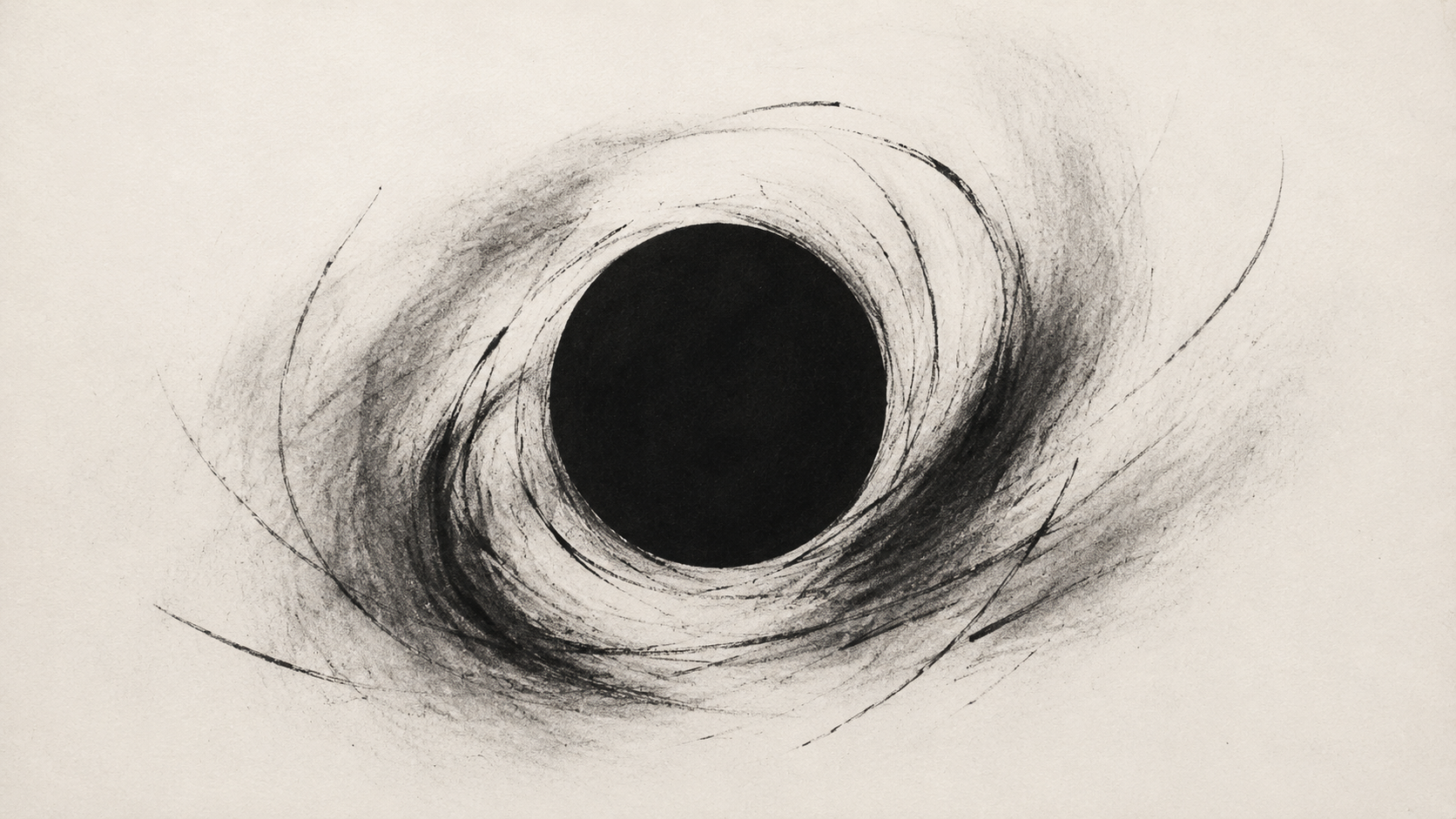
The Eye That Keeps Watch
One of my best friends gave me a charcoal drawing while Christa was pregnant with Charlotte. He has moved into more geometric and mixed-media work since then, though not entirely, and I love that work too. But, this piece belongs to a different moment in his life as an artist, and in mine as a person. It arrived before fatherhood. Before my house had the particular sound of my children inside it. Before attention became not just something I liked to think about, but something I would have to practice in ordinary, daily, bodily ways.
The drawing is called “Seeing Everything All at Once.”
It lives in a frame that feels almost architectural: matte black, clean edges, a kind of deliberate containment. The image inside does not behave like something contained. It feels pinned rather than presented, fastened at the corners like a note preserved for reasons I do not fully understand but immediately trust. Even before I get to the drawing itself, there is tension: order around the edges, unrest in the center.
Then there is the eye.
It is not a portrait eye, not really. It is too large, too charged, too absolute. It is not trying to reproduce an eye so much as reveal the condition of having one. Charcoal is perfect for this. It can make light feel dense. It can make a smudge feel intimate. It can give shadow the weight of thought. In a medium this spare, every mark has to answer for itself.
The lighter part of the eye reads to me as the whites, not the iris. That matters because it leaves the pupil as a blunt black center: flat, deep, nearly rude in its directness. If there is meant to be an iris here, I imagine the pupil has grown to encompass it, as if the eye has dilated past proportion under the pressure of too much seeing. The center has swallowed the detail that would normally soften it. What remains is not nuance, but aperture. Not decoration, but intake.
That dark point is one of the reasons the drawing has stayed with me. My own nystagmus can make a pupil seem to vibrate, as if the center of things cannot entirely settle. It can feel like sight itself has a tremor built into it, a restless motion underneath the attempt to focus.
So, when I look at that black circle in the middle of his drawing, I feel a strange double recognition. The pupil on the page is still. My seeing is not. The image gives me a fixed center while reminding me that the act of seeing, from inside my own body, can feel unsettled. The contrast does not cancel the resonance. It deepens it.
The eyelid is heavy and sharp at once. The lashes do not soften the image; they intensify it. Beneath the eye, the charcoal gathers in a way that suggests fatigue, vigilance, or the kind of wakefulness that does not feel chosen. The eye is not merely seeing. It feels like it is keeping watch. It feels tasked.
In the lower left corner are three horizontal marks, his signature. That matters. They are not a secret code, not some symbol I need to overinterpret. They are his way of signing the work. Still, a signature does something inside a piece like this. It places a human gesture beside something that feels larger than a person. It reminds me that this huge, unblinking presence was made by a hand I know. A friend sat somewhere with charcoal and paper and time and made this thing that now looks back at me years later.
The background is not blank. It is worked, darkened, pressured. The eye seems to emerge from the page rather than sit on it. The surrounding space does not decorate the subject; it gives the subject its force. Without it, the eye might have become a study. With it, it becomes a condition.
The title seals that condition into language.
“Seeing Everything All at Once.”
At first glance, that is impossible.
Of course it is impossible.
The Narrow Gate
Human perception is selective. I attend to one thing, then another. I scan. I prioritize. I miss almost everything around me almost all the time. The mind does not receive the world as a perfect totality. It edits. It filters. It foregrounds. It lets most of reality pass unregistered because otherwise I could not function at all.
In that ordinary sense, I am not seeing everything all at once. I am barely seeing enough.
The title has never felt to me like a claim about superhuman vision. It does not sound like a fantasy of total capture, as if the eye in the drawing could inventory every object, every thought, every hidden corner of the room. It feels more intimate than that, and more unsettling. It feels less like a power and more like a diagnosis.
Because there is another sense in which everything is arriving all at once.
Not everything in the universe. Not the whole cosmos pouring through a private aperture. I mean the whole field of lived experience in a given moment: the body, the sounds in the house, the low ache of worry, the memory that appears without being invited, the pressure of clothing, the thought interrupting another thought, the emotional pull beneath a normal afternoon, the faint outline of what needs doing later, the presence of someone I love nearby, the awareness of limitation, the awareness of gratitude, all of it arriving together before I separate it into categories and call that separation “myself.”
That is part of what I hear in the title. Seeing everything all at once is not mastery. It is not control. It is closer to the raw fact that consciousness receives a whole field before my preferences decide what counts.
That is why the drawing feels so alive to me. The eye is wide, but it does not look triumphant. It looks burdened, alert, open in a way that is almost painful. It feels like the image of a mind or a nervous system that cannot quite stop receiving. Not because it has failed, but because that is what being here is.
Vision, for me, is not a casual metaphor. It is practical, embodied, compromised, adaptive, and sometimes mourned. There are forms of looking that cost more now than they once did. There are ways perception slips or strains or flickers. A drawing like this does not land as a decorative meditation on awareness. It lands as recognition.
The eye is not only something I look at.
It is something I look through.
The Friend who Made the Door
I do not know what my friend intended when he made it. Maybe he meant something spiritual. Maybe he meant something psychological. Maybe he meant nothing I would recognize in my own interpretation. Maybe he was simply following the image where it wanted to go.
I may never know, and I like that.
Art is not locked inside original intention. The artist matters, obviously. The hand matters. The life matters. The choices matter. Once a piece leaves the studio and enters another life, though, it starts gathering meanings the artist could not have placed there in advance. It becomes less like a statement and more like an instrument. Different rooms make it resonate differently. Different years change the pitch.
He gave it to me while Christa was pregnant with Charlotte. That timing is now inseparable from the piece. Pregnancy does something strange to time. The future presses into the present. A life that has not arrived yet already starts rearranging everything. The ordinary becomes charged because it is no longer just ordinary. It is the last version of ordinary before another person enters the house and changes the meaning of every room.
So, this drawing became a marker in my own timeline. Not nostalgia, exactly. More like a stake in the ground.
We were here.
We were about to become something else.
Now, after years of parenting, after the slow reframing that disability forces on a life, after learning how fragile and costly attention can be, the title hits differently. It no longer sounds like an idea. It sounds like a practice.
Presence is not passive. Presence is work. Not the grinding, performative kind, but the steady kind. The kind that asks me to keep returning to what is actually here instead of letting the mind live entirely in rehearsal, regret, anticipation, and commentary.
Non-dual traditions have shaped the way I understand this, though I do not want to flatten them into one tidy point. Zen has its clean severity. Dzogchen points toward open clarity already present before effort begins. Advaita presses on the assumed solidity of the one who thinks he is separate from experience. Sufi thought often reaches the same depth through longing and intimacy. Different vocabularies, different temperaments, same pressure against the illusion that the real thing is somewhere else.
That is what the drawing says to me now.
Not “relax.”
Not “transcend.”
Look.
This is the field.
This is where life is happening.
The Trembling Center
There is a version of presence that gets sold as serenity. I understand the appeal. I am not against calm. Calm is wonderful when it comes. But, presence, as I actually experience it, is often less like calm and more like honesty.
It means letting the moment be as unstable as it is.
That is where the pupil matters. The black center of the drawing is still, flat, decisive. Yet because of my nystagmus, it almost seems to move. It suggests a center that cannot stop trembling, a point that should anchor the image but instead makes me feel the body’s refusal to become a clean metaphor.
I like that. I trust it.
Because presence is not the elimination of tremor. It is intimacy with tremor. It is staying close enough to experience that I stop requiring it to become smoother before I call it real.
Some of the most present moments in my life have not felt peaceful at all. They have happened in rooms full of child noise, in exhaustion, in pain, in love that had nowhere convenient to go. They have happened when I was not visually taking in much of anything, but was listening closely enough to feel the world’s texture through sound. They have happened with my eyes closed, or in the dark, or while holding one of my children and realizing that attention is not a spotlight I command. It is a relationship I keep entering.
Attention wanders. It startles. It clings to what hurts. It circles what it cannot solve. It invents futures. It rehearses conversations. It breaks concentration, then returns. Presence is not a permanent victory over that movement. Presence is the return itself.
This is why the drawing does not frighten me, even though it is intense. It looks severe, but it has tenderness in it. To “see everything all at once,” in the sense I mean, is not to dominate experience. It is to consent to the fact that experience is already here before I have organized it.
That consent can feel like relief.
There is no need to wait for a perfected version of myself before life counts as life. I do not need ideal conditions. I do not need a perfectly quiet mind, a perfectly cooperative body, a perfectly managed household, a perfectly understandable future. The real keeps arriving anyway. It arrives through this body, this mind, this family, this unfinished day.
The eye in the frame does not believe in later.
It believes in now.
What the Eye Offers
Maybe that is why the piece has lasted with me even as my friend’s work has evolved. This one remains like a primal sentence. A charcoal thesis. A gift that keeps changing because I keep changing in front of it.
I cannot see everything in any exhaustive or godlike sense. I cannot capture the whole of reality or hold the world still long enough to understand it cleanly. I cannot turn this moment into an object I possess.
But, I am always inside the only thing I can ever actually know: this living field, arriving now, all at once, more quickly and more fully than language can keep up with.
And, when I remember that, even briefly, the ordinary regains its actual weight. A quiet room. A child’s voice. A body with limits. A piece of art made by a friend years ago that still goes on speaking. None of it becomes simple, exactly. It just becomes more real.
The eye in the frame does not promise escape. It does not promise transcendence. It does not offer the clean fantasy of seeing everything from above.
It offers something smaller and harder.
It offers the fact of being here.
And, that is everything.
Seeing everything
Condition we’re always in
All conscious creatures