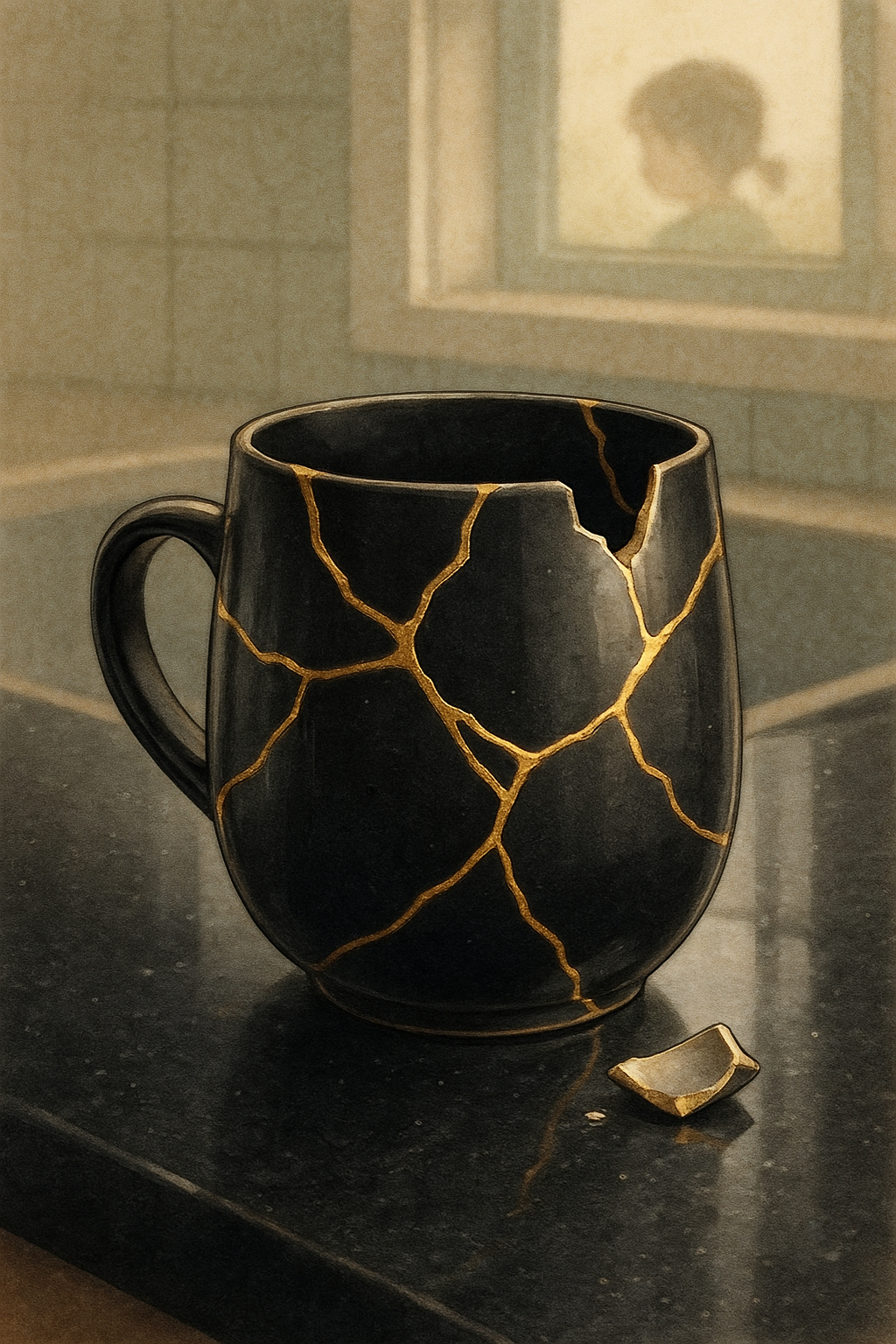
A week or so ago, one of the only mugs I can drink from without spilling shattered in our kitchen sink.
It didn’t explode in slow motion or anything. There was just the clink of dishes, a quick sharp crack, and then Charlotte’s small voice: “Daddy, I’m sorry.”
She was “helping” with the dishes, which really means moving things toward the sink in a chaotic but enthusiastic choreography. The mug was too close to the edge. She bumped another plate into it, it slipped, and gravity did the rest.
I knew immediately which one it was. I always know where that mug is. When you can’t drink easily from most cups without wearing half your coffee, you develop a kind of radar for the ones that work. The handle on this one was big enough, the lip gentle enough, the weight just right, the way it curved inward so the contents wouldn’t spill (I never noticed that before, but, when you need something, you feel it). It was a tiny piece of adaptive equipment masquerading as a souvenir.
For half a second my stomach tightened. Not at Charlotte—at the bare fact of it. One more small thing getting harder.
Then another thought landed right behind it, just as fast: this was kind of my fault.
I’d put the mug right there, practically begging to be sacrificed to the gods of the sink. I’d also, if I’m honest, stolen the thing about fifteen years ago.
The way you tell your story online can make all the difference.
“Stolen” might be a little dramatic, but I definitely liberated it. It was sitting on a teacher’s desk back in high school, full of pens, not coffee. One afternoon when no one was around, I slipped it into my backpack. I don’t remember why. Maybe I liked the shape. Maybe I liked the idea of owning something from a grown-up’s desk, like I was borrowing adulthood early.
Either way, the mug was never really mine in any clean, moral sense. It lived with me, followed me through apartments and jobs and moves, quietly doing its job while I grew up around it. I made coffee, tea, late-night hot chocolate in college. I held it during long phone calls and longer writing sessions. At some point it became my favorite by default, just because it had been there the longest.
So when I heard the crack, it felt less like losing a possession and more like the end of a very long loan. The mug had been on borrowed time since the day I took it.
I told her the truth: “Hey, it’s okay. I put it too close to the sink. That’s on me.”
I meant it. Not in the fake-adult way you sometimes say to kids when something is obviously not okay. I could feel my body wanting to be annoyed, to treat this as one more erosion of convenience in a body that already demands workarounds. But then there’s my daughter, who woke up and saw dishes in the sink and thought, I can help.
If the cost of her wanting to help is one old contraband mug, that’s the bargain I’ll take every time.
There’s also this simple fact: it’s just an object.
I don’t mean that in some stiff-upper-lip, nothing-matters way. I loved that mug. I relied on it. I would happily have kept it in rotation for another decade. But objects break. Hands slip. Kids try to help. Coffee finds the floor eventually.
The weird thing is how much lighter it feels when I remember the whole story. I took that mug off a desk that wasn’t mine. It rode out fifteen years of daily life. It made it from a fluorescent-lit classroom to a kitchen where my daughter is tall enough to reach the counter. That’s a pretty good arc for a ceramic cylinder that never consented to any of it.
If impermanence had a marketing department, this would be one of its smaller, gentler case studies.
We tend to think about impermanence in terms of big losses—health, relationships, careers, the hard things that rearrange a life. But most days it shows up as a broken cup, a missing sock, a favorite shirt that suddenly doesn’t fit. The universe practices on us with small things first.
Today’s lesson was simple. Some of the objects that quietly make my life easier are on loan. Some of them I purchased. Some, like that mug, I probably never had a clean claim to. All of them will break or vanish or become unusable. What stays is the way we respond, and the way we treat each other in the small disasters.
So yes, I’ll need to find another mug that doesn’t turn every sip into a trust fall. I’ll probably grumble when I realize how few of them there are. I’ll test different handles and lips and weights like a sommelier of ceramic accessibility.
But I’ll also remember that this one went out in the line of duty, in the hands of a kid who wanted to make my morning a little better, not worse. It was always on borrowed time. Now its job is done.
The coffee will keep coming. The dishes will keep breaking. And Charlotte will keep trying to help. That, more than any mug, feels like something I’m lucky to hold—for as long as I get to.
Objects don’t matter
Everything temporary
Don’t hold onto anger