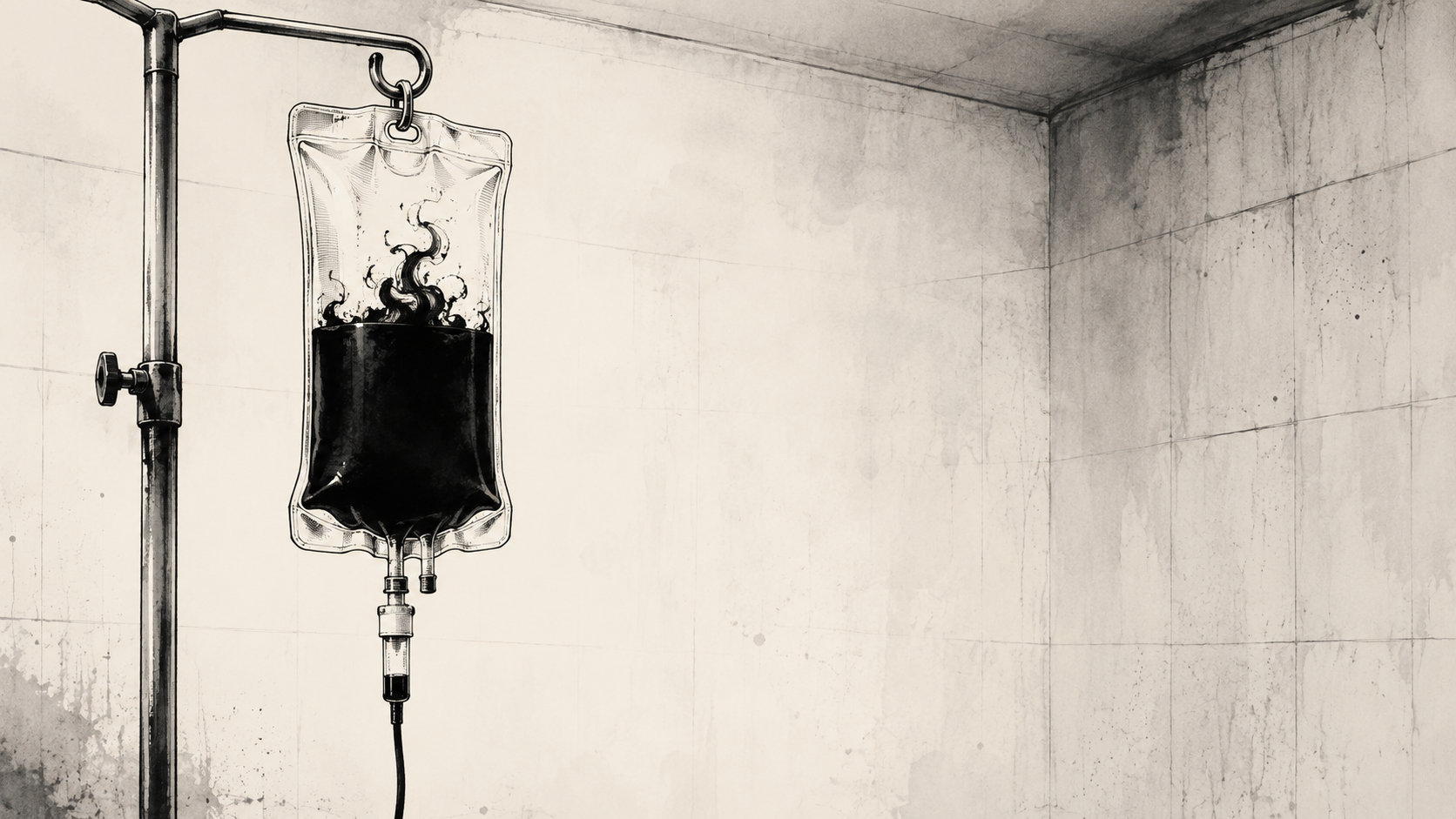
The lifeless bodies of comatose patients rest in beds that line the walls in the elongated New Life ward of the hospital. The hum of ventilators, bypass pumps, and other equipment is the only sound in the room. Light in the ward is dim; these patients have no use for it. Their night attendant, Shannah, has learned to cope and, in fact, even prefers it to the light outside. There is nothing left to see out there.
A network of tubes spreads over each patient. Feeding tubes run through their noses. Thick ventilator hoses emerge from their mouths. A saline IV flows into each patient’s right arm. And, on their left, another IV. Smaller, with an exceedingly slow drip of black serum.
Shannah opens her shift by tidying the blankets of each patient. The day nurses don’t pay as close attention. They don’t care for these minor details.
“They can’t tell the difference,” they say.
But, surely, they can. Like feverish dreams on a cold night, the mind is always aware of the outside world. Comforting the terminal residents of the corridor-like room is noble, Shannah thinks. Or, at the very least, a distraction from her loss of Nolan just under a year ago.
The night shift has become her anchor. It’s peaceful. Her old position was chaotic at best: running from room to room, drawing blood, checking vitals, the constant buzz of the hospital. When this was too much to handle, Shannah volunteered for the night shift in the New Life ward, and Dr. Ramsay happily agreed. It was difficult to find a willing nurse. In the dim light, time seems to crawl. These patients, though, with their rich internal lives, are a curious distraction.
The recently established New Life ward serves to give comfort to the comatose and even those in vegetative states. It keeps their minds working. With the serum, patients are thought to live in the virtual, dreamlike world of their own memories. And, though no one has ever emerged from the dream, Shannah imagines it as a world of peace.
She sees herself in the patients. Like Shannah, they are isolated and absent. In the ward, where she spends eight hours nearly every night, they live suspended from the world. After Nolan died, Shannah broke down. Unable to care for the kids, she sent them to her sister. And, now, she has nothing but her companions in the ward.
It’s one in the morning, and she goes about her routine. On a rotating basis, she’ll wash the bodies, change their clothes, trim their hair, and replace feeding tubes as necessary. And, of course, replenish each patient’s supply of the all-important serum. She’s no stranger to it.
She used to share it with Nolan when they could get it. It was intimate to mix your blood together with the serum and inject. You could share in the other’s past, imagine yourself in their shoes, connect on a level never possible before.
She’s stroking an elderly man’s arm with a washcloth, careful not to soak his sheets or disconnect the IV. He still has a full head of white hair and permanently pursed lips, a feature Shannah finds endearing. On an upstroke, he twitches, and Shannah nearly falls out of her chair.
They never move, not these people. They are separate from this world, in another place entirely. They do not move.
The remainder of the night passes without incident.
|||||
Each night, Shannah is drawn to the man. She never neglects her other duties but pays particular attention to him.
Lawrence is a frail but otherwise healthy patient who didn’t wake up after a stroke. She inspects his arms, his legs. She takes note of each fold in his sheets, where his tubes hang, anything that might shift with his movements. After a week, she’s failed to notice anything remarkable, but it is difficult to shake the feeling that something has changed, like he has tried to communicate in some way.
She has not had the serum herself for nearly a year. But, there has been zero progress, and the feeling has developed into a gnawing curiosity. Shannah attaches a syringe to his IV and draws his blood. It’s stained black, a side effect of the serum. She pulls more serum from a vial into the syringe. She draws her own blood and lets it mix before injecting the contents into her own veins.
Shannah is experienced with the serum and has little difficulty navigating its effects. She lies back in a chair and closes her eyes.
Lawrence has led a full life. He has seventeen grandchildren, and his wife is still alive. Shannah sees an experience with his daughter-in-law: they’re in his crab boat in the Chesapeake Bay. The motor has died, and Lawrence is exhausted in the sun. After several tries, Rebecca is able to get it started again, and they’re soon home safe. It becomes a common story at family gatherings, and the two have a permanent bond.
|||||
Shannah doesn’t stop. Sharing the serum with the man becomes part of her nightly routine. She’s careful not to withdraw too much blood from Lawrence and finds that it’s the only connection she’s made with someone in a long while.
His memories of family. His wedding, with his wife’s dress stained by a nosebleed just moments before the ceremony. When he told her he wouldn’t change anything about the day. How the dress was now entirely unique, theirs and theirs alone.
Shannah explores his life.
One night, a woman arrives at the door.
“I’ve just got a feeling,” she says. “Tonight’s the night.”
“Can I help you, ma’am?” says Shannah.
“My husband. He’s a patient here. I want to stay with him on his last night. Is that unusual?”
Shannah recognizes her immediately. Her faded red hair, cut to her shoulders. Unusual on a woman this old, like she’s kept it the same for decades.
“Lawrence. Lawrence Hardwick. I’m his wife.”
“No,” says Shannah.
The woman looks puzzled. “What do you mean, no?” she says.
“No, I mean… I’m sorry. No, it’s not unusual. It’ll be fine. He’s right this way. But, I’ve got to say, he’s really in pretty good shape, considering. I recently had to place him on a ventilator, but it could be temporary. He’s stable now.”
“I’ve just got a feeling I should be here for him.”
And, she’s wrong. Lawrence does not pass away, and for nearly three weeks, she returns every night to the ward and asks to spend the night. She lies next to her husband and doesn’t ask for anything.
Every night, she comes into the ward, and Shannah goes about her usual duties. She breaks to sit at her desk in the corner of the room and stares at the couple.
|||||
Lawrence dies after twenty days. Shannah shakes as she removes his tubes. She turns off the ventilator, still inflating dead lungs, still raising and lowering his chest. An illusion of life.
She holds the small bag of unused serum in her hands, then hangs it back on its hook.
Robbed. She’s been robbed of his life. The final, all-important days. That woman, she doesn’t feel for him this way. She didn’t deserve those days.
Shannah draws his blood, mixes the serum, and injects herself.
There is an immediate blackness, and then something quite unlike even black. Shannah struggles to maintain awareness. There is only silence, no odor, no taste. No feeling.
|||||
A day nurse discovers her on the tile floor. Needle still piercing her arm, mouth agape, eyes wide. The staff relocates Lawrence to the morgue.
“She’ll need a feeding tube. Breathing seems stable. Heart rate stable. We’ll set her up in this free bed,” says Dr. Ramsay.
When they have her in place, Dr. Ramsay attaches an IV to her left arm and starts the serum drip.