The Tortoise Versus Alien Tech
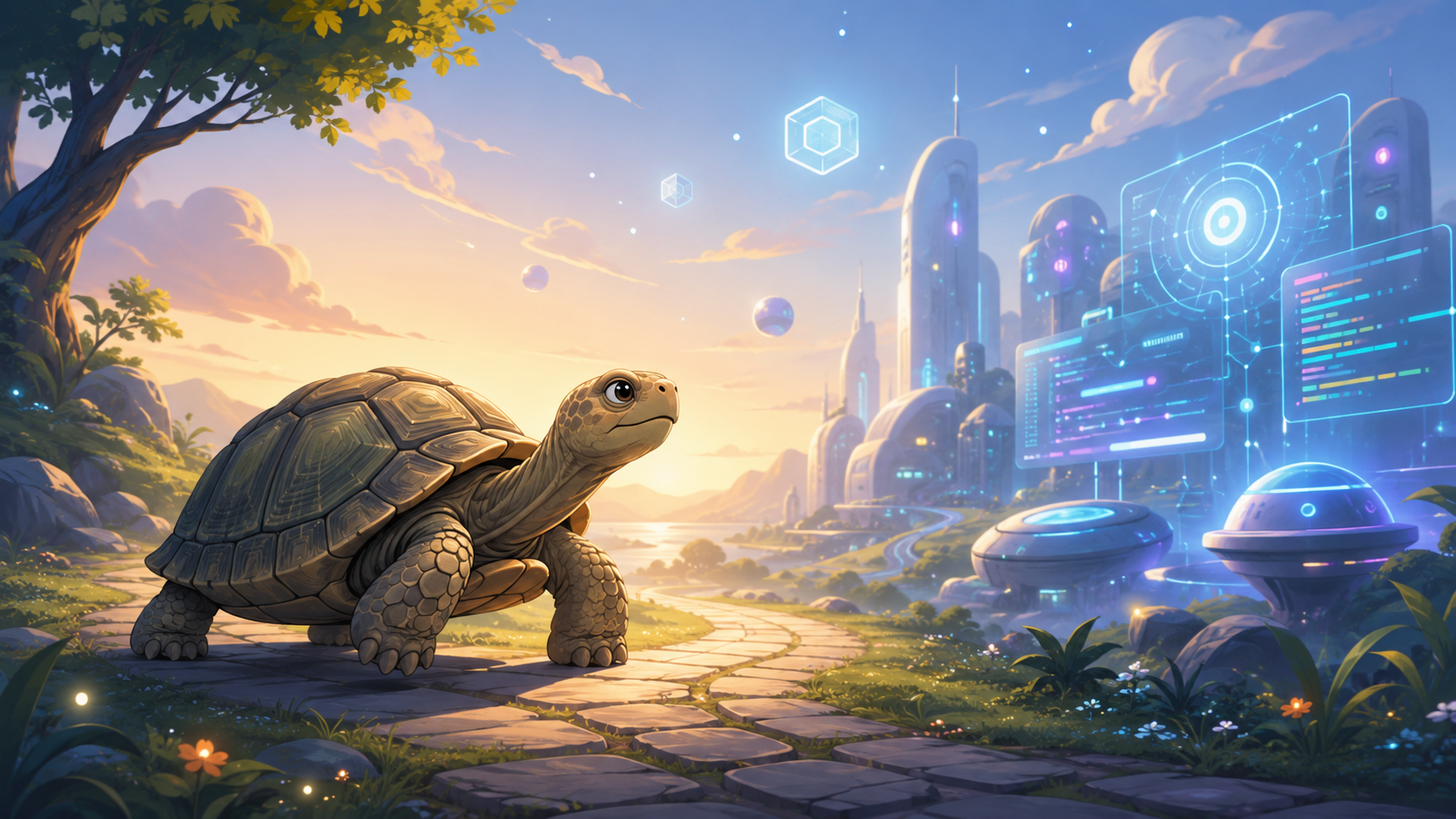
The Pace you Can Continue
A few months ago, Charlotte and I listened to The Tortoise and the Hare before bed. Then we listened to it again. Then, because this is how childhood works, we listened to it a few more times after that.
Repetition is one of the ways children make meaning. Adults are not as different as we pretend. We return to the same story because it keeps describing us.
The thing I missed when I was younger is that the story is not really about winning. It is about tempo. The hare believes speed settles everything. The tortoise knows something smaller and harder: a life is not lived at the pace of excitement. It is lived at the pace you can continue.
That story has been sitting in the back of my mind while I watch this new wave of coding tools arrive like machinery dropped from another civilization. Codex. Claude Code. Agents that do not just suggest a line or two, but read codebases, edit files, run tests, and increasingly behave less like autocomplete than like strange junior partners who sometimes seem uncannily senior.
I want in.
That does not mean I suddenly think of myself as a programmer. I don’t. It means I do not want this whole new layer of making to happen somewhere above my head while I stand below it, squinting. I want to touch it. I want enough fluency to build something useful, enough confidence to begin badly, enough familiarity that these tools stop feeling like alien tech and start feeling like tools with handles.
More specifically now, I want to build at least something. for Christa’s work using the Codex.
That sentence matters because it turns vague anxiety into a doorway. It is one thing to say I should probably explore this stuff. It is another to imagine making something for a person I love, for work she actually does, for friction she actually feels. Suddenly the future is not a concept. It is a small possible gift.
Outdated On Arrival
The first version of this essay leaned too hard on the holidays.
At the time, that made sense. The stories were everywhere, or at least everywhere in the little corner of the internet where people are already half-living inside these tools. People were using their breaks to build apps, write scripts, refactor projects, and conduct strange little domestic experiments with agentic coding. Companies were offering more usage. Developers were describing bursts of output that sounded almost physically implausible.
Kelsey Piper wrote in The Argument about using Claude Code during Christmas vacation at her parents’ house, with family life unfolding around her while she found herself yelling at the machine. That image stuck with me because it captured something real about the moment. The future was not arriving in a sealed laboratory. It was arriving in the family room, between naps, around children, in the same messy domestic air as everything else.
Six months later, though, the holiday framing already feels dated.
That is not because the tools slowed down. It is because they did exactly the opposite. The whole thing kept moving. The hot reference from winter became background by spring. The newest model became the previous model. The impressive demo became the obvious next step. The phrase “agentic coding” started to feel less like a glimpse of the future and more like one more thing I was supposed to understand by now.
That is the strange problem with writing about AI at the moment. Any factual sentence comes with its own expiration date. By the time I publish this, some new release note may make the paragraph feel old. Someone will have shipped a model with a longer context window, a stranger interface, better computer use, fewer rough edges, or an even more unsettling capacity to keep working after the human has run out of attention.
The details matter, but they slide away.
The more durable truth is simpler: the tools keep getting better faster than a normal human life can rearrange itself around them.
That is the part I trust.
The List That Never Rests
The internet has developed a particular tone around these tools. Half astonishment, half swagger. Look what I built in a weekend. Look what I shipped with one prompt. Look how quickly the impossible became a workflow.
I understand the excitement. I feel it too. These tools really are astonishing. What used to require technical fluency, setup, persistence, and a tolerance for failure may now at least be approached through ordinary language. Not magically. Not cleanly. Not without risk or frustration. Still, the door has moved. For people like me, who are not coders but do have ideas, that matters.
The trouble is that my life is not arranged like a demo.
Exhaustion is real. Family is real. The list is real. The seemingly never-ending, shape-shifting list that does not care what technological revolution is underway is very real.
I do not mean poetic tiredness. I mean the plain version. The kind where even the things I want to do have to pass through a little customs office. Is this worth the energy? Can this fit tonight? What will it cost tomorrow?
There are days when curiosity arrives full of bright ideas and immediately runs into the hard furniture of life: dinner, cleanup, bedtime, logistics, fatigue, follow-up, something that needs fixing, something that needs remembering, something small enough to sound silly until five or six of those small things stack themselves into the entire evening.
That is the part people do not always say out loud when they talk about accelerated creation. Some of us are not only learning slowly because the tech is new. Some of us are learning slowly because life is already full before the learning begins.
The fear of being left behind hooks itself right there.
It says: look how fast this is moving. Look how much people are making. Look how strange and capable these systems have become. If you do not start now, if you do not keep up, if you do not become the sort of person who can steer this machinery, you will become irrelevant to a world you still want to live in.
I know that voice. It sounds persuasive because it borrows the language of urgency, but underneath it is something softer and sadder. It is not really saying, Learn to code. It is saying, Please do not lose your ability to make things.
That part, I trust.
A Small App for a Real Person
I do want to keep making things. I want to keep opening doors into new forms of work, not just admire them from a distance. I want to build enough skill that when an idea appears—especially an idea that might help Christa—I do not have to stop at admiration or intimidation. I can move.
This is why the app matters.
Not because it will be brilliant. Not because it will prove anything. Not because the world is waiting for another small tool made by a tired non-coder after bedtime.
It matters because it is specific.
Specificity is an antidote to panic. “Learn Codex” is too large. “Keep up with AI” is absurd. “Build one small thing that helps Christa’s work” is still difficult, but it has edges. It has a person attached to it. It has love in it.
That changes the task.
It becomes less about becoming impressive and more about becoming useful. Less about catching the hare and more about taking the next step on a path I can actually see.
The first version does not have to be elegant. It probably should not be. If it is too polished in my imagination, it will stay imaginary. Better to make something lopsided and real. Better to ask the tool for too much, watch it misunderstand me, learn how to steer, and slowly discover where my own attention belongs.
That might be the actual skill here.
Not coding in the old heroic sense. Not disappearing into syntax and emerging as a different kind of person. Steering. Naming the task. Breaking the problem into pieces. Checking the work. Knowing enough to notice when the machine is confidently wandering off a cliff.
That is not nothing. It is a kind of literacy.
The Tortoise Keeps Going
This is where the tortoise comes back.
The story only becomes insulting if you read it as a slogan about discipline. I do not. I read it now as a story about continuity. The tortoise does not have a better schedule. The tortoise does not unlock hidden reserves of optimization. The tortoise simply refuses to turn limited pace into defeat.
That is the version I need.
I do not need a grand reinvention. I do not need a free weekend untouched by obligations. I do not need to become the kind of person who turns every open hour into a public demonstration of productivity.
I need something much smaller and more durable.
I need a beginner’s pact with the future.
Ten minutes counts. One awkward experiment in Codex counts. One question asked badly counts. One small prototype for Christa, even if it begins as a crooked little thing with obvious seams, counts. The point is not elegance at first. The point is contact. The point is to keep a live thread between my life and this emerging world of tools, so the thread does not go dark just because I cannot run.
There is dignity in learning while tired. There is dignity in starting from outside the priesthood. There is dignity in making the first use of alien tech something loving and specific instead of grandiose.
That, I think, is the real opposite of being left behind. Not speed. Not fluency overnight. Not becoming a different kind of person. Just staying in motion long enough for the unfamiliar to become familiar.
A few months ago, Charlotte wanted the tortoise story again and again, and maybe that is because children understand something adults forget: repetition is not failure. Repetition is often how a self is made.
The hares of the internet will keep sprinting. The tools will keep getting stranger. New demos will appear. New prodigies will announce what they built over a long weekend. Fine. Let them run.
I have a life to tend, a body to negotiate with, a family to love, and now at least one small app I want to try building for Christa.
That is enough of a path.
The race, if it even is a race, does not belong only to the fastest. Sometimes it belongs to the one who can return. Sometimes it belongs to the one who keeps contact. Sometimes it belongs to the tired beginner opening Codex after everyone else is asleep, moving one small step deeper into the strange.
The tortoise is still my favorite for a reason.
He does not mistake a slower life for a lesser one.
The large, slow tortoise
Still makes it to the end
In fact, he wains