The Rooms That Keep Breathing
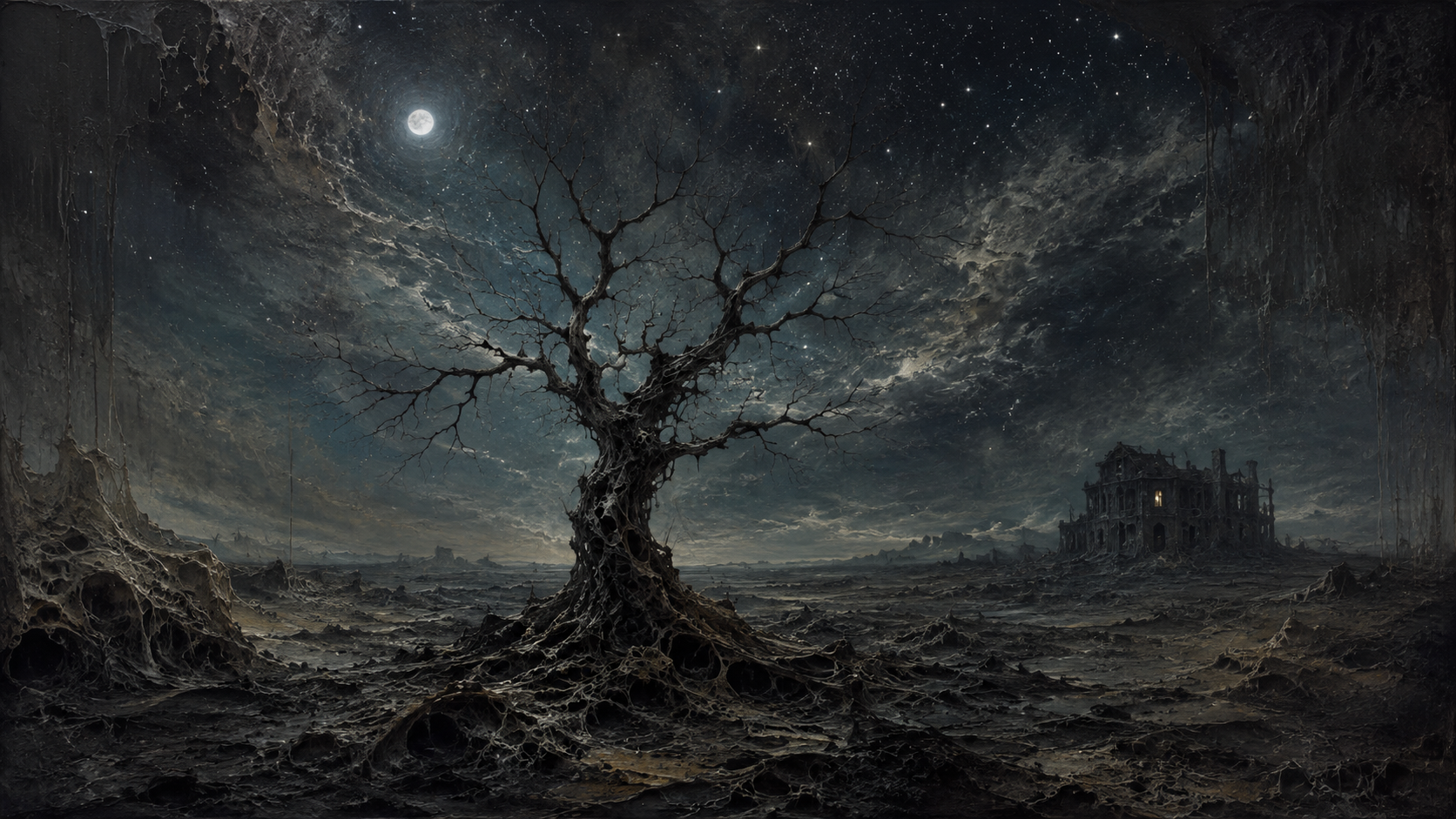
Dark ambient asks for a strange surrender. Not joy. Not uplift. Not even what most people usually mean by pleasure. It asks whether you are willing to enter a sound-world that does not care about your comfort, then remain there long enough for its darkness to become legible.
“Pleasure” still feels like the wrong word for music that sounds like a deserted hospital wing at 3 a.m., but I do not know a better one. There is satisfaction in it, anyway. A grave, dreary satisfaction. The feeling of encountering something that does not beautify fear or tidy up sorrow, but lets both remain what they are. Dark ambient does not soothe by pretending the room is bright. It soothes by refusing the lie.
Atrium Carceri. Cities Last Broadcast. Lustmord, especially the album Heresy, that dreadful patron saint looming over the genre. These are not artists I “listen to” in the ordinary sense. Their work feels less like music than entering a place that was already waiting for me. A low drone settles beneath everything like buried machinery. Metallic impacts arrive from somewhere impossible to picture. Water seems to move behind a surface I cannot locate. A bass tone presses at the edge of the body, not loud exactly, but physical—like the sound has remembered that hearing is not only in the ear.
The sound does not beckon. It closes around you with the faint chill of recognition.
You are already inside.
A Door That Knows Your Name
That is part of what makes it eerie. Dark ambient does not set fear on a stage and ask you to watch. It lets fear collect in the corners until you realize you have been sitting with it for several minutes already.
Real horror is not about jump scares. Jump scares are only sudden noise, a hand slamming the table. Real horror is slower than that, more listless, more exact. It lives in implication. It lives in the stretched second before you understand why something feels wrong. It lives in the long hush where nothing moves and the nothing itself starts to feel arranged. Dark ambient understands this instinctively. It does not pounce. It waits. It lets the mind furnish the silence with its own worst intuitions.
Still, it matters that this is chosen dread. Contained dread. Dread with a boundary line.
The dread that life hands out does not care whether you are ready for it. It arrives with fatigue, with loss, with bodies that go strange in familiar ways, with the slow and graceless humiliations of being alive. Dark ambient is not that. It is darker than comfort but kinder than panic. It offers a chamber where fear can reverberate without swallowing the whole house. You step in willingly. You remain for a while. You leave when you need to.
That fact changes the nature of the darkness.
Matchlight, Briefly
I think I have been circling this attraction for a very long time. In grad school I wrote an essay trying to define the kind of art that kept holding me, and my professor, not me, gave it the title My Aesthetic Defined. I still love the almost sepulchral neatness of that. The title feels imposed from above, clinical and faintly funereal, as if the thing I loved had already been pinned down under glass and labeled in a careful hand.
There is something perfect in that misfit between the title and the subject. I was trying to describe an attraction to art that would not stay still long enough to be named.
At the center of that old essay was an image that still feels true to me: a man in darkness striking a match. Nothing grand. No revelation. No flood of meaning. Just one small flame wavering in a room too dark to understand. It does not abolish the dark. It barely troubles it. It only proves that the room exists, and that the person holding the match is still there to see even that much.
That is what dark ambient feels like to me. Not illumination. Matchlight.
It offers the smallest possible mercy. A flicker across damp surfaces. A hint of scale. A suggestion of distance. Enough to catch the edge of something and then lose it again. The light starts dying almost as soon as it appears. That is part of the honesty. The music does not promise revelation. It does not widen into clarity. It lets you glimpse the fact that you are inside something larger, colder, stranger than you can neatly comprehend. Then it recedes and leaves you listening harder.
For me, that listening is never casual. Hearing rests so close to the base layer of my perceptual reality that sound is not merely accompaniment; it is one of the ways the world acquires shape. It is how a moment announces its edges. When vision is unreliable, sound can become the means by which space arrives at all. Dark ambient gives me space without crowding me. It does not overexplain. It does not tug me along. It does not ask me to parse sentiment or brace for release. It gives me one sustained field of attention and lets me dwell there.
“Dwell” is probably too gentle a word.
Sometimes it feels more like sheltering in place.
The Book That Refuses to Become Sound
There is comfort in sheltering somewhere honest. Dark ambient does not insist that pain is secretly beautiful or that dread can be redeemed into a life lesson if you tilt your head the right way. It sustains a tone: bleak, listless, faintly sacred, faintly mechanical. It lets the sound remain unresolved long enough for resistance to lose interest. There is relief in that kind of refusal. Not joy. Not peace. Something barer and more severe. Permission, maybe, to stop demanding that every dark thing become useful.
This is also why I keep thinking about House of Leaves whenever I think about dark ambient.
It remains one of my favorite books, and one of the stranger griefs of my visual life is that I cannot really read it now in the way I once could. It resists translation into audio because so much of what it is lives in the eye’s confusion. The page does not merely contain the story. It behaves like the story’s accomplice. Text narrows, breaks, turns, scatters. Footnotes drag you away from your footing just as you think you have found it. Reading becomes a kind of wandering.
The central impossibility is not symbolic. The house is literally bigger on the inside than it is on the outside. That is not a mood the book suggests; it is the fact the plot keeps returning to with increasing dread. Measurements cease to agree. A hallway appears where no hallway should fit. Interior space begins to exceed the limits of the structure that contains it. A home opens onto a cold, depthless dark that cannot be reconciled with the world’s ordinary rules.
The horror lies partly in the impossibility itself, but also in how stubbornly material it is. Tape measures. Walls. Doors. Distances. The wrongness is not abstract. It is measured and found to be real.
Audio cannot quite carry that same species of panic because so much of it lives in visual disruption—in the act of being made to turn the book, squint at it, double back, lose orientation, and feel the page itself misbehave. What disappears in audio is not only the format but the maze.
Dark ambient creates a related effect by different means.
Where the Far Thing Leans Close
Dark ambient gives you scale you cannot fully hold in the mind. A bass tone can feel subterranean, planetary, as if the sound were not emerging from speakers but from some pressure older than the room you are in. Then, just as quickly, the immense becomes intimate in the worst possible way. A scrape sounds too near. A faint movement seems to pass just beside the ear. The enormous and the immediate begin to trade masks. Vastness presses inward. Nearness opens onto something measureless.
That exchange is one of the things I love most about the genre. It feels cosmic and close at the same time, like staring into a depth that somehow has breath. It understands that dread is rarely only one thing. Sometimes it is the terror of scale, the sense that reality is far too large and indifferent to include you in any meaningful way. Sometimes it is smaller and meaner than that, the intimate wrongness of a sound too near your head in a room you thought was empty.
Dark ambient lets both be true together.
This is where Heresy matters, not just as a reference point but as a kind of gravitational center. The album sounds underground because, in a literal sense, some of its source material came from underground places. Crypts, caverns, mines, shelters, catacombs: spaces built for burial, hiding, extraction, survival. The knowledge does not make the album scarier in a cheap way. It makes it feel more honest. The dread is not painted on top. It comes from contact with places where human life is already reduced to echo, pressure, ritual, and trace.
That is the difference between darkness as costume and darkness as medium.
A lot of grim art wants you to admire how grim it is. Dark ambient at its best does not seem to care whether you admire it. It does not pose. It seeps. It lowers the room temperature of the mind. It replaces melody with persistence, drama with pressure, climax with duration. It makes a home for the parts of experience that are hard to say plainly without sounding melodramatic: dread, fatigue, uncertainty, grief, the dull animal knowledge that the body is temporary and the world will not explain itself just because we ask.
There is, for me, something almost contemplative in that refusal to resolve. Not contemplative in the scented and curated sense. More in the sense of being required to remain near what you cannot settle. The sound arrives. It shifts. It thins. It returns altered. The mind reaches instinctively for explanation. Machine or wind. Breath or pipe. Footstep or signal. The track does not answer. It keeps humming with a bleak indifference, and the question becomes whether you can stay with what will not clarify itself.
That feels close to life, unfortunately.
Or, maybe fortunately, depending on the day.
Much of existence never resolves into meaning. Pain does not become profound on command. Loss does not assemble itself into instruction. Bodies and minds and worlds do not always disclose what they are doing. Dark ambient does not solve that. It does something more modest and, to me, more valuable. It gives the unresolved a form. It lets dread become atmosphere instead of interruption. It lets darkness remain darkness while still making room to stand inside it.
Enough Light to Keep Moving
I keep returning to this music because it lets me practice a kind of attention I need. Not optimism. Not despair. Attention. The willingness to stay in contact with what is bleak without making bleakness into a personality. The willingness to notice the hum under things. The willingness to accept that some rooms will never fully reveal themselves, and that this does not mean we are helpless inside them.
The pleasure, if that is still the word, comes from something narrower and stranger than happiness. It is the pleasure of truthful containment. The pleasure of a place that does not deny its own shadows. The pleasure of holding a match long enough to feel the heat climb toward your fingers and knowing that the smallness of the light does not make it useless.
It only makes it honest.
That is often enough. A little sight. A little hum. A little failing flame. Enough to keep moving through what remains.
The sound
Unnatural
Something out of a cave
But, with some metal underneath
Strange space